
Quick Answer: What AI Governance Means For Critical Infrastructure Software
AI governance for critical infrastructure software is the operating model that decides where AI can be used, which risks must be controlled, who approves production use, how failures are contained, and what evidence proves the system remains trustworthy after launch. In healthcare, BFSI, utilities, manufacturing, logistics, transportation, and public-service software, governance has to become part of architecture, QA, security, release management, monitoring, and incident response.
The practical goal is not to block every AI idea. The goal is to prevent unreviewed models, opaque vendor tools, weak data pipelines, prompt-injection exposure, and autonomous actions from entering systems where bad output can create safety, security, financial, operational, or public-trust harm.
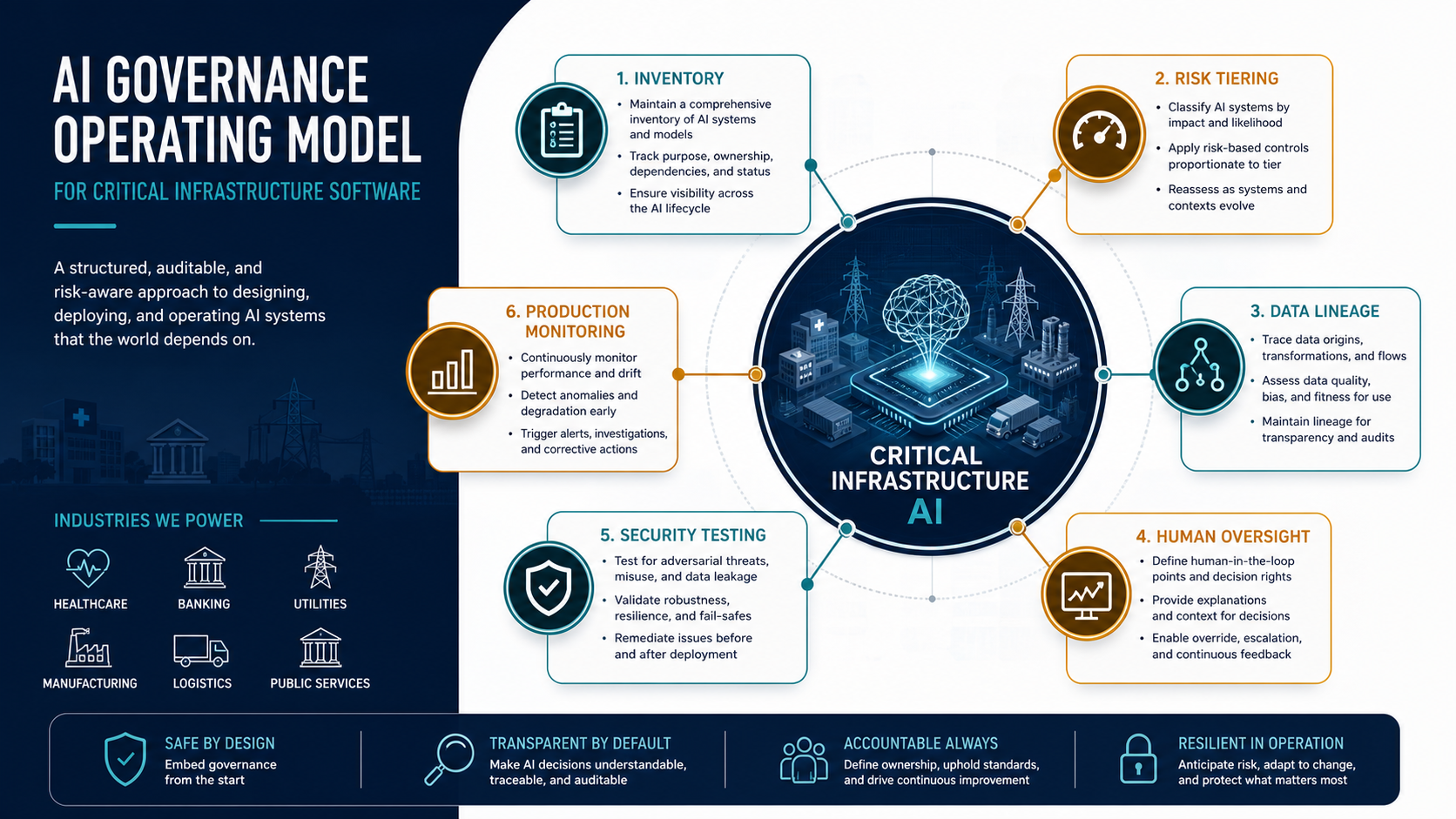
NIST released its concept note for a Trustworthy AI in Critical Infrastructure Profile on April 7, 2026. It builds on the AI Risk Management Framework and recognizes that critical infrastructure AI can span information technology, operational technology, and industrial control systems. For software teams, the takeaway is direct: governance must cover the full lifecycle, from use-case intake to production monitoring.
Why Critical Infrastructure AI Needs A Higher Bar
AI in a marketing dashboard and AI inside infrastructure-adjacent software do not carry the same blast radius. A recommendation error in a content workflow may be annoying. A bad prediction inside a patient-routing tool, fraud-control workflow, logistics dispatch system, energy maintenance process, or public-benefits eligibility flow can create real operational harm.
That difference changes the implementation standard. Regulated teams need to know what data the model sees, what decisions it influences, which humans can override it, how the system behaves when confidence is low, how outputs are logged, how incidents are escalated, and whether vendors can explain changes to models, prompts, retrieval indexes, or APIs.
The first gap is often not model quality. It is the absence of an AI inventory, risk owner, and evidence model. Teams cannot govern systems they cannot name, classify, monitor, or retire.
Use NIST AI RMF As An Operating Model
The NIST AI Risk Management Framework organizes AI risk work around Govern, Map, Measure, and Manage. Those functions translate cleanly into software delivery decisions when teams treat them as operating questions instead of documentation labels.
| AI RMF Function | Software Delivery Question | Evidence To Keep |
|---|---|---|
| Govern | Who owns AI policy, use-case approval, risk tolerance, and accountability? | AI policy, RACI, approval records, exception register, vendor obligations. |
| Map | Where does AI touch users, data, operations, security boundaries, and downstream decisions? | Use-case inventory, architecture diagrams, data lineage, dependency map. |
| Measure | How do we test accuracy, robustness, bias, privacy, security, and operational behavior? | Test plans, model evaluations, red-team findings, validation reports. |
| Manage | How are risks reduced, monitored, escalated, accepted, or retired after launch? | Controls backlog, monitoring dashboard, incident runbooks, audit trail. |
This is where AI development services for regulated environments differ from prototype work. The architecture must make governance observable. A model card hidden in a folder is not enough if production workflows cannot enforce confidence thresholds, approvals, logs, rollback paths, or access boundaries.
Start With An AI Use-Case Inventory
Before adopting a formal AI governance platform, create a plain inventory of every AI use case already in use or under consideration. Include internal tools, vendor products, embedded AI features, analytics models, chatbots, copilots, retrieval-augmented generation workflows, document extraction, image analysis, forecasting, anomaly detection, recommendation engines, and autonomous agents.
Each inventory entry should capture the business owner, technical owner, user group, data sources, model or vendor, decision impact, integration points, target environment, expected benefit, failure mode, planned controls, and retirement criteria. It should also identify whether the AI only advises a human, drafts content for review, triggers a workflow, changes system state, or makes a decision without direct approval.
That distinction matters. An AI tool that summarizes maintenance notes is not the same as a tool that schedules maintenance, blocks a transaction, changes a delivery route, or recommends clinical escalation. Governance should scale with the system's decision power and harm potential.
Classify Risk Before You Choose The Architecture
Many AI projects choose a model first and design controls later. Critical infrastructure software needs the opposite sequence. Classify the risk before selecting the architecture, vendor, deployment model, or autonomy level.
| Risk Tier | Example Workflow | Minimum Control Pattern |
|---|---|---|
| Low | Internal productivity assistant with no sensitive data or production action. | Policy, access control, usage logging, owner review. |
| Moderate | AI recommends operational actions but a trained user approves every action. | Human review, source traceability, validation set, monitoring. |
| High | AI affects regulated, safety, financial, security, or customer-impacting decisions. | Independent validation, fail-safe behavior, audit trail, incident runbook, release gate. |
| Deferred | Use case cannot yet meet evidence, privacy, resilience, or override requirements. | Block production launch; improve data, architecture, ownership, or controls first. |
Risk tiering changes engineering decisions. High-risk use cases may require private deployment, stricter identity controls, human-in-the-loop approval, data minimization, explainability artifacts, adversarial testing, independent validation, immutable audit logging, and graceful degradation. Low-risk use cases may only need basic policy and monitoring.
Map Controls By Sector And Failure Mode
Critical infrastructure is not one risk category. A healthcare workflow, banking workflow, logistics platform, factory quality system, utility maintenance process, and public-service application each has a different harm model. The governance plan should connect the sector, workflow, failure mode, and control pattern before engineering starts.
| Sector Or Workflow | AI Use Case | Failure Mode To Govern | Control To Design |
|---|---|---|---|
| Healthcare operations | Patient triage, scheduling, document intake, coding support. | Unsafe recommendation, missing context, privacy leakage. | Clinical review boundary, PHI minimization, audit logs, fallback queue. |
| BFSI and fintech | Fraud triage, KYC review, credit-risk support, claims routing. | False denial, discrimination, untraceable decision, model drift. | Risk explainability, appeal path, bias testing, decision evidence. |
| Manufacturing and OT-adjacent systems | Visual inspection, predictive maintenance, anomaly detection. | Unsafe maintenance recommendation, downtime, weak escalation. | Confidence thresholds, operator confirmation, safe-state behavior. |
| Logistics and transportation | Dispatch optimization, route recommendations, ETA prediction. | Service disruption, unsafe routing, cascading dependency impact. | Override tools, constraint rules, monitoring, incident escalation. |
| Public-service software | Eligibility support, case summarization, workload routing. | Unfair outcome, poor accessibility, unreviewed automation. | Human approval, explanation, appeals, audit-ready records. |
This sector view is useful during legacy software modernization. Older systems often lack clean data lineage, role-based access, release evidence, and observability, which makes governed AI harder to enforce even when the model layer is modern.
Build Controls Into The Delivery Lifecycle
The safest AI governance model is embedded in delivery. Product discovery should capture use-case purpose, affected users, decision impact, unacceptable failure modes, and risk tier. Architecture should document data lineage, model boundaries, API dependencies, security controls, recovery paths, and cost limits. Engineering should implement approvals, logging, rate limits, prompt and retrieval controls, fallback behavior, and access restrictions. QA should test realistic edge cases, adversarial inputs, drift scenarios, and degraded operations.
Release management also needs AI-specific gates. A launch decision should confirm that owners signed off, evaluation results are acceptable, human review is in place where needed, monitoring is live, rollback is tested, vendor changes are understood, and incident response teams know what to do when the AI system behaves unexpectedly.
For systems that combine AI, integration, workflow UX, and audit evidence, custom software development should include governance acceptance criteria in the backlog. Treating controls as an afterthought usually creates expensive rework.
Data Lineage And Model Boundaries Are Non-Negotiable
Critical infrastructure AI governance depends on knowing where data comes from, what transformations happen, who can access it, how long it is retained, and whether it is suitable for the use case. If the data is stale, biased, incomplete, sensitive, or collected for a different purpose, model performance metrics can create false confidence.
Teams should document input sources, ownership, retention rules, quality checks, privacy constraints, retrieval indexes, feature pipelines, and third-party processors. For RAG systems, governance must also cover document ingestion, chunking, access control, citation behavior, freshness, deletion workflows, and how the system responds when retrieved context conflicts.
The boundary of the AI system should be explicit. If a model only drafts a recommendation, say so. If it can trigger an action, name the action. If it writes to a production system, record every write path and approval condition. The LLM Application Security Checklist is a useful companion for prompt injection, RAG risk, data leakage, tool permissions, and logging controls.
Human Oversight Must Be Designed, Not Assumed
Human-in-the-loop controls fail when the human is overloaded, under-informed, or unable to override the system. A regulated AI workflow should define what the reviewer sees, what confidence signals are shown, what evidence supports the recommendation, when escalation is required, and how disagreement is recorded.
Oversight should match the workflow. Some AI outputs need mandatory review before action. Some need sampling and post-hoc audit. Some need dual approval during early rollout. Some should stay advisory until evidence proves reliability. High-stakes workflows also need graceful degradation: if the AI system is unavailable, uncertain, or anomalous, the software should fall back to a known safe process rather than silently continuing.
If the workflow needs tool use, multi-step planning, or write access, run an AI Agent Readiness Assessment before giving the system autonomy. Tool permissions, approval gates, and rollback paths belong in the design before production credentials exist.
Use A Release Evidence Matrix Before Production
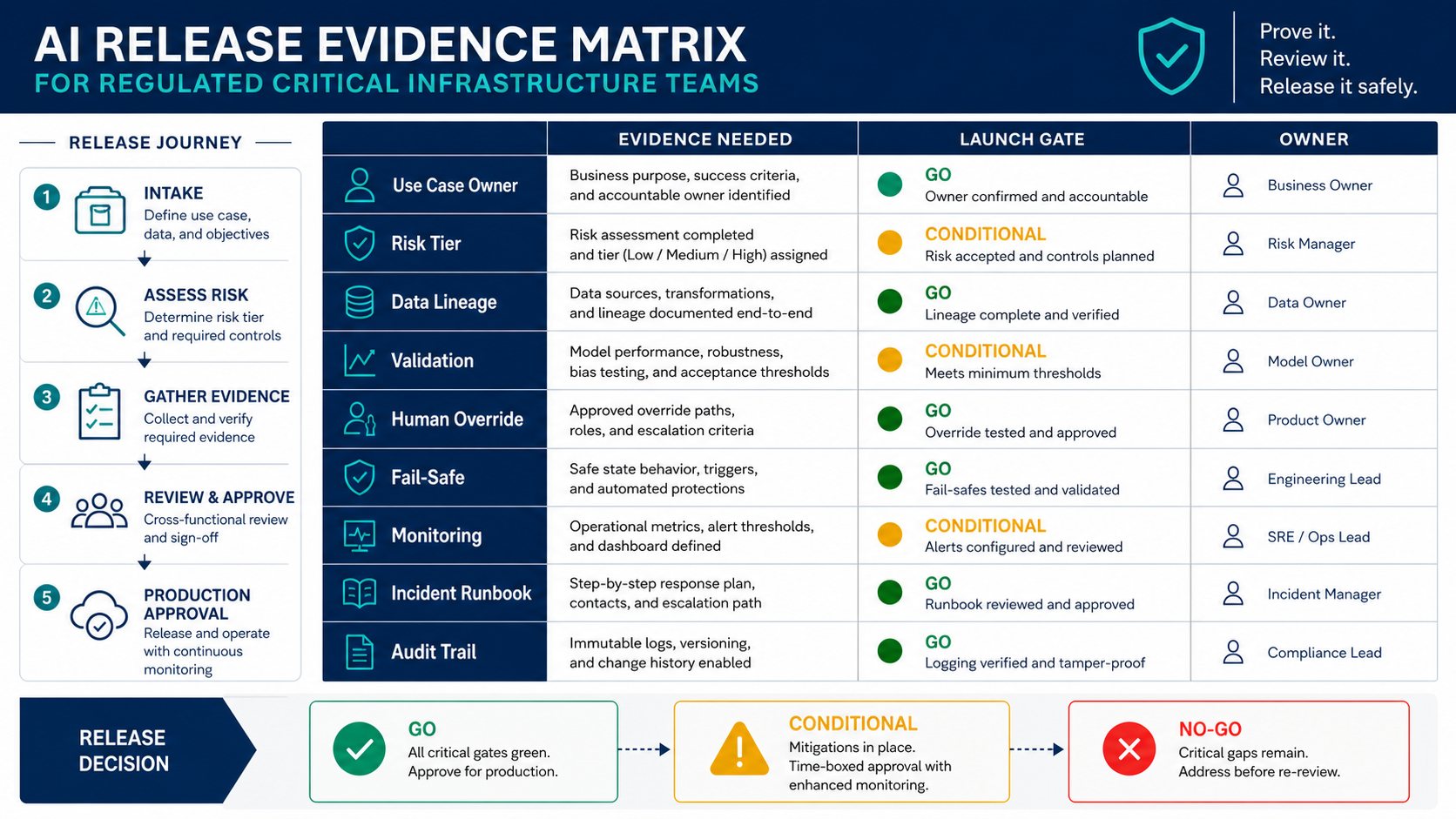
Governance becomes practical when release decisions are tied to evidence. A release evidence matrix should list each gate, what proof is required, who owns the proof, and what decision rule applies. Green means the evidence is complete and owned. Yellow means a time-bound mitigation is accepted with enhanced monitoring. Red means the launch should pause, narrow scope, or keep the feature behind a flag.
| Release Gate | Green Evidence | Red Flag |
|---|---|---|
| Use-case owner | Business, technical, security, and operations owners are named. | No accountable owner for production behavior. |
| Risk tier | Decision impact, harm potential, and control level are documented. | Autonomy level is unclear or underestimated. |
| Data lineage | Sources, transformations, access rules, and retention are verified. | Unknown provenance, stale data, or sensitive data leakage risk. |
| Validation | Accuracy, robustness, bias, privacy, and security tests meet thresholds. | Only demo prompts or happy-path examples were tested. |
| Human override | Reviewers see evidence, can override, and know escalation criteria. | Human review exists on paper but not in the workflow. |
| Fail-safe | Fallback behavior, kill switch, rollback, or manual queue is tested. | The system continues silently during uncertainty or vendor failure. |
| Monitoring | Drift, latency, cost, exception, override, and policy metrics are live. | Teams cannot detect degraded or unsafe behavior after launch. |
| Audit trail | Inputs, outputs, approvals, model versions, and changes are traceable. | Evidence must be reconstructed manually after an incident. |
Monitoring, Incident Response, And Audit Evidence
AI governance does not end at launch. Production systems need monitoring for output quality, drift, latency, cost, policy violations, security events, user overrides, data freshness, and unusual action patterns. Logs should connect prompts or inputs, retrieved context, model version, output, user action, approval state, and downstream system effect where privacy rules allow.
Incident response should define who can disable the AI feature, who investigates model or data issues, how affected users are notified, how records are preserved, and how fixes are validated before reactivation. For critical infrastructure software, the runbook should also cover vendor outages, model deprecations, API behavior changes, retrieval-index corruption, and suspicious prompt or data-injection attempts.
CISA's AI roadmap reinforces the same operating reality for critical infrastructure owners and operators: AI must be secure and resilient by design. Software teams should therefore connect AI monitoring with security operations, support workflows, release management, and customer-impact communications.
A Practical Checklist Before AI Touches Production
Use this checklist before moving an AI feature into production or expanding its autonomy:
- Inventory: The AI use case has named business, technical, security, and operations owners.
- Risk tier: The workflow's safety, security, privacy, financial, operational, and reputational risks are classified.
- Data lineage: Input data sources, access rules, retention, quality checks, and third-party processing are documented.
- Architecture boundary: The AI system's advisory, approval, and action paths are explicit.
- Validation: Accuracy, robustness, bias, privacy, security, and operational tests are complete enough for the risk tier.
- Human oversight: Reviewers have useful evidence, override authority, escalation paths, and workload capacity.
- Fail-safe behavior: The system can degrade safely when confidence is low, data is stale, vendors fail, or anomalies appear.
- Monitoring: Production telemetry can detect drift, misuse, policy exceptions, latency, cost, and user override patterns.
- Incident response: Teams know how to disable, investigate, notify, restore, and validate the AI feature.
- Audit evidence: Decisions, approvals, changes, evaluations, and incidents are recorded in a durable evidence trail.
Before requesting budget, teams can scope the implementation effort with a Custom Software Cost Estimator. The estimate should separate the model or API work from governance-heavy engineering such as data controls, logs, approvals, monitoring, and fail-safe operations.
How NextPage Plans Governed AI Implementation
NextPage treats governed AI implementation as a software architecture and operating model problem. We start by mapping the use case, users, decision impact, source systems, data sensitivity, integrations, compliance needs, and production failure modes. Then we define the smallest useful AI workflow that can be shipped with evidence, monitoring, and human control.
For regulated or infrastructure-adjacent teams, that often means starting with advisory workflows, internal copilots, controlled RAG, document intelligence, anomaly detection, or decision-support systems before expanding autonomy. It also means improving the surrounding foundation: identity, access control, data pipelines, observability, deployment, testing, security review, and incident response.
If your team is planning AI inside high-stakes software, start with the governance model before choosing the model. A governed roadmap keeps innovation connected to risk tolerance, operational resilience, and the evidence leaders need before production launch.