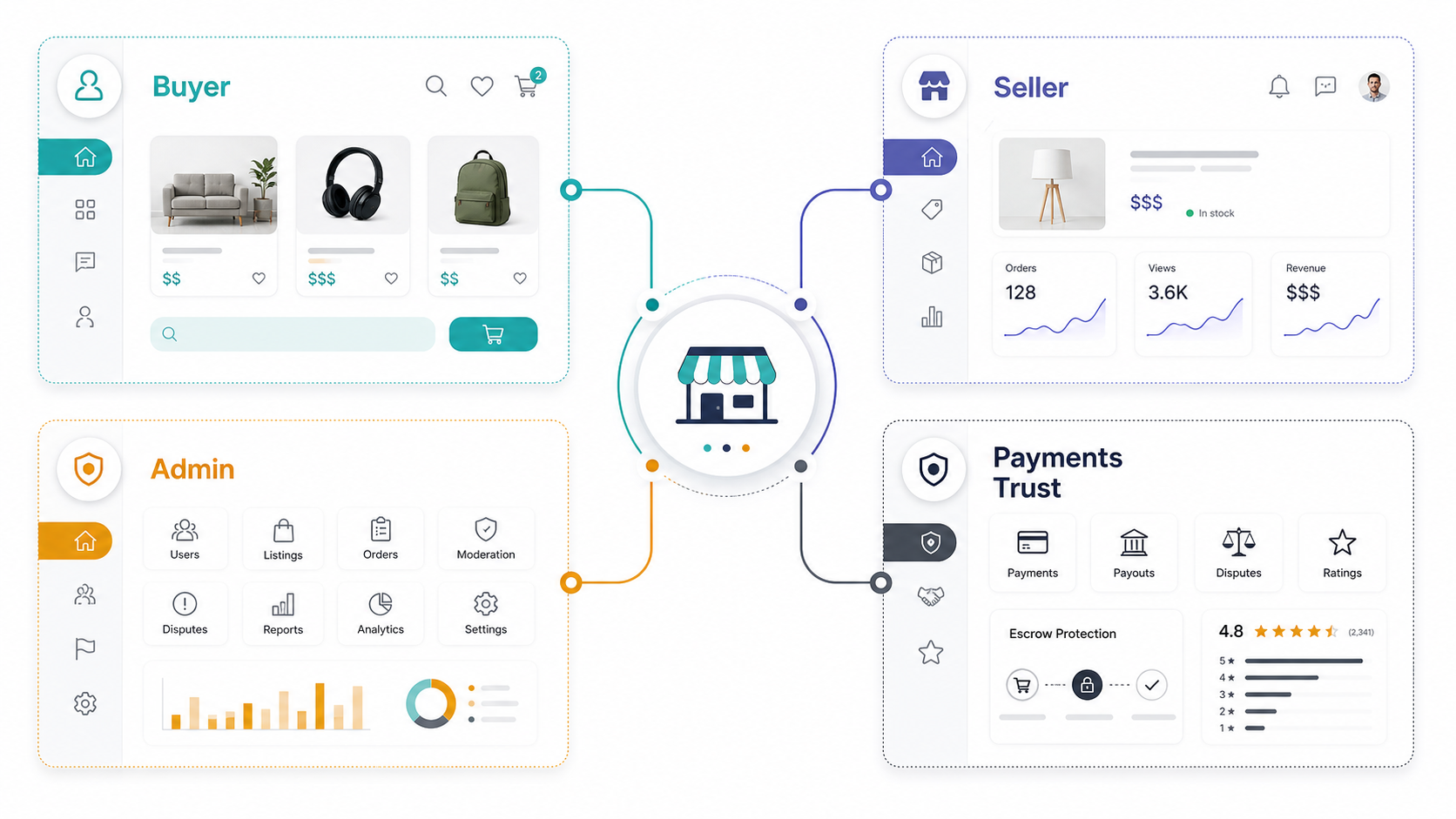

Quick Answer: Marketplace App Development Cost
Marketplace app development cost depends on the operating model you are building, not just the number of buyer and seller screens. A simple listing marketplace with manual approvals is a very different project from a platform with seller onboarding, catalogs, booking rules, split payments, payouts, disputes, moderation, ratings, search, analytics, and internal admin operations.
For planning, most marketplace builds fall into three broad bands. A focused MVP with one marketplace type, basic buyer flow, simple seller profiles, manual admin review, and a standard payment path can often be planned as a lean custom software project. A growth-ready marketplace costs more because sellers need dashboards, buyers need better discovery, the platform needs trust controls, and the operations team needs tools to handle refunds, disputes, content, and liquidity. Enterprise or regulated marketplaces cost more again because payment rules, verification, compliance, data integrations, automation, and scale requirements become core architecture.
If you need a directional budget, start with the Custom Software Cost Estimator. If the idea is still broad, use the Build vs Buy Decision Tool to decide whether a custom marketplace is justified or whether a commerce platform, no-code marketplace, or packaged tool can prove demand first.
What Counts As A Marketplace App?
A marketplace app connects two or more sides of a transaction. Buyers need to find, compare, book, purchase, or request offers. Sellers need to join, list, price, fulfill, communicate, and get paid. The platform owner needs to approve participants, manage policies, resolve issues, measure performance, and keep both sides active.
This is why marketplace scope is usually broader than a normal commerce app. An eCommerce store can focus on one merchant's catalog, checkout, order flow, and inventory rules. A marketplace must also support many sellers, each with their own products, services, schedules, availability, pricing, fulfillment rules, and service quality. If your product is closer to multi-vendor commerce than a single store, compare the scope against the eCommerce App Development Cost guide and then add the marketplace layers: seller tools, platform fees, disputes, moderation, and trust systems.
Common marketplace models include product marketplaces, service marketplaces, B2B procurement marketplaces, local booking marketplaces, rental marketplaces, creator marketplaces, and niche vertical marketplaces. Each model changes the build because the hard part may be catalog quality, seller verification, availability, matching, quote negotiation, logistics, payments, or compliance.
Typical Marketplace Cost Bands
Use cost bands as planning language, not fixed quotes. The estimate should change when the marketplace needs native apps, seller verification, negotiated pricing, escrow-like flows, subscriptions, advanced search, custom logistics, AI matching, or enterprise integrations.
| Marketplace scope tier | Typical build shape | Indicative planning range | What pushes it higher |
|---|---|---|---|
| Focused marketplace MVP | One marketplace model, buyer onboarding, seller profiles, listings, search/filtering, standard checkout or booking, basic admin, manual approvals | $30,000-$80,000 | Native mobile apps, custom payments, scheduling, messaging, reviews, seller dashboards, content moderation |
| Growth-ready marketplace | Buyer and seller dashboards, richer catalog or service workflows, platform fees, payout logic, ratings, disputes, analytics, notifications, support tools | $80,000-$220,000 | Multi-region rules, complex matching, inventory sync, quote workflows, advanced search, logistics, subscription seller plans |
| Enterprise or regulated marketplace | Verification, audit trails, compliance workflows, custom payment architecture, public API, ERP/CRM integrations, data warehouse, automation, high-scale operations | $220,000-$500,000+ | Regulated sectors, high transaction volume, custom merchant risk rules, multi-currency, white-labeling, AI automation, dedicated infrastructure |
The cheapest version is not always the safest version. A marketplace with real money movement, high-value services, regulated sellers, or safety-sensitive buyer outcomes needs more upfront product and risk planning than a low-risk listing MVP.
Marketplace Cost Drivers That Change The Estimate
The biggest marketplace cost drivers are marketplace type, buyer workflow, seller tooling, admin operations, payment rules, trust and safety, search quality, integrations, mobile requirements, and post-launch operations. These drivers matter because marketplaces fail when one side of the network cannot complete its job reliably.
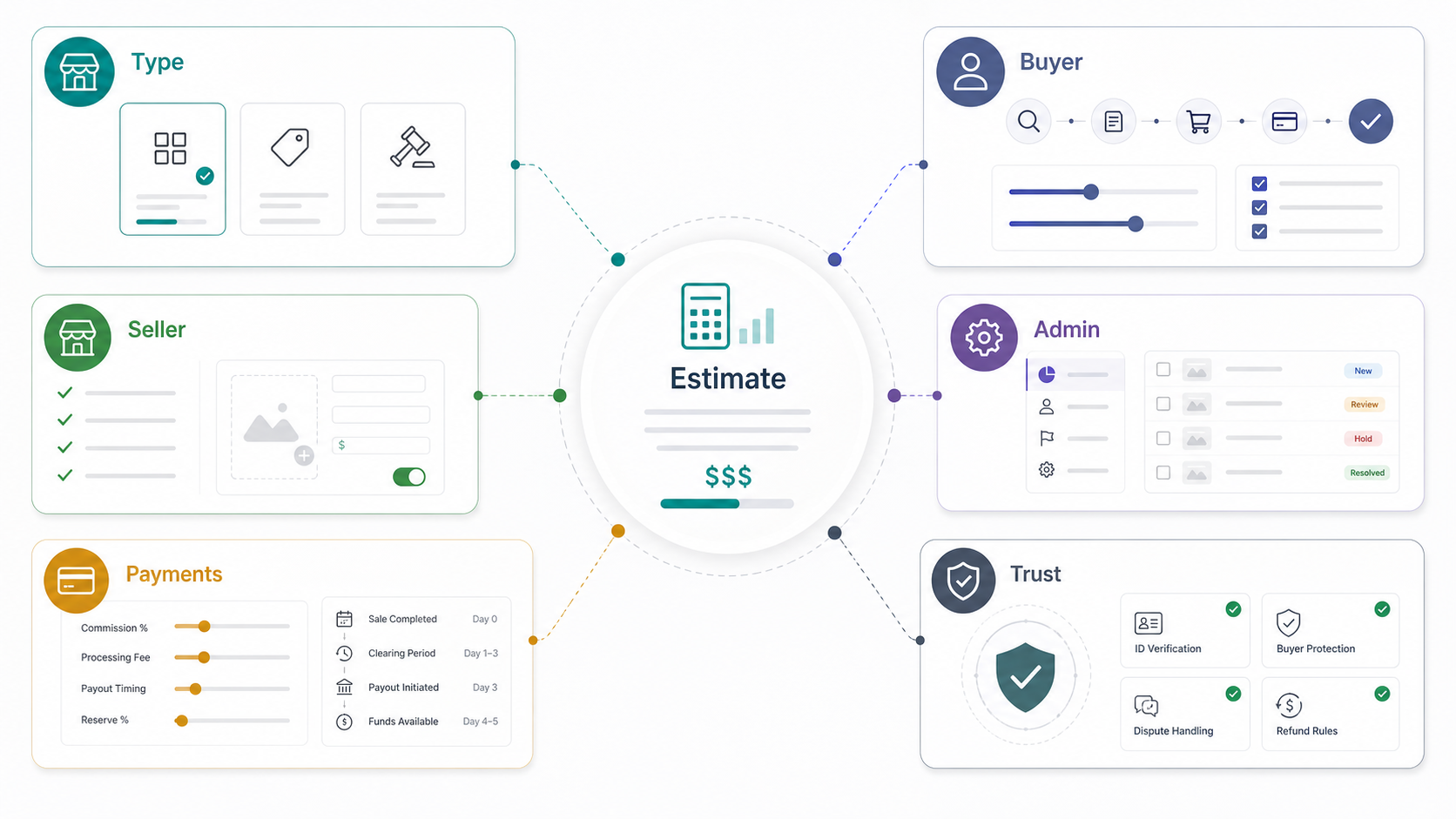
| Cost driver | Lower scope | Higher scope |
|---|---|---|
| Marketplace type | Simple listings or fixed-price products | B2B procurement, service booking, rentals, negotiated quotes, regulated sellers, or multi-party transactions |
| Buyer workflow | Search, detail page, cart or request form, payment, and receipt | Saved searches, recommendations, RFQs, booking calendars, chat, order changes, returns, claims, and buyer analytics |
| Seller tools | Profile setup, listing creation, manual approval, basic sales view | Bulk uploads, inventory sync, availability rules, pricing tools, promotions, seller analytics, payout history, and support workflows |
| Admin operations | Approve sellers, edit listings, view orders, handle support manually | Moderation queues, dispute workflows, policy enforcement, fraud signals, content review, account health, and operations dashboards |
| Payments and payouts | Simple platform checkout or lead generation without payout automation | Connected accounts, application fees, delayed payouts, refunds, disputes, negative balances, tax workflows, and multi-currency needs |
| Trust and safety | Basic ratings and manual reviews | Identity checks, seller verification, abuse reporting, risk scoring, transaction holds, insurance rules, audit trails, and policy automation |
MVP Scope For A Marketplace
A marketplace MVP should prove a narrow transaction loop. It does not need every future revenue model or seller tool. It does need enough workflow coverage to make buyers trust the supply and sellers believe the platform can bring demand.
Start with one marketplace type, one primary buyer segment, one seller segment, one transaction model, and one operational promise. Then decide which work can be manual during the first launch. Manual seller approval, manual dispute support, and manual liquidity management are often acceptable early. Manual payment reconciliation, unclear refund rules, or inconsistent seller data are usually riskier.
- Buyer proof: Buyers can find a useful option, understand price and availability, complete the action, and get a clear confirmation.
- Seller proof: Sellers can onboard, publish or offer services, receive demand, fulfill the transaction, and understand what they earned.
- Platform proof: Admins can approve supply, handle exceptions, manage fees, resolve support issues, and measure liquidity.
- Trust proof: Reviews, policies, moderation, identity checks, and support paths are good enough for the risk level.
This is where marketplace planning overlaps with custom software development. You are not only building a product interface. You are designing the operating system for the marketplace business.
Buyer, Seller, And Admin Features
Marketplace estimates become more realistic when the feature list is separated by user side. A buyer-facing search screen may look simple, but it depends on seller data quality, availability, pricing, content rules, ranking logic, payment state, and admin controls.
| Side | MVP features | Growth features |
|---|---|---|
| Buyer | Signup, search, filters, listing details, checkout or inquiry, order/booking status, notifications | Personalization, saved searches, recommendations, chat, reorders, buyer analytics, loyalty, dispute initiation |
| Seller | Onboarding, profile, listings, order view, basic earnings, notifications | Bulk tools, inventory or availability sync, promotions, analytics, payout history, team roles, seller support center |
| Admin | Seller approval, listing review, order lookup, support notes, fee settings | Moderation workflows, dispute management, fraud/risk signals, cohort dashboards, policy automation, audit logs |
Do not estimate these as isolated screens. Every additional role and exception adds QA coverage, permission rules, support states, and reporting needs.
Payments, Payouts, And Marketplace Risk
Payments are one of the largest sources of hidden marketplace complexity. Stripe Connect's marketplace guidance describes a marketplace as a platform that connects sellers with customers, processes payments, and then pays sellers. It also highlights practical decisions around connected accounts, platform fees, payouts, refunds, disputes, and merchant risk. Those decisions affect product scope even when the payment provider handles much of the regulated payment infrastructure.
A lead-generation marketplace may avoid in-platform payments at first. A transactional marketplace usually needs a clearer payment model: who is the merchant of record, how sellers are onboarded, when funds are captured, when payouts happen, how platform fees are applied, who pays payment fees, what happens during refunds, and how disputes are handled. These choices should be reviewed early with payment, finance, and legal advisors.
For MVP planning, separate payment integration from payment operations. Integration covers checkout, connected accounts, webhooks, fee logic, payout status, and receipts. Operations covers failed payments, refund policy, chargebacks, seller risk, negative balances, support workflows, and reconciliation. The second category is where many budgets are under-scoped.
Trust, Safety, Search, And Liquidity
A marketplace is valuable only when buyers trust the supply and sellers see enough demand. That means search quality, content quality, ranking, reviews, policies, support, and liquidity management are part of the product, not optional polish.
Trust and safety features can include seller verification, profile completeness, listing review, ratings, reviews, dispute reporting, abuse prevention, identity checks, insurance evidence, moderation queues, and audit logs. A low-risk product marketplace may start with manual checks. A local services, healthcare-adjacent, finance, education, rental, or B2B procurement marketplace may need stronger controls from day one.
Search and liquidity are connected. Buyers need enough relevant supply. Sellers need enough qualified demand. If supply is thin, the MVP may need curated onboarding and manual matching before advanced algorithmic ranking. If supply is large, the MVP may need stronger taxonomy, filters, ranking, and analytics earlier.
Timeline For Marketplace Development
A focused marketplace MVP often takes 10-18 weeks when the model is narrow, the payment path is standard, and admin operations are intentionally manual. A growth-ready marketplace can take 4-8 months. Enterprise or regulated marketplaces usually need phased delivery because payment operations, verification, integrations, and operational controls must be tested carefully.
| Phase | What happens | Typical duration |
|---|---|---|
| Discovery and marketplace model | Define buyer side, seller side, transaction model, fees, trust rules, and launch liquidity plan | 1-3 weeks |
| UX and architecture planning | Design buyer, seller, and admin flows; map data, payments, search, notifications, and support states | 2-4 weeks |
| MVP build and QA | Build onboarding, listings, discovery, transaction flow, admin tools, notifications, analytics, and tests | 7-12 weeks |
| Beta and launch operations | Onboard initial sellers, test real transactions, tune search, review support issues, and monitor liquidity | 3-6 weeks |
The timeline usually stretches when the team tries to solve every marketplace side at once. Narrowing the first market, first seller type, and first transaction pattern is the fastest way to improve delivery confidence.
Hidden Costs That Surprise Marketplace Founders
Marketplace founders often underestimate the work behind the admin layer. The public app may show listings, search, and checkout, but the operating team needs visibility into seller status, listing quality, failed payments, refunds, disputes, content reports, buyer complaints, payout status, and liquidity metrics.
Other hidden costs include seller onboarding, data cleanup, taxonomy design, mobile QA, notification reliability, fraud prevention, payment reconciliation, content moderation, customer support tooling, analytics definitions, and policy documentation. If the marketplace depends on integrations with ERP, inventory, logistics, CRM, calendar, or accounting tools, integration monitoring and retry workflows also need budget.
Post-launch cost matters too. A marketplace is not done when version one ships. It needs supply growth, buyer acquisition, seller success, conversion analytics, search tuning, support operations, security updates, and roadmap discipline. Budget support and improvement work as part of the product, not as an afterthought.
How To Estimate Your Marketplace Build
Before requesting an estimate, prepare a marketplace scope model. The goal is to make the uncertain parts visible before they become expensive changes.
- Name the marketplace type. Product, service, rental, B2B procurement, local booking, creator, or vertical marketplace.
- Define both sides. Describe the first buyer segment, first seller segment, and why each side will use the platform.
- Map the transaction. Decide whether the platform handles payment, booking, lead handoff, quote negotiation, subscription access, or offline settlement.
- Choose launch trust controls. List seller verification, content review, ratings, dispute process, refund rules, and support responsibilities.
- Set admin requirements. Identify what internal teams must approve, edit, monitor, and resolve after launch.
- Rank integrations. Mark payments, email, analytics, CRM, inventory, calendar, logistics, accounting, and data exports as launch-critical or later.
- Plan liquidity measurement. Track buyer searches, seller response, conversion, transaction success, disputes, repeat usage, and supply gaps.
Once that model is clear, the estimate can separate MVP scope from growth features and operating risk.
How NextPage Plans Marketplace Builds
NextPage plans marketplace builds by starting with the marketplace promise, the first transaction loop, and the operating model. We map buyer workflows, seller tools, admin responsibilities, payment assumptions, trust controls, search needs, integrations, analytics, and launch liquidity before recommending a first release.
For early products, that may mean a focused custom marketplace MVP with manual approvals, simple seller tools, and enough admin visibility to support real transactions. For growth-stage products, it may mean stronger dashboards, better search, payout history, dispute workflows, API integrations, and analytics. For enterprise marketplaces, it may mean verification, audit logs, policy automation, data exports, and payment/risk workflows from the start.
If you are planning a marketplace, estimate the business system first and the screens second. The right version one is the smallest platform that can create trust, complete transactions, and teach you where liquidity is real.