
Quick Answer: What Does Software Development Outsourcing To India Cost?
For 2026 planning, software development outsourcing to India commonly ranges from about $15-$30 per hour for junior developers, $25-$50 per hour for mid-level developers, and $40-$80+ per hour for senior, lead, cloud, AI, or architecture-heavy roles. A reliable monthly budget also needs product management, QA, DevOps, technical leadership, onboarding, documentation, security review, and vendor governance.
The right comparison is not simply India versus an in-house team. It is the total cost of reliable output under the operating model your project needs. A single staff-augmentation developer may look inexpensive on a rate card, while a managed product pod costs more because it includes delivery ownership, quality controls, and escalation.
If you are comparing options now, start with NextPage's software outsourcing in India service path. If your first question is team shape and monthly budget, the dedicated India team cost calculator can help you model roles before you speak with vendors.
When Outsourcing To India Makes Sense
India works well for software outsourcing when the project needs steady engineering capacity, a practical cost structure, and access to a broad talent market across web, mobile, backend, QA, cloud, data, and AI-enabled application work. It is a strong fit for SaaS roadmaps, MVP builds after discovery, modernization programs, internal platforms, integration-heavy tools, and long-running feature delivery.
It is a weaker fit when the business has no product owner, no priority order, no decision-maker, and no acceptance criteria. Outsourcing can add skilled execution, but it cannot replace product clarity. If the work is still vague, begin with discovery, architecture planning, or a small paid pilot before committing to a larger team.
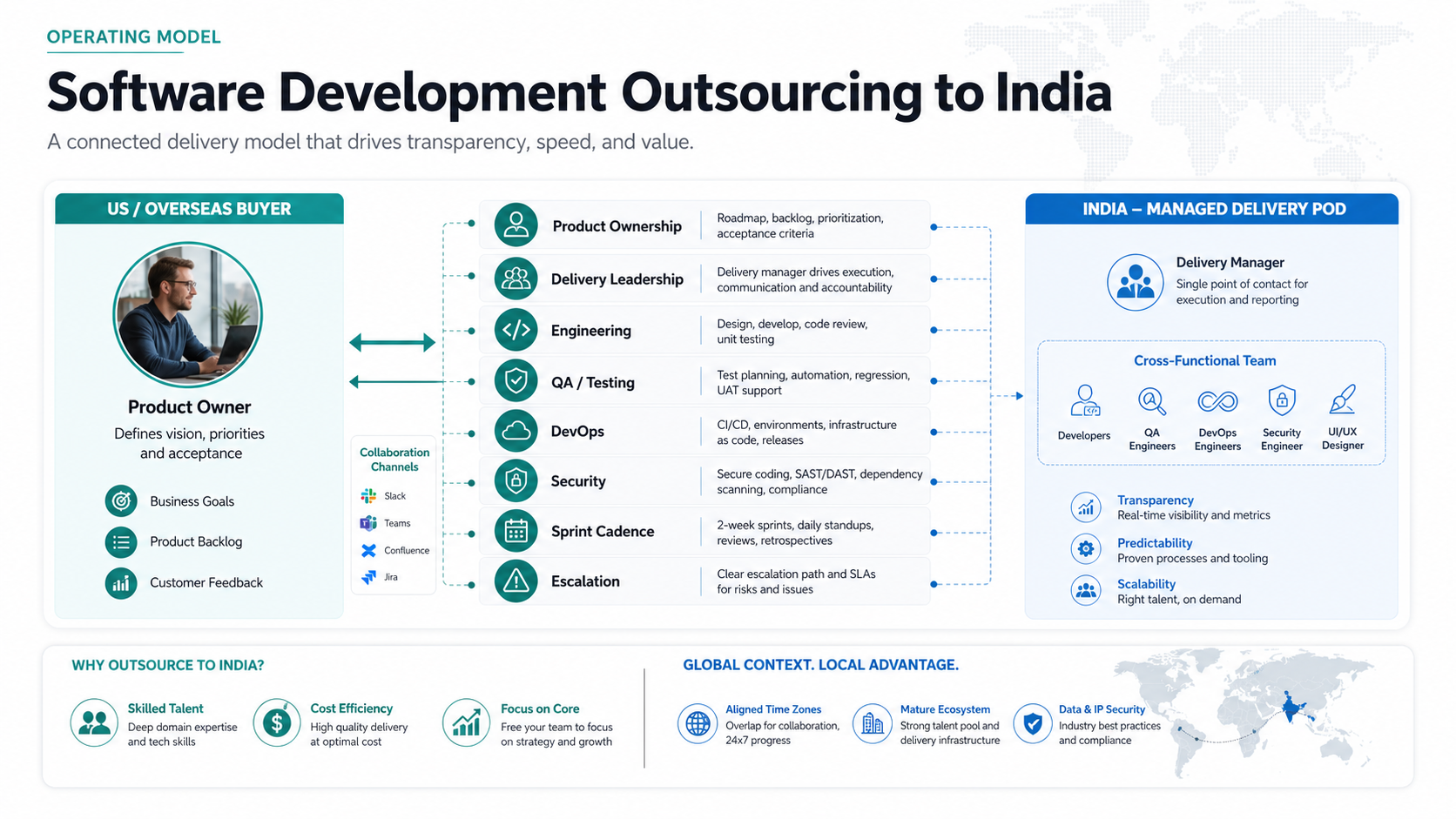
The strongest India outsourcing relationships usually combine buyer-side product ownership with vendor-side delivery discipline. The buyer owns business goals, budget, customer context, and acceptance decisions. The outsourcing partner owns the engineering system: sprint planning, code review, QA, release readiness, reporting, and escalation.
Compare The Main Outsourcing Models
Before comparing hourly rates, choose the engagement model. The model determines who owns architecture, project management, QA, delivery risk, and team continuity.
| Model | Best For | What You Manage | Main Risk |
|---|---|---|---|
| Staff augmentation | Adding developers or specialists to an existing internal team. | Backlog, architecture, code review, QA, sprint rituals, and release decisions. | Low rates can hide high management load. |
| Dedicated team | Ongoing product work where you want stable India-based capacity. | Product priorities, business decisions, and roadmap tradeoffs. | The vendor must support onboarding, replacement, communication, and quality controls. |
| Managed outsourcing | Feature streams, MVP builds, modernization work, or roadmaps that need a delivery layer. | Outcomes, acceptance criteria, budget, and domain context. | Weak vendors may sell management but still leave delivery ownership unclear. |
| Fixed-scope project | Well-defined builds with stable requirements and clear acceptance criteria. | Scope decisions, change requests, and final acceptance. | Changing requirements can turn fixed price into slow negotiation. |
| Product pod | Cross-functional delivery with engineers, QA, PM, and technical leadership. | Strategy, priorities, feedback, and business constraints. | Costs more than raw capacity but can reduce coordination risk. |
If your internal team already has strong technical leadership, staff augmentation can be efficient. If you need an accountable delivery system around the engineers, managed outsourcing or a product pod is safer. If you want India-based capacity that behaves like an extension of your company, compare NextPage's your team in India model alongside a broader outsourcing engagement.
What Should Be Included In The Cost?
A credible quote should separate developer rates from delivery overhead. Ask whether the monthly cost includes PM support, QA, technical leadership, DevOps, security review, product documentation, meeting cadence, reporting, replacement coverage, and account management. These layers can add cost, but they often prevent the rework and coordination delays that make cheap outsourcing expensive.
For a small team, you may only need a senior developer, one or two mid-level engineers, and fractional QA. For an MVP or modernization stream, you may need a lead engineer, product manager, QA, DevOps support, and a designer. For regulated, data-heavy, or AI-assisted software, you may also need security, compliance, architecture review, model evaluation, and observability work.
The right question is not, "What is the cheapest hourly rate?" The better question is, "What does this partner own when delivery becomes difficult?" If the vendor only owns resumes and time sheets, you are buying capacity. If the vendor owns process, quality, and escalation, you are buying a delivery system.
A Practical 2026 Cost Planning Table
Use these ranges for early planning, then validate them against stack, seniority, model, timezone overlap, project complexity, and vendor responsibilities. Recent 2026 market references continue to cluster around lower India rates for junior and mid-level work, with premiums for senior, cloud, AI, cybersecurity, and architecture roles.
| Role Or Setup | Planning Range | Use It When |
|---|---|---|
| Junior developer | $15-$30/hour | You have senior oversight and need help with clear tasks, QA support, bug fixes, or low-risk modules. |
| Mid-level developer | $25-$50/hour | You need feature delivery, API work, integrations, frontend/backend execution, and sprint participation. |
| Senior developer or lead | $40-$80+/hour | You need architecture judgment, code review, complex integrations, performance work, or leadership. |
| Specialist roles | Premium above standard senior rates | You need AI/ML, data engineering, DevOps, cloud-native, security, or niche platform expertise. |
| Managed delivery layer | Often priced as PM, QA, lead, and account allocation | You want delivery accountability instead of unmanaged developer time. |
For monthly planning, multiply hourly rates by roughly 160 hours for a full-time equivalent, then add the delivery layer. A team of three mid-level developers without QA or leadership may look cheaper than a managed pod, but the unmanaged option can become slower if your internal team must supply every missing process.
Monthly Budget Scenarios For India-Based Teams
A practical budget should map roles to responsibility, not just headcount. The same three-developer team can behave very differently depending on who owns architecture, QA, release management, and product decisions.
| Scenario | Typical Team Shape | Budget Logic | Best Fit |
|---|---|---|---|
| Capacity extension | 1-2 developers added to your existing team | Mostly developer hours, with lightweight vendor support | You already own architecture, sprint rituals, QA, and releases. |
| Feature delivery pod | 2-4 engineers, QA, part-time PM, technical lead | Developer rates plus delivery management and test coverage | You need a vendor-owned feature stream with visible progress. |
| MVP or modernization pod | Lead engineer, backend/frontend, QA, DevOps, product/design support | Higher monthly cost because the vendor owns more release risk | You need architecture, build, test, deployment, and launch support. |
| Long-term managed team | Stable cross-functional India team with replacement and reporting terms | Monthly capacity plus governance, retention, onboarding, and continuity | You want a durable extension of your engineering organization. |
For buyers considering a longer-term extension, NextPage's hire dedicated developers in India page is the better next step after the outsourcing model is clear.
What Drives Outsourcing Cost Up Or Down?
Cost increases with seniority, scarce technical skills, complex architecture, AI or data work, cloud infrastructure, security requirements, regulated-domain experience, timezone overlap, and leadership responsibility. It can also increase when the vendor provides strong QA, PM, release management, documentation, and replacement terms.
Cost can be lower when requirements are clear, the stack is common, the buyer supplies technical leadership, and the outsourced team works on bounded tasks. Lower cost is not automatically bad. It becomes risky when it comes from skipped QA, shared developers pretending to be dedicated, weak screening, no code review, or no clear escalation path.
Contract structure matters too. Fixed-scope pricing works when requirements are stable. Time-and-materials works when the roadmap evolves. A dedicated team works when the work will continue for months. Many buyers start with a discovery sprint or pilot, then scale the team once working rhythm, quality, and communication are proven.
How To Choose A Software Outsourcing Partner In India
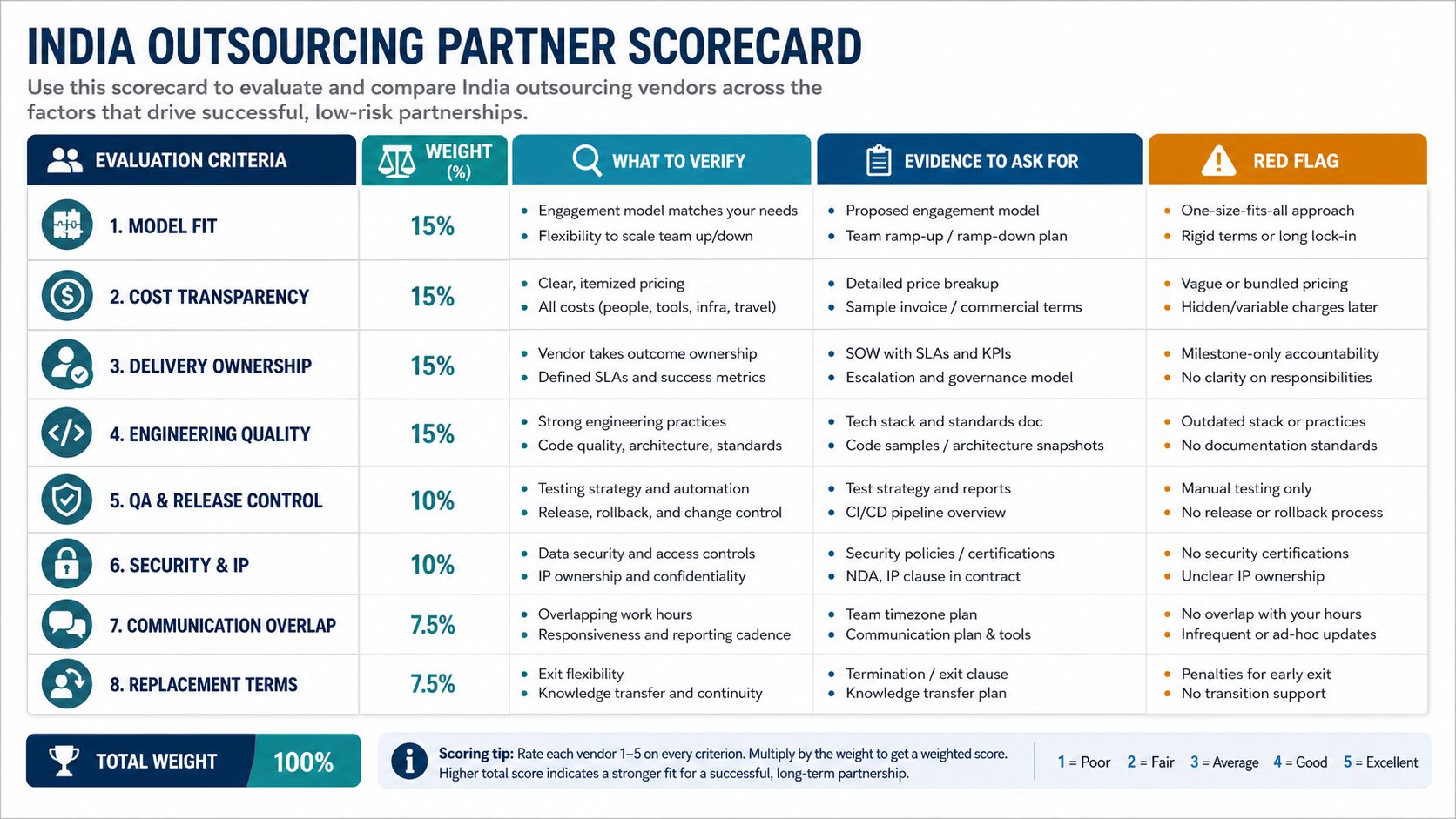
Start by asking each vendor to recommend a model for your project and explain why. A serious partner should be able to say when staff augmentation is enough, when a managed pod is safer, and when a fixed-scope build is a poor fit. If every conversation becomes a generic rate-card pitch, the partner may be optimized for staffing rather than outcomes.
Then evaluate the operating system. Ask who owns sprint planning, backlog refinement, technical decisions, QA signoff, deployments, risk reporting, security, and code review. Ask how they replace underperforming developers, how quickly they can add specialist roles, and how they handle urgent production issues.
Finally, evaluate proof. Look for relevant project experience, example delivery artifacts, client references, technical screening process, communication expectations, and contract clarity. You do not need a vendor that claims it can do everything. You need one that can explain the exact team, process, and risk controls your project requires.
Security, IP, And Data Diligence For 2026
Security diligence should happen before repository access. Ask for NDA and IP assignment terms, subcontractor disclosure, background-check policy, least-privilege access rules, device management, secrets handling, incident response, and offboarding steps. If the work touches customer data, healthcare data, financial records, AI prompts, or production infrastructure, also ask for security certifications, data processing terms, audit logs, and breach notification duties.
India's DPDP compliance conversation has made vendor data handling more visible. Even when a project is not primarily an Indian consumer-data product, buyers should still clarify where personal data is processed, which tools store project data, who can access repositories and cloud accounts, and how access is removed when a developer rolls off.
For a deeper governance checklist, pair this article with NextPage's guide to mitigating loss of control in IT outsourcing. The core lesson is consistent: most outsourcing failures begin as governance gaps before they become engineering gaps.
Risk Checklist Before Signing An Outsourcing Contract
- Scope clarity: the first backlog, success metrics, assumptions, and acceptance criteria are written down.
- Ownership model: the contract says who owns project management, QA, technical leadership, release readiness, and support.
- Code quality: pull requests, review standards, branching, tests, and documentation expectations are explicit.
- Security and access: repos, cloud accounts, databases, secrets, and production permissions follow least-privilege rules.
- IP and confidentiality: the agreement covers ownership, NDA terms, subcontracting, third-party assets, and offboarding.
- Communication cadence: overlap hours, async updates, demos, sprint reports, and escalation channels are practical.
- Replacement terms: the vendor explains how it handles underperformance, attrition, and role changes.
- Cost transparency: the quote separates developer time from PM, QA, DevOps, tools, infrastructure, and support.
Pilot-To-Scale Governance Plan
A small pilot is useful only if it tests the working relationship you plan to scale. Do not use a toy assignment that hides architecture, product ambiguity, QA, and communication. Pick a real but bounded backlog item with acceptance criteria, integration needs, code review, deployment steps, and a clear definition of done.
- Week 0: align on roles, access, communication channels, acceptance criteria, and security rules.
- Weeks 1-2: deliver a bounded feature or technical spike with code review, QA evidence, and a demo.
- Week 3: review velocity, quality, communication, ownership, and decision latency.
- Week 4: decide whether to scale, revise the model, change roles, or stop before a long commitment.
This is also the right moment to decide whether the work is best treated as outsourcing, a dedicated India team, or broader IT outsourcing services across QA, DevOps, maintenance, migration, and product development.
Red Flags When Comparing Outsourcing Vendors
Be careful if a vendor promises senior talent at unusually low rates, refuses developer interviews, cannot explain QA practices, avoids naming the delivery owner, uses vague IP language, pushes a large long-term commitment before a pilot, or says every requirement can be fixed later without documenting change control.
Also watch for overstaffing. More developers do not automatically create faster delivery. If architecture, product decisions, QA, and release process are weak, adding people can increase coordination cost. Scale the team after the first sprint or pilot proves the working rhythm.
How NextPage Approaches Software Outsourcing In India
NextPage treats software outsourcing as a delivery model, not a staffing transaction. Depending on the project, that can mean adding one or two engineers to your workflow, building a dedicated India-based team, or running a managed product pod with PM, QA, technical leadership, and release support.
The goal is to make the operating model visible before the team scales. That includes role scorecards, sprint cadence, communication expectations, QA flow, code review, security rules, reporting, and escalation. For buyers, this makes cost easier to compare because the quote maps to responsibilities, not just headcount.
If you are choosing between vendors now, use software outsourcing in India with NextPage to discuss the right engagement model. If your project is closer to a long-term team extension, compare it with your software team in India and hiring dedicated developers in India so the first version of the team fits your roadmap, budget, and risk tolerance.