
Quick Answer: What Should A Software Supply Chain Security Checklist Include?
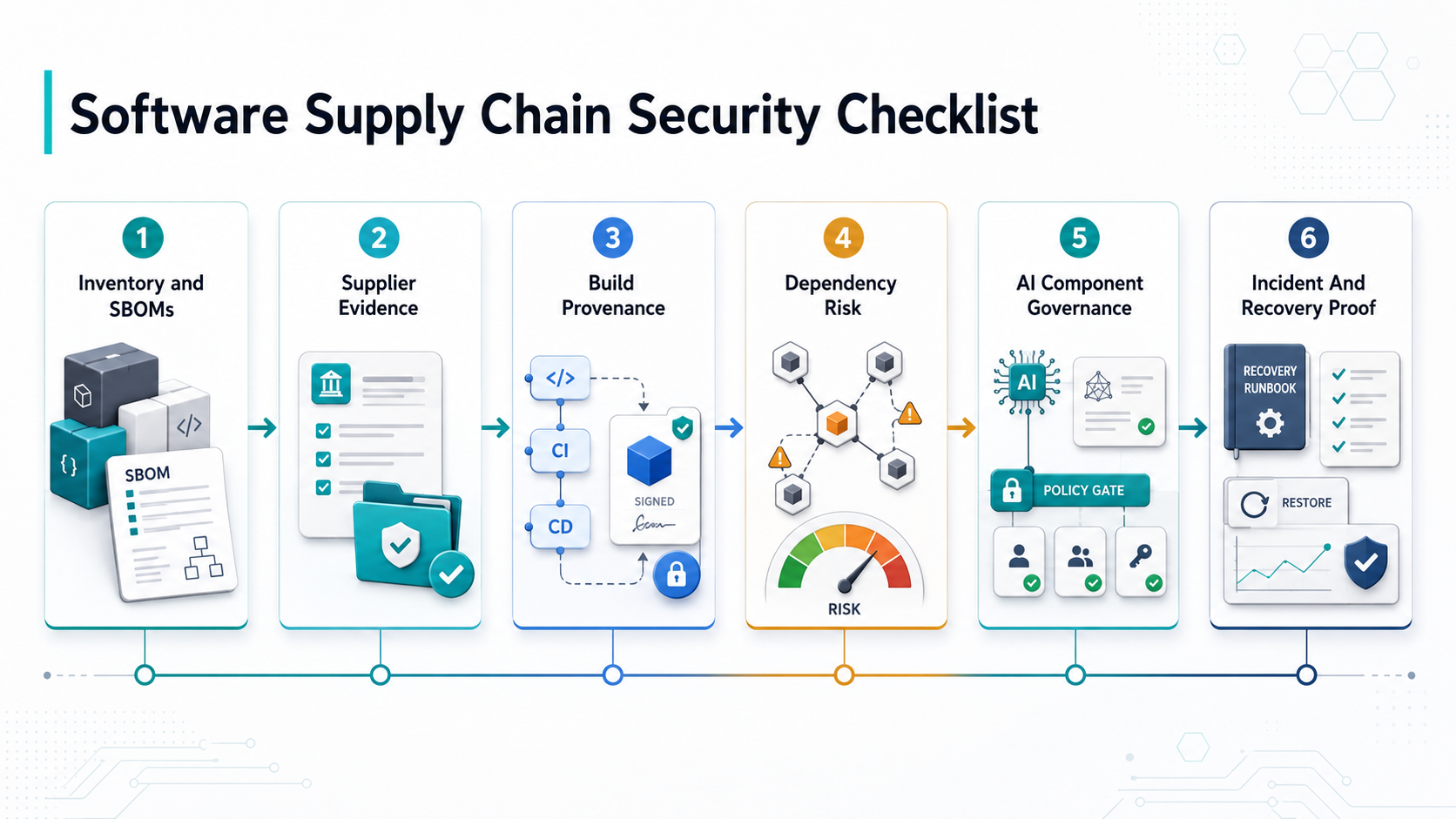
A software supply chain security checklist should prove what code, packages, tools, vendors, AI services, build systems, deployment paths, and recovery controls your software depends on. The checklist is useful only when it produces evidence: SBOMs, dependency risk decisions, vendor security records, build provenance, release approvals, incident drills, and recovery proof.
This matters for custom applications, SaaS products, internal workflow systems, AI agents, partner portals, and legacy platforms. A vulnerable open-source package is only one failure mode. The same business can be exposed by a weak vendor review, a compromised CI/CD token, an unverified container image, an AI API with unclear data handling, or a recovery plan that has never been rehearsed.
Use this guide as a practical operating checklist. If your team is modernizing older systems, connect it to a legacy software modernization scorecard. If releases are already moving through CI/CD, pair it with a DevSecOps pipeline checklist so supply-chain controls become release evidence instead of a separate spreadsheet.
Why This Risk Is Now A Board-Level Issue
Software supply-chain risk has moved beyond engineering hygiene. The World Economic Forum's Global Cybersecurity Outlook 2026, produced with Accenture, describes a risk landscape shaped by accelerating AI adoption, geopolitical fragmentation, faster attacks, and widening cyber capability gaps. That context matters because most digital products now depend on external code, managed cloud services, SaaS platforms, package registries, infrastructure-as-code modules, contractors, APIs, and AI providers.
The business question is no longer, "Do we use open source?" Almost every modern team does. The better question is: can we prove which components and suppliers matter, which ones can change production behavior, how we would detect a compromise, and how quickly we could recover if a trusted upstream dependency became unsafe?
OWASP's Software Component Verification Standard is useful here because it treats component assurance as a cross-functional risk program. Engineering owns many controls, but procurement, legal, finance, product, security, and operations also decide which vendors are acceptable, what evidence is required, and when risk must be escalated.
Content Brief For Security And Engineering Leaders
| Planning Item | Decision For This Post |
|---|---|
| Primary keyword | Software supply chain security checklist. |
| Related queries | SBOM checklist, vendor risk review, dependency inventory, SLSA provenance, build integrity, AI dependency governance, incident recovery evidence. |
| Search intent | Problem-aware planning and commercial investigation. |
| Expected format | Checklist, owner matrix, evidence table, incident drill plan, and buyer-readiness guide. |
| Reader job | Decide what controls and evidence are needed before trusting software, vendors, and AI components in production. |
| CTA | Request a software supply-chain risk review covering SBOMs, vendors, dependencies, AI components, build integrity, and recovery readiness. |
The Software Supply Chain Security Checklist
Use the checklist as a control map. The goal is not to buy one tool and declare the problem solved. The goal is to make dependency risk visible, assign ownership, and keep evidence current as code, vendors, infrastructure, and AI workflows change.
| Control Area | What To Verify | Evidence To Keep |
|---|---|---|
| Inventory | First-party code, open-source packages, commercial libraries, containers, cloud services, SaaS integrations, AI APIs, models, plugins, and build tools. | System inventory, SBOMs, service catalog, data-flow map, integration register. |
| Supplier risk | Vendor security posture, support commitments, incident notification, access to data, subcontractors, resilience, and exit path. | Security questionnaire, contract clauses, SOC reports, renewal review, owner sign-off. |
| Build integrity | Source control, CI/CD permissions, artifact provenance, signed releases, secrets handling, and package publishing controls. | Pipeline policy, SLSA target level, provenance records, signing logs, access review. |
| Dependency risk | Known vulnerabilities, license risk, abandoned packages, transitive dependencies, exploitability, and patch SLA. | SCA reports, exception register, VEX notes, remediation tickets, release approvals. |
| AI components | Model/API ownership, prompt/data exposure, plugin permissions, agent tool access, memory stores, evaluation data, and rollback options. | AI inventory, data handling review, permission manifest, evaluation record, incident runbook. |
| Recovery | Incident detection, supplier notification, build rollback, dependency replacement, backup restore, customer communication, and legal reporting. | Tabletop results, restore proof, comms templates, decision log, post-incident review. |
1. Map The Software And Service Inventory
Start with an inventory that reflects how the product actually runs. Include applications, repositories, runtime services, containers, build images, package managers, infrastructure modules, data stores, SaaS tools, authentication providers, observability agents, payment providers, support tools, AI APIs, model endpoints, and internal automations.
SBOMs are central, but they are not the whole inventory. An SBOM can list components in a build, while the service inventory explains where that build runs, which business workflow it supports, who owns it, which data classes it touches, and which recovery procedure applies. Without that context, a vulnerability scan can produce noise without business prioritization.
For legacy platforms, inventory work often exposes unsupported frameworks, pinned libraries, fragile build servers, unowned integrations, and manual deployment paths. The legacy application modernization roadmap is useful when the supply-chain issue is part of a broader architecture and maintainability risk.
- Repository level: source code, dependency manifests, lockfiles, build scripts, test tooling, secrets policy, and ownership.
- Artifact level: packages, containers, binaries, deployment manifests, signatures, provenance, and release channels.
- Runtime level: cloud services, managed databases, queues, SaaS tools, AI providers, identity providers, and observability agents.
- Business level: workflows, customer data, regulated records, vendor criticality, and recovery priority.
2. Make SBOMs Operational, Not Archival
An SBOM should be generated and updated as part of the software lifecycle, not assembled manually after an incident. At minimum, the SBOM should identify component names, versions, suppliers, dependency relationships, identifiers, author/source of the SBOM data, and timestamp. Mature teams also track licenses, hashes, package URLs, vulnerability references, exploitability status, and release context.
The practical issue is trust. Recent SBOM research continues to show gaps around hidden dependencies, component variants, inconsistent scanner output, privacy concerns, and tool adherence. That means a team should avoid treating SBOM generation as a checkbox. Test whether the SBOM captures the dependencies that actually ship, whether different tools disagree materially, and whether downstream consumers can interpret the output.
| SBOM Practice | Why It Matters | Failure To Avoid |
|---|---|---|
| Generate per release | Connects components to a specific deployable artifact. | Maintaining one old SBOM that no longer matches production. |
| Store with provenance | Shows how the artifact was built and by which pipeline. | Publishing a component list without build context. |
| Track direct and transitive dependencies | Most exploitable risk may sit below the first layer. | Scanning only top-level package manifests. |
| Record exceptions | Explains why a vulnerable component was accepted temporarily. | Letting unresolved findings disappear between scans. |
| Share selectively | Supports customers and auditors while protecting sensitive architecture details. | Emailing raw inventory without classification or access control. |
3. Review Supplier And Vendor Risk
Supplier risk is broader than package vulnerability risk. A vendor can expose your organization through weak access controls, poor incident notification, unclear subcontractors, unsupported products, risky data processing, opaque AI usage, poor backup practices, or an exit path that leaves business-critical data trapped.
Classify suppliers by business impact and system access. A low-risk marketing widget should not receive the same review depth as a payment provider, cloud platform, AI API, code-hosting tool, identity provider, offshore delivery partner, or managed service provider with production credentials.
| Supplier Tier | Examples | Review Depth |
|---|---|---|
| Critical | Cloud provider, identity provider, CI/CD platform, payment processor, production support vendor. | Security review, contract clauses, access review, incident notification, continuity plan, annual reassessment. |
| High | SaaS tools with customer data, AI providers, analytics pipelines, managed databases, source-code tools. | Data handling review, SOC/security evidence, owner approval, integration monitoring, exit plan. |
| Moderate | Commercial SDKs, business workflow SaaS, messaging tools, support tools. | Dependency owner, renewal review, vulnerability and access checks. |
| Low | Non-production tools, read-only content tools, low-data utilities. | Basic owner, purpose, access scope, and renewal record. |
Procurement should not be isolated from engineering. The people approving contracts need to know whether a vendor can change production behavior, access sensitive data, or block recovery. The people designing architecture need to know which contractual and operational commitments are actually enforceable.
4. Harden The Build And Release Chain
A secure dependency list is not enough if an attacker can change code after review, compromise CI/CD secrets, replace an artifact, publish a malicious package, or deploy from an untrusted workstation. SLSA is valuable because it focuses on tamper-resistant evidence across source, build, packaging, and distribution.
Set a realistic target level for your organization and risk profile. Early improvements may include protected branches, mandatory reviews, reproducible build steps where practical, isolated runners, least-privilege CI tokens, signed artifacts, provenance records, dependency pinning, and environment-specific deployment approvals.
These controls should be visible in release management. If your team already uses a DevSecOps pipeline checklist, add supply-chain gates for dependency changes, build image changes, package publishing, artifact signing, and emergency exceptions.
- Limit who can change package manifests, lockfiles, CI/CD workflows, deployment scripts, and release keys.
- Use separate identities for humans, automation, integrations, and deployment systems.
- Rotate and scope tokens used by package registries, build systems, cloud environments, and SaaS tools.
- Review build images, base containers, and CI/CD plugins as dependencies, not as invisible plumbing.
- Keep a rollback path for bad releases, compromised packages, and revoked credentials.
5. Govern AI Dependencies And Agent Tools
AI adds new software supply-chain questions. A product may depend on an external LLM API, embedding model, vector database, agent framework, prompt library, evaluation dataset, browser automation tool, code-generation assistant, or reusable agent skill. These components can affect data exposure, output quality, security boundaries, auditability, and incident response.
Treat AI dependencies as production dependencies. For action-taking systems, pair the inventory with enterprise AI agent governance so permissions, monitoring, human review, and rollback are defined before tools reach sensitive workflows. Record the provider, model, version or deployment name where available, data sent, retention settings, tool permissions, evaluation criteria, fallback behavior, and owner. If an agent can call APIs, write records, deploy code, read documents, or invoke browser actions, its tool permissions belong in the same risk register as service accounts and vendor integrations.
Use the AI Agent Readiness Assessment before giving an agent access to sensitive workflows. The shadow AI governance checklist can also help teams discover unmanaged AI tools before they become undeclared dependencies.
| AI Dependency | Control Question | Evidence |
|---|---|---|
| LLM or embedding API | What data is sent, retained, logged, or used for training? | Provider settings, data handling review, contract terms. |
| Agent tool | Can it read, write, approve, deploy, or send external messages? | Permission manifest, audit logs, human approval rules. |
| Prompt or skill package | Who authored it, how is it versioned, and how can it be rolled back? | Source record, review history, test results. |
| Vector store or memory | Which records are indexed, how are they deleted, and who can query them? | Data inventory, retention policy, access review. |
| Evaluation set | Does it test security, privacy, quality, and business failure modes? | Evaluation report, regression baseline, exception log. |
6. Prioritize Risk With Business Impact
Supply-chain programs can stall when every finding looks urgent. Prioritization should combine exploitability, exposure, business criticality, data sensitivity, compensating controls, supplier criticality, and recovery difficulty. A vulnerable package in a public marketing page is not the same as a vulnerable package in a payment workflow, admin console, healthcare record system, or CI/CD runner.
Use a risk register that forces decisions. Each exception should have an owner, reason, compensating control, deadline, and escalation path. Avoid permanent "accepted risk" notes that nobody revalidates. If the application is tied to a migration or modernization program, the application migration readiness checklist can help connect dependency risk to data, cutover, rollback, and production support.
| Signal | Higher Risk When | Lower Risk When |
|---|---|---|
| Exposure | Internet-facing, privileged, multi-tenant, or customer-data workflow. | Internal, isolated, read-only, no sensitive data. |
| Exploitability | Known exploit, reachable code path, no mitigation. | Unreachable path, patched runtime, compensating control. |
| Supplier dependency | No replacement path, unclear support, poor incident transparency. | Clear SLA, alternatives, documented recovery plan. |
| Operational impact | Stops revenue, regulated reporting, support, fulfillment, or access control. | Limited inconvenience with manual workaround. |
7. Test Incident And Recovery Readiness
A software supply-chain incident is different from a normal bug. The organization may need to identify affected products, disable a vendor integration, rotate tokens, rebuild artifacts, replace a package, notify customers, preserve evidence, restore backups, and coordinate legal or regulatory communications. This is hard to invent during an active incident.
Run tabletop drills around realistic scenarios. If inherited infrastructure, vendor handoff, or fragile recovery paths are part of the risk, a software project rescue review can expose the cloud, data, access, and deployment issues that would block recovery. Then drill around realistic scenarios: a compromised package registry account, a malicious dependency update, a leaked CI/CD token, a vendor breach, a SaaS outage, an unsafe AI provider behavior, or a critical vulnerability in a widely used library. The drill should test who can answer which systems are affected, which customers are exposed, which builds contain the component, and what rollback path exists.
Recovery evidence should connect to cloud and data operations. If the incident requires infrastructure rollback, pair the plan with cloud migration services or a managed cloud services checklist mindset: backups, restore tests, monitoring, access controls, and incident ownership all matter.
- Can you identify all products and environments affected by one vulnerable package?
- Can you rebuild and redeploy from trusted source without using compromised credentials?
- Can you disable or replace a vendor integration without corrupting business records?
- Can you prove which customer data or regulated records were touched?
- Can you restore service from backups and verify data integrity?
- Can legal, support, sales, and customer-success teams communicate from an approved fact base?
Owner Model For Supply Chain Security
Supply-chain security fails when every team assumes another team owns the risk. Use a simple owner model that ties controls to evidence.
| Workstream | Accountable Owner | Evidence Output |
|---|---|---|
| Software inventory and SBOMs | Engineering platform lead | Release SBOMs, service catalog, component owner map. |
| Dependency vulnerability management | Security engineering | SCA reports, exception register, remediation SLA. |
| Vendor risk | Procurement or vendor management | Supplier tier, security evidence, contract terms, renewal review. |
| Build and release integrity | DevOps or platform engineering | CI/CD access review, provenance, signing logs, release approvals. |
| AI dependency governance | AI product owner and security lead | AI inventory, data handling review, permission manifest, evaluation record. |
| Incident response and recovery | Security operations and application owner | Tabletop results, runbooks, restore proof, post-incident actions. |
Common Pitfalls To Avoid
- Publishing an SBOM once and never tying it to releases, runtime systems, or vulnerability response.
- Scanning application dependencies while ignoring CI/CD plugins, build images, infrastructure modules, and deployment tools.
- Letting vendors pass procurement without understanding data access, incident notification, subcontractors, and exit options.
- Accepting vulnerable dependencies without owner, deadline, compensating control, or review date.
- Giving AI agents or copilots broad tool access without permission manifests and audit logs.
- Failing to rehearse supplier-breach, package-compromise, and recovery scenarios before a real incident.
- Keeping supply-chain evidence in scattered tickets, chat threads, and spreadsheets that cannot support an audit or customer review.
NextPage's Software Supply Chain Security Checklist
Before approving a major release, vendor integration, modernization wave, or AI-enabled workflow, confirm that your team can answer yes to these questions:
- Do we have a current inventory of code, dependencies, build tools, vendors, SaaS integrations, cloud services, and AI components?
- Are SBOMs generated per release and connected to deployable artifacts?
- Do critical suppliers have security evidence, incident obligations, owner approval, and an exit path?
- Are CI/CD systems, package registries, signing keys, and deployment credentials protected with least privilege?
- Are vulnerability exceptions owned, time-bound, and reviewed against business impact?
- Are AI APIs, models, prompts, tools, and memory stores governed as production dependencies?
- Have we rehearsed package compromise, vendor breach, token leakage, and recovery scenarios?
- Can we produce evidence for customers, auditors, insurers, and internal risk leaders without rebuilding the story from scratch?
NextPage helps teams turn this checklist into practical engineering work: dependency inventory, DevSecOps release gates, vendor integration review, modernization planning, cloud recovery controls, and AI governance. Start with a software supply-chain risk review when you need one evidence-backed plan across product, engineering, security, procurement, and operations.