Portfolio case study

ClearPath Health: Mobile lab test reporting and patient results platform

A mobile-first lab test reporting platform that connects patient onboarding, family member intake, location-aware test workflows, payment collection, PDF result delivery, and staff-operated report management through one API-backed healthcare product.

Name changed to respect NDA.

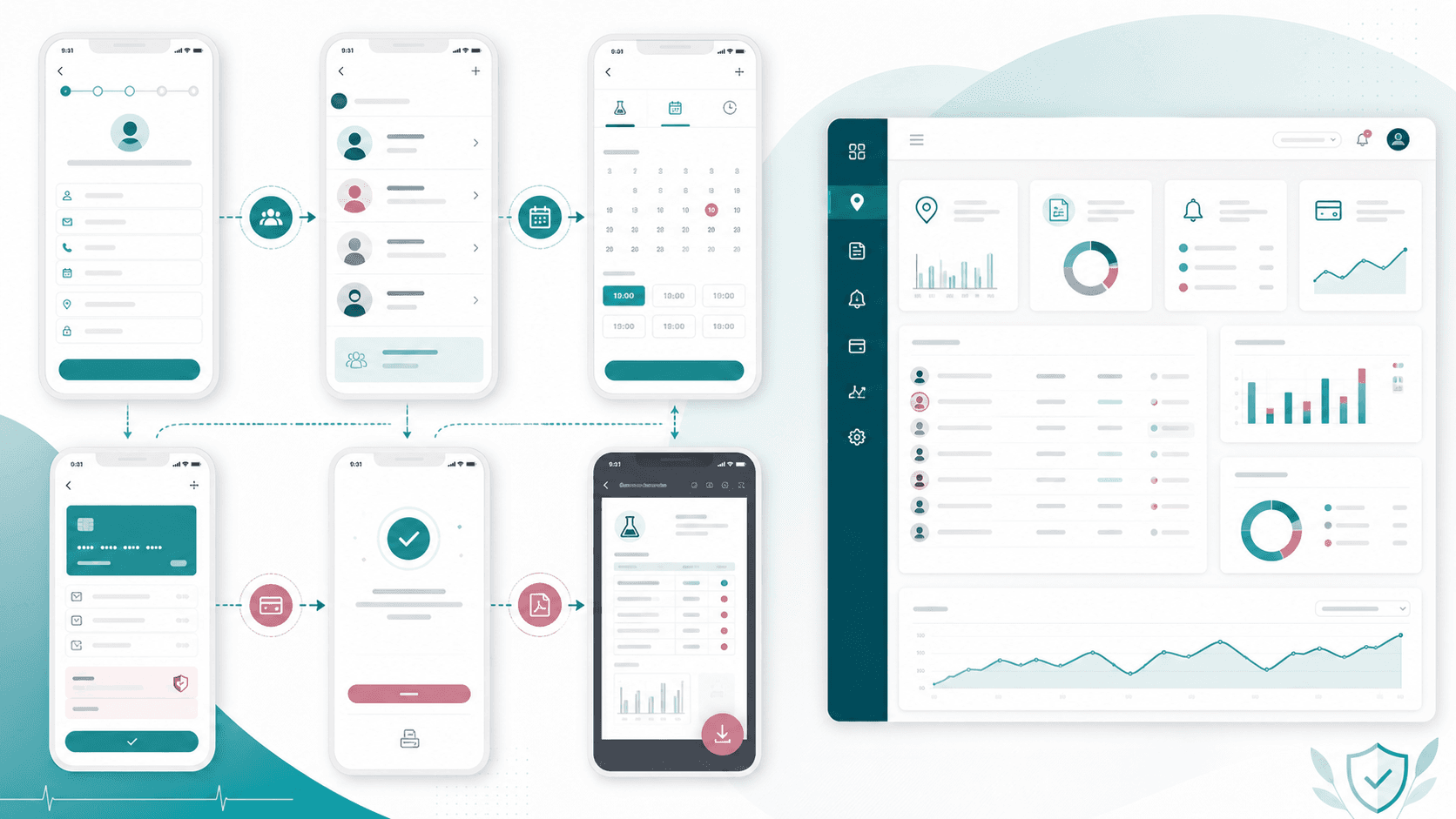
Mobile lab reporting platform visual with patient registration, family profiles, payment confirmation, PDF results, notifications, and backend operations dashboard cards
Project scope

Flutter mobile app engineering, ASP.NET Core API delivery, patient and relative workflows, PDF result generation, payment handling, email and SMS notifications, role-aware report operations, and healthcare data modeling

2
connected product layers
Family
relative and dependent intake
PDF
generated result reports
Stripe
payment workflow support

Timeline

Mobile patient app and API-backed health reporting platform delivery

Test results needed to move from staff workflows to patients without manual handoffs

The product needed to guide patients through registration and verification, collect family and test details, handle payments, and let staff generate and share result reports through email, SMS, and in-app access.

  • Patients needed mobile registration, OTP verification, login, profile setup, and password recovery without a heavy web portal
  • Families needed dependent profiles with contact, date of birth, relation, location, passport, and scheduled test details
  • Staff needed controlled access to users, reports, test types, locations, payments, and generated result documents
  • Result delivery had to combine in-app history, PDF generation, email, and SMS notification paths

A Flutter patient app backed by a role-aware healthcare API

ClearPath Health pairs a Flutter mobile experience with an ASP.NET Core API so patients can register, manage dependents, pay for tests, view reports, and receive results while operations teams manage reports, locations, test types, and notifications.

  • Flutter screens for registration, OTP verification, login, profile forms, relative intake, settings, payment, report list, report detail, and report history
  • API controllers for users, reports, payments, countries, locations, test types, transactions, and authenticated profile access
  • PDF templates and report-generation services for result documents with test dates, return dates, patient details, and document links
  • Email and SMS delivery flows for OTP verification, password recovery, result sharing, and family-member report notifications

Product surfaces

What the platform brought together

The work spanned core product operations, daily user workflows, data-heavy coordination, and resilient platform management.

Patient onboarding and verification

The app gives users a guided account path before they reach sensitive healthcare and payment workflows.

  • Email registration, verification code flow, sign-in, username creation, password verification, password changes, and saved session tokens
  • Profile forms for name, phone, address, date of birth, location, passport, country, state, city, and test scheduling details
  • Environment-aware API configuration and local preferences for authenticated mobile sessions

Family and dependent intake

The product supports test reporting for both the primary account holder and relatives connected to the same account.

  • Relative forms for relation, identity, contact data, address, location, passport, and test appointment fields
  • Parent account linkage so family-member results can be delivered through the right account contact details
  • Validation rules for dependent contact needs and date formats before records enter the reporting workflow

Payments and test options

Payment workflows stay close to test selection, family members, and report access instead of becoming a disconnected checkout.

  • Payment option lookup by user, test-type selection, payment history, and pay-for dialogs for account holders or relatives
  • Card payment support with customer records, payment methods, payment intents, amount capture, and transaction history
  • Mobile payment screens that explain delivery channels and route paid users back into the report experience

Result reporting and notification delivery

Staff can generate, save, and share report documents while patients receive updates through the channels they already use.

  • Report list, report history, report detail, pending states, and generated PDF links surfaced in the mobile app
  • PDF generation from templates with patient data, result type, test timestamps, passport details, stamps, and document storage
  • Email and SMS services for verification, password recovery, and report-sharing notifications to patients or guardians

Buyer priorities

What mattered most to the people evaluating the platform

Prospective buyers want to know whether the work solved real workflow, adoption, reliability, data, and operations problems. These priorities shaped the product decisions.

Patient clarity

The platform had to make sensitive result, payment, and family workflows understandable on a small screen.

  • Registration, verification, profile, payment, and report screens are separated into distinct mobile journeys
  • Family-member data capture keeps dependent testing workflows near the account holder relationship
  • PDF results, report history, and payment status make next steps visible after a test is processed

Operational control

Healthcare staff needed API controls for users, reports, test types, locations, and transactions without exposing the same controls to patients.

  • Role checks separate user, manager, staff, and admin behavior in API report and payment routes
  • Report generation and sharing are restricted to authorized staff actions
  • Location, country, test-type, transaction, and user repositories keep reporting operations structured

Result delivery reliability

Result reporting depended on more than one channel, so delivery needed in-app history, generated PDFs, email, and SMS.

  • PDF links are attached to patient records after generation
  • Email and SMS templates support OTP, account, and result workflows
  • Report history and payment history give users a durable record inside the app

System model

How the platform connects roles, workflows, and product surfaces

The product architecture brings every role into the same operating model, with shared data moving cleanly between web, mobile, media, and notification layers.

Registration to result workflow

Patients move through account setup, verification, profile intake, payment, staff processing, PDF generation, and result delivery.

Mobile app and API operating layer

The patient app, staff report workflows, payments, PDF templates, and notifications share one backend foundation.

Role-aware reporting

Patients, guardians, staff, managers, and admins interact with different controls around the same report lifecycle.

Technology

The Stack We Used And Why

The stack section is written for buyers who need to understand the product architecture, operational trade-offs, and long-term maintainability of the system.

Mobile app

Used for patient registration, verification, profile setup, dependent intake, payment, report history, and PDF result access.

FlutterDartProviderDioShared PreferencesGoogle Fonts

Backend API

Used for authenticated users, roles, reports, locations, test types, payments, templates, and healthcare workflow orchestration.

ASP.NET CoreC#NPocoMySQLFluentValidationJWT tokens

Payments and documents

Used to support test payment flows, transaction records, customer cards, PDF report generation, and result document delivery.

StripePaymentIntentsPugPdfHTML templatesPDF storage

Notifications and operations

Used to deliver OTP, password, and report updates while keeping staff workflows auditable and recoverable.

Email templatesTwilio SMSELMAH error loggingMiniProfiler

Why Flutter For Patients

The primary experience was a focused mobile journey for account setup, family details, payment, and result access.

  • Flutter kept the patient app consistent across mobile platforms
  • Provider gave the app straightforward state boundaries for relatives, reports, and payments
  • Shared preferences preserved environment and authentication context between sessions

Why ASP.NET Core For Operations

The backend needed structured, role-aware business workflows around users, reports, payments, test types, and result documents.

  • Controllers separated user, report, payment, country, and location behavior
  • Repository models kept patient, relative, transaction, location, report, and template data organized
  • Validation and token services protected sensitive reporting operations

Why Document And Messaging Workflows Were First-Class

The value of the product depended on turning test processing into trustworthy patient communication.

  • HTML-to-PDF generation produced portable report documents
  • Email and SMS paths reduced dependence on users returning manually to the app
  • Report links and history gave patients a persistent record after staff shared results

Delivery

How the product came together

The work moved from domain modeling to core platform delivery, mobile adoption, and operational hardening.

1

Map patient and family journeys

Define the mobile flows for registration, OTP verification, profile setup, relative intake, payment, and report review.

2

Build the API operating core

Create user, report, payment, location, test type, transaction, template, and token-backed services.

3

Connect payments and report generation

Tie test options, card payments, transactions, generated PDFs, and report history into the product workflow.

4

Add delivery and support paths

Layer in email, SMS, error logging, environment configuration, and staff-controlled report sharing.

Operational depth

What made the platform usable after launch

The strongest case studies are not only feature lists. They show how the system is operated, monitored, governed, and improved when real users depend on it.

Staff-controlled report sharing

Report generation and delivery are treated as authorized operational actions rather than simple file uploads.

  • Staff can generate PDF reports from validated result, test date, and return date inputs
  • Report sharing marks pending users complete and saves a report history record
  • Relative reports can route notifications to the parent account when needed

Payment and report linkage

Payment status and report access sit in the same mobile experience so users understand whether action is still required.

  • Payment options are fetched for each user or dependent profile
  • Transaction records capture mode, amount, user, and payment provider identifiers
  • Report screens surface unpaid, pending, paid, and completed states around the test result journey

Healthcare data structure

The product models the practical details needed for mobile test reporting without collapsing every person into a single flat profile.

  • Primary users and relatives support separate identity, relationship, DOB, passport, address, and test fields
  • Country, state, city, location, and test type models keep intake data normalized
  • Templates support reusable communication and report-document content

Results

The measurable and observable lift from the work

The strongest improvements are the ones a buyer can connect to daily work: fewer disconnected tools, safer operations, clearer workflows, and more reliable product behavior.

2 layers

Product Architecture

A Flutter patient app and ASP.NET Core API worked together across registration, payment, reporting, and notifications.

5 roles

Access Model

Patients, guardians, staff, managers, and administrators were supported through role-aware API behavior and mobile workflows.

4 channels

Result Delivery

Results could be delivered through in-app history, generated PDFs, email, and SMS notifications.

Family-ready

Dependent Intake

Relative profiles allowed account holders to manage test details and report access for family members.

Outcome

A stronger operating system for mobile lab test reporting and patient results platform

The platform reduced tool fragmentation and gave each role a clearer path from live activity to day-to-day action.

A mobile healthcare reporting flow that connects patient onboarding, relatives, payments, and result history

An API-backed operating layer for users, reports, payments, locations, test types, templates, and notifications

Generated PDF reports that staff can share through in-app access, email, and SMS

A public-safe healthcare platform proof point focused on trust, family workflows, and operational report delivery

FAQ

Frequently Asked Questions About ClearPath Health

Answers about the mobile lab test reporting and patient results platform scope, platform model, technology choices, operational workflows, and related build patterns.

What Kind Of Healthcare Product Does This Case Study Represent?

It represents a mobile lab test reporting platform with patient registration, family-member intake, payment collection, PDF result generation, report history, and staff-controlled result sharing.

Why Was A Custom Mobile App Useful For Test Reporting?

The workflow needed account verification, dependent profiles, payment state, report history, generated documents, and delivery through multiple channels. A custom app kept those steps connected for patients and staff.

Can This Pattern Support Other Health Screening Programs?

Yes. The same pattern can support mobile diagnostic reporting, clinic result delivery, family health programs, travel testing, wellness checks, and other healthcare workflows where intake, payment, documents, and notifications need to stay coordinated.

What Should A Buyer Prepare Before Building A Similar App?

The most useful inputs are role definitions, intake fields, family-account rules, test types, payment rules, report templates, notification copy, result-sharing permissions, and compliance boundaries for patient data.

Related services

Build a similarly ambitious product without starting from a blank page.

We can help scope the web, mobile, AI, media, and operating layers needed for your own platform.

Start a project inquiry