Portfolio case study

FanPulse: Sports trivia challenge web platform

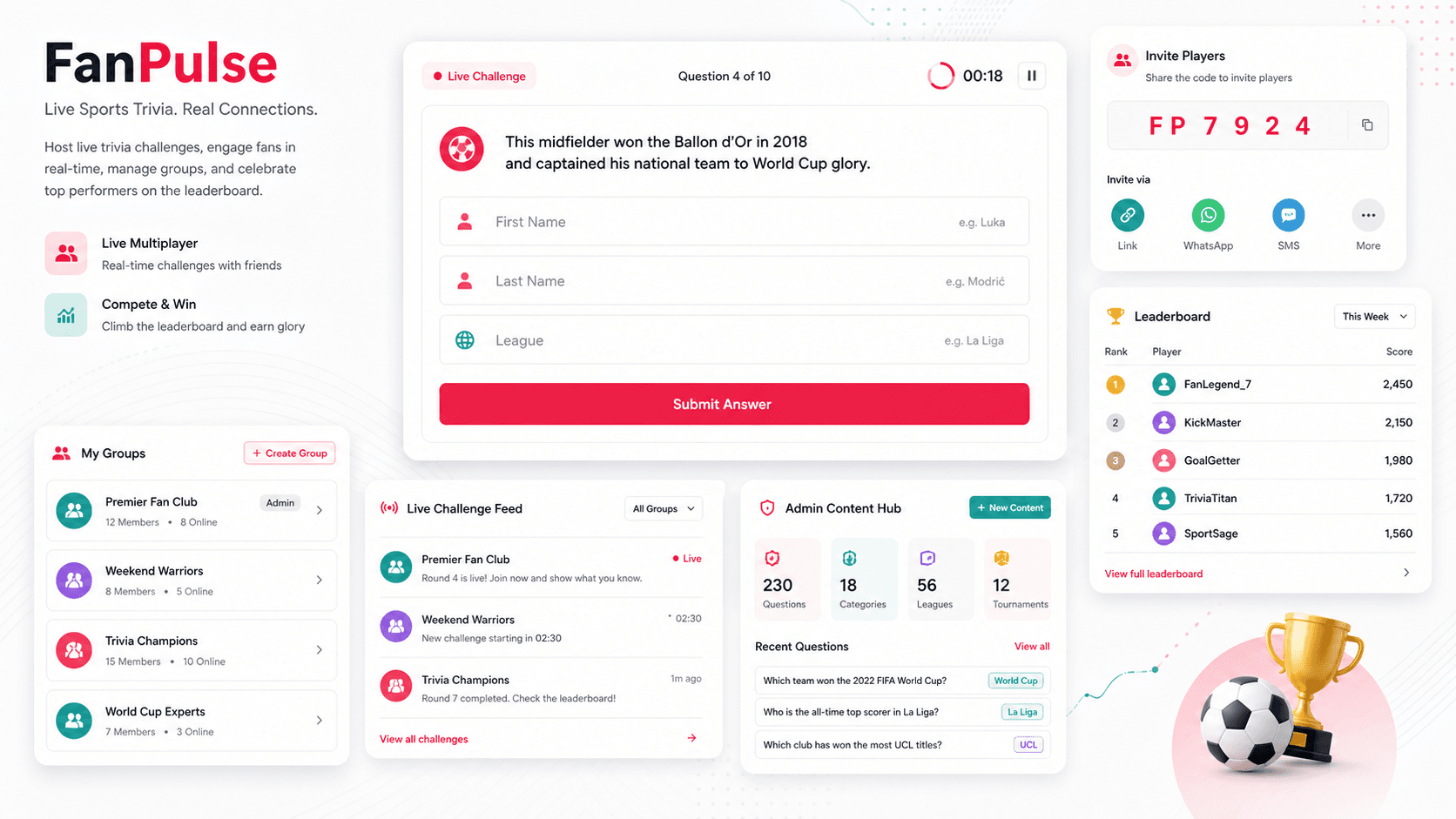
A web-based sports trivia challenge platform that brings timed quizzes, multiplayer invites, private groups, game-of-the-day leaderboards, player history, profiles, and admin-managed content into one connected fan engagement product.

Name changed to respect NDA.

Sports trivia challenge platform visual with timed quiz fields, invite panel, groups, leaderboard, live challenge feed, and admin content hub
Project scope

Frontend product engineering across the player web app, admin dashboard, authenticated routes, quiz workflows, invite flows, groups, leaderboards, profile history, API integration, and content-management surfaces

2
connected React app surfaces
3
core play modes and contexts
Groups
private fan challenge spaces
Admin
user and content operations

Timeline

Dual-surface React product build for fan trivia engagement and operations

A trivia game needed to feel social, repeatable, and manageable

The product needed more than a single quiz screen. Players had to create accounts, start timed sports-name challenges, invite friends, join groups, compare scores, review history, and return for daily games, while operators needed a way to manage users and reusable content.

  • Timed answer entry needed validation, league selection, multiple answer rows, auto-submit behavior, and result routing
  • Multiplayer invites, friend emails, group invitations, and pending group actions had to stay clear for casual players
  • Leaderboards needed daily, historical, group, and game-specific views without losing the active quiz context
  • Administrators needed searchable user and snippet management separate from the player-facing experience

A connected fan challenge system with player and admin surfaces

FanPulse combines a customer-facing React app for daily and group sports trivia with a separate React admin workspace for operational management, both integrated through API-backed authentication, quiz, group, user, and snippet endpoints.

  • Authenticated player routes for dashboard, new game setup, quiz play, results, profiles, invites, groups, pending groups, and leaderboards
  • Game setup choices for duration, scoring model, single-player or multiplayer play, friend invites, and group challenge launch
  • Group workspaces with member lists, active games, challenge status, leaderboard review, member removal, and accept-or-reject invite actions
  • Admin workspace for searchable users, role-aware user details, reusable snippets, table views, forms, and protected dashboard routes

Product surfaces

What the platform brought together

The work spanned core product operations, daily user workflows, data-heavy coordination, and resilient platform management.

Timed quiz engine

The core game flow turns generated questions into a timed answer surface with validation and result handoff.

  • Question retrieval, quiz metadata loading, countdown timer handling, and automatic submission when time expires
  • Answer rows for first name, last name, and league with pattern validation and controlled multi-answer expansion
  • Result navigation tied to quiz and user context so players can review outcomes after submission

Challenge and invite flows

Players can move from solo play into social challenges without leaving the product context.

  • New game setup supports duration, scoring mode, individual play, multiplayer play, and email invite entry
  • Friend challenge sending with validation and toast feedback for success or failure states
  • Game-of-the-day entry points connect daily play to leaderboard discovery

Groups and leaderboards

Fan communities get shared spaces for recurring challenges, member management, and score comparison.

  • My groups, pending invites, group detail, new group, group membership, and group challenge screens
  • Group-specific game lists with played-state handling and leaderboard drill-down
  • Daily leaderboard filters for today, yesterday, and selected dates

Admin operations

Operational users can manage player records and reusable content through a protected dashboard experience.

  • User list and user detail forms with role selection, profile fields, create/update, and delete paths
  • Snippet list and detail workflows for reusable content records
  • Table, search, pagination, toast, API hook, and protected route patterns for repeatable admin views

Buyer priorities

What mattered most to the people evaluating the platform

Prospective buyers want to know whether the work solved real workflow, adoption, reliability, data, and operations problems. These priorities shaped the product decisions.

Player momentum

Trivia products depend on short, repeatable sessions, so the flow had to make starting, playing, and reviewing a game fast.

  • Dashboard entry points reduce friction for daily play, new games, groups, and invites
  • Timers, answer validation, and result routing keep each game session focused
  • Profile and player history views give users a reason to return after a single quiz

Social engagement

The platform needed to create a reason for fans to play together rather than treat quizzes as isolated single-user tasks.

  • Multiplayer challenge invites support direct friend-to-friend play
  • Private groups create recurring communities around challenge history and member activity
  • Leaderboards make game-of-the-day and group results visible enough to drive repeat participation

Operational control

A fan engagement product still needs lightweight administrative controls for users, content records, and support workflows.

  • The admin app keeps management tasks away from player-facing routes
  • Searchable tables and detail forms support user and role administration
  • Snippet management gives operators a reusable content surface for product copy and question-adjacent content

System model

How the platform connects roles, workflows, and product surfaces

The product architecture brings every role into the same operating model, with shared data moving cleanly between web, mobile, media, and notification layers.

Daily challenge to result

A player starts a timed game, answers sports-name prompts, submits before the countdown ends, and lands on a result view.

Players, groups, and operators

Players, friends, group members, group admins, and content operators each interact with the platform through scoped workflows.

Two React surfaces, one API model

The player web app and admin dashboard connect through shared authentication, quiz, group, user, leaderboard, and snippet endpoints.

Technology

The Stack We Used And Why

The stack section is written for buyers who need to understand the product architecture, operational trade-offs, and long-term maintainability of the system.

Player web app

Used to deliver the public fan challenge experience with authenticated routes, game screens, groups, leaderboards, invites, and profile flows.

ReactJavaScriptCreate React AppReact RouterBootstrapSass

Admin web app

Used for protected operational workflows around users, roles, snippets, tables, forms, dashboard layouts, and search.

ReactTypeScriptReact RouterReduxRedux-SagaReact BootstrapReact Table

API integration

Used to connect authentication, quiz generation, question retrieval, answers, groups, invites, leaderboards, users, roles, and snippets.

AxiosBearer tokensAPI endpoint constantsLocal storage session stateResponse interceptors

Experience utilities

Used to support timed play, forms, validation, date selection, notifications, loading states, and reusable UI controls.

React Hook FormReact ToastifyReact DatepickerReact SelectLoading overlaysReusable controllers

Why Separate Player And Admin Surfaces

The player app and admin app served very different jobs, so splitting them kept the fan experience focused while allowing dense operational screens.

  • Player routes stay centered on play, groups, invites, profile history, and leaderboards
  • Admin routes can use tables, forms, role management, snippets, and dashboard layouts without cluttering the game app
  • Both surfaces can share API-backed concepts while preserving different UI density and permissions

Why API-Backed Quiz State

Quiz questions, game state, user progress, invites, group memberships, and leaderboard data needed to stay current across sessions.

  • Generated quizzes are requested from backend endpoints rather than hard-coded into the client
  • Leaderboards, game history, and group games can be queried by date, group, quiz, and user context
  • Bearer token handling keeps protected player and admin actions tied to authenticated users

Why Lightweight Web UI Patterns

The product needed familiar, fast-to-ship web patterns for forms, tables, modals, dates, and notifications.

  • Bootstrap and React Bootstrap accelerated form-heavy screens and admin layouts
  • Toast feedback made invite, group, and admin actions easier to understand
  • Reusable API and form helpers reduced repetition across quiz, group, user, and snippet workflows

Delivery

How the product came together

The work moved from domain modeling to core platform delivery, mobile adoption, and operational hardening.

1

Map the game loop

Define account access, dashboard entry points, daily games, new challenges, timed quiz play, result review, and replay paths.

2

Build social play

Add multiplayer invites, group creation, group member lists, pending invitations, group games, and leaderboard context.

3

Connect APIs and sessions

Wire user, quiz, answer, group, invite, leaderboard, role, and snippet endpoints with authenticated request handling.

4

Ship admin controls

Create protected operational screens for user records, roles, snippets, searchable tables, forms, and detail views.

Operational depth

What made the platform usable after launch

The strongest case studies are not only feature lists. They show how the system is operated, monitored, governed, and improved when real users depend on it.

Protected route model

The apps protect authenticated player and admin areas while keeping public account recovery and registration flows separate.

  • Token-aware routing sends unauthenticated players back to account entry screens
  • Admin routes use a protected layout for dashboard, users, snippets, and management views
  • Local session values preserve user and quiz context across route transitions

Leaderboard context

The product supports leaderboard views tied to daily games, selected dates, groups, and individual game history.

  • Game-of-the-day leaderboards can be filtered by today, yesterday, or selected dates
  • Group screens can open game-specific leaderboards and result drill-downs
  • Profile and history routes preserve individual progress context

Reusable admin foundations

The admin app uses repeatable table, form, search, pagination, and API-hook patterns for future operational screens.

  • User and snippet modules share searchable table behavior
  • Detail views support create, update, and delete actions with toast feedback
  • Role and metadata endpoints keep administrative values backend-driven

Results

The measurable and observable lift from the work

The strongest improvements are the ones a buyer can connect to daily work: fewer disconnected tools, safer operations, clearer workflows, and more reliable product behavior.

Timed

Quiz Sessions

Players get a focused countdown-driven answer experience with validation, multiple answer rows, and result handoff.

Social

Challenge Loops

Friend invites, pending group invitations, group games, and leaderboards create repeatable reasons to return.

Dual Surface

Player And Admin Apps

The public fan experience and internal management dashboard stay separate while working from the same product model.

API-Led

Content And Results

Questions, quizzes, groups, users, leaderboards, roles, and snippets are coordinated through backend-backed services.

Outcome

A stronger operating system for sports trivia challenge platform

The platform reduced tool fragmentation and gave each role a clearer path from live activity to day-to-day action.

A React sports trivia web app with account access, dashboard, new game setup, timed quiz play, answers, results, invites, groups, leaderboards, and profile history

A companion React and TypeScript admin app for protected user management, role-aware detail forms, snippets, searchable tables, and operational dashboard layouts

API-integrated challenge workflows spanning quiz generation, game-of-the-day play, group games, invite acceptance, leaderboard filters, and result review

A reusable frontend foundation for extending fan engagement features without merging player-facing and operator-facing workflows

FAQ

Frequently Asked Questions About FanPulse

Answers about the sports trivia challenge platform scope, platform model, technology choices, operational workflows, and related build patterns.

What Kind Of Product Does FanPulse Represent?

FanPulse represents a sports trivia challenge web platform with timed quizzes, multiplayer invites, private groups, leaderboards, player history, and an admin dashboard for user and content operations.

Why Was A Custom Web App Useful For Sports Trivia?

A custom app was useful because the product needed more than static questions: it needed authenticated play, timed sessions, answer validation, group challenges, invites, leaderboards, and admin-managed content workflows.

How Do The Player And Admin Apps Work Together?

The player app handles quiz sessions, groups, invites, profiles, and leaderboards, while the admin app manages users, roles, snippets, and operational records through protected API-backed screens.

Can This Pattern Support Other Fan Engagement Products?

Yes. The same architecture can support football prediction games, esports trivia, creator community challenges, quiz leagues, training competitions, loyalty games, and other repeatable engagement products.

Related services

Build a similarly ambitious product without starting from a blank page.

We can help scope the web, mobile, AI, media, and operating layers needed for your own platform.

Start a project inquiry