Portfolio case study

FeastFlow: Social dining and restaurant meetup platform

A native iOS and Android social dining platform that connects profile discovery, restaurant-based meal offers, maps, chat, subscriptions, support, check-ins, moderation, and admin operations through a shared API backbone.

Name changed to respect NDA.

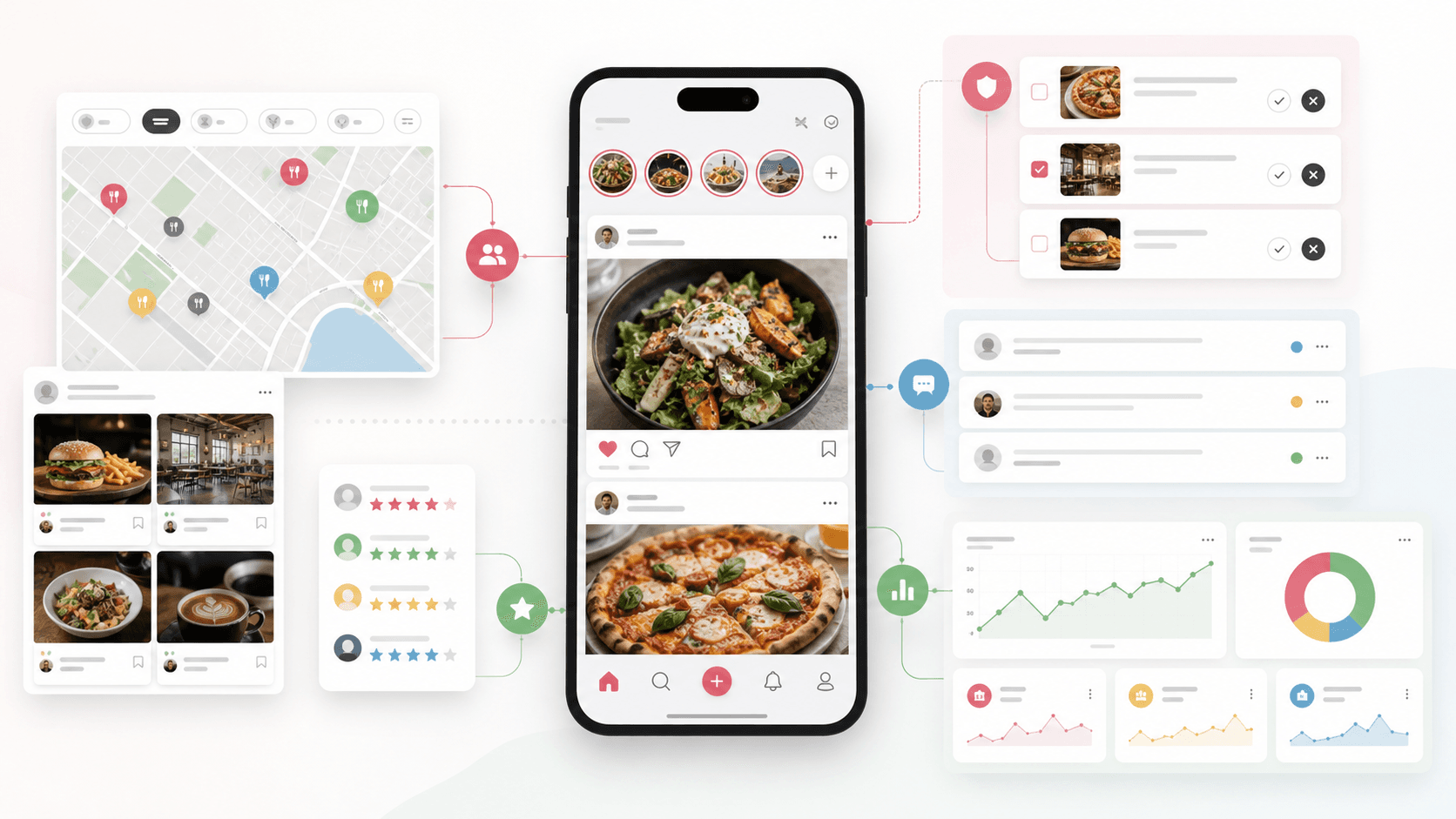
Abstract social dining platform visual with mobile profile cards, restaurant map discovery, meal offer workflows, chat, subscriptions, support, and admin moderation surfaces
Project scope

Full-stack product engineering across native iOS, native Android, React administration, ASP.NET API services, Rocket.Chat communication, Google Places restaurant discovery, Firebase/OneSignal notifications, subscriptions, moderation, and platform operations

4
connected product surfaces
2
native mobile apps
API
offers, users, files, chat, support
Trust
reports, blocks, support, check-ins

Timeline

Multi-surface social dining platform build with native mobile, API, chat, subscriptions, admin, trust, and operations layers

Social dining needed trust, logistics, and restaurant context

The product had to coordinate profile discovery, restaurant selection, meal invitations, chat, check-ins, subscriptions, and admin review without becoming a generic dating app, review directory, or delivery product.

  • Users needed profile, identity, location, favorites, restaurant, and preference flows that made social dining feel intentional and safe
  • Meal offers needed to carry restaurant, budget, attire, intention, date, invited user, response, cancellation, and check-in state across devices
  • Messaging needed to connect matched users while still supporting offer creation, declined conversations, notifications, and channel cleanup
  • Operators needed user management, support inboxes, blocked accounts, reported media, and moderation decisions in one admin console

A social dining platform with native apps and an operations layer

FeastFlow connects native consumer apps, a .NET API, restaurant and map integrations, Rocket.Chat messaging, subscriptions, support workflows, and a React admin console into one coordinated product system.

  • Native iOS and Android apps for onboarding, profile discovery, favorites, restaurant browsing, offer creation, chats, subscriptions, support, and check-ins
  • React admin console for user search, user detail edits, account blocking, support tickets, reported-image review, and keep/remove moderation decisions
  • ASP.NET API foundation for authentication, JWT sessions, users, offers, files, favorites, blocked users, contact support, app settings, ads, Google Maps, Rocket.Chat, and notifications
  • Restaurant and location workflows that combine Google Places-style restaurant data, map views, directions, offer dates, no-show states, and in-person check-in status

Product surfaces

What the platform brought together

The work spanned core product operations, daily user workflows, data-heavy coordination, and resilient platform management.

Onboarding and account identity

The signup flow turns first launch into a profile, safety, and discovery setup instead of a long undifferentiated form.

  • Registration, login, forgot password, privacy policy, verification, profile edit, photo, and location flows across mobile apps
  • Profile fields for identity, age, education, profession, favorite food, sign, photos, and location-aware discovery
  • Account status, blocked users, delete account, support, and admin-controlled user records for safer operations

Profiles, favorites, and engagement

The mobile experience centers on profile discovery, favorites, invitations, and return paths that help users move from browsing to a planned meal.

  • Profile cards, user detail screens, favorites, blocked users, profile photos, identity fields, and location-aware discovery
  • Offer invitations that connect one user to another through a restaurant, meal type, budget, attire, intention, and scheduled date
  • Push and app-state flows for unread offer status, messaging prompts, accepted or declined responses, and return engagement

Restaurant offers and check-ins

Restaurant selection is connected directly to the social workflow so meal plans can move from place discovery to offer acceptance and arrival confirmation.

  • Restaurant list, map, detail, cuisine, and search screens powered by place data and location permissions
  • Offer detail flows with restaurant name, address, cuisine, budget, scheduled time, attendee state, and directions
  • Check-in and no-show states that help the product handle real-world meal plans instead of only online matching

Messaging, notifications, and operations

Community interaction and platform governance are supported by real-time services, push delivery, and admin controls.

  • Rocket.Chat-backed channels, direct-message prompts, channel deletion, message lists, and chat detail screens
  • Firebase and OneSignal notification flows across mobile activity, chat, offers, and return engagement
  • Admin workflows for user management, account blocking, contact support, reported images, and moderation actions

Buyer priorities

What mattered most to the people evaluating the platform

Prospective buyers want to know whether the work solved real workflow, adoption, reliability, data, and operations problems. These priorities shaped the product decisions.

Mobile adoption

The app had to feel useful from the first session while still collecting enough profile, location, restaurant, and notification state to support repeat use.

  • Native onboarding, verification, profile, photo, and location flows prepared users for social discovery
  • Profile cards, favorites, offers, messages, and notifications created multiple return paths
  • iOS and Android implementations gave each platform native navigation, permissions, and notification behavior

Meal logistics

The differentiator was not only browsing people or restaurants. The product needed meal-specific logistics that could support a real-world meetup.

  • Offers captured restaurant, date, budget, attire, intention, invited user, and acceptance state
  • Map and directions flows helped users understand the venue before committing
  • Check-in and no-show states gave the product operational truth after an offer was accepted

Trust and safety

A social meetup platform needs moderation, account controls, support handling, and safety workflows from the beginning.

  • Blocked user flows and admin-controlled account status gave users clearer boundaries
  • Reported image queues and keep/remove decisions kept moderation actionable
  • Support inboxes and detail views gave operators a structured path for user issues

System model

How the platform connects roles, workflows, and product surfaces

The product architecture brings every role into the same operating model, with shared data moving cleanly between web, mobile, media, and notification layers.

Four social dining loops

Profile discovery, restaurant selection, offer responses, and check-ins all feed the social dining experience.

Four connected surfaces

Native iOS, native Android, the API, and admin operations share restaurant data, messaging, notifications, support, and trust workflows.

Community roles and controls

Diners, invited guests, subscribers, moderators, support operators, and admins interact through role-appropriate experiences.

Technology

The Stack We Used And Why

The stack section is written for buyers who need to understand the product architecture, operational trade-offs, and long-term maintainability of the system.

Native mobile apps

Used for the primary consumer experience across onboarding, profile discovery, favorites, restaurant browsing, offer workflows, messaging, subscriptions, support, and check-ins.

SwiftUIKotliniOSAndroidNative navigationLocation permissions

Backend API

Used to centralize authentication, profiles, offers, favorites, files, support, blocked users, ads, settings, maps, notifications, and admin operations.

ASP.NET CoreASP.NET Web APIRESTJWTNPocoMySQLELMAHNLog

Admin operations

Used for internal platform operations across users, account status, support requests, reported images, and moderation decisions.

ReactTypeScriptMaterial UIReact RouterReact Hook Formi18next

Discovery and communication

Used to connect restaurant search, map context, chat channels, direct-message prompts, push notifications, and mobile return flows.

Google Maps PlatformGoogle PlacesMapKitRocket.ChatFirebaseOneSignal

Commerce and trust

Used to support paid access, user trust, support escalation, reported media handling, and safer in-person social dining workflows.

App Store subscriptionsGoogle Play subscriptionsReported media reviewSupport inboxBlocked users

Why Native Apps For The Social Flow

The product depended on platform-specific mobile behavior for location, maps, subscriptions, notifications, chat, profile browsing, and in-person check-ins.

  • SwiftUI gave the iOS app native navigation, MapKit surfaces, subscription handling, and push-notification extension support
  • Kotlin gave Android a native activity and fragment model for profile discovery, offers, messages, restaurants, support, and check-ins
  • Separate native apps let the team tune permissions, store subscriptions, and platform interaction patterns without forcing one generic experience

Why A Typed API And Chat Layer

The platform needed reliable boundaries for identity, profiles, offers, restaurant relationships, favorites, files, support, messaging, and admin workflows.

  • ASP.NET Web API kept authentication, permissions, offer rules, support data, and moderation actions explicit
  • Rocket.Chat supported direct channels, message lists, chat detail views, and invitation prompts without building chat from scratch
  • JWT sessions, hashed passwords, and role-aware admin controls supported security-sensitive account flows

Why Dedicated Operations Surfaces

Social meetup platforms need admin systems early because accounts, support, reports, and trust workflows cannot be handled only through code changes.

  • React gave operators a dense dashboard for user search, user edits, account blocking, support tickets, and reported image review
  • Reusable tables, pagination, details pages, confirmation popovers, and form controls made repetitive operations faster
  • Support and moderation flows gave the team a repeatable way to respond to user issues and unsafe media

Delivery

How the product came together

The work moved from domain modeling to core platform delivery, mobile adoption, and operational hardening.

1

Model the social dining loop

Define the core loops around profile discovery, favorites, restaurant selection, offers, messaging, check-ins, and safety.

2

Build the mobile core

Ship onboarding, profile browsing, restaurant detail views, offer creation, favorites, messages, subscriptions, support, and account controls.

3

Connect API and operations

Add authentication, offers, files, favorites, chat, maps, support, user management, report queues, and moderation workflows.

4

Harden the trust layer

Support blocked users, reported media decisions, support inboxes, account status, subscription access, and check-in/no-show states.

Operational depth

What made the platform usable after launch

The strongest case studies are not only feature lists. They show how the system is operated, monitored, governed, and improved when real users depend on it.

Moderation workflow

The platform gave operators a structured way to review user, media, and message reports without relying on ad hoc support threads.

  • Reported-image list and detail screens
  • Keep or remove decisions from the moderation detail view
  • User and reporter context visible beside the reported media

Admin-managed configuration

Support and account controls were available from the console, reducing dependence on ad hoc database or engineering interventions.

  • Searchable user tables with role and active/blocked status
  • User detail editing, password reset support, delete action, and block toggles
  • Contact support list, support detail pages, email links, and delete controls

In-person trust signals

The product included operational state around real-world meetups, not only online messages.

  • Offer accept and decline state
  • Check-in and no-show flows tied to restaurant location
  • Blocked users, reported files, support requests, and admin review paths

Results

The measurable and observable lift from the work

The strongest improvements are the ones a buyer can connect to daily work: fewer disconnected tools, safer operations, clearer workflows, and more reliable product behavior.

4 surfaces

One Product System

Native iOS, native Android, API services, and admin operations were connected through one product system instead of treated as separate projects.

Offers

Meal Planning Workflow

Restaurant, budget, attire, intention, date, invited user, response, cancellation, and check-in state turned discovery into a real-world dining workflow.

Chat

Relationship Layer

Rocket.Chat-backed channels connected social conversations to offer creation, declined conversations, and message return loops.

Admin

Trust Operations

User blocking, support requests, reported images, and moderation decisions gave operators practical control over platform safety.

Outcome

A stronger operating system for social dining and restaurant meetup platform

The platform reduced tool fragmentation and gave each role a clearer path from live activity to day-to-day action.

A differentiated social dining platform instead of a delivery app, reservation app, generic dating app, or restaurant review directory

Native iOS and Android experiences for profile discovery, favorites, restaurant browsing, offer creation, messages, subscriptions, support, and check-ins

Restaurant meetup workflows powered by place data, map views, offer scheduling, accepted or declined responses, directions, and no-show states

A platform operations layer for users, account blocking, support requests, reported images, and moderation decisions

FAQ

Frequently Asked Questions About FeastFlow

Answers about the social dining and restaurant meetup platform scope, platform model, technology choices, operational workflows, and related build patterns.

What Kind Of Food-Tech Platform Does FeastFlow Represent?

FeastFlow represents a native mobile social dining platform with profile discovery, restaurant-based meal offers, favorites, chat, subscriptions, support, check-ins, reported media review, and admin operations.

Why Was Custom Software Needed Instead Of A Review Directory Template?

The product needed social discovery, restaurant data, offer logistics, real-time messaging, subscription access, support requests, check-ins, blocked users, reported media handling, and admin operations in one coordinated system.

How Does The Stack Support Social Dining?

SwiftUI and Kotlin support native mobile flows, ASP.NET Web API centralizes identity and offer logic, Rocket.Chat supports messages, Google Maps and Places support restaurant context, and React supports dense admin workflows.

Can This Pattern Be Adapted To Other Local Discovery Products?

Yes. The same pattern can support local experiences, venue communities, hobby meetups, creator-led events, travel discovery, or any product where social matching, location context, trust workflows, and real-world attendance need to work together.

Related services

Build a similarly ambitious product without starting from a blank page.

We can help scope the web, mobile, AI, media, and operating layers needed for your own platform.

Start a project inquiry