Portfolio case study

NumerixIQ: Adaptive K-8 mathematics learning platform

A full-stack adaptive mathematics learning platform that connects K-8 practice, teacher assignments, parent visibility, tutor operations, multilingual content, analytics, and AI-assisted learning support.

Name changed to respect NDA.

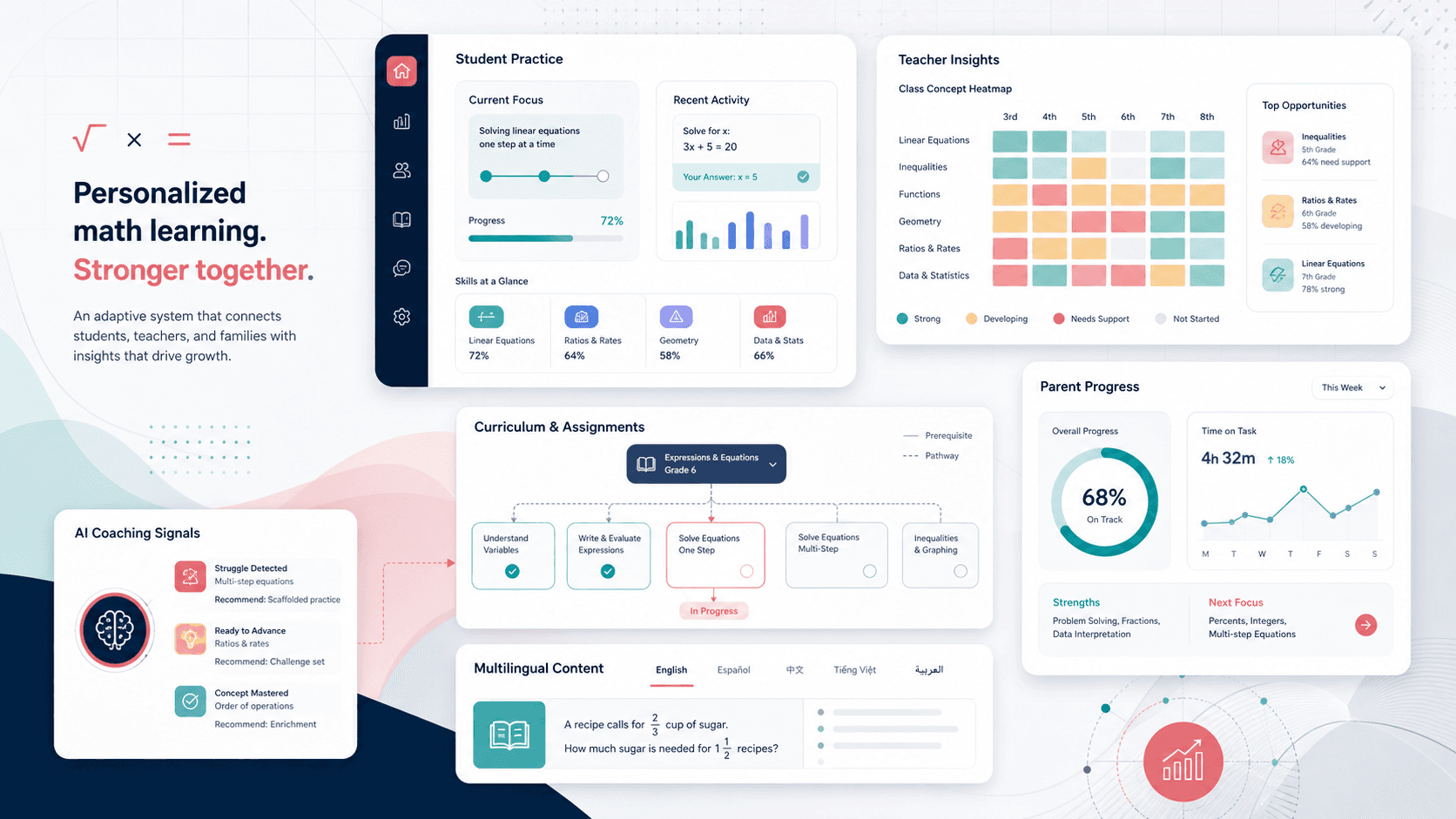
Adaptive mathematics learning platform visual with anonymous student practice, teacher analytics, curriculum tree, parent progress, and AI coaching panels
Project scope

Full-stack product engineering across learning workflows, educator dashboards, parent and tutor portals, adaptive practice logic, AI tools, localization, data model, authentication, deployment, and testing

7
role-specific experiences
3
supported content languages
5
curriculum hierarchy levels
AI
coaching, categorization, and difficulty support

Timeline

Multi-role education platform build with adaptive learning, analytics, monetization, and operational hardening

Mathematics learning needed to adapt across every stakeholder

Schools, tutors, parents, and students needed one platform for curriculum-aligned practice, assignments, analytics, multilingual content, and learning recommendations without creating a fragmented toolset.

  • Students needed personalized practice that matched current ability instead of a static question sequence
  • Teachers needed class tags, assignment controls, heatmaps, question review, and student history in one workspace
  • Parents and tutors needed scoped visibility, assignment tools, reminders, onboarding links, and operational workflows
  • Administrators needed curriculum governance, translation coverage, AI-assisted content maintenance, and secure role boundaries

A unified learning operating system for K-8 mathematics

NumerixIQ brings student practice, teacher dashboards, parent access, tutor operations, admin governance, multilingual content, and adaptive routing into a single cloud-hosted product.

  • Role-aware dashboards for students, teachers, tutors, parents, administrators, super-teachers, and superadmins
  • Curriculum assignment engine with grade, major topic, main topic, sub topic, unit, and question-level structure
  • Adaptive question delivery using estimated student ability, mastery-aware routing, and blank-unit protection
  • AI-assisted coaching, question categorization, and difficulty calibration with practical fallback behavior

Product surfaces

What the platform brought together

The work spanned core product operations, daily user workflows, data-heavy coordination, and resilient platform management.

Student learning experience

Students get one home base for assigned work, adaptive practice, progress charts, AI coaching, teacher connections, and math-rich content.

  • Visual dashboard with activity growth, subject mastery, topic mastery, assigned work, recent activity, and linked teachers
  • Priority-based practice routing across assessments, assigned practice sets, class-tag content, and adaptive practice
  • MathJax rendering and answer snapshots so learners and educators review the same mathematical content

Teacher and classroom operations

Educators can manage groups, assign curriculum at different levels, inspect question coverage, and understand class performance patterns.

  • Tag-based roster management for classes, remedial groups, homerooms, and shared-teacher situations
  • Drag-and-drop curriculum tree assignment with assessment and practice-set modes
  • Question list, question viewer, quality controls, video/image/translation coverage, and performance heatmaps

Parent and tutor portals

The platform supports home learning, private tutoring, onboarding, reminders, invoicing context, public tutor profiles, and scoped child progress visibility.

  • Parent dashboard with linked-child progress, assigned assessments, completion status, and supplemental practice assignment
  • Tutor dashboard with daily classes, reminders, task manager, activity stream, onboarding invitations, and student follow-up workflows
  • WYSIWYG tutor profile builder with reorderable blocks, design controls, visibility toggles, and silent-save feedback

Curriculum, AI, and localization

Content governance combines structured curriculum, adaptive difficulty, multilingual support, and AI-assisted maintenance tools.

  • Five-tier curriculum hierarchy with explicit cascade assignment, ghost-unit protection, and mastery-aware routing
  • AI coach cards, AI question categorization, and batch difficulty calibration with data-informed fallback behavior
  • English, French, and Traditional Chinese UI and content support with translation gap audit tools

Buyer priorities

What mattered most to the people evaluating the platform

Prospective buyers want to know whether the work solved real workflow, adoption, reliability, data, and operations problems. These priorities shaped the product decisions.

Learning personalization

The product had to guide students toward the right next question without making teachers manually tune every practice session.

  • Estimated student ability scores helped route questions near the learner's current level
  • Assessment priority and mastery-aware routing kept assigned learning paths intentional
  • AI coach cards translated progress data into short, motivating next-step guidance

Educator control

Teachers and administrators needed practical control over classes, assignments, question quality, translations, and cohort-level insight.

  • Class tags and shared-tag support handled real classroom structures
  • Assignment records were frozen at assignment time for auditability and stability
  • Heatmaps and translation coverage audits helped educators spot gaps before they became invisible

Trust and access safety

A multi-role education product must keep student records, parent visibility, teacher controls, and administrator privileges tightly scoped.

  • Role-based access control governed pages, API endpoints, and actions
  • Parent data access was scoped through linked-child relationships
  • HttpOnly JWT cookies, secure password recovery, and server-side validation supported safer account workflows

System model

How the platform connects roles, workflows, and product surfaces

The product architecture brings every role into the same operating model, with shared data moving cleanly between web, mobile, media, and notification layers.

Seven roles, one learning platform

Students, teachers, parents, tutors, administrators, super-teachers, and superadmins share the same learning records through scoped workflows.

Adaptive practice routing

Learning requests move through assessment priority, assigned practice, class-tag content, adaptive selection, and progress tracking.

Shared education foundation

Dashboards, curriculum data, AI assistance, localization, authentication, and analytics connect through one API-first platform.

Technology

The Stack We Used And Why

The stack section is written for buyers who need to understand the product architecture, operational trade-offs, and long-term maintainability of the system.

Application frontend

Used for role-specific dashboards, marketing-to-signup flows, curriculum tools, tutor profile editing, charts, and responsive learning experiences.

Next.js 16React 19Tailwind CSSshadcn/uiChart.jsAlpine.js

Learning interfaces

Used for math-heavy interaction, assignment trees, page-builder editing, notifications, and low-friction user feedback.

MathJax@dnd-kitSonnerModal registration flowsResponsive dashboards

Backend and data

Used for API-first business logic, role-scoped queries, curriculum assignment, authentication, AI orchestration, and relational records.

ASP.NET CoreREST APIsMySQLJWTService orchestrationRole-scoped data access

AI and messaging

Used to generate student coaching guidance, categorize questions, calibrate difficulty, and deliver account or onboarding communication.

OpenRouter APIDeepSeek V3GPT-4o-miniResendFallback recommendations

Infrastructure and QA

Used to keep the cloud-hosted SaaS deployable, testable, maintainable, and ready for ongoing product evolution.

DockerWoodpecker CIVPS hostingrsync over SSHPlaywright

Why Next.js And React

The product needed a responsive web application that could support marketing, signup, dashboards, charts, curriculum tools, and content-rich learning flows.

  • Next.js supported full-stack React surfaces for role-specific dashboards and public conversion flows
  • React component patterns fit repeated learning, analytics, assignment, and admin interfaces
  • Tailwind and shadcn/ui helped ship consistent, dense product screens without slowing iteration

Why A Structured API And MySQL

Education workflows depend on relationships between users, roles, classes, curriculum units, assignments, attempts, translations, and payments.

  • ASP.NET Core kept core learning and permission logic behind explicit API boundaries
  • MySQL fit the relational structure of students, teachers, tags, assignments, questions, and results
  • Role-scoped data access reduced the risk of broad queries exposing the wrong student records

Why AI Was Operationalized

AI was added where it could reduce educator and administrator effort while preserving clear product fallbacks.

  • Student coaching translated real performance data into concise next-step guidance
  • Question categorization and difficulty calibration helped maintain a growing question bank
  • Fallback recommendation behavior kept dashboards useful when AI services were unavailable

Delivery

How the product came together

The work moved from domain modeling to core platform delivery, mobile adoption, and operational hardening.

1

Map education roles

Define student, teacher, parent, tutor, administrator, department-head, and superadmin workflows before shaping the platform model.

2

Build the curriculum engine

Create the content hierarchy, assignment flows, practice routing, assessment priority, mastery tracking, and question delivery safeguards.

3

Add analytics and portals

Layer in dashboards, heatmaps, parent progress, tutor operations, activity feeds, profile building, and reporting views.

4

Harden AI and operations

Add AI coaching, categorization, difficulty calibration, localization audits, authentication controls, deployment workflows, and automated tests.

Operational depth

What made the platform usable after launch

The strongest case studies are not only feature lists. They show how the system is operated, monitored, governed, and improved when real users depend on it.

Assignment integrity

The curriculum engine was designed so assignment state remains understandable even when content hierarchy or question availability changes later.

  • Explicit child-unit assignment records created at assignment time
  • Ghost-unit protection skips units with no active questions
  • Mastery-aware routing avoids sending students back into already-passed assessments

Localization governance

Multilingual support required tools for content teams to see and maintain translation coverage, not just switch interface labels.

  • Language preference persisted across dashboards
  • Inline translation editing for question content
  • Translation gap audits for French and Traditional Chinese coverage

Account and access controls

Role-specific portals were backed by server-side validation and authentication patterns that keep student data scoped.

  • Hierarchical RBAC for pages, endpoints, and actions
  • HttpOnly JWT cookies with production security flags
  • Single-use password recovery tokens that invalidate earlier reset links

Results

The measurable and observable lift from the work

The strongest improvements are the ones a buyer can connect to daily work: fewer disconnected tools, safer operations, clearer workflows, and more reliable product behavior.

7 roles

Unified Education Workspace

Students, teachers, parents, tutors, administrators, super-teachers, and superadmins received role-specific workflows on one platform.

5 levels

Curriculum Precision

Assignments could be managed from grade-level strands down to individual units while keeping audit-friendly records.

3 languages

Multilingual Reach

English, French, and Traditional Chinese support covered interface labels, curriculum names, question content, and educator audit workflows.

AI assisted

Lower Content Operations Load

AI coaching, categorization, and difficulty calibration supported learning guidance and question-bank maintenance without removing human review.

Outcome

A stronger operating system for adaptive education technology platform

The platform reduced tool fragmentation and gave each role a clearer path from live activity to day-to-day action.

A connected K-8 mathematics platform instead of separate tools for practice, assignments, progress, parent visibility, tutoring, and administration

Adaptive practice that combines assignment priority, mastery history, question difficulty, and fallback behavior for a more reliable student journey

Teacher and administrator visibility across class heatmaps, question coverage, translation gaps, activity timelines, and school-wide cohort trends

A SaaS foundation ready for freemium plans, institutional licensing, teacher referrals, multilingual deployment, and future mobile or integration work

FAQ

Frequently Asked Questions About NumerixIQ

Answers about the adaptive education technology platform scope, platform model, technology choices, operational workflows, and related build patterns.

What Kind Of Education Platform Does NumerixIQ Represent?

NumerixIQ represents an adaptive K-8 mathematics learning platform with student practice, teacher assignments, parent visibility, tutor workflows, administrator controls, multilingual content, analytics, and AI-assisted support.

Why Was Custom Software Needed For This Learning Model?

The product needed a role-aware curriculum engine, adaptive practice routing, scoped student data access, translation coverage, AI-assisted content operations, and monetization workflows that generic classroom tools would struggle to keep connected.

How Does The Stack Support A Product Like This?

A Next.js and React frontend supports dense dashboards and responsive learning flows, while an ASP.NET Core API and MySQL data model keep curriculum, roles, attempts, assignments, and permissions structured behind clear service boundaries.

Can This Pattern Be Adapted To Other Education Products?

Yes. The same architecture can support tutoring platforms, assessment products, school portals, skill-practice apps, language learning, test preparation, or any education workflow that combines roles, content, analytics, and adaptive recommendations.

Related services

Build a similarly ambitious product without starting from a blank page.

We can help scope the web, mobile, AI, media, and operating layers needed for your own platform.

Start a project inquiry