Portfolio case study

OddsLane: Sports odds and wallet web platform

A full-stack sports odds and wallet platform that connects live event discovery, racing coverage, streaming-aware event views, bet slip workflows, deposits, withdrawals, account management, and transaction history in one responsive web experience.

Name changed to respect NDA.

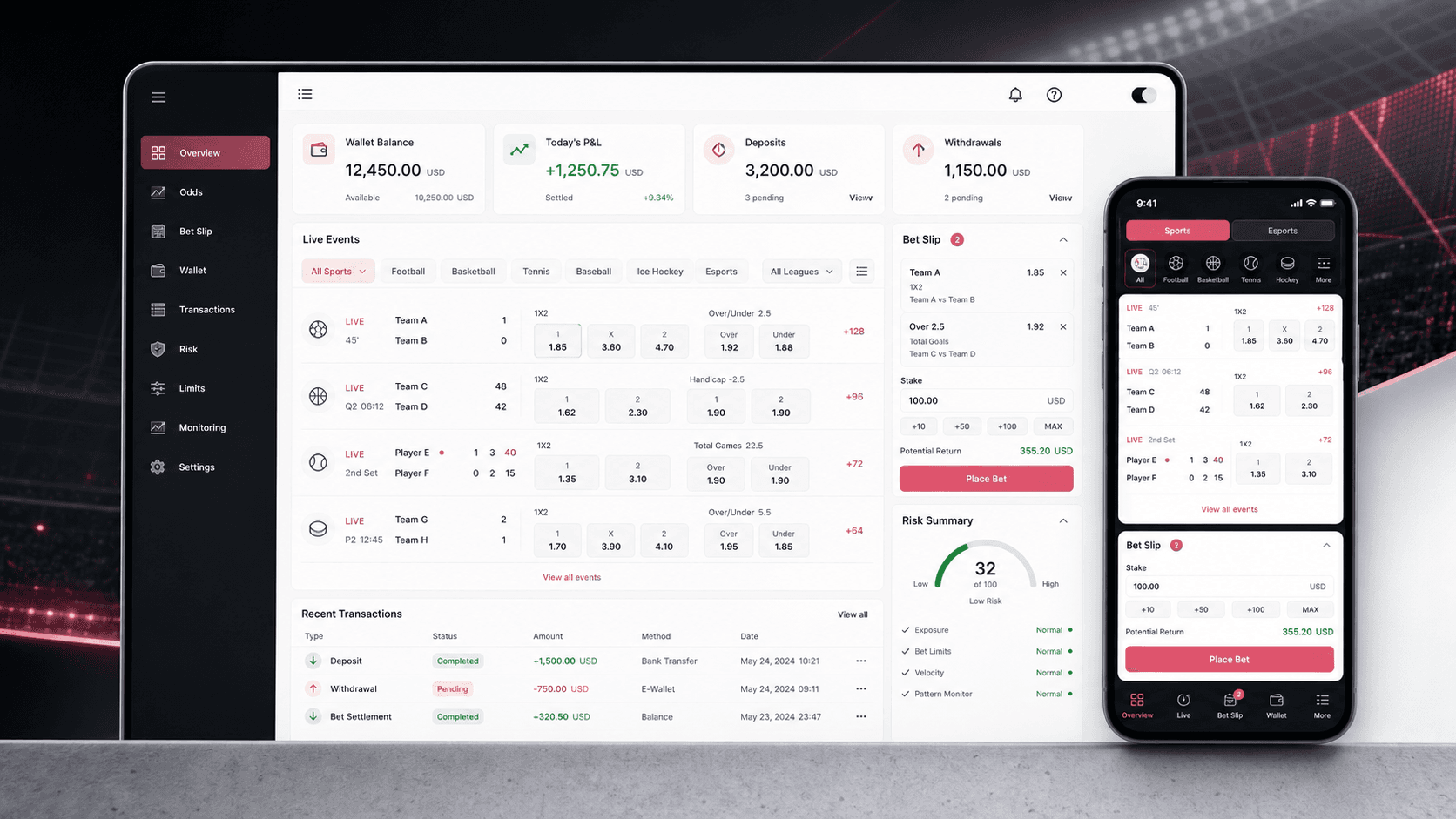
Sports odds and wallet platform visual with event cards, odds tiles, bet slip controls, and transaction panels
Project scope

Full-stack product engineering, React web app, ASP.NET Core API, wallet workflows, and platform integration

2
connected surfaces
6+
core user workflows
Live
odds and event data
Wallet
deposit and withdrawal layer

Timeline

Customer web platform and API delivery

Sports odds, wallet actions, and user history needed one connected product flow

The product needed to help users move from event discovery to odds selection, stake entry, wallet funding, and transaction review without splitting the experience across disconnected screens.

  • Sports, racing, live events, virtual markets, leagues, and odds had to be organized into a clear browsing path
  • The bet slip needed to preserve selected odds, risk and win values, and authenticated account state
  • Deposits, withdrawals, balances, and transaction history needed predictable wallet workflows
  • The platform needed responsible-play controls, dynamic content pages, affiliate journeys, streaming hooks, caching, validation, and integration points for odds and payment services

A responsive odds platform with an API-backed wallet and bet slip

OddsLane combines a React customer web app with an ASP.NET Core API so users can browse sports markets, select odds, manage stake values, fund accounts, request withdrawals, and review betting and transaction history from one product.

  • Responsive routes for signup, login, home odds browsing, event details, racing views, account, profile, deposits, withdrawals, transactions, and bet history
  • A persistent bet slip that supports selected odds, removal, risk and win editing, and place-bet submission
  • API services for users, sports, odds, bets, snippets, payments, transactions, app settings, content pages, and templates
  • Caching, validation, logging, token lookup, real-time event refresh, streaming-aware event modules, and third-party integrations for odds feeds and wallet operations

Product surfaces

What the platform brought together

The work spanned core product operations, daily user workflows, data-heavy coordination, and resilient platform management.

Sports, Racing, And Odds Discovery

Users can move from a sports and racing directory into league, event, stream-aware, and odds views without losing context.

  • Sidebar navigation for sports, racing categories, virtual events, leagues, and game-level browsing
  • Upcoming events, live-event hooks, future odds, league filters, event detail pages, and race-specific content
  • Odds feed normalization and caching so event data can be rendered in product-friendly groups

Bet Slip And Stake Controls

Selections become an editable bet slip that keeps the wagering workflow visible while users browse.

  • Add, remove, and refresh selected odds from event and league views
  • Risk and win inputs at both full-slip and individual-selection levels
  • Place-bet flow with loading, error, and success feedback for authenticated users

Wallet And Transaction Operations

Funding and payout workflows are connected to the same account model as bets and user history.

  • Deposit request, save-deposit, withdrawal request, and account balance paths
  • Payment gateway integration for receive and send transaction workflows
  • Transaction and bet-history screens for user review and operational support

Account, Content, And Platform Controls

The product includes the account and content plumbing needed to make the customer surface manageable.

  • Signup, login, forgot-password, profile, account, and change-password flows
  • Promotion pages, affiliate entry points, responsible gambling controls, dynamic forms, snippets, and configurable public pages
  • Token-aware API access, validation, CORS policy, logging middleware, and reusable service boundaries

Module depth

Dedicated product blocks for the highest-value workflows

For large platforms, the conversion story depends on showing how each major module solves a specific operating problem, not only listing features.

Revenue workflow

Event-To-Bet Conversion Path

The browsing experience is structured around a clear conversion path from event discovery to odds selection and stake confirmation.

Source evidence includes home, event, odds, bet slip, bet service, and place-bet API flows.

  • Sports and league filters narrow the market list before a user selects an odd
  • Bet slip state remains visible beside the event experience on desktop and adapts for mobile
  • Stake editing and submission happen inside the authenticated account context

Operations workflow

Wallet And Ledger Visibility

Deposit, withdrawal, balance, transaction, and bet-history flows make account activity visible to users and operators.

Source evidence includes payment services, transaction services, deposit and withdrawal pages, and account models.

  • Funding and payout requests are modeled as first-class product actions
  • Transaction screens give users a place to verify account movement
  • Backend services connect wallet actions to payment gateway and account records

Platform workflow

Odds Feed Normalization

External odds data is reorganized into sport, racing, league, event, market, and selection structures the product can display reliably.

Source evidence includes odds service methods, event screens, sports catalogs, live-event refreshes, stream-aware race components, event grouping, and cache keys.

  • The API caches repeated odds and event requests to reduce feed pressure
  • League, racing, virtual, and event grouping turns raw feed data into browsable product sections
  • Sports records connect internal icons and metadata to external feed names

Buyer priorities

What mattered most to the people evaluating the platform

Prospective buyers want to know whether the work solved real workflow, adoption, reliability, data, and operations problems. These priorities shaped the product decisions.

Conversion clarity

The customer surface needed to keep users oriented while they moved from sports discovery to bet placement.

  • Odds, events, selected markets, stake values, and place-bet controls stayed in one journey
  • The layout supported both public browsing prompts and authenticated user actions
  • Notifications and loaders helped confirm wallet and bet-slip actions

Wallet trust

Money movement workflows required predictable account state, transaction visibility, and error handling.

  • Deposit and withdrawal paths were connected to user account records
  • Balance checks and validation guarded stake and payout actions
  • Transaction and bet history gave users a review surface after activity

Operational control

The backend needed reusable services and repositories so odds, users, payments, settings, and content could evolve without one-off endpoints.

  • Controller and service layers separated API routes from product logic
  • Reusable repositories covered users, sports, bets, deposits, withdrawals, snippets, templates, and transactions
  • Logging, validation, token parsing, and cache helpers supported production operations

System model

How the platform connects roles, workflows, and product surfaces

The product architecture brings every role into the same operating model, with shared data moving cleanly between web, mobile, media, and notification layers.

Browse To Slip Workflow

Sports and event browsing feed selected odds into a visible bet slip with risk and win controls.

Wallet Operations Layer

Deposits, withdrawals, transactions, balances, and bet history connect around the user account.

Customer And Operations Roles

Users manage account activity while operators rely on API, content, payment, and transaction controls behind the scenes.

Technology

The Stack We Used And Why

The stack section is written for buyers who need to understand the product architecture, operational trade-offs, and long-term maintainability of the system.

Modern Web App

Used for the responsive customer experience where users browse odds, manage slips, view racing content, and review account activity.

Next.js App RouterReact 19TypeScriptTailwind CSS v4Server ComponentsReact Hook Form

Backend And Realtime API

Used for authenticated business logic, account workflows, odds organization, live event refresh, wallet actions, and operational services.

ASP.NET Core 10C#Entity Framework CoreSignalROpenAPIFluentValidation

Sports, Wallet, And Compliance Integrations

Used to connect live sports market data, racing streams, account funding, identity checks, and responsible-play workflows to the product experience.

Odds feed integrationPayment orchestrationKYC and age checksResponsible gaming controlsHMAC signingTransactional email

Data, Delivery, And Operations

Used to persist users, bets, transactions, deposits, withdrawals, snippets, settings, and platform records while keeping production delivery observable.

PostgreSQLRedisEdge cachingDockerCloudflareOpenTelemetry

Why Next.js And React 19

The public stack is intentionally modernized from the source implementation because a sportsbook surface benefits from server-rendered discovery pages, fast interaction, and typed full-stack routing.

  • Next.js App Router supports SEO-friendly sports, racing, promotion, and account entry pages
  • React 19-era patterns keep bet slip, odds refresh, and wallet UI responsive during async work
  • TypeScript and schema-backed forms reduce mistakes around sensitive account and money movement states

Why A Typed API And Realtime Layer

The product needs typed services, validation, logging, and realtime refresh around odds, racing, wallet, and account workflows.

  • ASP.NET Core 10 and OpenAPI keep user, bet, sport, payment, transaction, snippet, and settings contracts explicit
  • SignalR or equivalent realtime transport supports live event and price update moments
  • Redis-backed caching protects external feed integrations during repeated sports and racing browsing

Why Compliance And Observability Belong In The Stack

Sports wagering products need product controls that are visible to users and operational controls that are visible to the business.

  • KYC, age checks, and responsible gaming controls belong near signup, wallet, and betting workflows
  • OpenTelemetry and structured logging help support teams diagnose feed, payment, and account states
  • Cloudflare, edge caching, and containerized delivery keep high-traffic event pages easier to operate

Delivery

How the product came together

The work moved from domain modeling to core platform delivery, mobile adoption, and operational hardening.

1

Map The Customer Journey

Define the core path from sports discovery through odds selection, wallet readiness, bet placement, and history review.

2

Build The API Foundation

Create the services and repositories for users, sports, odds, bets, wallet activity, content, and settings.

3

Connect Wallet And Feed Integrations

Integrate odds data, payment actions, cache helpers, validation, and error logging around the core workflows.

4

Polish Responsive Account Workflows

Bring profiles, transactions, deposits, withdrawals, password changes, and bet history into the same web app.

Operational depth

What made the platform usable after launch

The strongest case studies are not only feature lists. They show how the system is operated, monitored, governed, and improved when real users depend on it.

Cached odds requests

Odds and event API calls use cache keys for sport, league, game, date, and live-state combinations so repeated browsing does not always hit the external feed.

  • Game odds cache
  • Live-event cache
  • Sport metadata cache

Wallet validation

Stake, deposit, and withdrawal workflows are handled through authenticated API routes with validation, account lookup, and gateway integration points.

  • Balance checks
  • Payment requests
  • Transaction records

Configurable content

Snippet, template, and settings services give the product room to manage public pages and operational configuration without hardcoding every screen.

  • Snippet services
  • App templates
  • Settings repository

Results

The measurable and observable lift from the work

The strongest improvements are the ones a buyer can connect to daily work: fewer disconnected tools, safer operations, clearer workflows, and more reliable product behavior.

React + .NET

Full-Stack Delivery

The customer web app and API layer were delivered as paired surfaces rather than isolated prototypes.

Odds + wallet

Connected Core Loop

Event discovery, odd selection, stake controls, deposits, withdrawals, and history all tie back to one account experience.

Service-based

Maintainable API Shape

Controllers, services, repositories, validators, cache helpers, and logging keep sensitive workflows easier to operate.

Outcome

A stronger operating system for sports odds and wallet web platform

The platform reduced tool fragmentation and gave each role a clearer path from live activity to day-to-day action.

A responsive customer web app for sports and racing event browsing, odds selection, bet slip management, wallet actions, and account history

A modernized public architecture around Next.js, React 19, TypeScript, Tailwind CSS v4, typed APIs, realtime event refresh, and observable operations

External odds feed handling that organizes raw market data into sports, racing categories, leagues, events, market names, and selectable odds

Deposit, withdrawal, exchange-rate, balance, responsible-play, and transaction workflows connected to authenticated account records

FAQ

Frequently Asked Questions About OddsLane

Answers about the sports odds and wallet web platform scope, platform model, technology choices, operational workflows, and related build patterns.

What Kind Of Platform Does This Case Study Represent?

It represents a sports odds and wallet web platform with event browsing, racing coverage, odds selection, bet slip controls, deposits, withdrawals, transactions, user accounts, and a service-based API layer.

Why Does A Sports Odds Product Need Both Web And API Work?

The customer UI needs fast browsing and stake entry, while the backend must handle odds normalization, account state, wallet workflows, validation, logging, and integrations with stronger operational controls.

Can This Pattern Apply To Fantasy Sports Or Prediction Products?

Yes. The same product architecture can support fantasy contests, prediction markets, sports analytics dashboards, social picks, and regulated wallet workflows when the compliance model is defined up front.

What Should A Buyer Prepare Before Building A Similar Platform?

Useful inputs include target markets, sports and racing coverage, odds or data providers, wallet and payment requirements, compliance constraints, user roles, transaction reporting needs, streaming requirements, and responsible-use controls.

Related services

Build a similarly ambitious product without starting from a blank page.

We can help scope the web, mobile, AI, media, and operating layers needed for your own platform.

Start a project inquiry