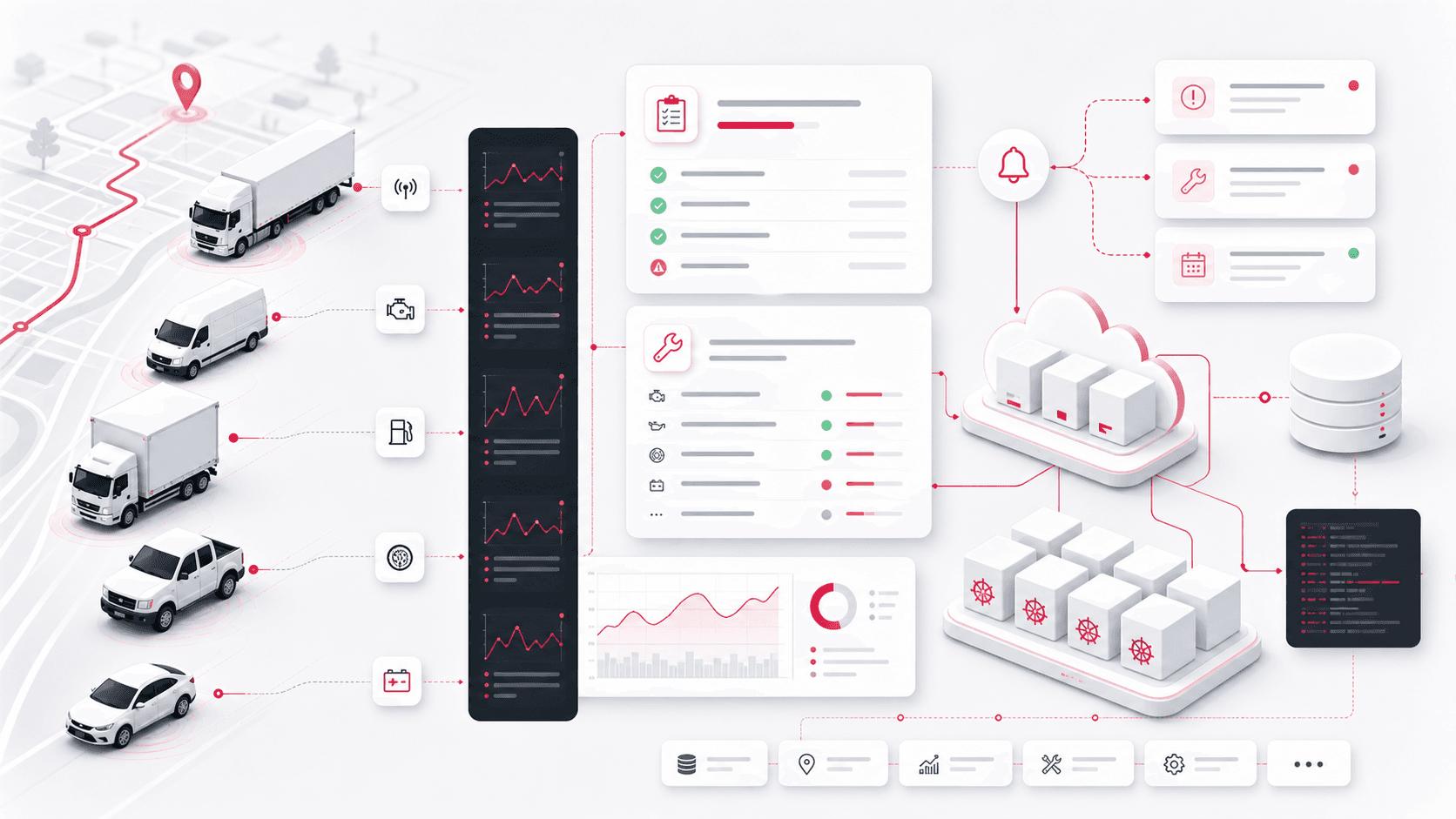
Backend API, service architecture, fleet data workflows, integrations, and deployment infrastructure
.NET
service architecture
Fleet
inspection and maintenance workflows
GPS
telemetry and asset history
K8s
deployment-ready operations
Timeline
Multi-service backend build and operational platform delivery
Fleet operations needed more than a CRUD backend
The platform had to coordinate fleet assets, companies, people, permissions, inspections, maintenance, costs, live telemetry, device connections, notifications, files, and deployment concerns without turning every workflow into a brittle one-off API.
Inspection templates, inspection records, maintenance rules, and asset records needed consistent lifecycle handling
Telemetry, GPS history, current asset data, events, geozones, and device relationships required dedicated instrumentation APIs
Costs, receipts, attachments, images, invitations, and notifications had to work across the same fleet domain model
A modular fleet backend with shared platform primitives
RouteLedger organizes fleet management into focused APIs and background services while using shared libraries for entity management, permissions, caching, database access, file storage, and request handling.
Core fleet APIs for assets, companies, people, projects, relations, security rights, inspections, maintenance, monitoring, images, and invitations
Instrumentation APIs for asset data history, snapshots, current state, events, geozones, device connections, metrics, DTCs, and camera workflows
Background services for data ingress, asset analysis, maintenance monitoring, event notifications, synchronization, and image serving
Helm and Kubernetes deployment assets for separate API, auth, notification, analysis, ingress, Redis, Timescale, and database utility workloads
Product surfaces
What the platform brought together
The work spanned core product operations, daily user workflows, data-heavy coordination, and resilient platform management.
Fleet domain APIs
The core API layer exposes structured fleet operations around assets, companies, people, relations, projects, inspections, maintenance, monitoring, security, and images.
Asset, company, person, group, category, relation, project, and tenant controllers
Inspection template and inspection record workflows with search, create, update, delete, and approval actions
Maintenance rules, maintenance records, monitoring configurations, security grants, and user security scope APIs
Telemetry and instrumentation
Dedicated services handle vehicle data streams, GPS devices, event feeds, geozones, diagnostics, and historical asset state.
Asset data history, snapshot, and current-state endpoints with UTC-normalized time windows
GPS device, data connection, geozone, event, DTC, metric correction, and camera-related controllers
Data ingress workers for multiple telematics, camera, and OEM server connection types
Analysis and notification services
Background workers turn raw fleet data into operational signals and notify the right people when configured events or maintenance conditions change.
Asset analyzers for speed limits, geozone events, reverse geocoding, movement, idling, engine state, seatbelt, and device activity signals
Event monitors that poll changed instrumentation events, match notification configuration, and write notification state
Maintenance notification analysis and content generation for email, SMS, and web push channels
Operational platform layer
Shared libraries keep the service estate consistent across auth, permissions, data access, caching, storage, image handling, and deployment.
Reusable entity managers, search/read/create/update/delete stores, relationship stores, and hydration managers
Role, permission, security grant, request-context cache, Redis cache, and tenant-aware data access primitives
Azure Blob storage, image service, Timescale/Postgres templates, Redis, Helm charts, and database utility jobs
Buyer priorities
What mattered most to the people evaluating the platform
Prospective buyers want to know whether the work solved real workflow, adoption, reliability, data, and operations problems. These priorities shaped the product decisions.
Domain completeness
Fleet products often fail when inspections, maintenance, telemetry, costs, files, and permissions are added as disconnected side modules.
The backend treats fleet entities, relations, inspections, maintenance, monitoring, and security as one operating model
Shared entity and relationship managers keep repeated workflows consistent across API surfaces
Search endpoints and typed managers make operational views easier to compose on top of the platform
Telemetry reliability
Asset data is only useful when ingestion, history, snapshots, analysis, and event processing can keep up with real operating conditions.
Dedicated instrumentation services separate live data concerns from core fleet administration
Background workers publish heartbeat and ready-asset signals through Redis
Analyzer state services support incremental processing across raw and derived telemetry streams
Deployment readiness
The platform needed to run as a service estate, not just a local API, so deployment shape mattered from the start.
Separate deployments and services for core API, auth, cost, notification, instrumentation, analysis, ingress, image serving, Redis, and Timescale
Shared startup and service registration patterns reduce drift between independently deployed APIs
System model
How the platform connects roles, workflows, and product surfaces
The product architecture brings every role into the same operating model, with shared data moving cleanly between web, mobile, media, and notification layers.
Fleet event processing loop
Device feeds enter the platform, asset data is normalized, analyzers derive operational events, and notifications move the signal to users.
Operations around the asset record
Fleet managers, drivers, maintenance teams, cost reviewers, and administrators interact with shared asset, inspection, and telemetry data through role-aware APIs.
Multi-service backend estate
Core APIs, instrumentation APIs, auth, cost, notification, analysis, image serving, Redis, Timescale, and database jobs run as coordinated services.
Technology
The Stack We Used And Why
The stack section is written for buyers who need to understand the product architecture, operational trade-offs, and long-term maintainability of the system.
Backend APIs
Typed API services expose fleet, inspection, cost, authentication, notification, image, and instrumentation workflows.
.NETASP.NET CoreC#SwaggerNewtonsoft.Json
Data Platform
Relational and time-series patterns support entity lifecycle workflows and asset telemetry history.
Service-specific deployment templates support environment config, ingress, databases, secrets, and long-running workers.
KubernetesHelmDockerRedisTimescaleDB
Why Modular .NET Services
Fleet operations mix administrative APIs, telemetry ingestion, notifications, images, authentication, and analysis jobs. Separate .NET services keep those workloads isolated while sharing common platform libraries.
Focused deployments
Shared abstractions
Clear service ownership
Why A Shared Entity Layer
Assets, companies, people, groups, inspections, maintenance records, and relations share lifecycle patterns, so reusable managers reduce repeated controller and store logic.
Search/read/write consistency
Relationship handling
Soft delete and approval paths
Why Background Analysis
Telemetry value comes from processing time-series data into events, geozone state, speed-limit context, and maintenance signals without blocking user-facing requests.
Incremental analyzers
Worker state
Event-driven notifications
Delivery
How the product came together
The work moved from domain modeling to core platform delivery, mobile adoption, and operational hardening.
1
Model the fleet domain
Define the asset, company, person, relation, inspection, maintenance, security, and telemetry entities that make the platform coherent.
2
Build shared API primitives
Create reusable controllers, managers, stores, search contracts, permissions, request context, and response wrappers for repeated fleet workflows.
3
Wire telemetry and workers
Add ingestion, current and historical asset data APIs, analyzer state, event monitors, notification state, and provider-specific processors.
4
Prepare service operations
Package the APIs and workers with Docker, Helm templates, environment config, storage, Redis, Timescale, and database utility jobs.
Operational depth
What made the platform usable after launch
The strongest case studies are not only feature lists. They show how the system is operated, monitored, governed, and improved when real users depend on it.
Approval-ready inspections
Inspection records can move through submit, grant, and reject actions instead of remaining flat checklist data.
Inspection template and record APIs
Searchable inspection records
Approval actions for operational review
Incremental telemetry analysis
Analyzer state and worker coordination let the system process current and historical fleet records without losing late-arriving data.
Analyzer positions and retry windows
Shared data fetches for related analyzers
Derived signals for movement, idling, geozones, speed, and device state
Notification state control
Notification services compare changed events against active configurations and prior notification state before creating follow-up records.
Configuration-driven event matching
Event change polling
Email, SMS, and web push content generation paths
Results
The measurable and observable lift from the work
The strongest improvements are the ones a buyer can connect to daily work: fewer disconnected tools, safer operations, clearer workflows, and more reliable product behavior.
40+
Service Projects
The solution is organized into API, library, worker, database utility, integration, image, Redis, and test projects.
3 data modes
Telemetry Access
Asset data APIs expose historical ranges, point-in-time snapshots, and current state for operational views.
4 provider paths
Fleet Data Ingress
Provider-specific processors support multiple fleet data connection types through one ingress service model.
Helm
Deployment Discipline
The service estate includes Kubernetes templates for APIs, workers, databases, Redis, storage, ingress, and config.
Outcome
A stronger operating system for fleet operations api platform
The platform reduced tool fragmentation and gave each role a clearer path from live activity to day-to-day action.
A modular fleet management backend with core APIs for assets, companies, people, inspections, maintenance, monitoring, security, images, invitations, projects, relations, and tenant scope
Instrumentation services for GPS devices, asset telemetry history, snapshots, current data, geozones, event streams, DTC data, metrics, reports, and camera workflows
Background processing for provider ingress, asset analysis, maintenance signals, event notification matching, synchronization, and image operations
A deployment-ready service estate with Docker, Helm, Kubernetes workloads, Redis coordination, Timescale/Postgres infrastructure, Azure Blob storage, and database utility jobs
FAQ
Frequently Asked Questions About RouteLedger
Answers about the fleet operations api platform scope, platform model, technology choices, operational workflows, and related build patterns.
What Kind Of Platform Does RouteLedger Represent?
RouteLedger represents a fleet operations API platform with asset management, inspections, maintenance, telemetry, GPS device connections, notifications, cost records, image storage, permissions, and background analysis services.
Why Does Fleet Software Need Dedicated Telemetry Services?
Fleet software needs telemetry services because live and historical vehicle data has different reliability, time-window, ingestion, and analysis needs than standard administrative CRUD workflows.
How Did The Backend Support Inspections And Maintenance?
The backend includes inspection template and record APIs, approval actions, maintenance rules, maintenance records, monitoring configurations, event monitors, and maintenance notification analysis.
Can This Architecture Support Other Field Operations Platforms?
Yes. The same architecture can support equipment monitoring, field service, construction fleet management, rental asset tracking, maintenance compliance, logistics telemetry, and inspection-heavy operational products.
Related services
Build a similarly ambitious product without starting from a blank page.
We can help scope the web, mobile, AI, media, and operating layers needed for your own platform.