Portfolio case study

StayOps: Hotel stay allotment and hospitality operations admin platform

A hospitality operations admin platform that helps teams manage hotel inventory, project lodging budgets, staff stay allotments, payment details, status tracking, search, pagination, and CSV exports from one authenticated web console.

Name changed to respect NDA.

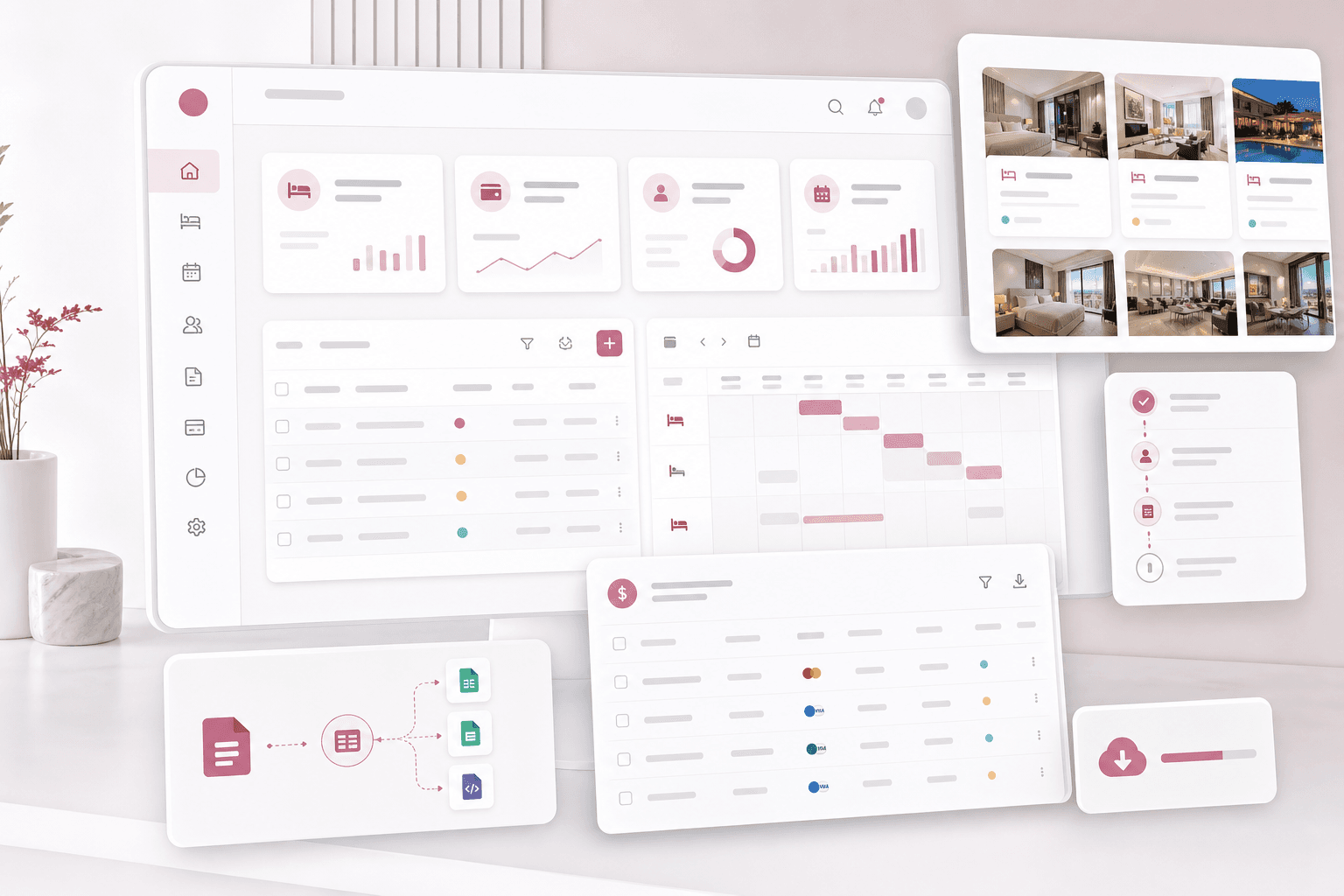
Abstract hospitality operations admin platform visual with hotel inventory, project budget, stay allotment, payment, schedule, and export dashboard panels
Project scope

Authenticated React administration console for lodging operations, including hotel records, project budgets, employee stay assignments, tabular workflows, filters, exports, and API-backed CRUD screens

4
core admin modules
CSV
operational exports
RBAC
authenticated console access
API
service-backed records and forms

Timeline

Focused admin dashboard build for hospitality allocation and operational record management

Hotel assignments and project lodging costs needed one operational view

The team needed a practical internal console for coordinating hotels, projects, employees, stay assignments, payment details, confirmation data, and exports without relying on scattered spreadsheets or ad hoc record updates.

  • Hotel inventory, nightly rates, contact details, confirmed rooms, and active status needed a searchable management workflow
  • Project records needed budget, spent amount, hotel-price, net-total, duration, location, and active-state visibility
  • Stay allotments needed to connect projects, workers, reporting managers, hotels, check-in and check-out dates, room numbers, payment details, status, and notes
  • Operations users needed pagination, search, status filtering, CSV export, add/edit forms, and delete confirmations across dense tables

A focused admin console for lodging operations

StayOps brings hotel records, project cost tracking, user records, snippets, and hotel stay allotments into one authenticated React workspace with reusable table, form, search, filtering, and API patterns.

  • React Router protected routes separate users, hotels, projects, snippets, and hotel stay allotment workflows
  • Reusable data tables support sorting, pagination, row-click detail pages, search controls, and action columns
  • Stay allotment forms connect users, reporting managers, projects, hotels, stay dates, duration, room information, payment records, notes, and status
  • API helpers centralize CRUD calls for users, hotels, projects, snippets, and hotel stay allotments while hooks handle loading, error, pagination, and toast states

Product surfaces

What the platform brought together

The work spanned core product operations, daily user workflows, data-heavy coordination, and resilient platform management.

Hotel inventory management

Operations teams can maintain hotel records that are used later in stay allotments and cost calculations.

  • Hotel list with name, address, email, phone number, nightly rate, confirmed-room count, search, pagination, and CSV export
  • Add and edit detail screens for hotel properties and pricing data
  • Delete confirmation flow and refreshed table state after successful actions

Project lodging budget tracking

Project records give teams a budget-aware view of where lodging spend is attached and how active work is progressing.

  • Project table with name, location, duration, total budget, total spent, total hotel price, net total, and active status
  • CSV export support for operational reporting and finance review
  • Detail routes and forms for project updates, with reusable API and pagination patterns

Hotel stay allotment workflow

The core allotment module connects employees, projects, hotels, dates, payments, confirmations, and status into a single record.

  • Stay allotment table includes project, employee, reporting manager, hotel, payment mode, payment ID, confirmation number, room number, duration, rate, total price, check-in, and check-out details
  • Status filtering supports quick review of pending and all allotments
  • Detail form supports multi-user selection, reporting manager selection, hotel selection, project selection, notes, status, dates, and payment fields

Admin workspace foundations

The platform wraps operational screens in an authenticated admin shell with reusable controls and consistent data loading behavior.

  • Protected routing redirects unauthenticated users to login while authenticated routes render inside selectable admin layouts
  • Reusable components cover tables, page titles, search, select filters, form inputs, phone controls, pagination, toasts, loaders, and delete confirmations
  • Redux layout state, Redux-Saga auth scaffolding, API core helpers, and local utility functions support maintainable admin workflows

Buyer priorities

What mattered most to the people evaluating the platform

Prospective buyers want to know whether the work solved real workflow, adoption, reliability, data, and operations problems. These priorities shaped the product decisions.

Operational speed

The admin console needed to make common lodging operations faster than working across multiple spreadsheets and message threads.

  • Searchable, paginated tables keep high-volume records scannable
  • CSV exports let operations and finance teams move records into reporting workflows
  • Row-click detail routes keep review and editing close to the list view

Cost visibility

Project lodging has financial impact, so budget and stay-cost fields needed to remain visible in daily admin screens.

  • Project screens surface total budget, total spent, hotel-price total, and net total
  • Allotment screens show nightly rate, duration, total price, payment mode, payment ID, and confirmation number
  • Hotel records keep pricing and confirmed-room data attached to the operational workflow

Controlled access

Internal lodging records contain staff, project, hotel, and payment context, so the admin experience needed authenticated access and predictable route protection.

  • Protected routes keep core modules behind login state checks
  • Layout and route structure separates public auth pages from operational admin screens
  • Delete confirmations and API response handling reduce accidental changes during record management

System model

How the platform connects roles, workflows, and product surfaces

The product architecture brings every role into the same operating model, with shared data moving cleanly between web, mobile, media, and notification layers.

Request to allotment workflow

Project lodging needs move from project context to hotel selection, staff assignment, payment details, and confirmation tracking.

Operations role model

Admins, project managers, reporting managers, employees, and finance reviewers interact with the same lodging records from different angles.

Admin platform foundation

React routes, API helpers, reusable tables, form controls, auth checks, and exports work together as one internal operations console.

Technology

The Stack We Used And Why

The stack section is written for buyers who need to understand the product architecture, operational trade-offs, and long-term maintainability of the system.

Admin frontend

Used for the authenticated browser console, route-based workflows, dense tables, and CRUD screens.

React 18TypeScriptCreate React AppReact RouterReact Bootstrap

Forms and data entry

Used to manage hotel, project, user, snippet, and stay-allotment records with validation-oriented inputs.

react-hook-formYupReact SelectReact Datepickerreact-phone-input-2

Data tables and exports

Used for sortable operational lists, pagination, search, status filters, and export-ready records.

react-tableBootstrap tablesCSV export endpointsSearch filtersStatus filters

State and API layer

Used to coordinate authenticated API calls, loading states, pagination, errors, toasts, layout state, and auth scaffolding.

AxiosCustom useApi hookReduxRedux-SagaJWT decodenotistack

UI system and operations polish

Used for a familiar admin layout with side navigation, icons, loaders, menus, profile controls, and responsive shell behavior.

Bootstrap 5SassFeather iconsSimplebar ReactMoment.jsi18next

Why React For Dense Admin Work

The product was a route-heavy operations console where tables, forms, filters, detail screens, and reusable admin shell components mattered more than marketing presentation.

  • React Router maps users, hotels, projects, snippets, and allotments into predictable list and detail routes
  • React Bootstrap provides practical admin primitives for cards, rows, buttons, badges, spinners, and forms
  • Reusable local components keep search, pagination, table behavior, page titles, and delete confirmations consistent

Why A Shared API Hook

Most modules follow a list-detail CRUD pattern, so centralizing loading, pagination, success, error, search, and recall behavior reduced repeated state management.

  • The useApi hook normalizes table pagination across modules
  • Success and error callbacks allow each screen to show toasts and refresh state without duplicating request boilerplate
  • API helper files keep endpoint concerns separate from page rendering

Why Export And Filter Controls Matter

Lodging operations often need spreadsheet handoff, status review, and finance reconciliation, so reporting controls are part of the core product experience.

  • Hotel, project, user, and stay-allotment list screens include export-oriented flows
  • Allotment status filtering helps teams separate pending records from broader history
  • Search and pagination make dense operational data usable without overloading the page

Delivery

How the product came together

The work moved from domain modeling to core platform delivery, mobile adoption, and operational hardening.

1

Map Lodging Records

Identify the core entities behind the workflow: users, projects, hotels, snippets, and hotel stay allotments.

2

Build Reusable Admin Patterns

Create shared list, detail, search, pagination, form, toast, and delete-confirmation behavior across modules.

3

Connect Cost And Stay Details

Bring project budgets, hotel rates, stay duration, total price, payment details, dates, and confirmation data into operational screens.

4

Prepare Reporting Workflows

Add CSV export and status filtering so operational data can move into reporting, reconciliation, and review routines.

Operational depth

What made the platform usable after launch

The strongest case studies are not only feature lists. They show how the system is operated, monitored, governed, and improved when real users depend on it.

List-detail CRUD structure

Each core admin module follows a predictable management pattern that helps operators review records and move into detail edits quickly.

  • Users, hotels, projects, snippets, and stay allotments expose list and detail route patterns
  • Row-click navigation keeps the table as the main operational entry point
  • Delete confirmation components protect high-friction admin actions

Pagination and search behavior

The shared data hook turns repeated table needs into a reusable module-level behavior.

  • Page changes and page-size changes recall the current API with updated parameters
  • Search resets pagination and applies filter parameters for list screens
  • Loading and fetching states keep tables responsive during API calls

Stay assignment detail capture

The allotment detail form captures the operational fields that are easy to lose when lodging is coordinated informally.

  • Project, worker, reporting manager, hotel, check-in, check-out, room, duration, notes, and status fields
  • Payment mode, payment ID, confirmation number, total price, and hotel confirmation details
  • Multi-user selection and manager selection support real staff assignment scenarios

Results

The measurable and observable lift from the work

The strongest improvements are the ones a buyer can connect to daily work: fewer disconnected tools, safer operations, clearer workflows, and more reliable product behavior.

4 modules

Core Operations Coverage

Users, hotels, projects, and hotel stay allotments moved into connected list-detail admin workflows.

Finance-ready

Cost And Payment Visibility

Budgets, nightly rates, durations, total prices, payment IDs, payment modes, and confirmation data are visible where operations teams review records.

Exportable

Reporting Handoff

CSV export flows support hotel, project, user, and allotment review outside the app when finance or operations teams need spreadsheet-ready data.

Reusable UI

Maintainable Admin Pattern

Shared table, search, pagination, form, route, and API patterns make additional admin modules easier to add later.

Outcome

A stronger operating system for hospitality operations admin platform

The platform reduced tool fragmentation and gave each role a clearer path from live activity to day-to-day action.

A practical hotel stay allotment admin console for coordinating projects, employees, hotels, rooms, dates, payments, confirmations, and statuses

Searchable and paginated admin tables that reduce reliance on scattered spreadsheets for lodging operations

Budget and cost visibility across projects, hotels, nightly rates, stay durations, total prices, and payment details

A reusable React admin foundation with protected routes, API helpers, shared table behavior, form controls, CSV exports, and confirmation patterns

FAQ

Frequently Asked Questions About StayOps

Answers about the hospitality operations admin platform scope, platform model, technology choices, operational workflows, and related build patterns.

What Kind Of Platform Does StayOps Represent?

StayOps represents a hotel stay allotment and hospitality operations admin platform for managing hotel inventory, project lodging budgets, employee stay assignments, payment details, confirmations, CSV exports, and authenticated back-office workflows.

Why Was A Custom Admin Console Useful For This Workflow?

Hotel allotment operations combine staff, project, hotel, finance, date, room, and confirmation data. A custom console keeps those records searchable, editable, exportable, and connected instead of spreading them across spreadsheets and messages.

How Does The Stack Support Admin Productivity?

React, TypeScript, React Router, React Bootstrap, react-table, reusable form controls, Axios helpers, and a shared API hook support dense list-detail workflows with pagination, search, loading states, exports, and protected routes.

Can This Pattern Extend To Other Operations Platforms?

Yes. The same pattern fits travel desks, facilities teams, workforce lodging, field-service accommodations, project expense management, vendor allocation, asset allotment, and other internal operations consoles.

Related services

Build a similarly ambitious product without starting from a blank page.

We can help scope the web, mobile, AI, media, and operating layers needed for your own platform.

Start a project inquiry