Portfolio case study

StudyLane: Education commerce and IELTS preparation web platform

An IELTS preparation and course commerce platform that brings exam guides, skill-specific learning hubs, course catalog pages, checkout flows, bilingual content, and blog-driven acquisition into one web experience.

Name changed to respect NDA.

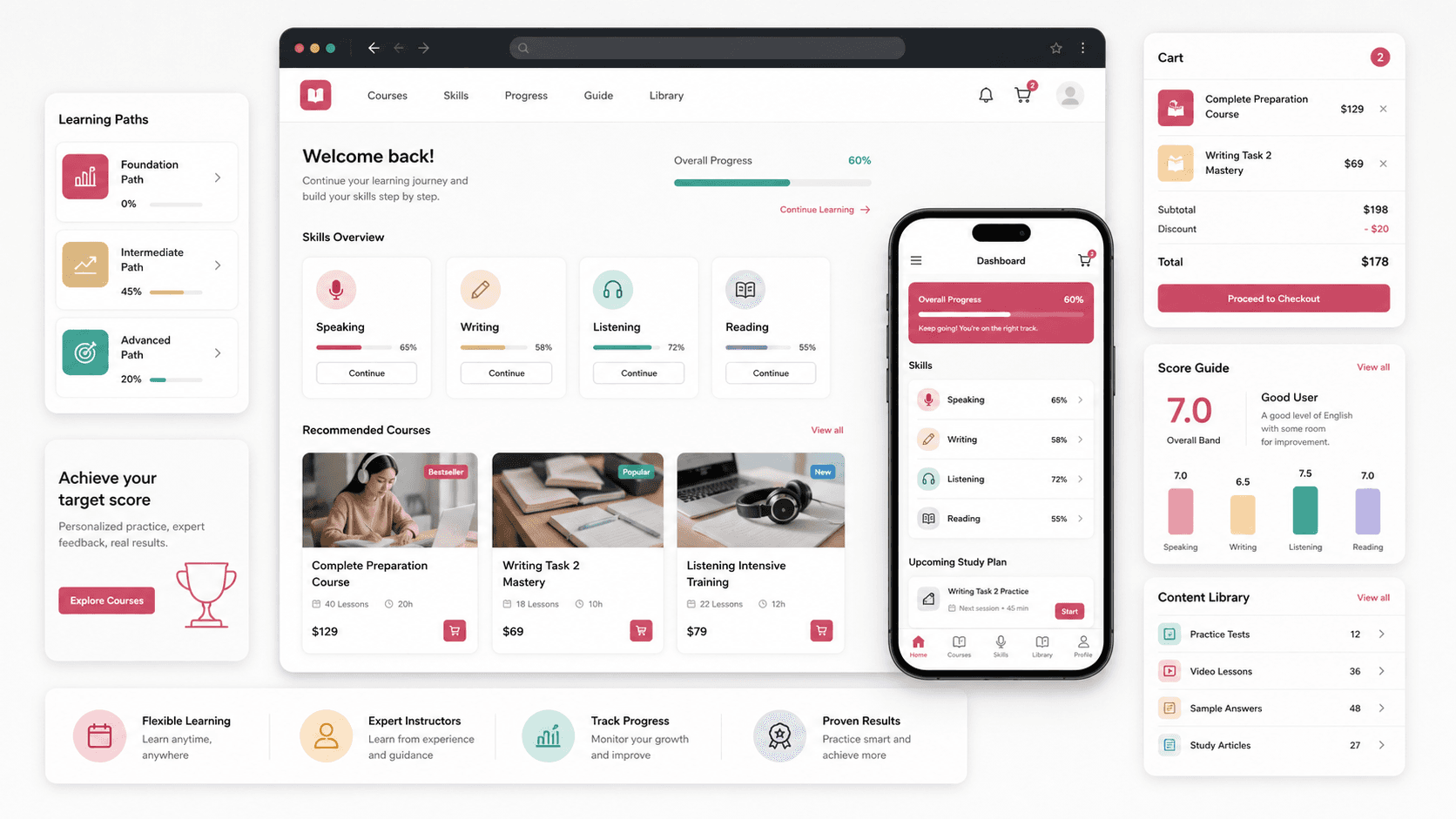
Education commerce platform visual with course cards, skill modules, checkout summary, score guide, and content library panels
Project scope

Web product engineering for an exam-preparation business, covering bilingual learning content, course merchandising, checkout foundations, blog acquisition, and responsive page composition

4
exam skill hubs
6
course catalog offers
2
cart and order surfaces
AMP
hybrid content delivery

Timeline

Next.js web platform for exam-prep content, course discovery, and ecommerce entry flows

The education business needed content depth and course conversion in one place

Students preparing for a high-stakes language exam need clear guidance, skill-specific study paths, course options, pricing context, and a low-friction path from research to enrollment. The site needed to support both learning credibility and commercial intent.

  • Exam information, scoring guidance, preparation tips, academic word lists, course pages, and blog content needed to feel connected instead of scattered
  • Course discovery needed to explain core, grammar, plus, bootcamp, writing, and free class options with enough detail for informed enrollment
  • Cart, order, checkout, currency, contact, and payment method scaffolding needed to prepare the business for paid course transactions
  • The product needed bilingual content handling and responsive layouts for students researching from mobile and desktop devices

A bilingual learning and course commerce web platform

StudyLane combines public exam-prep content, course merchandising, ecommerce entry flows, and API-backed blog content inside a Next.js web experience designed for student research, trust-building, and course conversion.

  • Next.js page structure for exam information, scoring, study guides, academic word lists, workshops, skill-specific hacks, courses, blog, cart, order, and policy pages
  • Course catalog and detail pages covering program summaries, syllabus tables, student testimonial media, schedule embeds, pricing, and add-to-cart actions
  • Checkout foundation with cart tables, student contact fields, Taiwan currency formatting, country-code handling, and multiple payment method options
  • i18next-powered bilingual content plumbing with hybrid AMP support for lightweight content delivery and search-friendly exam resources

Product surfaces

What the platform brought together

The work spanned core product operations, daily user workflows, data-heavy coordination, and resilient platform management.

Exam-prep content architecture

The site organizes IELTS learning around the decision points students care about before they commit to a course.

  • Information pages explaining exam formats, scoring, timing, sections, centers, preparation expectations, and comparison guidance
  • Dedicated speaking, writing, listening, and reading preparation routes for skill-specific study intent
  • Academic word list, exam guide, workshop, and scoring pages that support long-tail search and student education

Course catalog and detail flows

Course pages translate a complex education offering into clear product cards, detail pages, syllabus content, pricing, and action paths.

  • Six course offers covering core IELTS, grammar, plus, bootcamp, writing task, and free class programs
  • Course detail pages with video testimonial areas, descriptions, syllabus tables, price display, and enrollment actions
  • Course slider and product-card patterns for scanning offer differences quickly

Checkout and payment foundation

Commerce scaffolding gives the education business a path from course interest to transaction readiness.

  • Cart and order pages with item tables, quantities, subtotals, discounts, tax placeholders, and total calculations
  • Student profile fields for name, email, phone, Taiwan country code, and validation patterns
  • Payment method configuration for cards, LINE Pay, Apple Pay, Google Pay, wallet options, and local payment rails

Content acquisition and publishing

The platform supports learning-led acquisition through blog content and reusable page sections rather than only static campaign pages.

  • Blog listing and dynamic blog detail routing connected to a WordPress API base
  • Reusable banner, navigation, footer, card, table, CTA, image, and metadata components
  • Hybrid AMP configuration across major content and commerce pages for lighter content delivery

Module depth

Dedicated product blocks for the highest-value workflows

For large platforms, the conversion story depends on showing how each major module solves a specific operating problem, not only listing features.

Revenue workflow

Course Discovery To Checkout

Education buyers need to compare programs, understand learning value, and move into enrollment without losing context.

Source evidence includes course catalog data, product identifiers, course detail routes, add-to-cart actions, cart/order views, price display, and payment method configuration.

  • Course catalog cards explain program differences, durations, included coaching, mock tests, and writing or speaking review support
  • Detail pages combine testimonials, syllabus tables, pricing, schedule embeds, and clear purchase actions
  • Cart and order screens prepare the transaction path with totals, profile capture, and payment readiness states
  • Local payment options align the checkout surface with Taiwan student expectations

Adoption workflow

Skill-Specific Learning Hubs

Students often arrive with one weak skill in mind. The platform gives each skill a dedicated path while keeping the broader exam journey visible.

Source routes cover speaking, writing, listening, and reading pages, with supporting scoring, information, guide, and academic word list content.

  • Speaking, writing, listening, and reading hubs match the way students search for exam help
  • Scoring and information pages answer pre-purchase questions that influence trust and readiness
  • Guide and workshop pages create additional paths from research to course interest
  • Navigation dropdowns make deep exam resources reachable without overwhelming the first screen

Publishing workflow

Bilingual Search And Content Layer

The product needed to speak to local learners while remaining searchable and maintainable for a content-led education business.

Source evidence includes i18next integration, reusable translated content constants, AMP hybrid page configuration, metadata components, and WordPress-backed blog fetching.

  • Bilingual content handling supports Taiwanese students researching exam preparation in their preferred language
  • Reusable constants keep course and exam content structured across pages
  • Hybrid AMP support improves the content delivery model for guide and learning pages
  • Blog integration gives the business a path to publish fresh exam-prep content without hardcoding every article

Buyer priorities

What mattered most to the people evaluating the platform

Prospective buyers want to know whether the work solved real workflow, adoption, reliability, data, and operations problems. These priorities shaped the product decisions.

Course revenue readiness

Education platforms need a credible path from content trust to paid enrollment.

  • Course pages explain value, timing, syllabus, and pricing before a student reaches checkout
  • Cart and order surfaces reserve space for transaction, discount, tax, and payment workflows
  • Payment method configuration supports both cards and local wallet expectations

Search-led student acquisition

Exam-prep buyers often begin with informational queries before they are ready to buy.

  • Exam information, scoring, guide, skill-prep, and blog pages create multiple search entry points
  • Reusable metadata and banner patterns keep long-form resources consistent
  • WordPress API integration lets operators expand article coverage over time

Local learner trust

Students need clear language support, familiar payment patterns, and mobile-friendly pages before sharing contact or payment details.

  • Bilingual content plumbing reduces friction for local learners
  • Taiwan currency and phone patterns match the operating market
  • Responsive card and table layouts make course details accessible across devices

System model

How the platform connects roles, workflows, and product surfaces

The product architecture brings every role into the same operating model, with shared data moving cleanly between web, mobile, media, and notification layers.

Education commerce platform model

Course discovery, exam content, checkout, and publishing workflows operate as connected surfaces rather than separate mini-sites.

Student learning journey

Students move from exam research to skill-specific prep, course comparison, enrollment, and continued learning content.

Operating roles

Students, instructors, marketers, and administrators each need clear surfaces for discovery, learning, publishing, and operations.

Technology

The Stack We Used And Why

The stack section is written for buyers who need to understand the product architecture, operational trade-offs, and long-term maintainability of the system.

Web platform

Used for public course pages, exam-prep resources, routing, metadata, AMP-aware rendering, and responsive content delivery.

Next.jsReactTypeScriptNext Pages Router

Content and localization

Used to manage bilingual education content, structured exam guides, reusable course data, and API-backed blog acquisition.

i18nextreact-i18nextWordPress REST APIReusable content constants

Commerce foundation

Used to model course products, cart/order surfaces, checkout fields, local currency formatting, and payment method readiness.

React stateCourse product dataCart modelsPayment configuration

Interface system

Used to create course cards, banners, sliders, tables, CTA sections, video blocks, checkout forms, and mobile-responsive page layouts.

SassSwiperReact IconsReusable UI components

Why Next.js For Education Commerce

The product needed both content depth and conversion pages, so routing, metadata, and page-level performance mattered.

  • Static and server-rendered page patterns support exam guides, course pages, blog pages, and checkout entry points
  • Hybrid AMP configuration gives long-form learning resources a lighter delivery option
  • Reusable components keep course and guide pages consistent as content grows

Why Structured Content Constants

Exam-prep pages contain repeated tables, sections, course lists, and translated paragraphs that need predictable rendering.

  • Course and exam data can drive cards, dropdowns, detail pages, and tables from shared definitions
  • Structured content reduces layout drift across speaking, writing, listening, reading, scoring, and information pages
  • Translation wrappers keep multilingual copy integrated into the UI layer

Why Commerce Was Built Into The Content Journey

Students rarely buy before they understand course fit, so the ecommerce path had to sit close to learning content.

  • Course detail pages connect syllabus, testimonials, schedules, and pricing with purchase actions
  • Cart and order screens prepare the enrollment path without forcing a separate storefront
  • Payment method scaffolding leaves room for cards and local digital wallets as the business scales

Delivery

How the product came together

The work moved from domain modeling to core platform delivery, mobile adoption, and operational hardening.

1

Map the learning journey

Organize the student path around exam awareness, scoring, skill practice, course selection, and enrollment intent.

2

Build reusable content blocks

Create shared banners, cards, tables, navigation, metadata, CTA, and media components for consistent education pages.

3

Connect commerce flows

Add cart, order, profile, currency, product, and payment method scaffolding so course pages can lead toward revenue.

4

Prepare content growth

Support bilingual content, blog fetching, AMP-aware pages, and structured constants so operators can expand the platform.

Operational depth

What made the platform usable after launch

The strongest case studies are not only feature lists. They show how the system is operated, monitored, governed, and improved when real users depend on it.

Course merchandising

The course system gives operators a clear structure for offer differences, program content, syllabus, pricing, and student proof.

  • Course list and detail pages share data for names, durations, benefits, descriptions, syllabus tables, prices, and actions
  • Student testimonial media areas support trust-building on conversion pages
  • Course cards and sliders help students compare offers quickly

Checkout preparation

The web app includes the pieces needed to turn education interest into a paid transaction workflow.

  • Cart and order tables for products, quantities, totals, and empty-state recovery
  • Profile fields for student contact details and validation-ready input patterns
  • Payment configuration for card and local wallet methods

Content operations

The site structure supports ongoing acquisition and education work beyond the initial course pages.

  • Blog listing and article routes backed by a CMS API
  • Reusable translated content definitions for exam-prep resources
  • Navigation dropdowns that keep high-depth educational content discoverable

Results

The measurable and observable lift from the work

The strongest improvements are the ones a buyer can connect to daily work: fewer disconnected tools, safer operations, clearer workflows, and more reliable product behavior.

4 skills

Prep Coverage

Speaking, writing, listening, and reading each receive dedicated learning surfaces for search and student intent.

6 offers

Course Catalog

The catalog supports core, grammar, plus, bootcamp, writing task, and free class paths.

Checkout

Revenue Path

Cart, order, profile, currency, and payment method patterns prepare the platform for course transactions.

Bilingual

Local Market Fit

Localization support helps the platform serve Taiwanese students while maintaining reusable content structures.

Outcome

A stronger operating system for education commerce and exam preparation platform

The platform reduced tool fragmentation and gave each role a clearer path from live activity to day-to-day action.

A Next.js education web platform with exam information, scoring, guides, academic word lists, workshop pages, skill-prep hubs, and blog acquisition

A structured course catalog with six offer types, course detail pages, syllabus tables, testimonial media, pricing, schedules, and enrollment actions

Cart and order foundations with product tables, contact fields, Taiwan currency formatting, payment configuration, and checkout readiness states

Reusable bilingual content, navigation, banner, CTA, table, media, and metadata components that support long-term education content growth

FAQ

Frequently Asked Questions About StudyLane

Answers about the education commerce and exam preparation platform scope, platform model, technology choices, operational workflows, and related build patterns.

What Kind Of Platform Does StudyLane Represent?

StudyLane represents an education commerce and IELTS preparation web platform with exam guides, skill-specific learning hubs, course catalog pages, course detail pages, checkout foundations, bilingual content, and blog-driven acquisition.

Why Combine Exam Content With Course Commerce?

Students often need to understand exam structure, scoring, and skill gaps before buying a course. Combining education content with course discovery keeps trust-building and enrollment in the same product journey.

What Ecommerce Capabilities Were Prepared?

The platform includes course product data, cart and order pages, quantity and total displays, student contact fields, Taiwan currency formatting, validation patterns, and payment method configuration for cards and local wallets.

Can This Pattern Support Other Education Businesses?

Yes. The same pattern can support test-prep academies, tutoring marketplaces, cohort-based courses, certification training, language schools, professional education portals, and content-led course commerce platforms.

Related services

Build a similarly ambitious product without starting from a blank page.

We can help scope the web, mobile, AI, media, and operating layers needed for your own platform.

Start a project inquiry