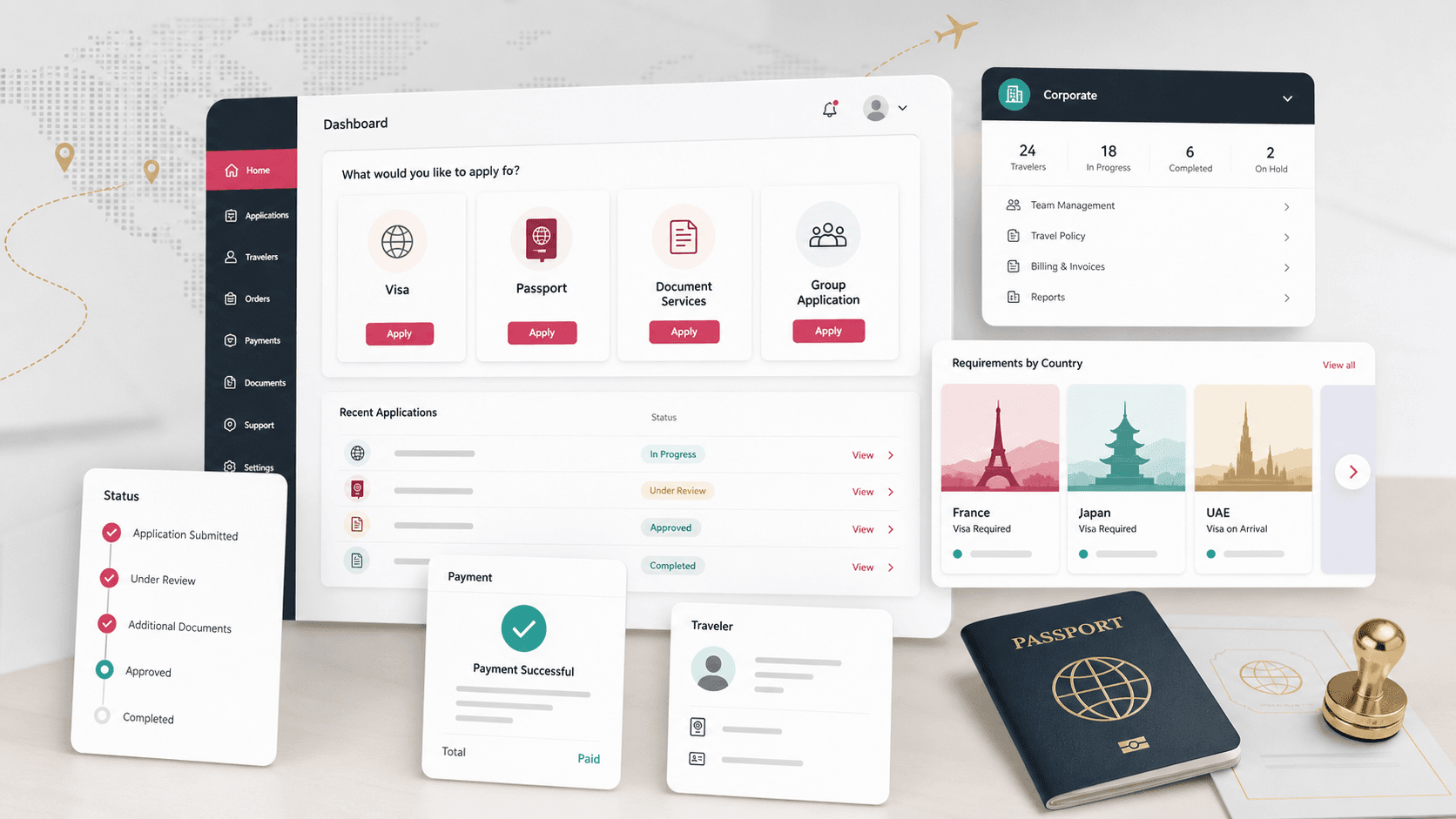
VisaBridge: Visa and passport application services platform
A travel document services platform that connects passport applications, visa requirement lookup, multi-passenger orders, service pricing, payment processing, order tracking, corporate rate access, and document-authentication content into one guided web experience.
Web application engineering, guided order workflows, CMS-backed travel document content, payment processing, email operations, and Node API support for a passport and visa services platform
18+
public and transactional routes
Multi
traveler order intake
Cards
payment authorization workflow
CMS
country and requirement content
Timeline
Public web app and API delivery for travel document ordering, status tracking, and service operations
Travel document services needed a guided digital ordering path
Customers needed to understand passport, visa, legalization, and document-authentication options, then submit accurate traveler information, fees, shipping details, and payment data without falling out of the service flow.
Passport and visa service selection had to account for traveler count, processing urgency, countries, visa types, fees, and shipping choices
Customers needed order status lookup and printable order instructions after checkout
Corporate buyers needed a separate access path for rate and account workflows
Operations needed email notifications, payment handling, CMS-backed page content, and API-connected order records
A React storefront with order, payment, and status workflows
VisaBridge was structured as a route-driven React app backed by service utilities, CMS table reads, payment helpers, transactional email, and Node/Express endpoints for customer communication and card processing.
Public service pages for passports, visas, legalizations, document authentication, FAQs, contact, company information, and guarantee/legal content
Guided order forms for contact details, multiple passengers, passport service needs, visa needs, required dates, shipping, and notes
Order processing and instruction screens that calculate service, consular, passport office, and shipping fees while preparing next-step documentation
Order status lookup, corporate login/rate pages, payment endpoints, card validation helpers, and customer/admin email templates
Product surfaces
What the platform brought together
The work spanned core product operations, daily user workflows, data-heavy coordination, and resilient platform management.
Passport, visa, and document content
The public site gives customers a clear path from service research into ordering.
Passport, new-passport, visa, country, visa-requirement, legalization, and document-authentication routes
CMS-backed page content, banners, country data, visa requirement steps, and service detail pages
FAQ, about, company, legal guarantee, contact, and support pages around the transactional core
Guided application intake
The order flow collects customer, traveler, service, shipping, and timing details with validation and reusable fields.
Redux Form powered contact, address, date, passenger, passport service, and visa-needed fields
Multi-passenger add/remove flows with traveler passport details and per-passenger service choices
State, city, country, shipping, service, and visa option helpers connected to backend data sources
Pricing, payment, and confirmation
Order processing brings together service fees, government fees, consular fees, shipping, payment mode, and confirmation states.
Fee calculations across passport office fees, service fees, visa fees, consular fees, and shipping
Credit card validation and payment authorization helpers integrated with a Node payment endpoint
Thank-you, order-processing, order-instruction, and printable documentation paths after submission
Operations and corporate access
The platform includes supporting workflows for corporate customers and back-office service communication.
Corporate login and corporate rate routes for business customers
Order status lookup by order number with detail routing for customer self-service
Customer and admin email templates triggered by service requests and order events
Buyer priorities
What mattered most to the people evaluating the platform
Prospective buyers want to know whether the work solved real workflow, adoption, reliability, data, and operations problems. These priorities shaped the product decisions.
Customer confidence
Travel document users need reassurance because mistakes can delay trips, so the product had to make service choices, requirements, fees, and next steps visible.
Service pages explain passport, visa, legalization, and document-authentication options before order intake
Order instructions summarize application requirements and shipping steps after checkout
Status lookup gives customers a self-service path after submission
Transaction completeness
The checkout path needed to collect enough information for operations without forcing customers to restart across disconnected forms.
Multi-passenger intake keeps travelers, passport services, and visa needs in one order context
Fee calculations connect service selections, country requirements, government fees, and shipping choices
Payment and email flows connect the frontend order to operational follow-up
Content-backed operations
Visa and passport services change by country and document type, so the app needed editable content and lookup-driven service options.
CMS table reads support country, page, visa requirement, shipping, and service data
Country and visa requirement routes expose relevant document guidance to customers
Admin email templates and API endpoints support service-team handoff
System model
How the platform connects roles, workflows, and product surfaces
The product architecture brings every role into the same operating model, with shared data moving cleanly between web, mobile, media, and notification layers.
Application to instruction workflow
Customers move from service discovery into traveler intake, fee calculation, payment, confirmation, printable instructions, and status tracking.
Service and operations layers
Public pages, order forms, CMS tables, payment endpoints, email templates, and operations handoff work together as one service platform.
Customer and corporate journeys
Individual travelers and corporate customers use different entry points while sharing the same service, pricing, and order foundation.
Technology
The Stack We Used And Why
The stack section is written for buyers who need to understand the product architecture, operational trade-offs, and long-term maintainability of the system.
Frontend app
Used for route-driven public pages, service discovery, guided forms, order status, corporate access, and post-order instructions.
The product blended marketing, customer education, and transaction workflows, so route-level structure kept service pages and order states connected.
React Router separated public service pages, order forms, processing, status, corporate, and thank-you screens
Redux Form preserved multi-step order data across passenger, service, shipping, and payment sections
Reusable render fields and dropdown helpers reduced repeated validation work across large forms
Why CMS-Backed Requirement Data
Travel document requirements depend on country, purpose, service type, and timing, so static copy alone would not support the operating model.
Backend table APIs fed page content, country options, visa requirement steps, and service pricing
Country and requirement routes let customers find relevant information before ordering
Editable operational data made the site more maintainable than hard-coded service pages alone
Why Payment And Email Sat In The Core Flow
A document-services order is not complete until fees are handled and operations receives enough context to act.
Payment helpers connected order totals to card authorization paths
Customer and admin email templates created a handoff after service requests
Order instruction and status pages gave customers a follow-through path after checkout
Delivery
How the product came together
The work moved from domain modeling to core platform delivery, mobile adoption, and operational hardening.
1
Map the service catalog
Translate passport, visa, legalization, country, requirement, and document-authentication content into clear routes and service choices.
2
Build guided order intake
Create form flows for contact details, travelers, passport services, visa needs, dates, shipping, notes, and corporate account details.
3
Connect order economics
Wire fee lookup and calculation across service, consular, passport office, shipping, and payment-mode choices.
4
Support post-order operations
Add payment processing, email notifications, order instructions, print support, and status lookup so submitted orders could move into fulfillment.
Operational depth
What made the platform usable after launch
The strongest case studies are not only feature lists. They show how the system is operated, monitored, governed, and improved when real users depend on it.
Large-form reliability
The order path spans many required fields and conditional service choices, so form state, validation, and repeatable fields were core product concerns.
Multi-passenger field arrays support families, teams, and grouped travelers
Date and dropdown helpers standardize inputs for service timing, addresses, country choices, and shipping
Conditional required fields keep payment and document sections aligned to selected options
Order follow-through
The platform does not stop at submission; it gives customers the status and instruction surfaces needed after checkout.
Order status lookup routes users to order detail information
Order instruction pages calculate and display service-specific next steps
Print styling supports handoff from digital order to physical document preparation
Operational notifications
Email templates and API endpoints help move customer requests into service-team workflows.
Customer confirmation and admin notification templates
Node endpoints for service requests, payment, validation, and version checks
Operational logging around payment responses and API activity
Results
The measurable and observable lift from the work
The strongest improvements are the ones a buyer can connect to daily work: fewer disconnected tools, safer operations, clearer workflows, and more reliable product behavior.
18+ routes
Service And Order Coverage
The app covered public service education, order intake, payment, status, corporate access, and post-order instruction pages.
Multi-traveler
Application Intake
Grouped passenger fields let one customer submit passport and visa needs for multiple travelers in a single order context.
Fee aware
Pricing Workflow
Service, consular, passport office, shipping, and visa-related fees were calculated inside the order flow.
Payment ready
Transaction Support
Card validation, payment authorization helpers, and email notifications supported the handoff from application to fulfillment.
Outcome
A stronger operating system for visa and passport services platform
The platform reduced tool fragmentation and gave each role a clearer path from live activity to day-to-day action.
A React travel document services web app covering passport, visa, legalization, document-authentication, order, payment, corporate, and status workflows
A guided multi-passenger order intake experience with validation, date inputs, service choices, address and shipping details, and customer notes
CMS-backed country, page, service, shipping, and visa requirement data connected to customer-facing pages and order calculations
Node/Express support for email notifications, payment processing, card validation, operational logging, and production API endpoints
FAQ
Frequently Asked Questions About VisaBridge
Answers about the visa and passport services platform scope, platform model, technology choices, operational workflows, and related build patterns.
What Kind Of Platform Does VisaBridge Represent?
VisaBridge represents a visa and passport services platform with public service pages, guided application intake, multi-traveler orders, fee calculation, payment processing, order instructions, corporate access, and status tracking.
Why Does A Travel Document Platform Need Guided Intake?
Passport and visa services depend on traveler details, service type, country, timing, shipping, fees, and document requirements. Guided intake helps customers submit the right information while giving the operations team a clearer fulfillment record.
How Did The Product Support Post-Order Follow-Up?
The app included thank-you, order-processing, printable instruction, and order-status routes, plus email templates and API endpoints that helped move submitted applications into service-team workflows.
Can This Pattern Support Other Regulated Service Marketplaces?
Yes. The same pattern can support immigration services, legal document filing, insurance applications, credentialing, licensing, compliance forms, and other guided service-ordering products.
Related services
Build a similarly ambitious product without starting from a blank page.
We can help scope the web, mobile, AI, media, and operating layers needed for your own platform.