
AI-native SaaS modernization is not the same as adding a chatbot to an existing product. It means redesigning high-value workflows so software can understand context, retrieve the right data, take bounded actions, coordinate with other systems, and prove what happened. The practical roadmap starts with workflow selection, then moves through data readiness, agent architecture, pricing, governance, integrations, and phased delivery.
That sequence matters because the SaaS market is moving from "AI features" toward products where agents perform work. Deloitte's 2026 software outlook describes pressure from AI-native companies, new pricing models, enterprise-grade infrastructure needs, and governance gaps. Gartner has also forecast that task-specific agents will be embedded in a much larger share of enterprise applications by the end of 2026. For established SaaS teams, the question is no longer whether AI belongs in the roadmap. The harder question is which workflows deserve agentic redesign and which features should stay conventional.
If you are evaluating a first agent-enabled workflow, start with NextPage's AI Agent Readiness Assessment. It helps score workflow clarity, data readiness, integration access, and human-review controls before product teams commit engineering budget. Teams that already have a use case can pair that score with the AI implementation roadmap to move from idea, to prototype, to production rollout without skipping evaluation gates.
Quick Answer: AI-Native SaaS Modernization
An AI-native SaaS modernization roadmap should answer seven questions: which customer job will be redesigned, what data the workflow needs, where agents can act safely, which integrations are required, how pricing changes when value shifts from seats to outcomes, what governance evidence buyers will expect, and which migration path protects current revenue while the product evolves.
| Roadmap Layer | Decision To Make | Evidence Needed |
|---|---|---|
| Workflow redesign | Which customer job should become faster, more autonomous, or more outcome-based? | Task frequency, user pain, measurable value, and failure cost. |
| Data foundation | Which records, documents, events, and permissions must the workflow understand? | Data quality, lineage, access rights, freshness, and retrieval tests. |
| Agent architecture | Should the system recommend, draft, execute, or coordinate? | Risk tier, tool permissions, evaluation results, and approval rules. |
| Pricing | Does the value metric remain seats, usage, credits, tasks, or outcomes? | Unit economics, compute cost, support load, and customer ROI. |
| Governance | What must be logged, reviewed, revoked, and explained? | Audit trail, policy checks, human review, and incident response. |
Why AI-Native SaaS Is Different
Traditional SaaS sells access to screens, permissions, workflows, and reporting. AI-native SaaS sells a stronger promise: the product can complete more of the work with less manual coordination. That shift changes product design. The interface may become less important than orchestration, integrations, data quality, and trust evidence.
A useful modernization effort starts by separating three product motions. First, AI-assisted features help users draft, summarize, search, classify, or recommend. Second, AI workflow automation moves a bounded process from intake to action with review points. Third, agentic workflows coordinate tools, remember context, and execute multi-step tasks. Each motion has different architecture, QA, support, and pricing implications.
Do not treat every feature as an agent. A deterministic rule, workflow automation, search index, or classic machine-learning model may be more reliable and cheaper. AI-native modernization means choosing the right AI depth for each customer job.
What Changed In 2026
The 2026 shift is not just better models. It is a business-model and product-architecture shift. Deloitte's 2026 software outlook frames the software market around agentic AI adoption, AI-first product design, margin pressure from model costs, and competition from AI-native challengers. That matters for established SaaS teams because adding a thin AI layer may not defend the product if the customer workflow can be rebuilt around agents, integrations, and outcome evidence.
The buyer expectation is also changing. Enterprise customers want AI features that can prove value, explain cost, respect permissions, integrate with existing systems, and show governance evidence. McKinsey's 2026 pricing research makes the same operational point for commercial workflows: agentic AI creates value only when workflows, data foundations, governance, and human oversight are redesigned together. The modernization roadmap should therefore treat pricing, reliability, security, and adoption as product requirements rather than post-launch cleanup.
The practical implication is simple: pick fewer workflows, instrument them better, and prove outcomes before expanding autonomy. A broad collection of AI features is less defensible than one high-value workflow with clean data, scoped tools, evaluation evidence, pricing logic, and enterprise controls.
Modernization Roadmap Stages
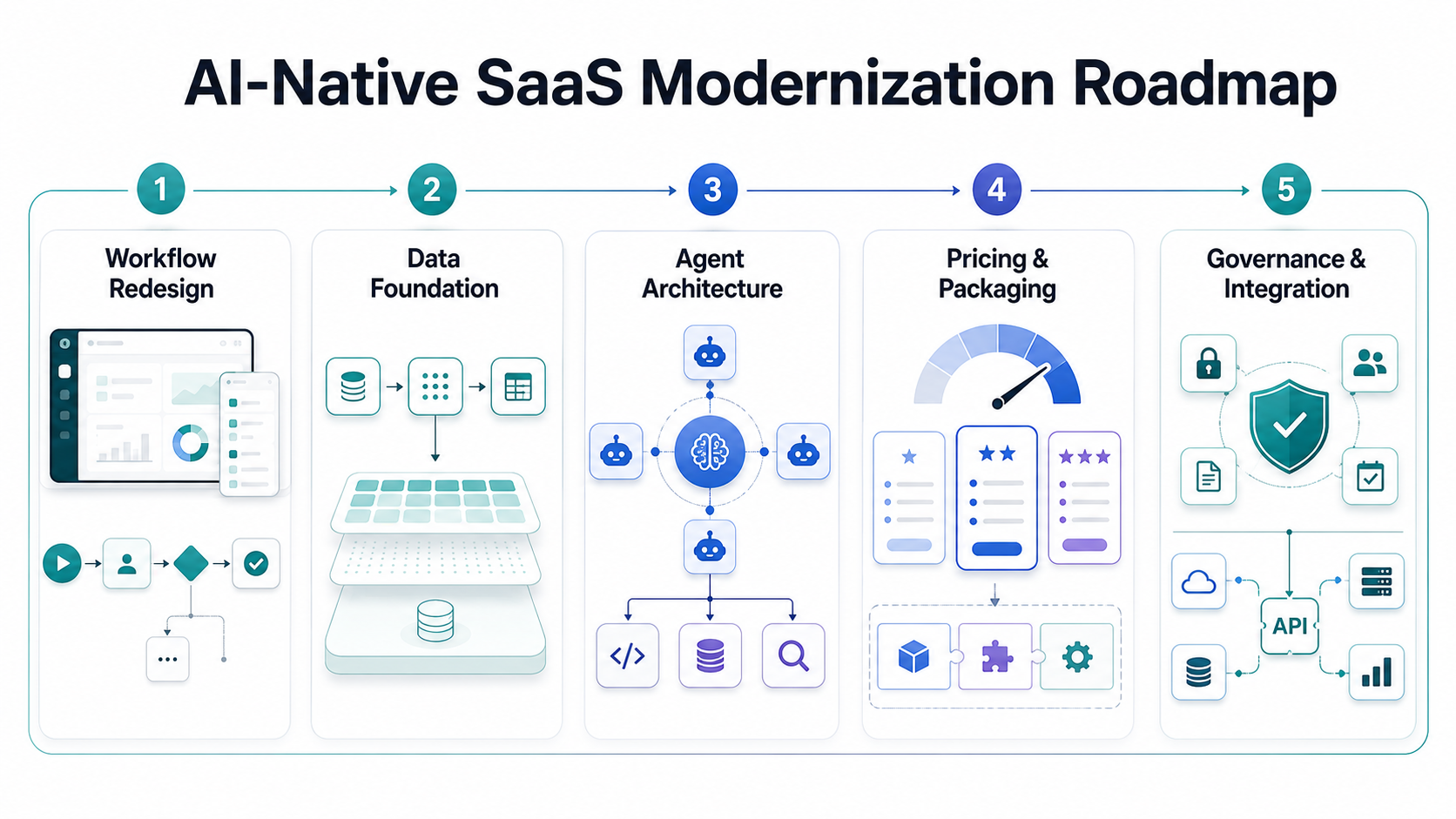
The safest roadmap modernizes one high-value workflow first, then expands the pattern after usage, reliability, and buyer trust improve. This is where AI-native SaaS modernization overlaps with AI development services: the work is not only prompt design, but also product discovery, data engineering, integration, QA, monitoring, and change management.
- Map work, not features. Document the real job users perform across your product, spreadsheets, email, chat, CRM, ticketing, billing, and internal tools.
- Choose the first workflow by value and risk. Prioritize frequent, costly, measurable work where AI can reduce cycle time without taking irreversible action too early.
- Build the data foundation. Normalize records, permissions, documents, events, and product telemetry before you expect agents to reason well.
- Design the agent boundary. Decide where the system recommends, drafts, executes, escalates, or asks for approval.
- Connect the workflow. Add APIs, webhooks, identity, audit logs, and rollback paths so the agent can act inside real customer systems.
- Price around value. Model compute cost, usage variability, customer ROI, and the risk of charging for activity instead of outcomes.
- Operationalize governance. Log prompts, retrieved context, tool calls, approvals, policy decisions, and outcomes so enterprise buyers can trust the system.
Pick The Right Workflow First
The first AI-native workflow should be narrow enough to validate and meaningful enough to change the product story. Good candidates have repeated inputs, clear success criteria, accessible data, measurable business value, and a human review point. If the team is still deciding whether the workflow is automation-ready, the Workflow Automation Opportunity Finder can separate repeatable process value from AI novelty. Poor candidates require ambiguous judgment, fragmented permissions, high legal exposure, or irreversible external action before the team has proven reliability.
| Candidate Workflow | Modernization Opportunity | Risk To Control |
|---|---|---|
| Customer support triage | Classify issues, retrieve history, draft replies, and route escalations. | Wrong policy, sensitive data leakage, or bad refund/action. |
| Sales operations | Enrich accounts, summarize calls, update CRM fields, and suggest next steps. | Bad data writes, duplicate outreach, or hallucinated account facts. |
| Finance operations | Match invoices, flag anomalies, prepare approvals, and explain exceptions. | Unauthorized payment action or weak audit trail. |
| Product analytics | Answer questions, detect trends, generate hypotheses, and create tasks. | Misleading metrics or missing denominator context. |
NextPage's AI Automation ROI Calculator is useful before this step because it forces teams to estimate repeated hours, automation potential, and payback instead of chasing AI novelty.
Data Foundation Before Agent Features
AI-native products depend on data that is permissioned, current, explainable, and connected to workflow context. A SaaS product with messy tenant boundaries, inconsistent event names, weak role permissions, and unstructured customer documents will struggle to support reliable agents. The agent will inherit every product data problem and make the failures more visible.
Start with a data readiness checklist: tenant isolation, identity model, role and permission rules, source-of-truth records, document freshness, retrieval quality, event taxonomy, audit logs, data retention, and customer-configurable controls. For knowledge-heavy workflows, pair RAG design with data prep and evaluation. For transactional workflows, focus on API contracts, validation rules, idempotency, and rollback.
Teams that need architecture help can align this foundation with SaaS development services so product, data, backend, and integration work are planned together.
Architecture Readiness Map
Before adding agents, map the product architecture that has to support them. Most failures do not come from the model alone. They come from unclear tenant boundaries, missing event history, weak permissions, brittle integrations, incomplete rollback paths, and observability that cannot explain why the agent acted.
| Architecture Layer | Modernization Question | Proof Before Launch |
|---|---|---|
| Tenant and identity model | Can the agent read and act only inside the right account, workspace, role, and policy boundary? | Role tests, scoped credentials, audit logs, and denied-action cases. |
| Knowledge and retrieval | Can the workflow retrieve current product, customer, document, and policy context? | Retrieval evals, freshness checks, source citations, and fallback behavior. |
| Tool and API contracts | Can the agent preview, execute, verify, and recover from tool calls? | Typed tools, idempotency, rate limits, error handling, and rollback tests. |
| Observability | Can product and support teams inspect requests, context, decisions, cost, latency, and outcomes? | Traces, eval dashboards, cost reports, exception queues, and incident owners. |
| Deployment boundary | Should the workflow use SaaS APIs, private endpoints, VPC deployment, or a more controlled model runtime? | Data-classification decision, security review, vendor terms, and operating-cost model. |
For sensitive workflows, compare deployment boundaries early. The private generative AI deployment guide is useful when a SaaS team needs stronger data isolation, private endpoints, VPC deployment, or self-hosted model options before enterprise buyers will approve rollout.
Agent Architecture And Integration Patterns
The core architecture choice is not "which model?" It is how much agency the product should expose. A copilot can draft or recommend. A workflow agent can complete a bounded task with approvals. A coordinating agent can break work into steps across systems. Each step increases value and risk.
For most established SaaS products, the first production pattern should include retrieval, policy checks, tool permissions, evaluation, observability, and a human approval path. Tool access should be scoped by tenant, role, workflow, and action type. Treat every action tool as a product surface: it needs argument validation, preview states, approval rules, failure handling, retry limits, and evidence that the final state matches the requested outcome. Logs should show the user request, retrieved context, tool calls, policy decisions, approval state, and final result.
NextPage's generative AI development work usually combines LLM application design, RAG, agents, evaluations, API integrations, and production monitoring. When the workflow requires classic prediction, recommendations, ranking, or anomaly detection, machine learning development services may be the better foundation than a pure LLM workflow.
Pricing And Packaging For AI-Native SaaS
AI changes SaaS pricing because product value can move from access to work completed. Seat-based pricing still fits human productivity tools, but agentic workflows often need usage, task, workflow, credit, or outcome-aware packaging. Deloitte's recent accounting discussion around outcome-based pricing also shows why finance, legal, and product teams need to model what is actually being delivered.
A practical pricing model should answer four questions: what value event does the customer recognize, what does it cost you to deliver, what failure or review work remains, and how predictable will usage be? Charging per token can expose cost, but it rarely maps cleanly to buyer value. Charging per outcome can align value, but it requires verification, exclusions, and confidence that the system can deliver repeatably.
Use hybrid packaging early: base subscription for platform access, usage or workflow tiers for AI-heavy work, and enterprise controls for governance, audit, model choice, data residency, and support. Outcome-based pricing should wait until the product can define a successful outcome, verify completion, handle partial failures, and separate customer value from background model activity. The Custom Software Cost Estimator can help founders scope the engineering side before they promise a new commercial model. For a deeper budget baseline, the SaaS application development cost guide breaks down tenant architecture, billing, integrations, analytics, AI features, security, and operating scale.
AI-Native SaaS Modernization Scorecard
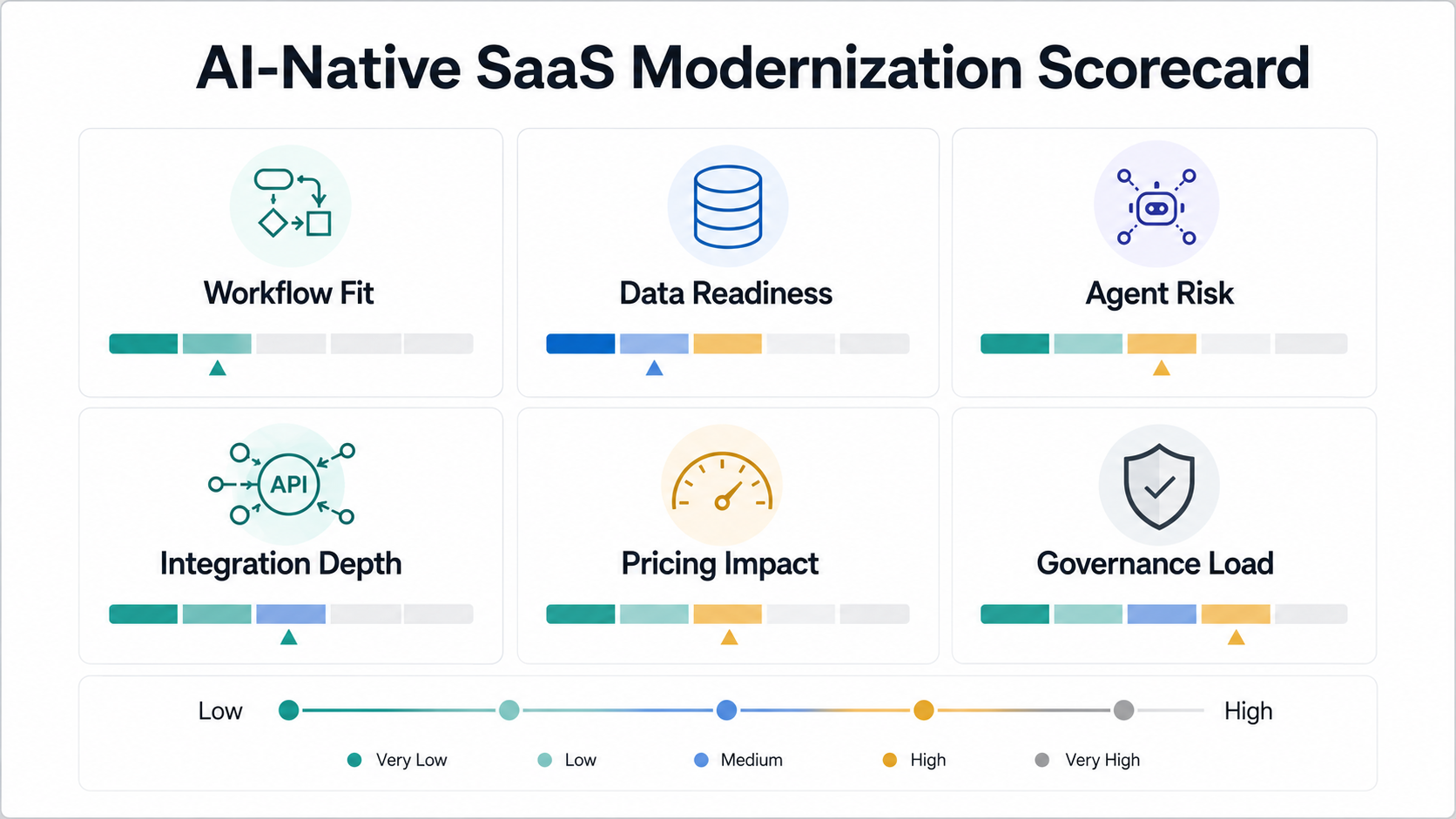
Use a scorecard before you commit roadmap capacity. The strongest first workflow scores high on value and readiness, moderate on risk, and low enough on governance load that the team can ship and learn.
| Dimension | Low Score Means | High Score Means |
|---|---|---|
| Workflow fit | Ambiguous, rare, or hard to measure. | Frequent, painful, and tied to a clear business result. |
| Data readiness | Missing, stale, unpermissioned, or scattered data. | Trusted records, clean permissions, and useful retrieval tests. |
| Agent risk | Irreversible actions or high compliance exposure. | Bounded actions, review gates, and easy rollback. |
| Integration depth | Many brittle systems before value appears. | One or two stable APIs can prove the first use case. |
| Pricing impact | No clear value metric or unpredictable cost. | Usage and outcome are measurable enough to package. |
| Governance load | Audit, identity, and policy controls are undefined. | Controls can be logged, reviewed, and explained to buyers. |
Governance Enterprise Buyers Will Expect
Enterprise customers will ask how the AI workflow handles permissions, logs, model behavior, data retention, human review, and incident response. If the product acts across CRM, support, finance, HR, code, cloud, or regulated records, governance becomes part of the product, not a compliance appendix.
At minimum, define agent identity, workflow ownership, allowed tools, data boundaries, approval rules, evaluation cadence, audit logs, and revocation paths. NextPage's AI agent identity governance checklist is a useful companion for teams moving from demos to production permissions. The enterprise AI agent governance guide can help shape the broader operating model.
90-Day Migration Plan For The First AI-Native Workflow
A first modernization wave should be small enough to ship and serious enough to prove the pattern. A 90-day plan works when the workflow is already chosen, the owners are available, and the team can access realistic data and integrations.
| Timeframe | Workstream | Exit Criteria |
|---|---|---|
| Days 1-15 | Workflow discovery, current-state mapping, data inventory, risk scoring, and success metric selection. | Approved workflow brief, no-scope list, ROI hypothesis, and governance owner. |
| Days 16-35 | Data cleanup, retrieval design, tool contract design, UX flow, and evaluation dataset creation. | Testable prototype scope, initial eval cases, tool permissions, and integration plan. |
| Days 36-65 | Build the agent-assisted workflow with logging, human review, fallback, and support visibility. | Working pilot flow, trace logs, cost telemetry, pass/fail thresholds, and support playbook. |
| Days 66-90 | Pilot with a limited customer or internal cohort, tune reliability, confirm ROI, and prepare scale decision. | Adoption evidence, defect list, governance signoff, pricing assumptions, and next-wave backlog. |
Do not use the first 90 days to rebuild the whole product. Use it to prove that one workflow can move from assisted to partially agentic while keeping customer trust, support operations, and revenue risk under control.
Build, Retrofit, Or Launch A New Product Line?
Not every SaaS product should be rebuilt. Retrofit when your current product has strong data gravity, customer trust, and workflows that can be improved incrementally. Rebuild a subsystem when the old architecture cannot support permissions, eventing, retrieval, evaluation, or integration needs. Launch a new product line when the AI-native workflow changes the buyer, price metric, onboarding model, or service promise so much that the legacy product would constrain it.
A common path is a three-track roadmap: protect the core product, modernize one workflow for existing customers, and prototype a more AI-native experience for a narrower segment. This lets the company learn without betting the entire revenue base on a single rewrite.
If the first release needs to stay disciplined, use NextPage's MVP Scope Builder to separate must-have workflow proof from later automation, analytics, and enterprise controls.
Release Gates Before Scaling Agents
Modernization should not expand autonomy until the product has passed explicit release gates. These gates protect buyers from agent sprawl and protect the SaaS business from support, margin, and trust problems that are expensive to unwind after launch.
- Value gate: the workflow has measurable time savings, revenue impact, risk reduction, or customer retention value.
- Data gate: retrieval quality, freshness, tenant permissions, and source visibility are strong enough for real users.
- Reliability gate: evals cover common, edge, negative, and adversarial cases, with clear thresholds for launch and rollback.
- Cost gate: model, retrieval, tool, review, and support costs are visible enough to price the feature without margin surprises.
- Governance gate: logs, approvals, human review, incident owners, and revocation paths are built into the product flow.
- Adoption gate: users understand when the product is assisting, recommending, acting with approval, or acting autonomously.
When these gates pass, the next step is not unlimited autonomy. It is a second workflow with the same operating model, improved tooling, and a clearer product story.
How NextPage Can Help
NextPage helps SaaS teams turn AI-native ambition into a buildable roadmap: workflow selection, product discovery, data readiness, LLM/RAG architecture, agent boundaries, API integration, QA, governance, and phased delivery. The goal is not to bolt generic AI onto every screen. The goal is to choose the workflows where AI can create measurable product value without creating avoidable operational risk.
If your SaaS roadmap is stuck between incremental AI features and a larger product modernization, start with a focused workshop. We can score candidate workflows, identify the data and integration gaps, define the first agent-safe release, and plan the migration path from today's product to a more AI-native platform.