
Quick Answer: Beauty App Development Features
A strong beauty app helps customers discover the right service or product, book with confidence, pay safely, receive reminders, review the experience, and return without friction. The essential feature set usually includes customer profiles, service or product discovery, provider profiles, appointment booking, calendar availability, secure payments, offers, reviews, support, admin controls, and analytics.
The right product model matters before the feature list. A salon booking app, at-home beauty marketplace, cosmetics commerce app, and hybrid beauty platform all need different workflows. Plan the customer app, beauty professional app, and admin console together so the business can manage service quality, payments, cancellation rules, inventory, loyalty, and performance from one operating system.
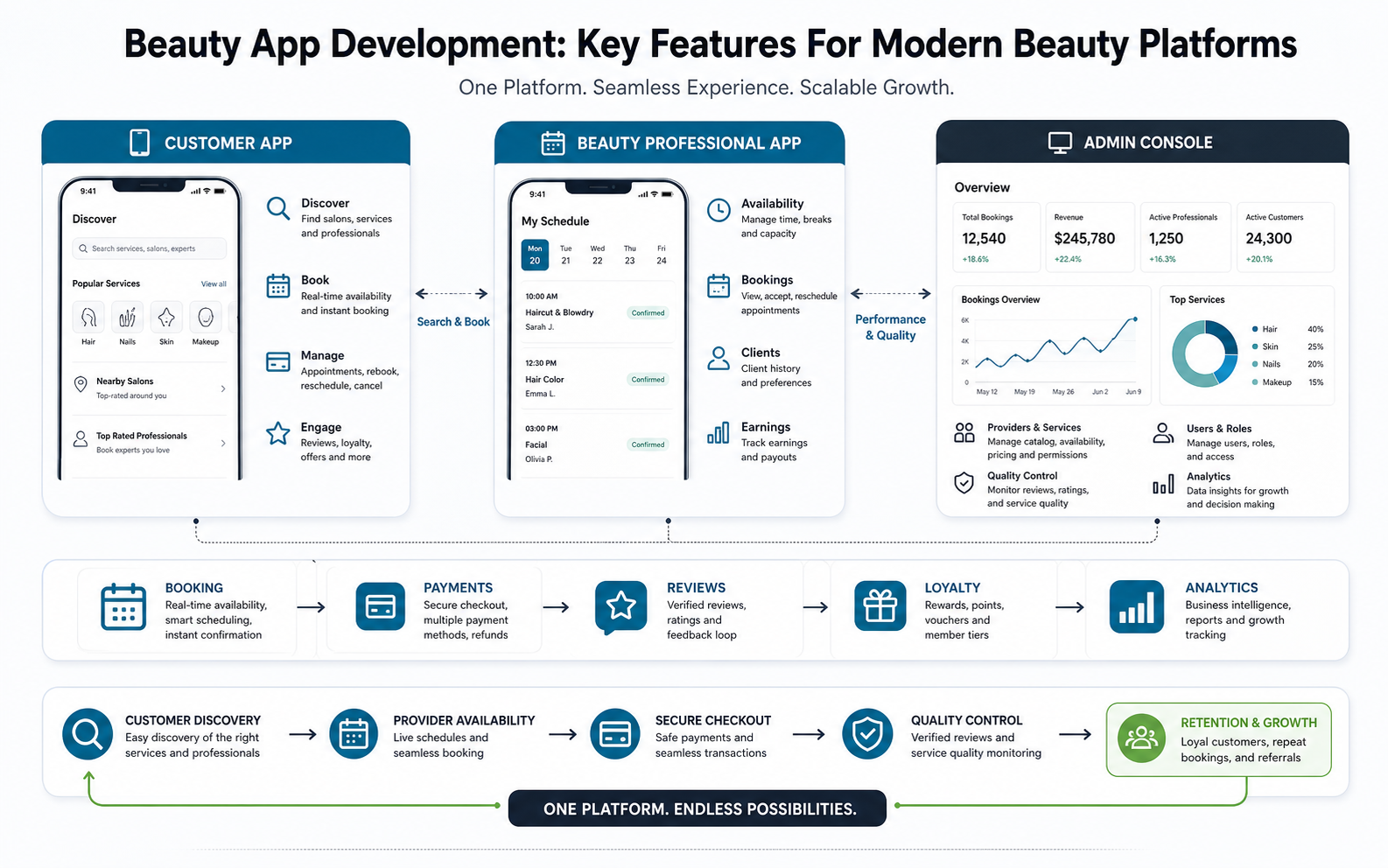
Define The Beauty App Product Model First
Beauty app development should start with the operating model, not a generic screen list. Decide whether the app will sell salon appointments, on-demand home services, beauty consultations, products, subscriptions, memberships, or a mix of services and commerce. This decision affects roles, catalog structure, payments, fulfillment, support, and compliance.
If the product will be mobile-first and needs native device behavior, the roadmap should be shaped during mobile app development planning. The first release should focus on repeatable workflows that can be operated reliably before adding advanced personalization or marketplace expansion.
Beauty App Feature Stack
| Feature Area | What It Should Include | Launch Priority |
|---|---|---|
| Customer experience | Signup, profiles, location, service or product discovery, saved preferences, reviews, support, and rebooking. | Must have |
| Booking and availability | Provider calendars, time slots, duration rules, deposits, cancellation windows, reminders, and rescheduling. | Must have |
| Provider operations | Professional profiles, skill tags, portfolio photos, schedule management, booking acceptance, earnings, and customer notes. | Must have |
| Payments and commerce | Cards, wallets, deposits, refunds, payouts, coupons, product catalog, cart, checkout, and invoices when commerce is included. | Must have |
| Trust and quality | Ratings, reviews, verification, moderation, support tickets, service policies, data security, and dispute handling. | Must have |
| Growth and intelligence | Loyalty, referrals, memberships, recommendations, segmentation, analytics, and campaign automation. | Growth stage |
Salon-specific products can go deeper into staff calendars, stylist profiles, service rules, and loyalty. For a nearby feature breakdown, compare this roadmap with Must-Have Features For Your Salon App.
Booking Flow From Discovery To Repeat Visit
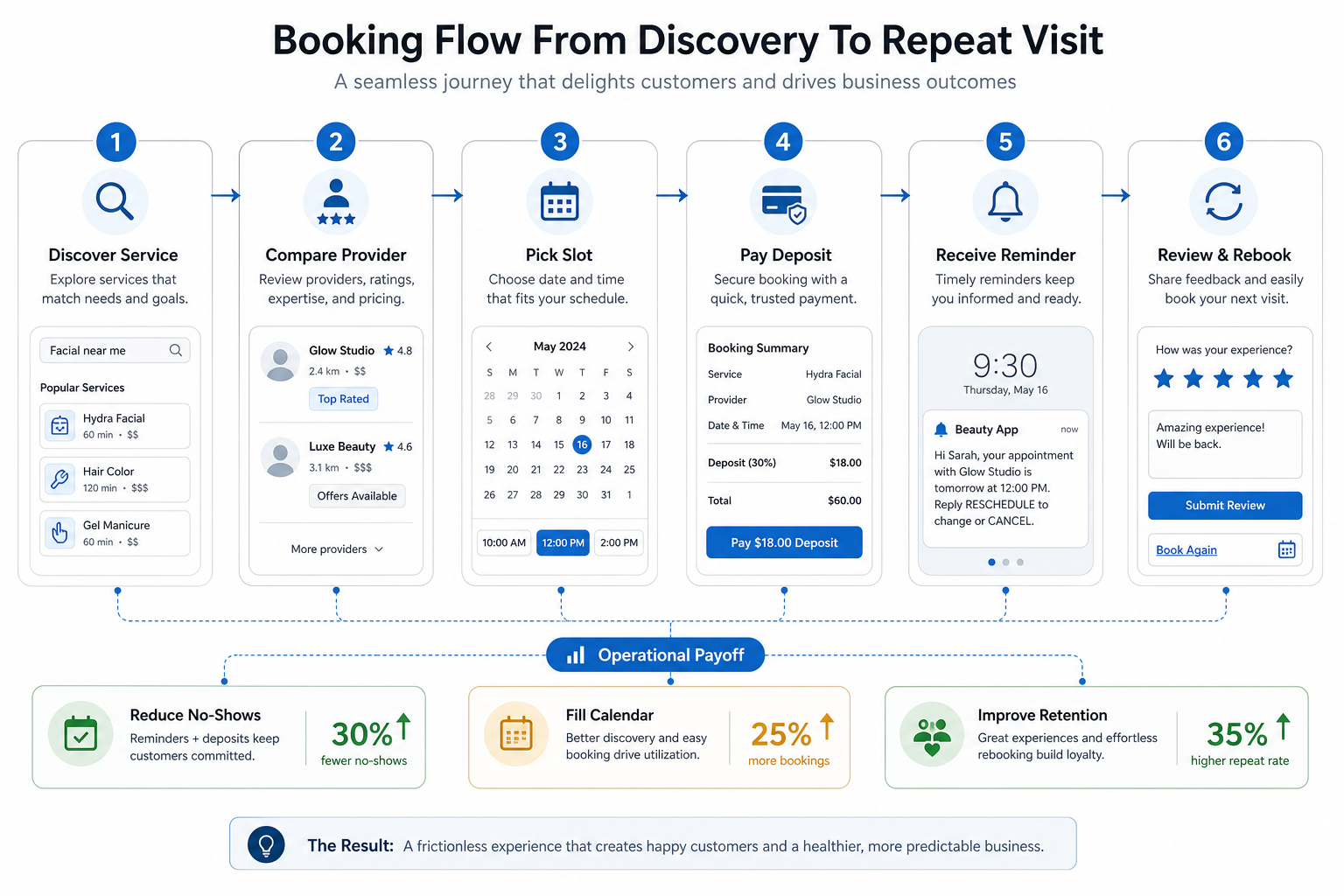
The customer journey should move from intent to confirmation quickly: discover a service, compare providers, choose a slot, pay a deposit or full amount, receive a reminder, complete the appointment, leave a review, and rebook when timing is right. Each step should make service duration, price, cancellation rules, location, and provider availability clear.
Beauty appointments share many risks with healthcare and wellness scheduling: missed slots, late cancellations, provider availability conflicts, and reminder timing. Use the same operational thinking behind scheduling and reminders in appointment booking apps, then adapt it to stylist skills, service buffers, travel time, and deposits.
Customer-Side Features That Build Confidence
The customer app should make selection feel trustworthy. Useful features include location-aware service discovery, filters by service type and price, provider profiles, portfolio images, verified reviews, saved favorites, booking history, saved preferences, allergy or sensitivity notes, digital consultation forms, support chat, and easy rebooking.
Beauty services are personal, visual, and trust-sensitive, so the interface should avoid hiding service rules or forcing customers through vague menus. Pair this feature plan with a salon app design checklist when designing service detail pages, provider profiles, and checkout flows.
Admin, Provider, And Quality Controls
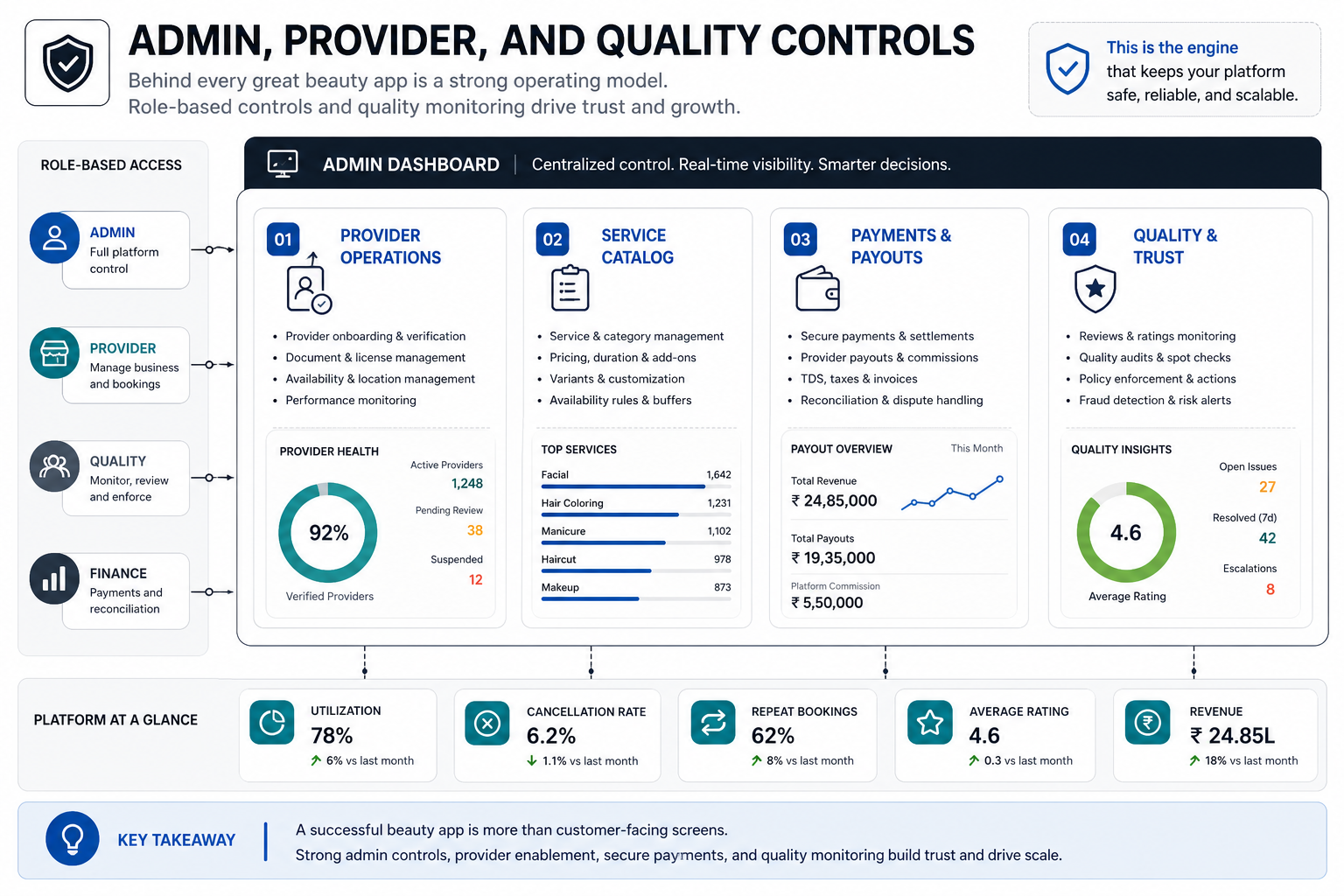
A beauty app cannot rely only on polished customer screens. Admin and provider workflows control the business. The platform should let teams manage provider onboarding, skill verification, service categories, prices, add-ons, duration buffers, working hours, leave, payout rules, refunds, coupon rules, reviews, moderation, and support queues.
Multi-provider and multi-location products also need permissions, branch rules, local pricing, provider transfers, service availability, audit logs, and dashboards for utilization, cancellation rate, repeat bookings, average rating, and revenue. Without these controls, the app can generate demand that the operation cannot deliver consistently.
Payments, Commerce, And Loyalty
Payment design should match the service model. At-home beauty services may need deposits, final settlement, tips, provider payouts, refunds, and cancellation fees. Cosmetics commerce may need product catalog, cart, checkout, discounts, subscriptions, order tracking, and returns. Hybrid apps often need both service payments and retail checkout.
If product commerce is a core part of the roadmap, use eCommerce app development cost planning to separate catalog, checkout, promotion, inventory, and fulfillment scope from appointment-booking scope. Loyalty can then connect service frequency, product purchases, referrals, memberships, and winback offers.
Personalization, AI, And Future-Ready Features
Personalization becomes useful after the app has reliable service history, preferences, product interactions, location behavior, provider ratings, and campaign data. Practical features include rebooking reminders, service recommendations, preferred provider shortcuts, product suggestions, personalized offers, customer segmentation, and demand forecasting.
Advanced AI should be introduced only when the data model is clean and consent rules are clear. If the roadmap includes recommendations or automated campaigns, review AI and machine learning personalization for salon apps before adding complexity to the first release.
MVP Roadmap For Beauty App Development
- Launch the core transaction: customer profiles, service discovery, provider profiles, booking, payment or deposit, reminders, reviews, and basic admin controls.
- Add operational depth: provider schedules, service buffers, refund rules, payout workflows, support queues, quality moderation, and reporting.
- Build the growth layer: loyalty, referrals, memberships, offers, rebooking prompts, customer segmentation, and campaign analytics.
- Scale intelligence and commerce: recommendations, demand forecasting, product catalog, subscriptions, inventory integration, and multi-location controls.
When scope is uncertain, the Custom Software Cost Estimator can help frame likely budget, timeline, feature complexity, team shape, and integration assumptions before implementation starts.
Cost, Security, And Development Risks
Beauty app cost depends on product model, user roles, booking complexity, payment flows, provider operations, commerce depth, integrations, design fidelity, admin controls, and analytics. A simple booking MVP costs far less than a marketplace with provider onboarding, payouts, subscriptions, product commerce, loyalty, and AI recommendations.
Security should cover authentication, role-based access, payment handling, personal data, customer notes, uploaded media, provider documents, audit logs, and secure admin operations. Development risks usually appear when teams underestimate availability rules, cancellation policies, payout reconciliation, review moderation, service quality control, and support workflows.
Launch Metrics To Track
The best metrics connect customer behavior with business performance. Track service search success, profile completion, booking conversion, payment failure rate, cancellation rate, no-show rate, provider utilization, review volume, average rating, support volume, repeat booking rate, offer redemption, loyalty enrollment, average order value, and revenue per active customer.
Marketing should be tied to these metrics. App store optimization, local SEO, social proof, referral programs, provider-led promotion, and lifecycle campaigns all work better when the product can measure which users book, return, refer, and buy again.
Final Recommendation
Build the beauty app around the complete service lifecycle: discover the right service or product, trust the provider, book a reliable slot, pay safely, receive reminders, complete the experience, review it, and return. Start with dependable booking, payment, provider, admin, and quality workflows, then expand into loyalty, commerce, personalization, and AI when the operating data is strong enough to support them.