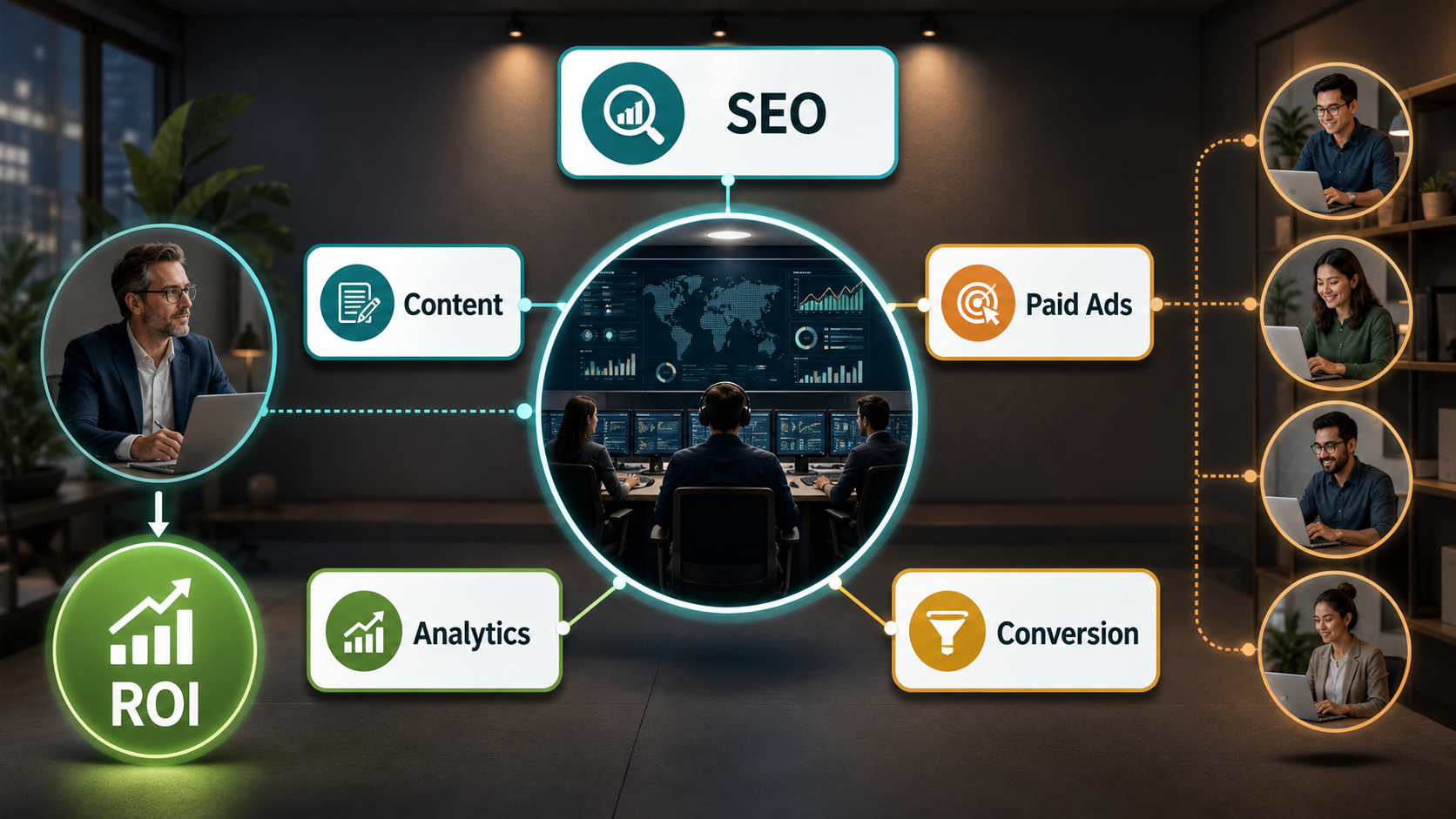

Outsourcing digital marketing is no longer just a way to save payroll cost. For many growing businesses, it is a way to get consistent strategy, sharper execution, better reporting, and access to specialists without building a full internal department before the business is ready.
The short answer: outsource digital marketing when your team needs reliable SEO, content, paid media, analytics, conversion, and campaign operations but cannot justify hiring every specialist in-house. Keep business strategy, customer knowledge, positioning, and final budget decisions internal; use an agency or specialist team to turn that direction into measurable execution. If your website, CRM, dashboards, or campaign workflows are also holding growth back, connect the marketing plan with custom software development or web platform improvements so the traffic you buy or earn can convert.
Quick Answer: What Are The Benefits Of Outsourcing Digital Marketing?
The main benefits are faster access to specialized talent, lower tool and hiring overhead, stronger campaign consistency, fresher outside perspective, and clearer performance accountability. Outsourcing works best when the business has clear goals and an operating rhythm for reviewing work, approving campaigns, and measuring outcomes.
- Best for small teams: outsourcing fills SEO, content, PPC, social, analytics, and conversion gaps without hiring six separate roles.
- Best for growth stages: an outside team can launch campaigns, test channels, and improve reporting while the internal team focuses on product, sales, and customer experience.
- Best when marketing has stalled: an external review can expose weak messaging, poor conversion paths, thin content, or tracking gaps that internal teams have stopped noticing.
- Not a replacement for leadership: the business still needs to own positioning, customer insight, commercial priorities, and final decisions.
Why Businesses Outsource Digital Marketing
Most companies do not struggle because they doubt digital marketing. They struggle because the work spans too many disciplines: search visibility, content planning, paid campaigns, landing pages, email, analytics, creative production, technical fixes, and continuous testing. A founder or small team can manage pieces of this work, but consistency is hard when operations, sales, hiring, and delivery keep taking priority.
Outsourcing gives the business a dedicated team whose job is to keep campaigns moving. That does not remove the need for internal input, but it prevents marketing from becoming a side task that only receives attention when revenue slows down.
10 Practical Benefits Of Outsourcing Digital Marketing
1. Access To Specialists Without Building A Full Department
A complete marketing function often needs SEO, content, paid media, design, conversion strategy, analytics, and marketing operations. Hiring all of those skills in-house can be expensive and slow. Outsourcing lets you access a blended team and scale support up or down as priorities change.
2. More Consistent Execution
In-house marketing often loses momentum when staff are busy with urgent operational work. A good agency keeps publishing, testing, reporting, and optimization on a defined schedule. That consistency matters because search visibility, content authority, and paid campaign learning all compound over time.
3. Better ROI Accountability
Outsourced partners should be measured by outcomes, not activity volume. That means clear KPIs, channel-level reporting, lead quality review, conversion tracking, and regular decisions about what to stop, continue, or improve. The relationship works best when the business and agency agree on revenue indicators before campaigns begin.
4. Fresh Outside Perspective
Internal teams know the product deeply, but that familiarity can hide weak positioning or confusing customer journeys. An external team can look at the website, offers, content, ads, and analytics with less bias. That perspective can reveal missing landing pages, unclear calls to action, weak trust signals, or content gaps that limit growth.
5. Access To Tools, Reporting, And Process
Digital marketing depends on tools for research, tracking, automation, dashboards, testing, and creative production. Outsourcing can reduce tool sprawl and give the business a more mature reporting rhythm. When reporting depends on custom CRM data, internal dashboards, or operational workflows, connect the marketing team with the product team early so campaign data is not trapped in disconnected systems.
6. More Focus For The Internal Team
Outsourcing frees owners, managers, and sales teams to focus on product quality, customer conversations, partnerships, and delivery. The goal is not to disconnect marketing from the business; it is to let internal leaders provide direction while specialists handle execution details.
7. Faster Campaign Launches
Experienced marketing teams bring repeatable launch playbooks for audits, keyword research, paid media setup, content calendars, landing pages, and reporting. This can shorten the time between a growth idea and a live campaign, especially when the internal team has been stuck waiting for bandwidth.
8. Cross-Channel Learning
A strong outsourced team can connect what is learned from paid ads, search queries, sales objections, analytics, and content performance. That makes each channel smarter. For example, paid search terms can shape SEO pages, sales objections can shape blog content, and conversion data can shape landing page improvements.
9. Better Website And Conversion Focus
Traffic alone does not create growth if the website is slow, unclear, outdated, or missing conversion paths. Outsourced marketing should surface these issues instead of only pushing more visitors to weak pages. If the site itself needs structural improvement, a focused website revamp may create more leverage than another campaign.
10. Lower Hiring And Management Risk
Hiring a senior marketer, content team, performance marketer, designer, and analyst before the business has a proven channel mix can create unnecessary fixed cost. Outsourcing gives you a way to test needs first, then decide which roles deserve permanent internal ownership.
Outsource Vs In-House: How To Decide
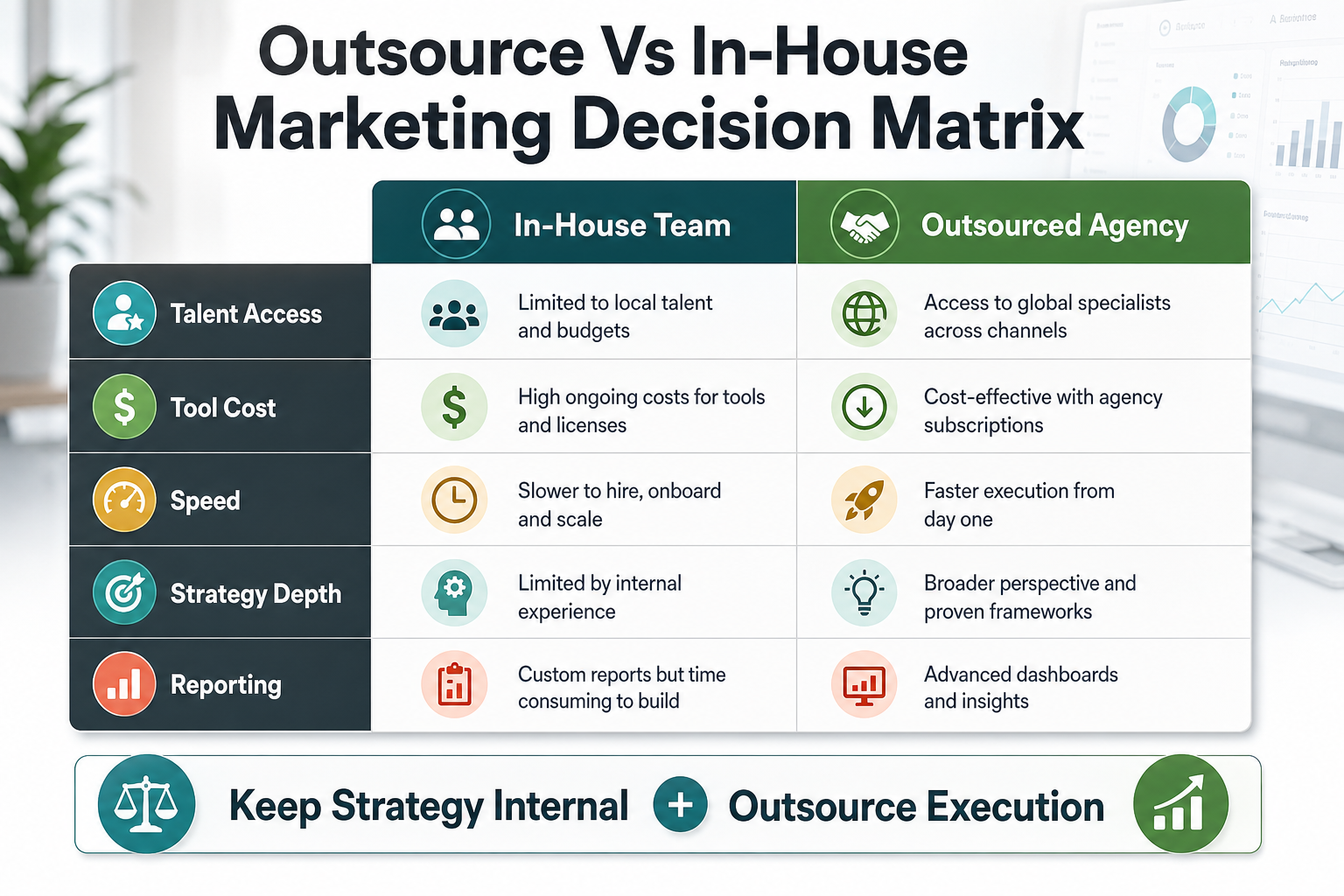
The right answer is rarely all agency or all internal team. Most growing businesses need a hybrid model: leadership owns strategy and customer knowledge, while outsourced specialists handle repeatable execution, technical channel work, creative production, and reporting.
| Need | Keep In-House | Outsource |
|---|---|---|
| Brand positioning | Customer insight, offer clarity, approvals | Messaging refinement, campaign angle testing |
| SEO and content | Subject matter input, product knowledge | Keyword research, briefs, editing, publishing rhythm |
| Paid campaigns | Budget decisions, sales feedback | Campaign setup, testing, bid management, reporting |
| Analytics | Revenue definitions, lead quality review | Dashboards, tracking QA, performance interpretation |
| Website improvements | Business priorities, conversion goals | Landing page recommendations and technical implementation support |
What To Expect From A Good Outsourced Marketing Partner
A good partner should not only promise rankings, traffic, or leads. They should explain the operating model: how they audit the current state, how they prioritize channels, who owns approvals, how reporting works, and how learnings turn into next actions.
Ask for a plan that includes the first 90 days, target KPIs, channel responsibilities, content workflow, landing page needs, tracking setup, and meeting cadence. If the plan depends on better technical SEO, structured content, or AI answer visibility, use an AI search visibility checker to identify whether your pages are understandable to search engines and AI answer systems.
A 90-Day Operating Loop For Outsourced Marketing
The first three months should create momentum and clarity. The goal is not to do every possible marketing task; it is to prove which channels, messages, and conversion paths deserve more investment.
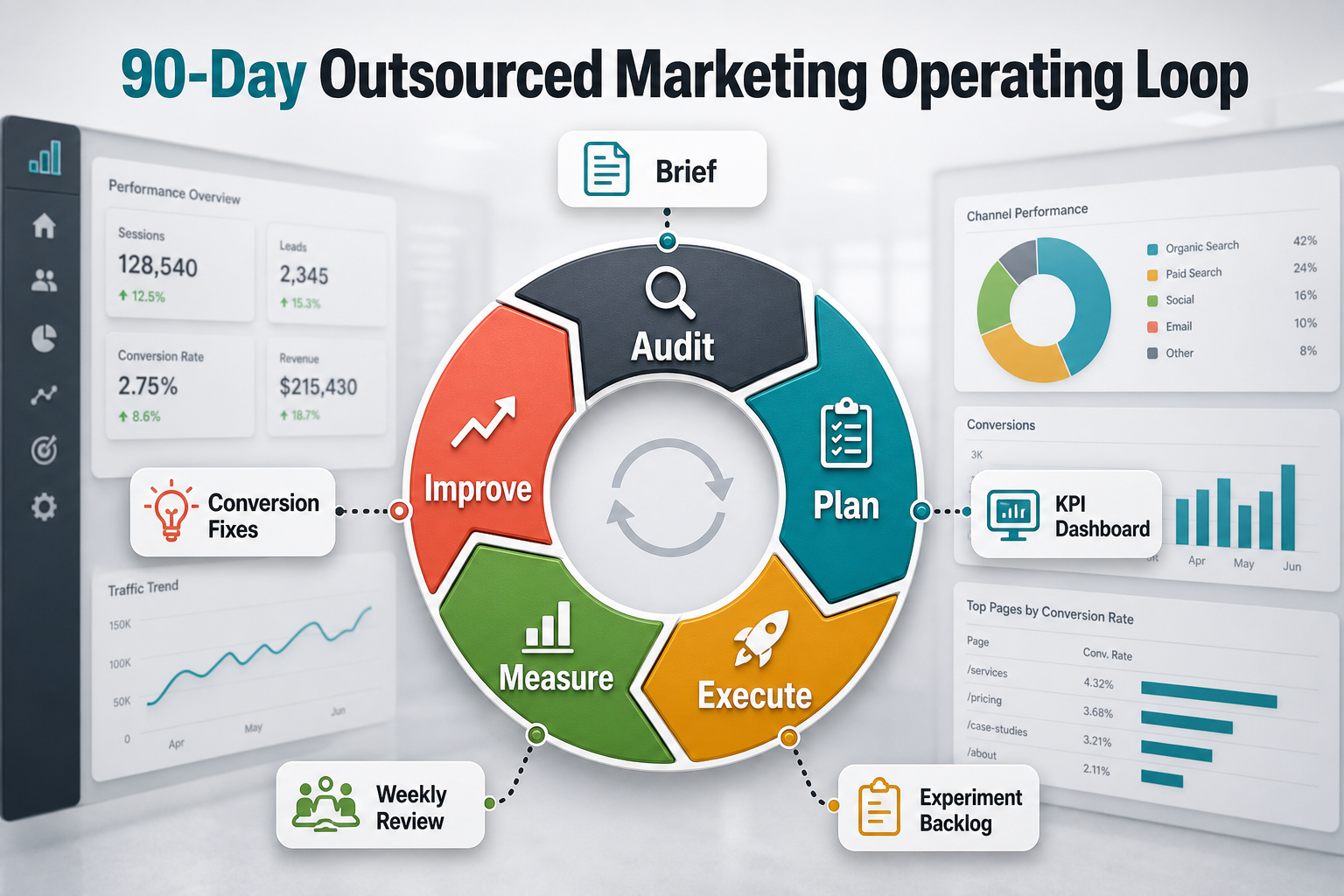
- Audit: Review current website, analytics, rankings, content, ads, conversion paths, and lead quality.
- Plan: Choose the first channels, target segments, offers, KPIs, and content priorities.
- Execute: Publish pages, launch campaigns, fix tracking, create assets, and run experiments.
- Measure: Review traffic, rankings, qualified leads, cost per lead, conversion rate, and sales feedback.
- Improve: Reallocate budget, rewrite weak pages, expand winning content, pause poor campaigns, and define the next experiment backlog.
Risks To Manage When You Outsource
Outsourcing works poorly when the business gives vague goals, delays approvals, hides sales feedback, or measures only vanity metrics. It also creates risk when the agency controls every account, document, dashboard, and creative asset without transparent access.
- Unclear ownership: Decide who owns strategy, creative approvals, budget decisions, account access, and final reporting.
- Weak measurement: Track qualified leads and revenue indicators, not only impressions, clicks, or generic traffic.
- Disconnected systems: Connect forms, CRM, analytics, call tracking, and dashboards so marketing decisions are based on real outcomes.
- Thin content: Give the outsourced team access to customer questions, sales calls, product experts, and case evidence.
- Website bottlenecks: If campaigns expose landing page or platform issues, prioritize a web app development or website improvement path instead of forcing the agency to work around weak infrastructure forever.
Modern SEO, AI Search, And Content Visibility
Digital marketing outsourcing should now account for both traditional SEO and AI-driven discovery. Buyers are using Google, ChatGPT, Perplexity, Copilot, and AI summaries to compare vendors and make shortlists. That means public pages need clear entities, direct answers, proof, schema, and helpful topic clusters.
If organic visibility is a major part of the outsourcing brief, include AI search readiness in the scope. NextPage's AI search optimization services can support the content, entity, and answer-readiness work needed when traditional SEO alone is not enough.
Final Recommendation
Outsource digital marketing when your business needs disciplined execution, specialist skills, better reporting, and faster campaign learning than the internal team can provide alone. Keep strategy, customer knowledge, and commercial priorities close to the business. Then use an outsourced partner to create the repeatable operating system that turns those priorities into measurable growth.