
Quick Answer: What Is A Digital Transformation Strategy?
A digital transformation strategy is a sequenced plan for changing how a business operates, serves customers, uses data, and makes technology decisions. It should connect measurable business outcomes to workflow redesign, software modernization, cloud readiness, data quality, AI opportunities, security controls, governance, and adoption metrics.
The useful version is not a slide deck full of tools. It is a decision system: which operating constraint should change first, which technology dependency blocks that change, which team owns adoption, and which metric proves the investment worked.
For most SMBs, the right first question is not, "Which platform should we buy?" It is, "Which workflow is limiting growth or service quality, and what modernization sequence removes that constraint without creating avoidable risk?" If the answer points to brittle systems, start with legacy software modernization. If the constraint is a unique workflow, plan a custom software development slice before committing to a broad transformation program.
Why Digital Transformation Strategies Fail
Digital transformation fails when the plan is broad enough to sound ambitious but too vague to drive trade-offs. Teams approve tools before redesigning workflows. Leaders ask for AI before cleaning up the data. Cloud migration becomes a hosting exercise instead of an operating-model change. Legacy software gets patched again because nobody has mapped what it blocks.
Those failures are usually sequencing failures. The work may be valuable, but it happens in the wrong order or without ownership. A CRM upgrade cannot fix a broken sales process. Analytics cannot produce better decisions if source systems disagree. AI automation cannot scale safely if permissions, data definitions, test cases, and escalation paths are unclear.
Recent digital and AI transformation research keeps pointing back to the same pattern: roadmaps need business alignment, operational readiness, governance, and measurable value. Gartner's 2026 AI roadmap guidance emphasizes sequencing AI workstreams by maturity and use-case priority. McKinsey's technology transformation work similarly frames modernization as gradual uplifts around data, integration, cloud, and reusable platforms rather than a big-bang rebuild.
Start With Business Outcomes, Not Tools
Transformation should begin with a small set of outcomes that leadership can actually measure. Common goals include faster quote turnaround, lower operating cost, fewer manual errors, better customer self-service, shorter fulfillment cycles, higher sales conversion, improved reporting, or reduced compliance risk.
Once the outcomes are named, map the friction behind each one. Is the problem caused by an old application, duplicated data entry, disconnected teams, slow approvals, unclear ownership, missing customer visibility, or poor integration between systems? The answer determines whether the next move is workflow redesign, modernization, cloud migration services, custom software, AI development services, or training.
This outcome-first framing protects the budget. If a technology choice does not improve one of the named outcomes, it should not be in the first wave. Use the Build Vs Buy Decision Tool when stakeholders disagree about whether a workflow needs a product, a vendor, or a custom operating layer.
Digital Transformation Roadmap For SMBs
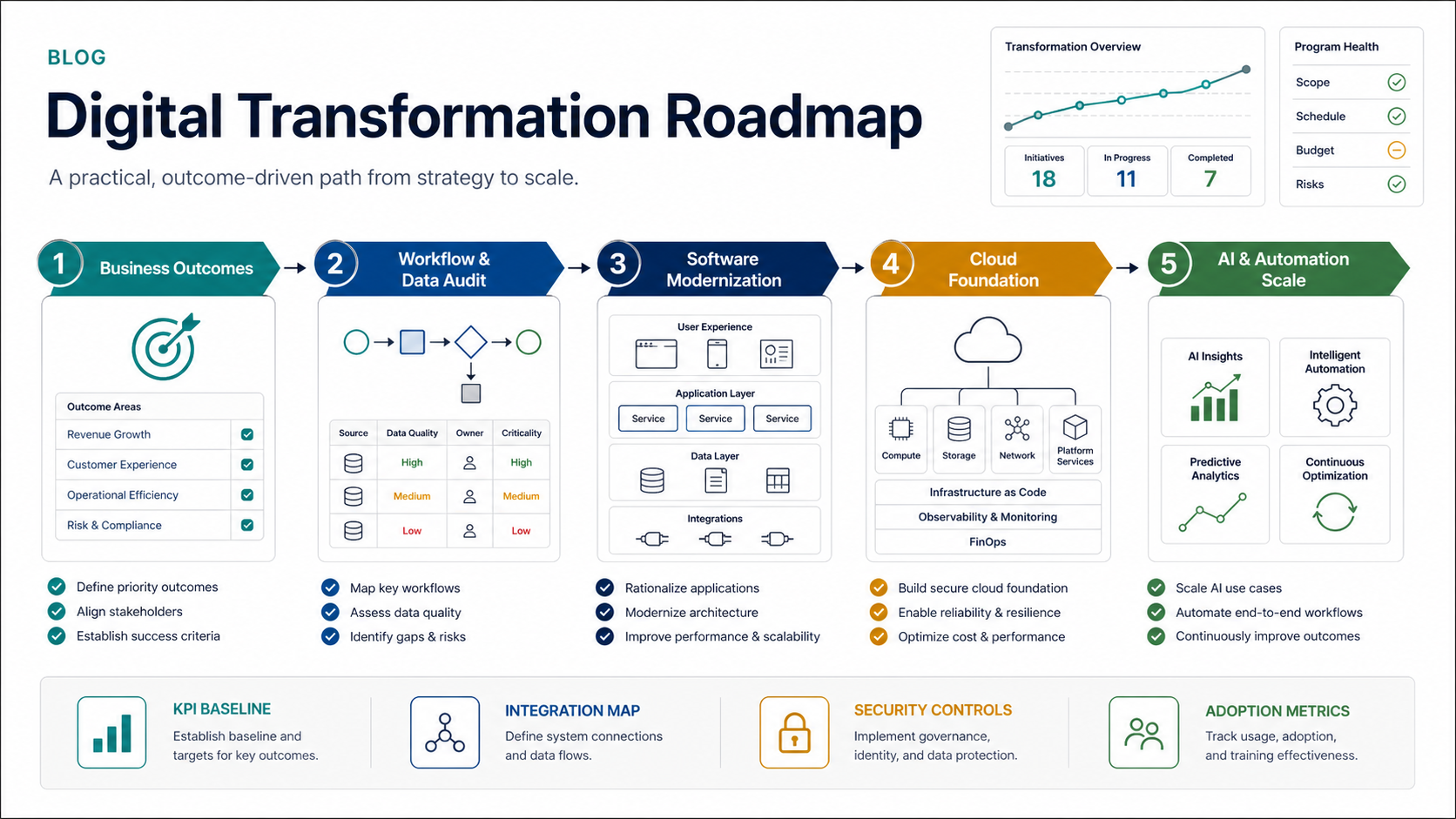
A practical roadmap should be sequenced around dependencies. Most SMB transformation programs can be organized into five connected stages. Each stage should produce evidence that informs the next decision instead of becoming a long-running parallel workstream with unclear ownership.
Stage 1: Map Operating Outcomes
Start with the workflows that most affect revenue, cost, service quality, or risk. Interview the people who live inside those workflows every day. Look for repeated handoffs, spreadsheet workarounds, unclear approval rules, support delays, duplicate entry, reporting gaps, and systems that only one person understands.
The output should be a short transformation brief: target outcome, affected teams, current friction, systems involved, business risk, estimated effort, expected impact, and success metric. This becomes the filter for every later decision.
Stage 2: Modernize The Software Layer
Many transformation plans stall because the core software layer is too fragile to support change. Old applications may lack APIs, role-based access, reliable reporting, mobile usability, or the flexibility needed for new workflows. Before adding advanced automation, decide whether the software foundation needs refactoring, replacement, integration, or a custom workflow layer.
This is where modernization becomes strategic. The goal is not to build custom technology for its own sake. The goal is to remove operating constraints that off-the-shelf tools cannot solve cleanly, while preserving the domain knowledge embedded in existing systems.
Stage 3: Build The Cloud Foundation
Cloud migration should support reliability, scalability, security, deployment speed, and cost visibility. It should not be reduced to moving servers from one place to another. The cloud plan should define which workloads move first, which data needs protection, which integrations must stay stable, and which operating practices need to change after migration.
Strong cloud work includes architecture decisions, backup and recovery planning, monitoring, access control, performance targets, and a cost-management model. If the application needs product-like scalability after migration, compare the plan against scalable software development services patterns before treating cloud as infrastructure-only work.
Stage 4: Prepare Data And AI Use Cases
AI should enter the roadmap where it can improve a known workflow, not where it sounds impressive in a slide deck. Good early use cases include customer support triage, document processing, sales assistance, forecasting, internal knowledge retrieval, quality checks, and workflow recommendations.
Before investing deeply, check whether the data is accessible, accurate, permissioned, and connected to the workflow. If the data layer is messy, the first AI project may need to be data cleanup and retrieval architecture rather than a customer-facing feature. The AI Agent Readiness Assessment is useful when leaders want to know whether the workflow is mature enough for agentic automation.
Stage 5: Govern Adoption, Security, And Scale
Transformation is operational change, so governance matters. Assign owners for each workflow, define escalation paths, measure adoption, monitor security, document decisions, and keep a visible backlog of improvements. Without governance, teams drift back to old habits or create new workarounds around the new system.
Governance does not need to be heavy. It needs to be explicit enough that people know who owns the process, what success means, what risks are unacceptable, and when the next investment should be made.
Transformation Readiness Scorecard
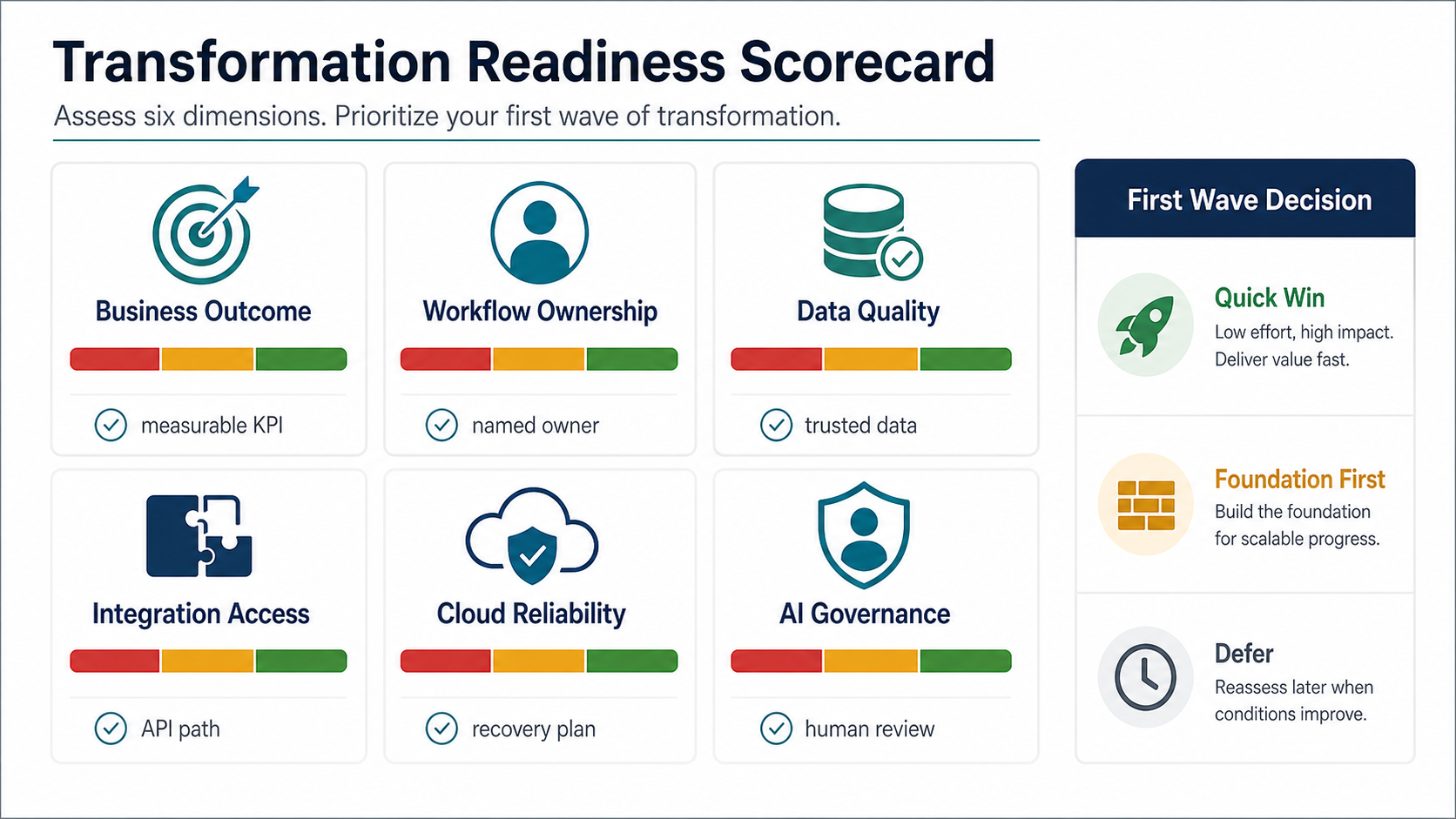
Before choosing the first project, score the business across six readiness dimensions. A high-value workflow can still be a poor first wave if the owner is unclear, data is untrusted, integration access is blocked, or the cloud foundation cannot support reliable delivery.
| Readiness area | Green signal | Warning signal | First action |
|---|---|---|---|
| Business outcome | Target KPI and baseline are visible | Goal is phrased as "go digital" or "use AI" | Name the metric and current baseline |
| Workflow ownership | One accountable process owner can make trade-offs | Every team agrees in principle but no one owns adoption | Assign owner, decision rights, and rollout role |
| Data quality | Core records have reliable identifiers and definitions | Reports disagree and manual reconciliation is normal | Clean the data path before automating decisions |
| Integration access | APIs, exports, or integration events are available | Work depends on copy-paste or one-off scripts | Map system boundaries and integration options |
| Cloud reliability | Recovery, monitoring, access, and cost controls are understood | Hosting is opaque and incidents are handled manually | Stabilize reliability and observability first |
| AI governance | Human review, permissions, evaluation, and audit logs are defined | AI use cases are ideas without controls | Start with assisted decisions and clear review gates |
If the scorecard exposes many red areas, the best transformation move may be a foundation project, not a feature launch. The Legacy Software Modernization Scorecard can help when the main blocker is a brittle application portfolio.
What To Modernize First
Prioritization should compare impact, urgency, dependency, and delivery risk. A high-impact workflow is not always the best first project if it requires a full data migration, multiple vendors, or major training before value appears. A good first wave usually creates visible progress without destabilizing the business.
| Modernization area | Prioritize it when | Delay it when |
|---|---|---|
| Customer workflow | It affects conversion, retention, service speed, or customer trust | The internal systems cannot yet support the promise |
| Legacy system replacement | The old system blocks integrations, reporting, security, or speed | The team has not mapped the workflow it needs to preserve |
| Cloud migration | Reliability, scale, deployment speed, or cost visibility is limiting growth | The workload inventory, recovery plan, or access model is unclear |
| AI automation | The workflow is repeatable, data is accessible, and quality can be measured | The data is fragmented, untrusted, or permissioned poorly |
| Analytics and dashboards | Leaders need faster decisions from agreed definitions | Source systems disagree and nobody owns data quality |
The best first project is often the one that removes a blocker for several later projects. For example, modernizing a core order-management workflow may unlock better customer updates, cleaner reporting, cloud migration, and future AI recommendations.
Build A Transformation Operating Model
A transformation roadmap needs an operating model, not just a project list. Define how decisions will be made, how scope changes will be controlled, how teams will test new workflows, and how leadership will judge progress.
- Executive owner: accountable for outcomes, trade-offs, and budget decisions.
- Process owner: responsible for the workflow being changed and the people affected by it.
- Technology owner: accountable for architecture, security, data, integration, and maintainability.
- Change lead: responsible for training, adoption, communication, feedback, and rollout readiness.
- Measurement owner: keeps the KPI definitions honest and visible.
Small teams can combine roles, but the responsibilities should not disappear. Clear ownership is what keeps transformation from becoming a scattered set of technology tasks. When the main opportunity is repeated cross-system work, the Workflow Automation Opportunity Finder can help separate automation candidates from process problems.
Metrics That Prove The Strategy Is Working
Transformation metrics should connect to the outcome behind the initiative. Avoid measuring only activity, such as number of tools launched or meetings completed. Useful measures show whether the business is working differently.
- Speed: cycle time, response time, release frequency, quote turnaround, approval duration.
- Quality: error rate, rework, support tickets, failed handoffs, data accuracy.
- Adoption: active users, workflow completion, old-system usage, manual workaround volume.
- Customer impact: conversion, retention, satisfaction, self-service usage, resolution time.
- Financial impact: cost to serve, operational savings, revenue lift, infrastructure cost visibility.
- Risk control: uptime, access exceptions, audit findings, incident response time, backup recovery evidence.
Set a baseline before the project starts. Without a baseline, teams end up debating whether the change helped instead of improving the next release. If leaders need a first-pass automation business case, pair the operating metric with the AI Automation ROI Calculator.
Budget And Risk Controls
Digital transformation budgets go off track when teams fund a large vision without decision gates. Use staged investment instead. Fund discovery and roadmap work first, then a pilot or modernization slice, then broader rollout after the first measurable proof.
Each stage should answer a decision question. Did we validate the workflow? Did the new system reduce manual effort? Did the migration improve reliability without increasing operational overhead? Did the AI pilot perform well enough to expand safely?
Risk controls should also be part of the roadmap. Include data backup, rollback plans, access control, vendor exit paths, security review, integration monitoring, and user training. The bigger the operational dependency, the more explicit the control plan needs to be. The release evidence discipline in the Pre-Launch QA Checklist For Custom Software is a useful pattern for transformation slices too.
Where AI Fits In A Transformation Strategy
AI is most valuable when it is attached to a process that already has a clear owner, clean enough data, and a measurable decision point. It is least valuable when it is bolted onto a broken workflow to create the appearance of modernization.
Good AI candidates usually share four traits. The task is repeatable. The data is available. The result can be evaluated. A human escalation path exists for uncertain cases. If those traits are missing, the roadmap should first address process design, data readiness, or governance.
Start with narrow pilots: internal search, document classification, support routing, lead qualification, anomaly detection, or operations copilots. Then expand only after the pilot proves accuracy, adoption, and operational value. For agentic workflows, use the governance patterns in the Enterprise AI Agent Governance guide before giving systems tool access.
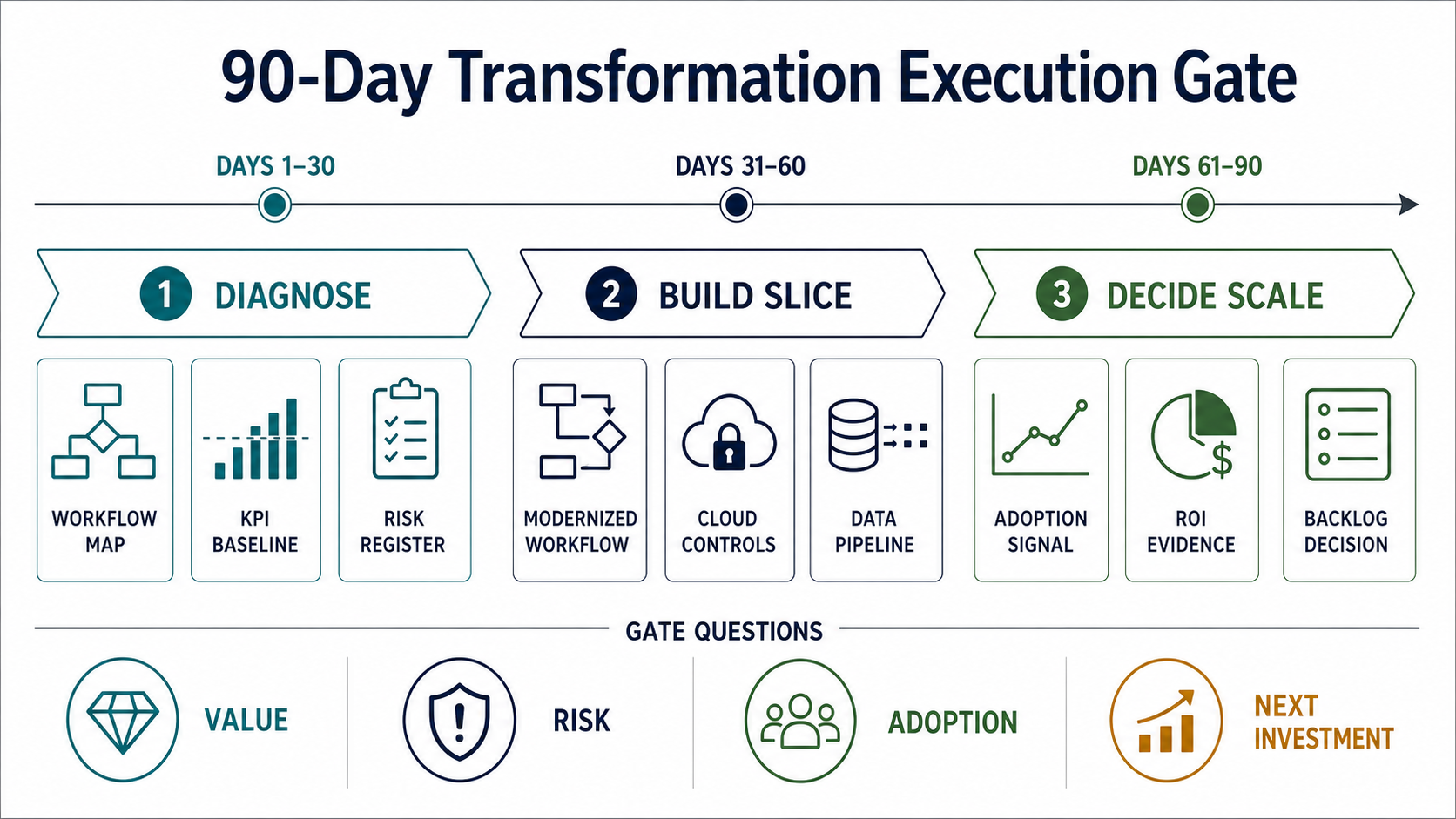
90-Day Transformation Execution Gate
A transformation roadmap becomes credible when the first 90 days produce evidence. Avoid launching a year-long program before the organization has proven that one workflow can be improved, adopted, measured, and governed.
- Days 1-30: diagnose. Map the workflow, capture baseline metrics, identify system dependencies, list risks, and agree on the first slice.
- Days 31-60: build the slice. Modernize one workflow path, connect required systems, add cloud or data controls, and test with real users.
- Days 61-90: decide scale. Review adoption, ROI, risk evidence, support load, and backlog quality. Then decide whether to scale, pivot, pause, or fix the foundation first.
The gate should ask four questions: did value improve, did risk stay controlled, did people adopt the workflow, and is the next investment clearer than it was before the slice started?
Portfolio Patterns That Match Transformation Work
Digital transformation can sound abstract until it is mapped to concrete operating systems. A maintenance workflow, fleet platform, internal admin surface, customer portal, or reporting layer all become transformation work when they change how teams coordinate, capture data, serve customers, and make decisions.
For example, the OpsLink case study shows how maintenance, tickets, work orders, forms, tables, and mobile workflows can become a role-aware operations platform. The LinePilot case study shows a connected race operations platform where data, scheduling, and field coordination matter as much as UI. These are the kinds of workflow systems that often sit behind real transformation outcomes.
Use portfolio patterns to make the roadmap specific. If the strategy says "improve operations," define which workflow will change, which roles will use it, which systems must integrate, which metric will move, and what evidence will prove the next wave is worth funding.
Common Mistakes To Avoid
- Buying tools before redesigning workflows. New software will not fix an unclear process.
- Starting with AI before data readiness. AI quality depends on accessible, trusted, permissioned data.
- Moving to cloud without operating changes. Cloud value comes from architecture, monitoring, deployment, security, and cost discipline.
- Modernizing everything at once. Broad scope increases risk and delays proof.
- Ignoring adoption. A system that people avoid is not a successful transformation.
- Skipping measurement baselines. Without a baseline, ROI becomes a story instead of evidence.
How NextPage Helps Build The Roadmap
NextPage approaches digital transformation as a sequence of business decisions before it becomes a build plan. The first step is to clarify the outcome, map the workflows and systems behind it, and decide which modernization move creates the strongest foundation for the next one.
For some teams, that means replacing a brittle legacy workflow. For others, it means building a custom software layer around operations, preparing the cloud foundation, or piloting AI inside a controlled process. The right roadmap may include all of those, but the order matters.
If you want a practical plan for what to modernize first, what to defer, and how to connect software, cloud, and AI investment to measurable outcomes, request a transformation roadmap call. The goal is not to chase every technology trend. It is to build the next operating system your business can actually use.