
Quick Answer: Language App Development Strategy
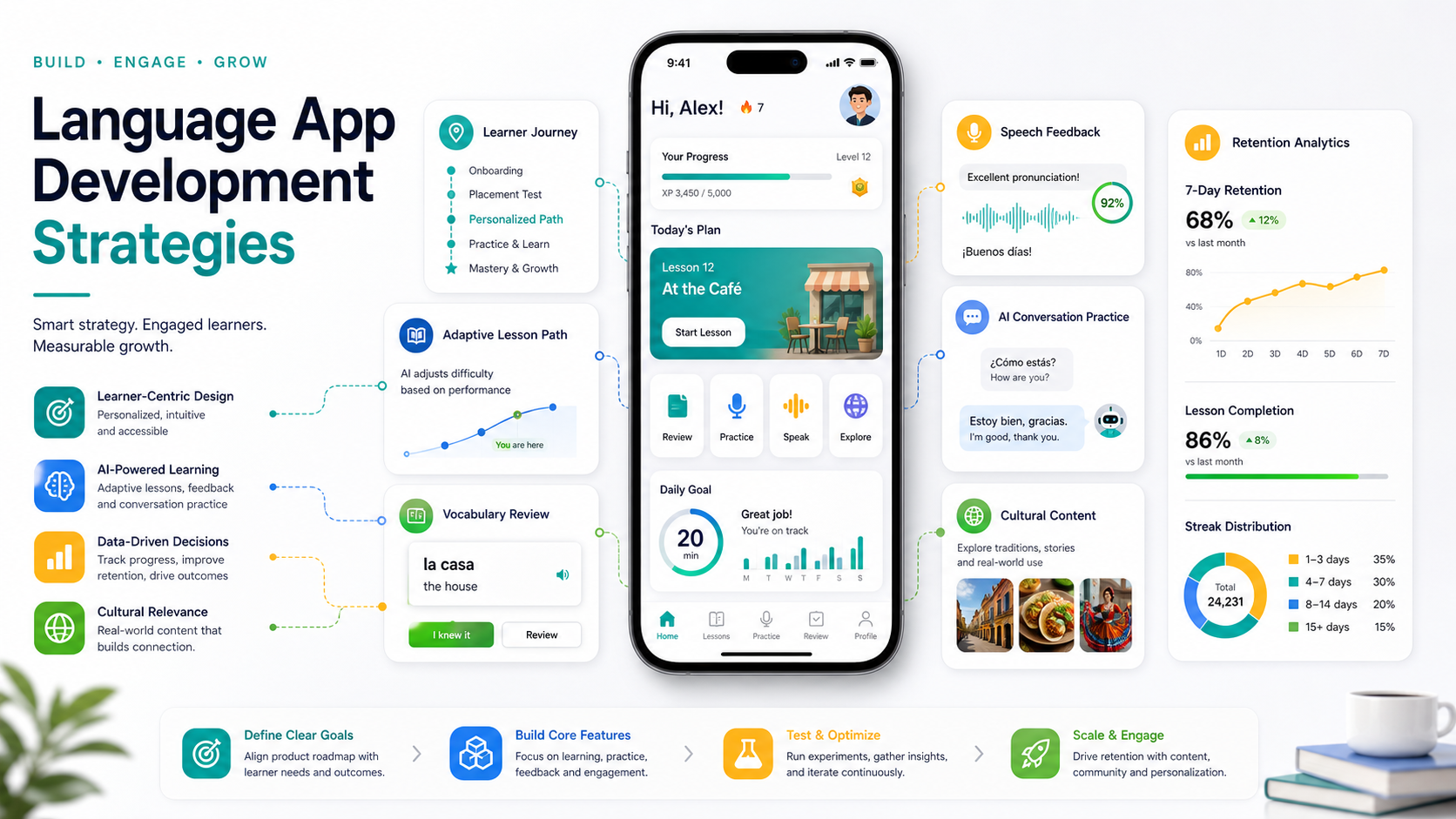
A strong language learning app helps users practice consistently, speak with confidence, remember vocabulary, understand real accents, and see what to do next. For product teams, that means the app strategy should connect learner goals, adaptive lessons, speech feedback, content operations, retention loops, accessibility, privacy, and analytics from the first release.
If the product needs native iOS and Android behavior, audio capture, offline lessons, push reminders, payments, and scalable backend services, treat it as a full mobile app development program rather than a simple content app. Language products succeed when pedagogy, product design, AI workflows, and operations are planned together.
Start With The Learner Journey
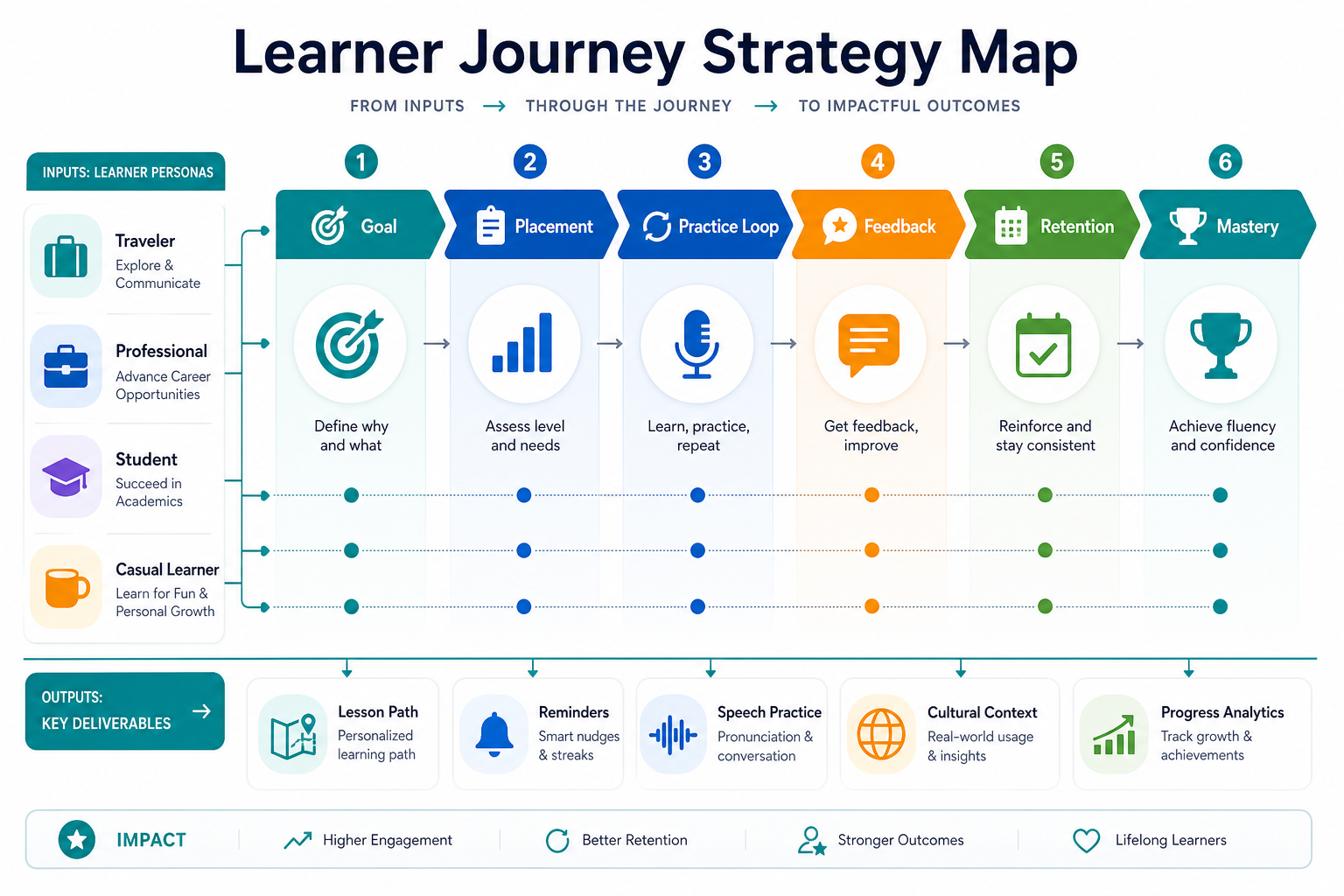
Language apps should not begin with a generic feature list. Start by defining who the learner is, why they are learning, what level they are at, how much time they can practice, and what success looks like. A traveler, school student, business professional, immigrant, hobby learner, and enterprise trainee all need different onboarding, lesson depth, vocabulary, speaking practice, and accountability.
The guide to user personas in app development is useful here because language learning outcomes depend heavily on motivation and context. Persona research should capture target language, current proficiency, confidence with speaking, preferred lesson length, native language, accessibility needs, and willingness to pay.
Prioritize Features By Learning Outcome
The best language apps combine multiple learning modes, but not every feature belongs in the first release. Prioritize the features that help users return, practice out loud, and improve a measurable skill.
| Strategy Area | What To Build | Why It Matters |
|---|---|---|
| Placement and goals | Level check, learner goal, target language, daily practice plan. | Users need the right starting point and a clear reason to return. |
| Adaptive lessons | Lesson paths that adjust by accuracy, speed, weak skills, and completion. | Practice should stay challenging without becoming frustrating. |
| Speaking feedback | Audio prompts, pronunciation scoring, role-play, and clear correction. | Fluency requires active production, not only recognition. |
| Vocabulary retention | Spaced repetition, contextual phrases, review queues, and recall checks. | Words stick when users see and use them repeatedly. |
| Immersion content | Native-speaker video, culture notes, everyday scenarios, and listening drills. | Real-world language includes accents, context, idioms, and pace. |
| Retention loops | Streaks, reminders, goals, progress views, and milestone rewards. | Small daily sessions compound only when users keep coming back. |
Build Adaptive Learning Paths
Adaptive learning should do more than shuffle lessons. The app should observe where the learner struggles, then adjust review, difficulty, examples, and feedback. Useful signals include answer accuracy, hesitation, pronunciation attempts, skipped exercises, lesson completion, vocabulary recall, and time between sessions.
A practical first release can start with rules-based adaptation: repeat missed words, increase speaking prompts for users who avoid audio, and unlock harder lessons only after mastery checks. More advanced versions can use machine learning to recommend lessons, predict churn risk, and personalize review intervals.
Design AI Speaking Practice Carefully
AI speaking practice is now a major expectation in language learning products. Duolingo has highlighted AI-powered Video Call and Adventures, Babbel documents speech recognition feedback, Memrise promotes MemBot as an AI language tutor, and Rosetta Stone has long emphasized speech recognition through TruAccent. The product lesson is clear: users want safe, low-pressure speaking practice before they speak in the real world.
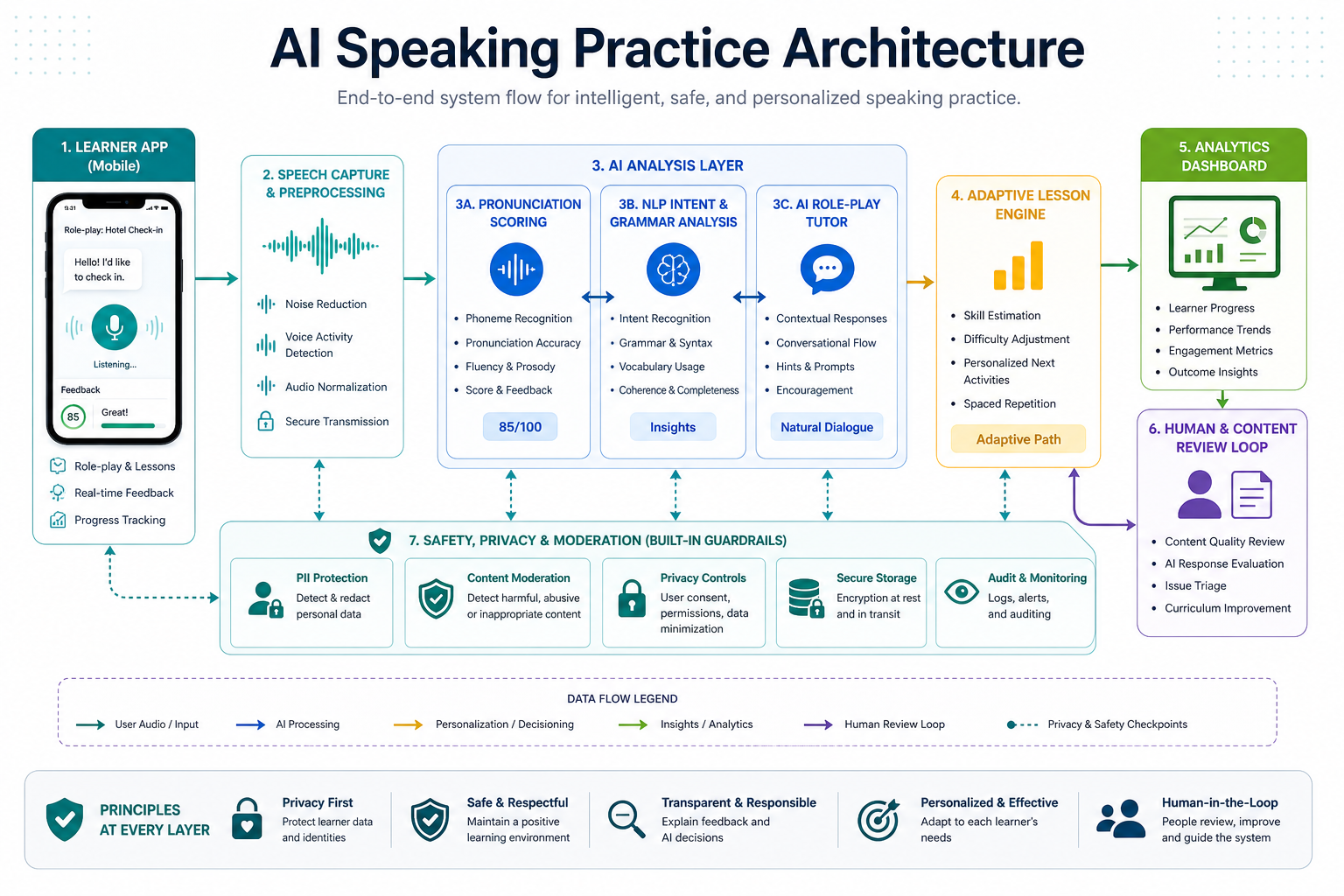
For builders, AI speaking practice is not just a chatbot. It needs speech capture, transcription, pronunciation scoring, grammar feedback, level-aware prompts, moderation, privacy rules, analytics, and graceful fallback when recognition is uncertain. NextPage's AI chatbot development process is relevant when conversation practice needs role-play flows, learner-safe responses, and production monitoring.
Use NLP For Feedback, Not Just Conversation
Natural language processing can support grammar checks, syntax feedback, pronunciation scoring, intent recognition, vocabulary suggestions, and conversation simulation. The key is making feedback actionable. A learner should know what was wrong, hear or see a better version, and get a short follow-up exercise.
Keep confidence scores and uncertainty visible in the product logic. If the app is not confident about a pronunciation judgment, it should retry, show an example, or switch to a different exercise rather than marking the learner wrong without explanation.
Make Immersion Practical
Immersion does not require a heavy VR world for every app. Most teams should start with practical immersion: native-speaker clips, everyday scenarios, local phrases, cultural notes, listening at different speeds, and prompts based on real moments such as ordering food, joining a meeting, booking a hotel, or introducing yourself.
Augmented reality, virtual reality, and location-based tasks can be useful for advanced products, but they should solve a real learner problem. Build them after the core practice loop already works.
Gamification Should Reinforce Learning
Streaks, badges, levels, points, and challenges can increase engagement, but they should not distract from learning. Reward meaningful behavior: completing a speaking exercise, reviewing weak words, returning after a missed day, passing a mastery check, or practicing in a real-world scenario.
Avoid designs that reward speed over accuracy or pressure users into low-value sessions. Good gamification makes the next useful action obvious and gives users a sense of progress without hiding the learning goal.
Community And Native-Speaker Features
Language is social, so community features can add real value. Useful options include peer practice rooms, native-speaker exchanges, moderated forums, instructor feedback, cohort challenges, and safe messaging. These features need trust controls, reporting, moderation, and clear boundaries for minors or school users.
Do not launch a full community layer before you can operate it. Start with small, structured interactions such as prompt-based peer review or scheduled speaking sessions, then expand when usage and moderation capacity are proven.
Content Operations Are A Product System
Language content ages and expands. Teams need workflows for new vocabulary, idioms, cultural references, audio recordings, translations, review, quality assurance, and regional variants. Without content operations, every update becomes a manual engineering task.
Build admin tools for lesson publishing, content tagging, audio review, translation status, curriculum versions, and analytics. This is especially important when the app supports many languages, multiple proficiency levels, or classroom use.
Accessibility, Offline, And Localization
Language apps should support different learning needs. Accessibility work can include captions, adjustable text size, keyboard navigation, screen-reader-friendly screens, high-contrast UI, audio transcripts, voice input alternatives, and practice modes that do not require speaking in public.
Offline access is also important. Learners may practice during commutes, travel, or low-connectivity moments. Let users download lessons, audio, vocabulary decks, and review queues, then sync progress safely when the device reconnects.
If the app itself targets global learners, localization is not just translation. It affects examples, cultural references, payment methods, app store listings, onboarding language, support, and notifications. The app launch plan should include app store optimization for each priority market.
Monetization And MVP Scope
Language apps commonly use subscriptions, freemium access, premium courses, tutoring, certificates, school licensing, enterprise training, or marketplace revenue. The model should match the value curve: users may try basic lessons for free, then pay for deeper content, speaking feedback, offline access, tutoring, or structured progression.
The supporting article on language learning app monetization covers revenue options in more depth. For a first release, keep the monetization promise simple and prove retention before expanding into too many languages, course types, or AI features.
Budget And Technical Scope
Language app development cost depends on mobile platforms, content depth, audio production, speech recognition, AI role-play, subscriptions, offline sync, admin tools, analytics, accessibility, classroom features, and support workflows. A focused MVP can be much smaller than a full Duolingo-style learning platform.
Use the Custom Software Cost Estimator when comparing a basic lesson app, a consumer subscription product, or an AI-heavy language platform. The estimate will be more useful if you already know the target learner segment, first language pair, content volume, AI scope, and launch market.
Analytics That Matter
Measure progress and product health together. Useful metrics include onboarding completion, first lesson completion, daily active learners, seven-day retention, speaking exercise attempts, pronunciation improvement, vocabulary recall, lesson mastery, subscription conversion, churn, and support issues.
Do not rely only on streaks or time spent. A language app can be sticky without improving fluency. Track whether learners are practicing the skills the product promises to improve.
Common Mistakes To Avoid
- Launching too many languages at once: quality drops quickly when content, audio, and review workflows are not ready.
- Treating AI as a shortcut for pedagogy: AI tutors still need level design, feedback rules, safety controls, and evaluation.
- Adding gamification without learning value: points and streaks should reinforce useful practice.
- Ignoring speech privacy: voice data, transcripts, and learner history require clear policies and secure handling.
- Underbuilding admin tools: curriculum updates, audio fixes, and content QA should not require developer intervention every time.
How NextPage Can Help
NextPage can help plan and build language learning apps from product discovery through UX, mobile apps, backend APIs, AI conversation workflows, content operations, analytics, QA, and launch support. If AI is central to the product, NextPage's AI development services can help define model selection, evaluation, privacy controls, and production monitoring before the app scales.
The best first step is a focused product strategy workshop: define the learner segment, first language pair, lesson model, speaking loop, content workflow, launch metrics, and technical risks. From there, the MVP can be narrow enough to ship and strong enough to prove whether learners keep practicing.