
Quick Answer: How Do You Turn A Fitness App Idea Into A Real Product?
Start by choosing the fitness outcome the app will own: habit building, workout coaching, nutrition support, wearable tracking, community accountability, trainer operations, or corporate wellness. Then define the smallest product that can deliver that outcome reliably across onboarding, plan creation, activity logging, progress feedback, notifications, support, and basic admin controls.
A fitness app is not only a set of workout screens. It needs product strategy, behavior design, mobile engineering, data privacy, performance testing, and launch analytics. If the product needs iOS, Android, backend APIs, QA, analytics, and release support, treat it as a full mobile app development project rather than a quick content app.
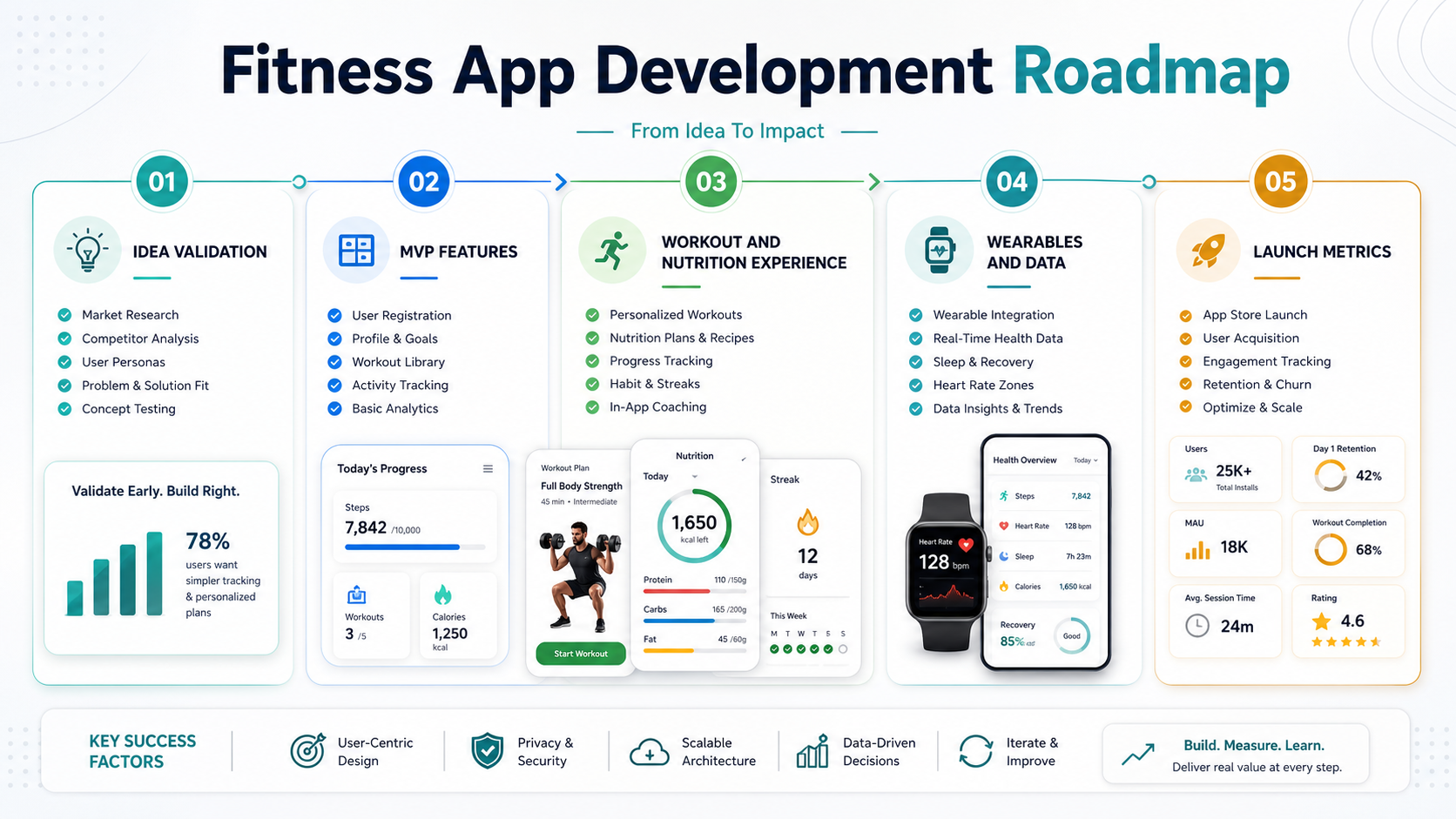
Define The Fitness App Model Before Features
The best first decision is the business model. A consumer workout app, trainer marketplace, gym companion app, nutrition tracker, running app, wellness habit product, and corporate fitness platform all need different journeys. A trainer-led product may need coach dashboards and program assignment, while a self-guided workout app needs strong content structure, personalization, reminders, and progress feedback.
Clarify the target user, use frequency, monetization model, content ownership, device integrations, and support model. This prevents the team from building a broad feature list that looks impressive but does not solve a repeatable user problem.
Validate The Idea With Real User Behavior
Idea validation should test more than whether users like the concept. Fitness products compete with low-cost apps, YouTube workouts, gyms, personal trainers, wearable ecosystems, and habit fatigue. Validate the exact motivation that would make users open the app repeatedly.
Use interviews, prototype testing, landing page demand, early community feedback, and concierge-style coaching experiments. Segment users carefully: beginners, runners, strength athletes, yoga users, people managing weight, people returning after injury, coaches, gyms, and corporate wellness teams have different trust and retention triggers. The post on user personas in app development is useful when turning those segments into product decisions.
Fitness App MVP Scope
A strong MVP should help users start, complete, and repeat a fitness habit while giving the business enough data to improve the product. Avoid launching with every advanced feature at once. Build the core loop first: goal setup, plan recommendation, workout or activity completion, progress feedback, reminders, and support.
| Area | MVP Scope | Why It Matters |
|---|---|---|
| Onboarding | Goals, fitness level, constraints, preferred activities, schedule, consent, and notification preferences. | Personalization starts with safe, relevant user context. |
| Workout experience | Workout library, plan view, exercise instructions, timers, substitutions, logging, and completion feedback. | Users need confidence during the session, not only a list of exercises. |
| Progress tracking | Activity history, streaks, measurements, milestones, and simple insights. | Progress visibility supports retention and paid conversion. |
| Admin or coach tools | Content management, user segments, plan templates, support, and basic analytics. | The business needs to update programs and observe adoption after launch. |
If the team needs an early budget and timeline range before detailed discovery, the Custom Software Cost Estimator can help frame the likely investment level.
Fitness App MVP Feature Matrix
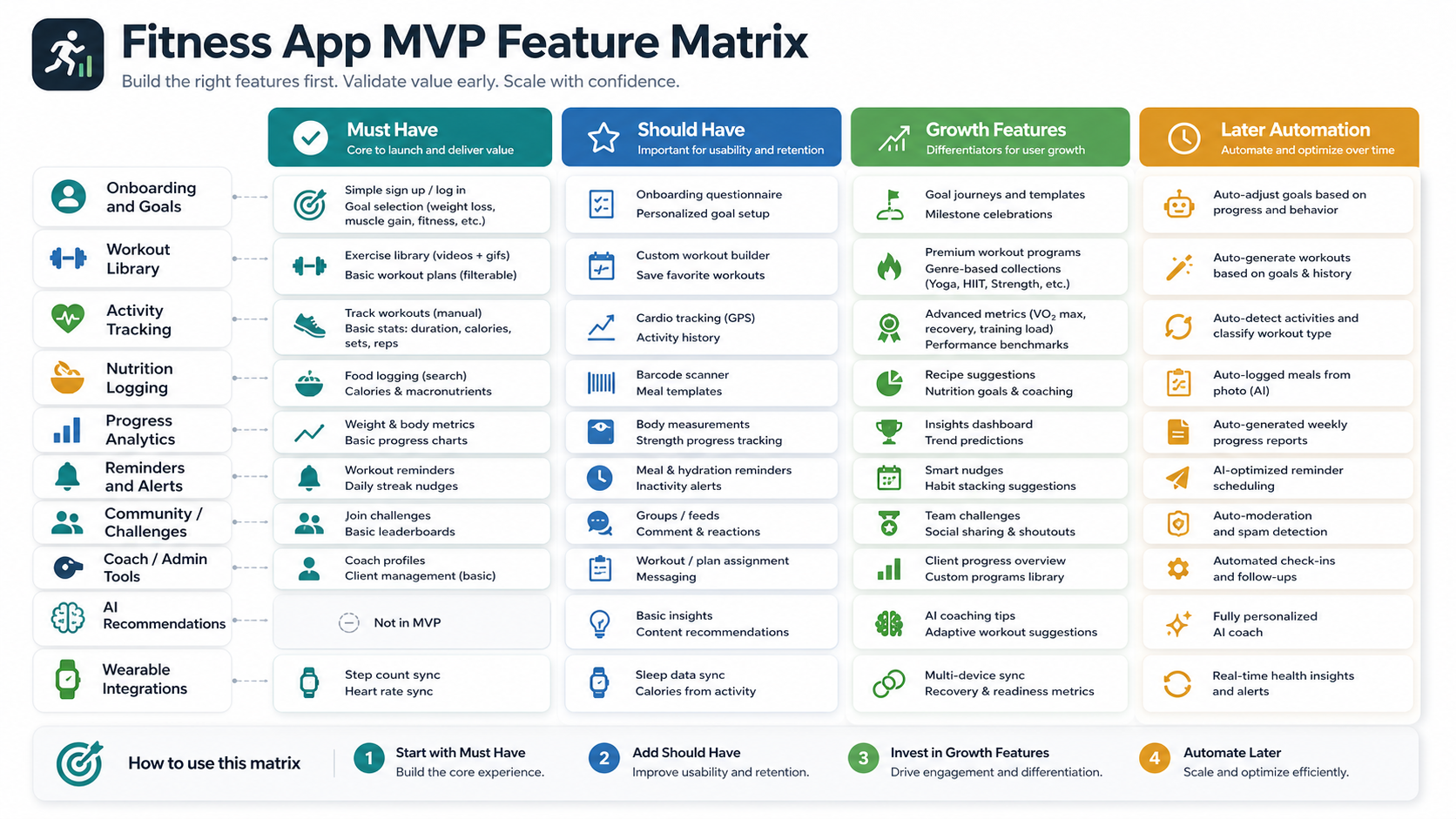
Must-Have Fitness App Features
The first release usually needs account setup, goal setting, plan selection, workout instructions, activity logging, progress tracking, reminders, push notifications, profile management, help or support, and basic analytics. For paid products, add subscription or payment flows, entitlement checks, and clear upgrade prompts.
Should-Have Features For Retention
Retention improves when users receive timely feedback. Useful additions include streaks, milestone badges, adaptive reminders, workout substitutions, short educational content, nutrition logging, habit check-ins, calendar views, and recovery prompts. For wellness-adjacent products, the guide to developing wellness apps for iOS and Android gives related product context.
Growth And Community Features
Community challenges, leaderboards, referrals, coach messaging, group programs, social sharing, and progress posts can help growth, but they should be added after the core experience works. Fitness users can abandon noisy social features quickly if the app does not already help them complete workouts or track progress.
Later Automation And AI Features
AI workout recommendations, form feedback, nutrition suggestions, and automated coaching should come after the data model, content quality, and safety rules are mature. Automation needs clear boundaries because health-related guidance can affect trust and user safety.
Design The User Experience For Habit Formation
Fitness UX should reduce friction at the moments users are most likely to quit: setup, first workout, missed day, unclear progress, and plateau. Keep onboarding short, show immediate value, make the next action obvious, and avoid shaming users for missed activity.
Use clear exercise instructions, accessible contrast, readable timers, offline-tolerant workout flows, and quick logging. The UX lessons in mental wellness app interface design also apply here: sensitive health-adjacent apps need calm copy, privacy clarity, and supportive progress feedback.
Choose The Right Technology Stack
Technology choice depends on performance, device access, content complexity, integrations, and team constraints. Cross-platform frameworks can be a good fit for many fitness MVPs, especially when the app uses standard screens, APIs, payments, notifications, and analytics. Native development may be better when the product depends heavily on sensors, background tracking, Bluetooth devices, advanced media, or strict performance requirements.
For a deeper tradeoff, compare native versus cross-platform mobile app development. Decide early how the backend will handle authentication, workouts, progress events, subscriptions, notifications, analytics, admin content, and third-party integrations.
Wearable Data And Privacy Architecture
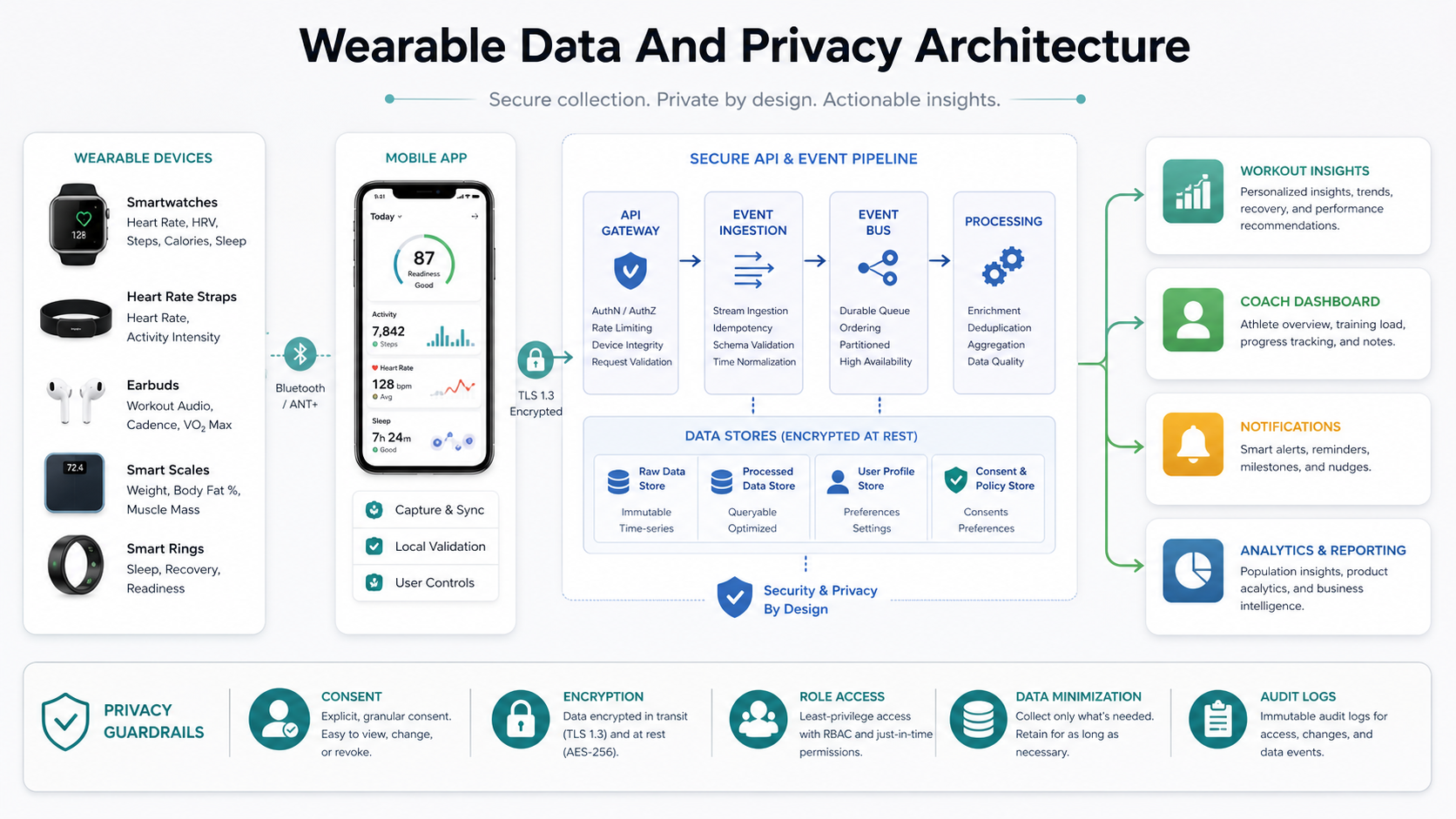
Wearables can improve a fitness app with steps, workouts, heart rate, sleep, calories, GPS activity, recovery signals, and device-specific achievements. They also increase engineering and privacy responsibility. Users should understand what is connected, what is synced, what is stored, and how they can revoke access.
Build wearable integration around consent, data minimization, secure token storage, retry handling, duplicate event prevention, rate limits, and clear fallback states when device data is delayed. If the app includes coach or admin views, use role-based access so sensitive user data is visible only to authorized people.
Security And Health Data Privacy
Fitness apps often collect sensitive information: age, weight, health goals, injuries, activity patterns, location routes, photos, nutrition, payments, and wearable data. Security cannot be added at the end. Plan encryption in transit, secure authentication, least-privilege admin access, audit logs, privacy settings, and deletion/export workflows from the beginning.
Be careful with medical claims. Unless the product is designed and governed as a medical or regulated health product, position guidance as fitness and wellness support, not diagnosis or treatment. Use simple privacy copy and avoid collecting data the app does not need.
Development And Testing Process
- Discovery: define user segments, outcomes, business model, content model, device integrations, compliance assumptions, and success metrics.
- Product design: prototype onboarding, workout completion, progress feedback, reminders, subscriptions, and admin workflows.
- Architecture planning: define APIs, data model, content management, notification rules, analytics events, payment flows, and wearable integration boundaries.
- MVP build: implement the mobile app, backend, admin tools, content workflows, subscriptions, notifications, QA, and release pipeline.
- Testing: test slow networks, offline sessions, timer behavior, duplicate logs, wearable sync delays, payment failures, privacy settings, accessibility, and device performance.
- Launch and iterate: track activation, workout completion, retention, subscription conversion, support issues, and user feedback before expanding the feature set.
Fitness app testing should cover real usage, not only clean demo flows. Users may start a workout with low battery, switch apps during a timer, lose connectivity outdoors, connect multiple devices, pause subscriptions, or miss a week and return later.
Fitness App Development Cost Drivers
Fitness app development cost depends on scope depth. A basic content and logging MVP is much smaller than a platform with subscriptions, coach dashboards, wearable integrations, video libraries, personalized plans, social features, AI recommendations, and enterprise wellness reporting.
| Cost Driver | Lower Complexity | Higher Complexity |
|---|---|---|
| Product model | Self-guided workout library and progress logs. | Trainer marketplace, gym platform, corporate wellness, or multi-tenant coaching. |
| Personalization | Manual goals and static plans. | Adaptive plans, recommendations, AI support, and coach overrides. |
| Media and content | Text instructions and simple images. | Video library, streaming, offline media, localization, and content operations. |
| Integrations | Payments, notifications, analytics. | Apple Health, Google Fit, wearables, CRM, marketing automation, and data warehouse. |
| Security and privacy | Standard auth and privacy settings. | Advanced consent, audits, enterprise permissions, and regulated workflows. |
Launch And Growth Plan
Launch planning should begin before development finishes. Prepare app store assets, onboarding analytics, lifecycle emails or notifications, referral flows, support scripts, content updates, and post-launch experiment ideas. The guide on App Store Optimization for app listings can help with screenshots, descriptions, and benefit-led positioning.
Track activation rate, first workout completion, seven-day retention, workout completion frequency, notification opt-in, subscription conversion, churn, support tickets, wearable connection rate, and content engagement. These metrics show whether the app is helping users build habits or only attracting installs.
Common Mistakes To Avoid
- Starting with too many features: a focused habit loop beats a crowded app users do not understand.
- Ignoring content operations: workouts, programs, videos, and nutrition guidance need updating after launch.
- Treating wearables as a simple add-on: syncing, consent, delayed data, and privacy controls need deliberate architecture.
- Using generic UX patterns: fitness apps need motivation, accessibility, recovery from missed days, and clear progress feedback.
- Skipping post-launch analytics: without event tracking, the team cannot see activation, retention, or monetization problems.
How NextPage Can Help
NextPage can help turn a fitness app idea into a practical product plan, clickable prototype, MVP, backend platform, admin system, integrations, QA process, and launch roadmap. The strongest first step is product discovery: define the user segment, behavior loop, feature priority, data model, privacy requirements, and release plan before writing production code.
If you are planning a workout, wellness, nutrition, wearable, trainer, gym, or corporate fitness platform, start with the smallest app that can create repeat usage and measurable progress. Once that loop is working, advanced personalization, social features, and automation become easier to justify.