
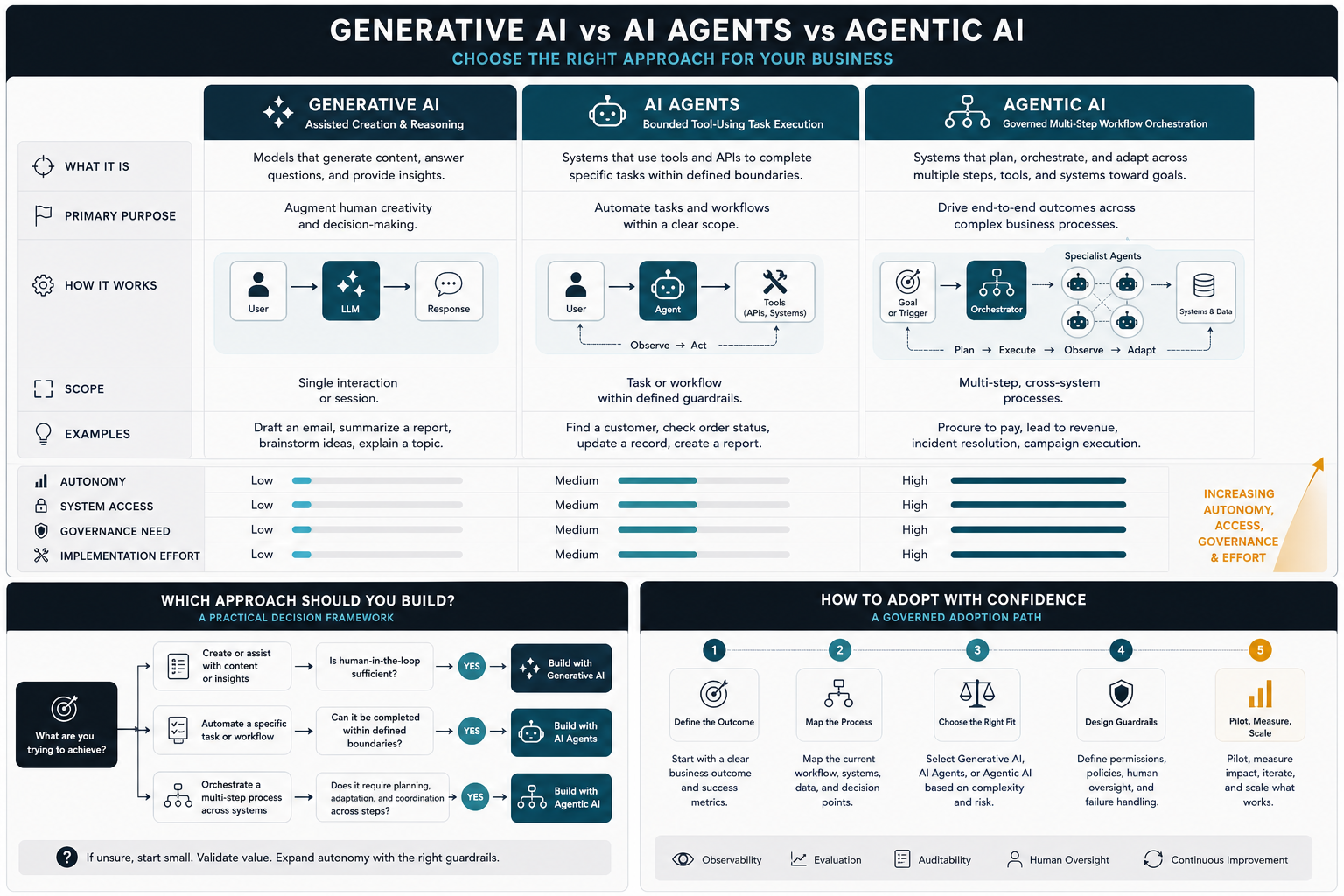
Generative AI, AI agents, and agentic AI are related, but they solve different business problems. Generative AI helps people create, summarize, classify, or reason over information. AI agents go a step further by using tools and APIs to complete a bounded task. Agentic AI coordinates multi-step work across systems, roles, and policies with stronger governance.
The safest build choice is usually the least autonomous system that can reliably solve the workflow. Use generative AI when a person can review the output before it changes anything. Use an AI agent when the task has a clear goal, scoped tools, testable success criteria, and a human handoff for exceptions. Use agentic AI when the business needs governed orchestration across several systems, approvals, and state changes. If you already have a candidate workflow, start with the AI Agent Readiness Assessment before choosing an architecture.
Quick Answer: Generative AI vs AI Agents vs Agentic AI
Generative AI produces or transforms content in response to prompts. It is best for drafting, summarizing, retrieval-assisted answers, classification, translation, explanation, and idea generation. AI agents use a model plus instructions and tools to act inside a defined workflow. Agentic AI is the broader operating model where one or more agents coordinate actions, state, rules, approvals, and monitoring across a business process.
For a business buyer, the practical difference is not vocabulary. The practical difference is operational responsibility. As autonomy increases, the system needs stronger evaluation, permissions, auditability, rollback, and ownership. A document assistant can be useful with review queues. A support triage agent needs CRM or helpdesk permissions. An agentic claims, onboarding, procurement, or finance workflow needs runtime monitoring, escalation rules, and accountable owners.
What Generative AI Is Best For
Generative AI is strongest when the job is to create, summarize, classify, rewrite, translate, explain, or reason over information. It works well for draft emails, knowledge-base answers, product descriptions, research summaries, policy explanations, code assistance, and first-pass analysis. The output can be valuable even when a human stays in charge of the final decision.
In production, generative AI still needs software around it. Teams often need retrieval, prompt workflows, evaluation sets, logging, permissions, and a review interface. Serious generative AI development is not only a model API integration; it is the surrounding product, context, quality, privacy, and workflow design that makes the model useful.
Use generative AI when the output can be reviewed before it affects a customer, record, payment, legal commitment, or operational decision. It is usually the right first step when a team is building AI fluency, reducing repetitive writing, searching private knowledge, or improving analysis speed without granting write access to business systems.
What AI Agents Add
An AI agent adds action. Instead of only producing an answer, it can inspect context, choose a tool, call that tool, review the result, and decide what should happen next. A useful business agent might read a support ticket, retrieve account history, draft a reply, create an internal task, and ask for approval before sending anything to the customer.
The implementation shift is tool access. Once an AI system can update records, send messages, change schedules, trigger workflows, or affect money, the project becomes production software with permissions, state, tests, logs, and rollback paths. The best first agents are narrow: one workflow, clear success criteria, limited write access, realistic eval cases, and explicit failure behavior.
This is where AI development services should feel more like product engineering than experimentation. The goal is not a clever demo. The goal is a dependable workflow that can be measured, supported, and improved after launch.
What Agentic AI Means In Practice
Agentic AI is best understood as a coordinated system of autonomy. It may include one agent with a planning loop, several specialized agents, a manager-worker pattern, or a workflow engine that combines agents with deterministic software. The important part is not the number of agents. The important part is that the system can pursue a goal across steps while staying inside business rules.
For example, an agentic customer onboarding system might read contract details, create project tasks, check missing documents, draft kickoff notes, update a CRM, alert finance, and escalate exceptions to a human owner. That is not just a chatbot. It is an operating workflow that needs observability, policy checks, permission boundaries, and human-on-the-loop monitoring.
Agentic AI fits work that is repeatable, valuable, and spread across multiple systems. It is risky when the workflow is poorly understood, data is unreliable, permissions are too broad, or nobody owns exceptions. For buyers who already know the workflow requires controlled orchestration, agentic AI development services should focus on governance, integration, and operating model design as much as model behavior.
Comparison Table
| Dimension | Generative AI | AI Agents | Agentic AI |
|---|---|---|---|
| Primary job | Create, summarize, classify, or explain information | Complete a bounded task with tools | Coordinate multi-step work across systems |
| Autonomy level | Low to moderate | Moderate | Moderate to high, with controls |
| System access | Usually read-only or human-mediated | Scoped read/write access | Multiple tools, policies, and workflow states |
| Best first use | Copilot, RAG assistant, content workflow, internal drafting | Ticket triage, CRM update, scheduling, document processing | Onboarding, claims, procurement, revenue operations, multi-system support |
| Main risk | Incorrect or low-quality output | Wrong action, stale context, tool failure | Coordination failure, governance gaps, hard-to-debug autonomy |
| Controls needed | Review, evaluation, retrieval quality | Permissions, logs, approvals, fallback behavior | Observability, policy orchestration, escalation, ownership |
Decision Framework: Which One Should You Build?
Start by mapping the workflow, not by selecting a technology label. If the work mostly creates or interprets information, start with generative AI. If the work has a clear objective and requires tool use, build an AI agent. If the work crosses systems, has many steps, and needs exception handling, design an agentic AI workflow after the process is mature enough to govern.
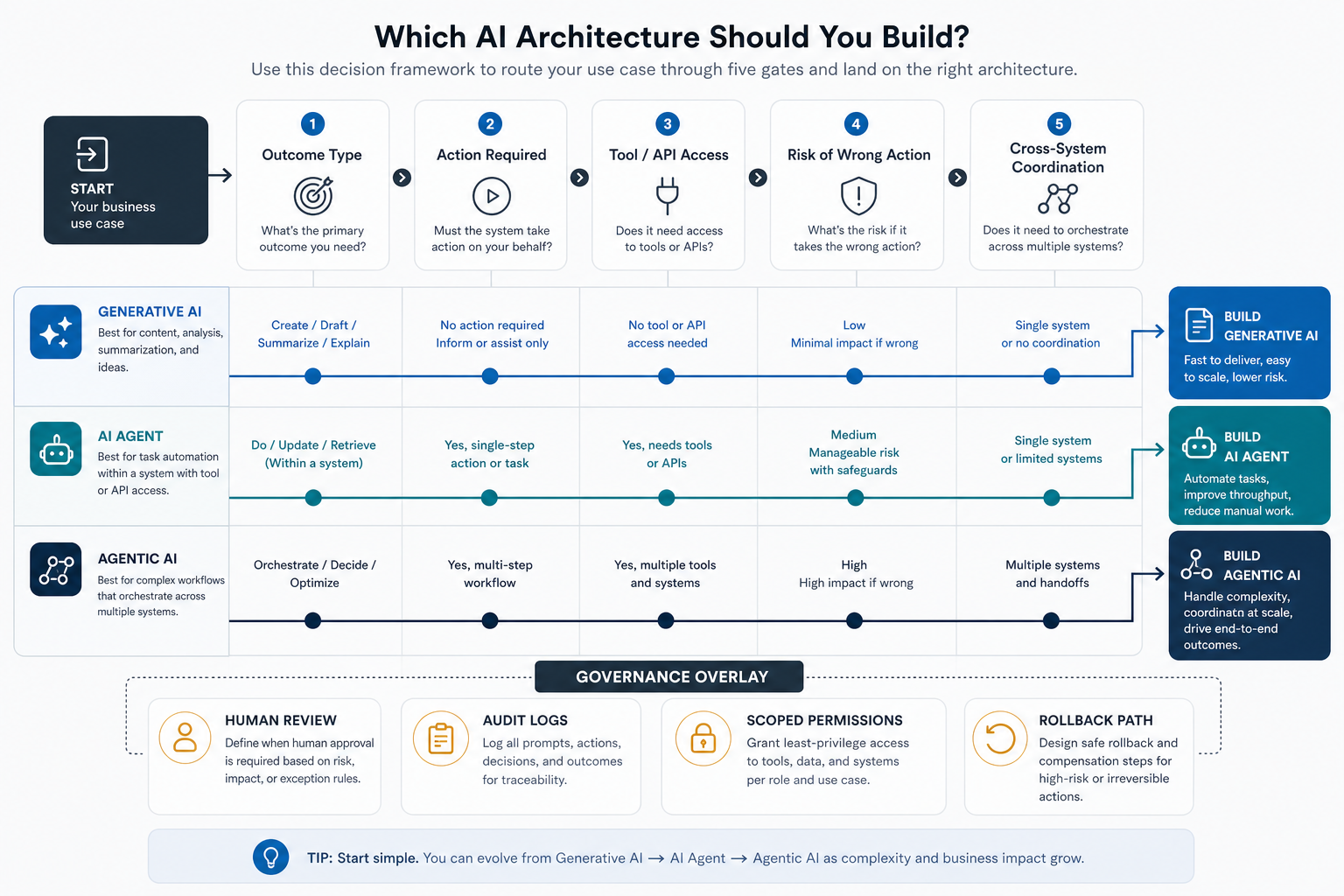
Use these questions to choose the first build:
- Does the AI need to take action? If no, generative AI may be enough.
- Can the action be bounded and tested? If yes, a single AI agent may be appropriate.
- Does the workflow require several systems or roles? If yes, consider agentic AI.
- Can a wrong action create business, legal, financial, safety, or customer risk? If yes, add approval gates and observability before autonomy.
- Is the workflow already stable? If no, fix the process before automating it.
ROI And Value Readiness
Do not build an agent because the label is fashionable. Build it when the workflow has enough volume, delay, cost, or quality variation to justify the engineering and operating work. A high-value workflow usually has repeated handoffs, unstructured information, slow decisions, measurable cycle time, and a clear owner who will use the system after launch.
The AI Automation ROI Calculator can help estimate whether the workflow has enough savings or throughput value to deserve automation. If the ROI case is weak, start with a smaller copilot or better internal tooling. If the ROI is strong but the workflow is unstable, improve the process before adding autonomy.
Business Examples By AI Type
A marketing team may use generative AI to draft campaign variants, summarize customer interviews, or repurpose long-form content. A sales team may use an AI agent to enrich a lead, check account context, prepare a follow-up, and update CRM fields after approval. A support organization may use agentic AI to route tickets, retrieve policy, draft responses, create engineering tasks, monitor SLA risk, and escalate edge cases.
In product operations, generative AI can summarize feedback. An AI agent can create tagged issues from that feedback. Agentic AI can coordinate triage across product, support, engineering, and customer success with status updates and review checkpoints. The AI workflow automation guide is a useful companion when the problem is less about a chat interface and more about moving work from intake to decision, action, review, and monitoring.
For a broader concept boundary, the narrow AI for business guide explains how task-specific AI, generative AI, and agents differ from each other. That distinction helps buyers avoid forcing every AI idea into an agent architecture.
Data, Integration, And RAG Readiness
Generative AI can often start with documents, examples, and user prompts. AI agents need more structure: reliable APIs, identity rules, workflow state, test accounts, and error handling. Agentic AI needs stronger foundations: event logs, permissions by role, shared state, evaluation scenarios, monitoring dashboards, and clear ownership for exceptions.
Data quality becomes more important as autonomy increases. If account records are stale, policy documents conflict, or integrations fail silently, a more autonomous system will only move bad assumptions faster. Before building agents, document systems of record, define what the agent can read or write, and decide which actions require human approval.
Teams building deeper private-knowledge assistants should evaluate the LLM development and enterprise RAG implementation layers early. Retrieval quality, permission-aware context, source freshness, and eval coverage often decide whether a copilot, agent, or agentic workflow is useful in production.
Governance Before Autonomy
Governance is not a final compliance layer. It is part of the architecture. At minimum, production AI workflows should define permission scopes, prompt and policy versions, audit logs, approval thresholds, fallback behavior, and owners for incidents or low-confidence decisions.
For generative AI, governance may mean review queues and evaluation examples. For AI agents, it means least-privilege tool access, action logs, and human approval for high-risk actions. For agentic AI, it also means runtime monitoring, escalation rules, retry limits, lineage across systems, and tests for cross-system failure. The more autonomy the system has, the more visible its decisions must become.
A useful governance test is simple: if the agent makes a wrong decision, can the business see what happened, who owned the workflow, which tools were used, which policy applied, and how the action can be reversed or compensated? If the answer is no, the system is not ready for broad autonomy.
Release Gates For Safe Autonomy
Autonomy should be earned in stages. Start with draft-only output, then supervised action, then limited production, then broader agentic workflow orchestration. Each stage should require evidence: eval pass rate, tool permission scope, human approval thresholds, trace logs, rollback readiness, and named owner escalation.
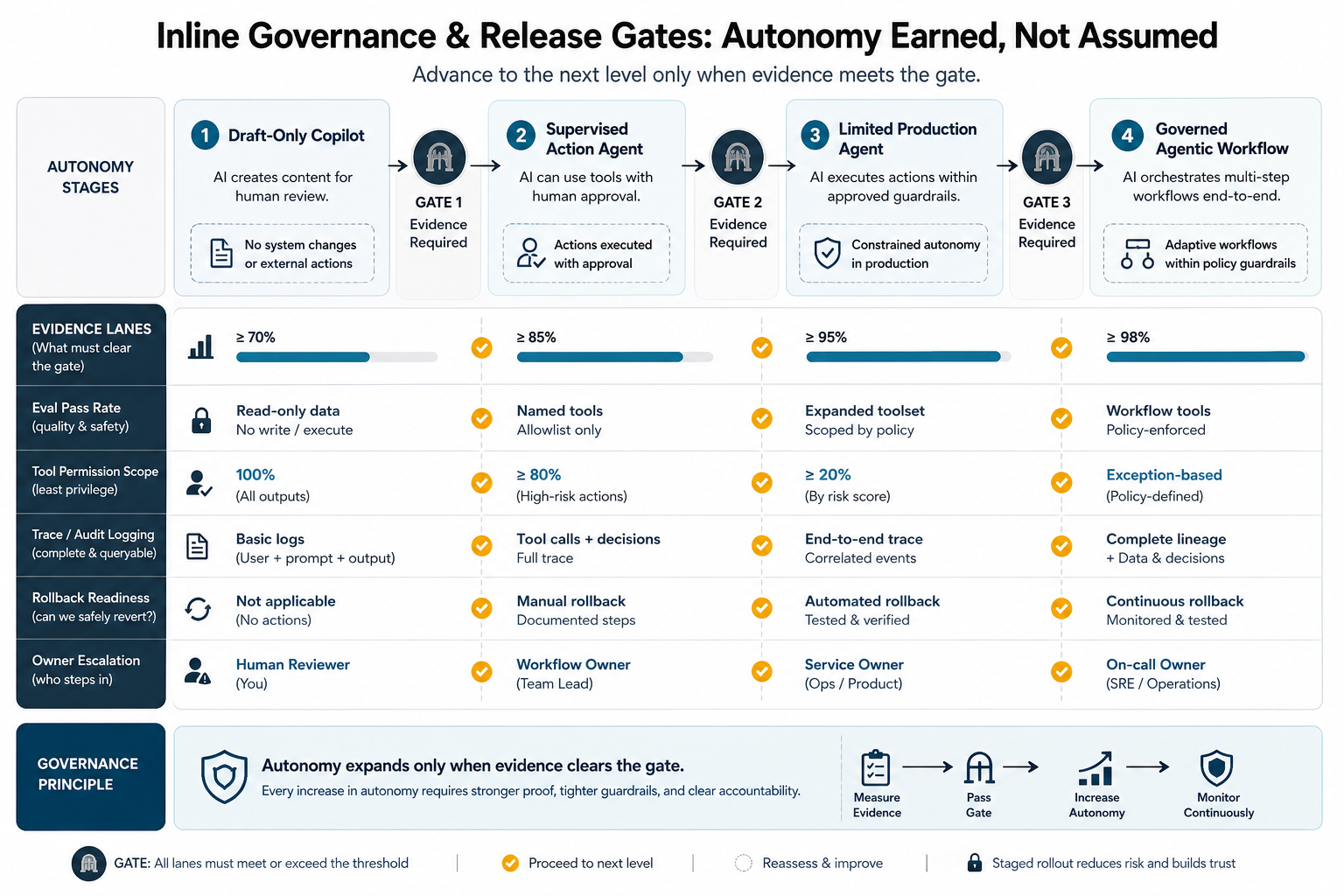
For support, sales, operations, finance, healthcare, or regulated workflows, high-risk actions should stay behind approval until production evidence proves the system can operate safely. Even then, exceptions should route to people, not disappear into logs. If your intended use case is customer support, compare the scope with AI customer service agent development so escalation, knowledge quality, CRM handoff, and analytics are designed from the beginning.
Implementation Roadmap
- Pick one workflow. Choose a repeatable process with measurable volume, cost, delay, or quality risk.
- Map the current process. Identify inputs, systems, decisions, exceptions, owners, and risky actions.
- Start with the smallest AI pattern. Build a copilot before an agent, and an agent before a multi-agent system unless the workflow truly needs more.
- Define tools and permissions. Separate read-only context, reversible actions, sensitive writes, and actions that need approval.
- Add evaluations and logs early. Test quality, tool behavior, failure paths, and human review before production use.
- Expand autonomy gradually. Move from draft, to recommend, to supervised action, to monitored autonomy only after evidence supports it.
Teams that want a more technical architecture path can use the generative AI architecture decision guide to compare API-only, RAG, fine-tuning, and agent patterns before committing engineering budget.
Common Mistakes When Choosing An AI Architecture
- Using agentic AI for a simple content problem: a reviewed generative AI workflow may deliver value faster with lower risk.
- Granting broad tool access too early: agents should start with least-privilege access and earn more permissions through evidence.
- Skipping evals: teams need realistic success and failure cases before launch, not only a few impressive demos.
- Ignoring workflow ownership: every automated decision needs a business owner, support path, and escalation rule.
- Confusing orchestration with intelligence: multi-agent systems can add coordination overhead when a single agent plus deterministic workflow steps would be simpler.
How NextPage Helps Choose And Build
NextPage approaches AI work as practical software delivery. The first step is not to sell the most advanced architecture. The first step is to understand the workflow, data quality, integration surface, risk level, and business outcome. From there, the right build might be a generative AI workflow, a narrow AI agent, or a broader agentic operating system.
If you are comparing options now, use the AI Agent Readiness Assessment to score workflow, data, governance, and integration readiness. When the use case is ready for implementation, NextPage can help with AI agent development, LLM applications, RAG systems, evaluation, guardrails, and production rollout.
Final Takeaway
The best AI architecture is usually the least autonomous system that can reliably solve the business problem. Use generative AI for knowledge and content assistance, AI agents for bounded tool-using workflows, and agentic AI for governed multi-step operations. The right sequence protects budget, reduces risk, and gives the business a clearer path from useful prototype to production system.