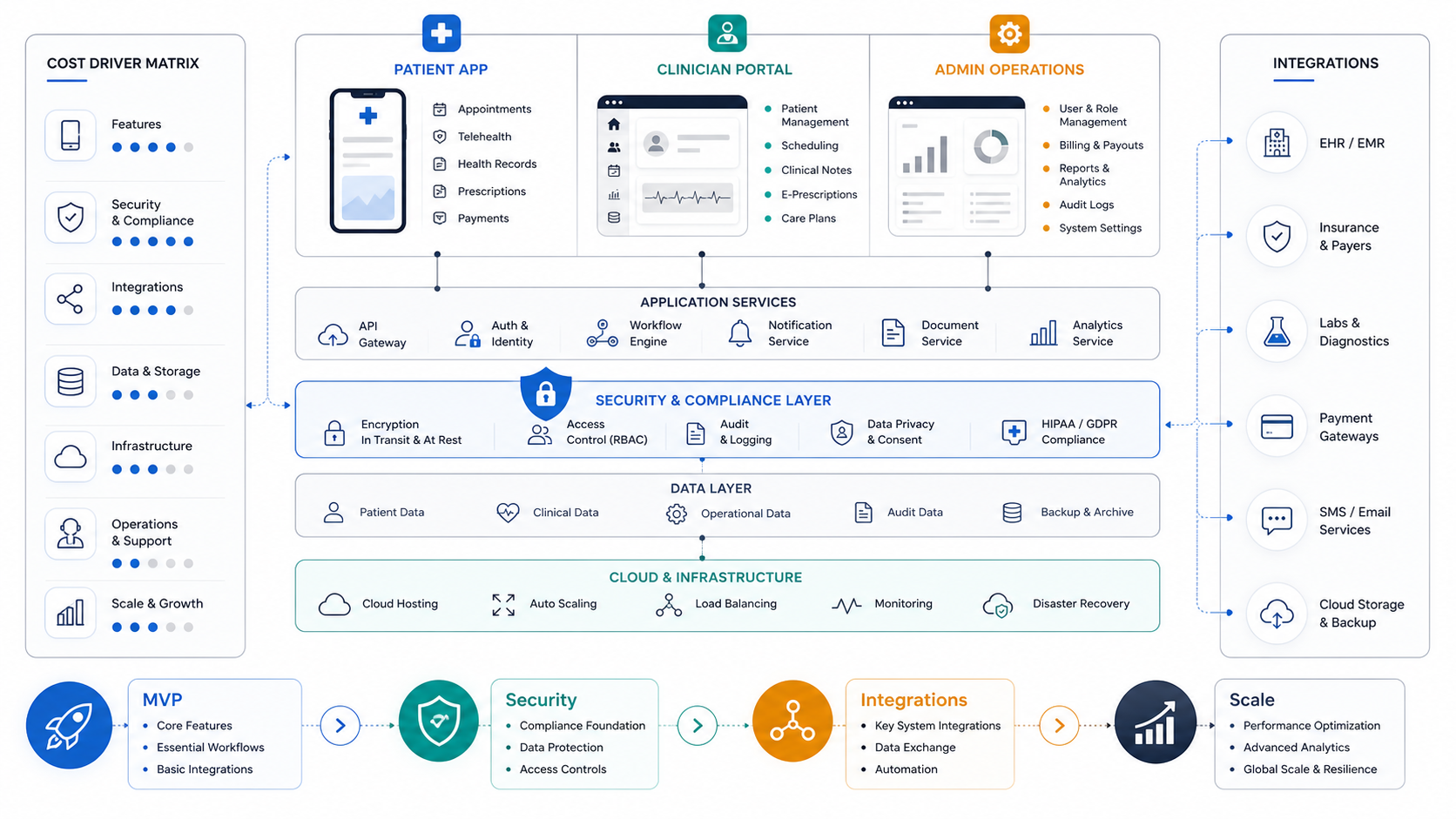

Quick Answer: Healthcare App Development Cost
Healthcare app development cost usually depends less on the number of screens and more on the risk profile of the product. A tightly scoped patient-facing MVP with secure sign-in, profiles, appointment booking, reminders, content, basic admin tooling, and limited integrations can often be planned in the $30,000-$75,000 range. A stronger clinic, telehealth, care-coordination, or wellness platform with patient and clinician roles, payments, EHR or CRM integrations, secure messaging, analytics, audit logs, and richer operations can move into the $75,000-$180,000 range. A regulated-scale healthcare platform with multiple care journeys, clinical review workflows, interoperability requirements, advanced security evidence, device or wearable data, and enterprise cloud operations can start around $180,000 and move past $500,000.
Those are planning bands, not fixed quotes. A simple wellness tracker, a clinic appointment app, a telehealth platform, and a remote patient monitoring product may all look like healthcare apps from the outside, but they have very different data, safety, integration, and operational demands. The safest way to estimate the build is to define the care workflow, the data boundary, the integration map, and the compliance evidence before committing to a feature list.
If you need a directional range before full discovery, start with the custom software cost estimator, then refine the healthcare-specific assumptions with architecture, privacy, integration, and release-evidence details.
Why Healthcare App Cost Varies So Much
Two healthcare apps can have the same login screen, dashboard, and notification flow, yet require very different budgets. The difference is usually hidden in the work around the product.
- Data sensitivity: products that store or transmit protected health information, diagnostic data, prescriptions, claims, or therapy notes need stronger controls than general wellness content apps.
- User roles: patient-only apps are simpler than apps with patients, clinicians, care coordinators, admins, support teams, auditors, and partner organizations.
- Clinical workflows: appointment booking is easier than triage, e-prescription handoff, virtual consultation, remote monitoring review, or clinician escalation.
- Integrations: EHR, lab, pharmacy, payment, messaging, CRM, wearable, insurance, or analytics integrations add discovery, testing, fallback, and vendor coordination.
- Compliance evidence: access control, audit trails, encryption, backups, retention, vendor controls, and incident processes must be designed into the system, not bolted on late.
- Operational tooling: admin queues, support workflows, exception review, reporting, and internal dashboards often take as much effort as the patient app.
This is why a healthcare product should be estimated as a secure workflow system, not a collection of mobile screens. The same principle guides broader mobile app development work when the app must handle sensitive users, integrations, and long-term maintenance.
Healthcare App Cost Drivers
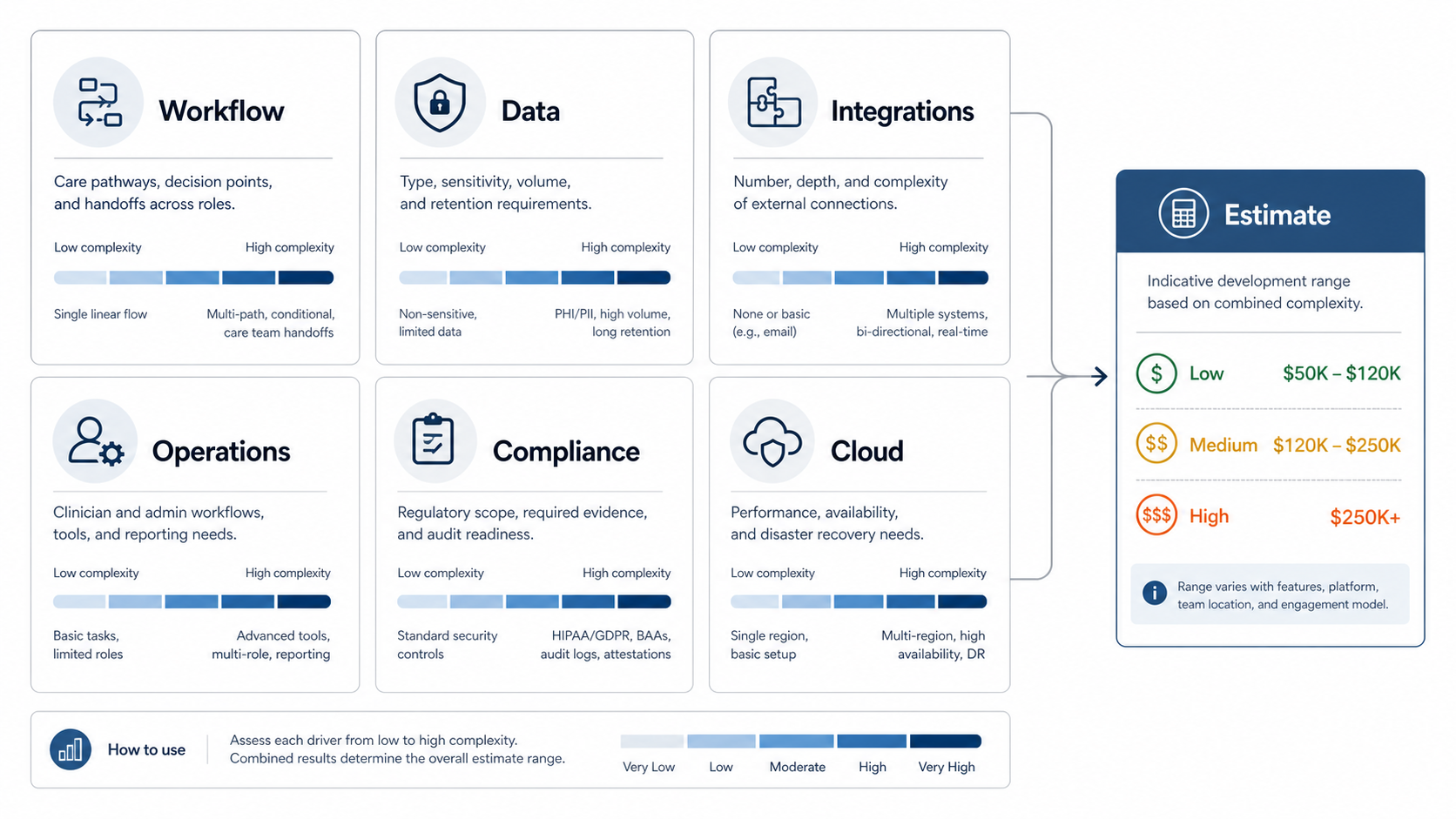
The cost drivers become clearer when you group the product into six planning areas.
| Cost driver | Lower-scope example | Higher-scope example | Why it changes budget |
|---|---|---|---|
| Care workflow | Appointment requests and reminders | Telehealth, triage, care plans, escalation, and clinician review | More roles, states, permissions, and edge cases |
| Data sensitivity | General wellness preferences | PHI, prescriptions, test results, therapy notes, or remote monitoring data | Stronger access, encryption, audit, retention, and vendor controls |
| Integrations | Email/SMS, payments, analytics | EHR, FHIR APIs, labs, pharmacy, insurance, wearables, CRM | Vendor coordination, mapping, testing, fallback paths, and support |
| Compliance evidence | Basic privacy policy and access controls | Risk analysis, audit trails, data-processing records, breach playbooks, admin evidence | More architecture, documentation, QA, and operational controls |
| Operations | Simple admin panel | Review queues, case management, roles, reporting, exports, support tooling | The internal product becomes a second application |
| Cloud reliability | Single-region managed deployment | Environment isolation, monitoring, backups, disaster recovery, secure CI/CD | Production healthcare systems need evidence-friendly operations |
For custom healthcare workflows, these drivers often make the work closer to custom software development than a simple app build. The patient experience matters, but the backend, admin, integration, and evidence layers decide whether the platform can operate safely.
MVP, Growth, and Scale Budget Ranges
A practical healthcare app estimate usually fits one of three phases.
| Phase | Typical scope | Directional budget band | What pushes it higher |
|---|---|---|---|
| MVP | Patient onboarding, profiles, booking, reminders, content, basic admin, secure authentication, simple reporting | $30k-$75k | Native apps plus web, payment flows, clinician roles, PHI storage, custom content tools |
| Growth release | Telehealth, secure messaging, clinician portal, richer admin, payments, analytics, selected integrations, audit logs | $75k-$180k | EHR/lab/pharmacy integrations, role-based workflows, multi-location clinics, advanced reporting |
| Regulated-scale platform | Multiple care pathways, FHIR or EHR interoperability, remote monitoring, enterprise security, governance, operations, cloud resilience | $180k-$500k+ | Multi-region operations, medical-device adjacency, complex clinical protocols, enterprise procurement evidence |
The right first release is rarely the largest one. A safer healthcare MVP proves the care journey, data boundary, support workflow, and operating model before funding every integration or clinical feature. If the scope is still too broad, use an MVP exercise before asking a team to price the full roadmap.
Healthcare App Cost Calculator Inputs
A healthcare estimate becomes more reliable when the scope is translated into inputs a delivery team can score. Before comparing vendor quotes, define the product type, user roles, data classes, integration count, compliance evidence, device or wearable dependencies, admin workflow, and launch operating model. These inputs explain why two apps with similar screens can land in very different budget bands.
| Estimate input | Low-complexity signal | Higher-complexity signal | Budget implication |
|---|---|---|---|
| Product model | Wellness content, booking, reminders | Telehealth, remote monitoring, care coordination | More workflow states, permissions, and review paths |
| Data boundary | Minimal profile and preference data | PHI, clinical notes, test results, claims, device readings | Security, retention, audit, backup, and vendor controls increase |
| Roles | Patient and admin | Patient, clinician, care coordinator, support, auditor, partner | Role-based access and QA matrix expand |
| Integrations | Email, SMS, payments, analytics | EHR, FHIR, labs, pharmacy, insurance, wearables, CRM | Discovery, mapping, sandbox access, retries, and reconciliation add work |
| Operations | Simple dashboard and exports | Review queues, case notes, escalations, reporting, evidence packs | The admin product becomes a major scope area |
For healthcare wearable, device-adjacent, or remote monitoring products, the estimate should also include pairing, permissions, stale-data states, alert routing, and device QA. NextPage's healthcare wearable app development services page shows how patient app flows, clinician dashboards, privacy controls, and integrations need to be scoped together instead of priced as isolated features.
Compliance and Security Planning
Healthcare compliance affects cost because it changes what the system must prove. In the United States, HHS describes the HIPAA Security Rule as requiring administrative, physical, and technical safeguards for electronic protected health information. That translates into estimation work around risk analysis, access control, audit controls, transmission security, workforce procedures, backup planning, incident response, and vendor responsibilities.
Interoperability can also change scope. ONC's Cures Act Final Rule pushed standardized APIs so patients and providers can securely access electronic health information, and ONC's FHIR material describes FHIR as a widely used standard for exchanging health information. If your product connects to certified health IT, EHR systems, or patient-access APIs, include time for data mapping, authentication, scopes, testing, and partner documentation.
For India-facing or global products, privacy obligations may also include consent, notice, purpose limitation, data minimization, retention, grievance handling, and data fiduciary responsibilities under regional privacy regimes such as India's Digital Personal Data Protection Act, 2023. The exact obligation depends on the product, geography, entity role, and data flow, so legal counsel should confirm the compliance model. Engineering still needs to budget for the controls that counsel and operations require.
If the app is connected to a regulated medical device or has device-software implications, do not treat it like a general wellness product. FDA's 2025 medical-device cybersecurity guidance, which superseded the September 27, 2023 final guidance, emphasizes cybersecurity design, labeling, documentation, and resilience for devices with cybersecurity risk. Even when a product is not itself a medical device, device adjacency can increase security review, documentation, and testing expectations.
Integration And Compliance Budget Checklist
Healthcare teams often underestimate the work around integrations because the feature list says only "connect to EHR" or "sync wearable data." A safer estimate separates business purpose, data ownership, authentication, consent, mapping, failure handling, monitoring, and audit evidence for each integration.
- Data-flow map: identify which system creates, stores, updates, and deletes each sensitive data element.
- Access model: define user roles, least-privilege rules, support access, break-glass expectations, and session controls.
- Interoperability scope: confirm whether the release needs read-only FHIR access, write-back, document exchange, lab results, claims, scheduling, or custom vendor APIs.
- Consent and retention: document what users consent to, what data is optional, how long records stay, and how deletion or export requests are handled.
- Evidence and QA: budget for audit logs, backup checks, security testing, integration test fixtures, incident runbooks, and release signoff.
Teams comparing partner options can use the healthcare software development company checklist to ask better questions about regulated workflows, data handling, clinical operations, and long-term support before accepting a low estimate.
Feature Scope by Healthcare Product Type
Healthcare app cost is easier to estimate when the product type is explicit.
- Clinic and appointment apps: booking, availability, intake forms, reminders, staff admin, payments, and patient communication.
- Telehealth apps: scheduling, video consultation, secure chat, consent, notes, prescriptions or referrals, payments, and support workflows.
- Patient portal apps: profile, records access, results, messages, forms, document uploads, care instructions, and EHR integration.
- Remote monitoring apps: device data ingestion, thresholds, alerts, clinician review queues, patient nudges, and escalation policies.
- Mental health and wellness apps: onboarding, content, journaling, assessments, coaching workflows, safety escalation, subscriptions, and privacy controls.
- Healthcare operations platforms: internal dashboards, case management, referral workflows, inventory, reporting, and role-based access.
A healthcare marketplace, care-coordination tool, or internal operations platform may not need the same mobile polish as a consumer wellness app, but it often needs more workflow depth. Comparable cost logic appears in other complex app categories too; for example, this eCommerce app development cost guide shows how integrations and operations can outweigh screens in budget planning.
Architecture Decisions That Change the Estimate
The architecture should make the safest path the easiest path. For healthcare apps, that usually means separating identity, application services, PHI storage, integration workers, audit logs, admin workflows, and reporting so each layer can be secured and monitored appropriately.
Common estimate-changing decisions include whether to build native apps or cross-platform apps, whether a clinician portal is needed in the first release, whether PHI lives in the new system or remains in a source clinical system, whether third-party providers handle video and payments, and whether the platform needs single-tenant or multi-tenant deployment. A clear architecture decision can reduce cost by shrinking the product boundary. An unclear one creates rework.
Cloud planning is also part of the estimate. Healthcare platforms often need environment separation, backup and restore processes, access logs, monitoring, alerting, deployment controls, and cost visibility from the start. If an existing platform needs to move or mature before the app can scale, the project may overlap with cloud migration services, software testing services, and a broader digital transformation strategy.
Timeline for a Healthcare App Build
A realistic delivery plan usually has four phases.
- Discovery and compliance mapping: 2-4 weeks to define the care journey, user roles, data flows, integration targets, privacy requirements, operating owners, and first-release success criteria.
- Architecture and design: 2-4 weeks for system architecture, UX flows, data model, security model, admin workflows, vendor assumptions, and release plan.
- MVP build and QA: 8-16 weeks for the app, backend, admin tools, integrations, test plans, analytics, deployment, and launch preparation.
- Growth and hardening: 6-16 more weeks for deeper integrations, reporting, automation, reliability, monitoring, compliance evidence, and operational improvements.
The biggest timeline risk is starting development before the product team knows who owns clinical review, support, incident response, vendor access, and data retention. These responsibilities do not feel like features, but they shape the build.
Cost-Control Decisions
The best cost-control decisions reduce risk without weakening the product.
- Use a phased care journey: prove one high-value patient workflow before supporting every condition, location, or clinician role.
- Delegate commodity capabilities: use reliable providers for video, messaging, payments, identity, analytics, or device data when ownership would add risk without differentiation.
- Keep PHI boundaries narrow: avoid copying sensitive data into new systems unless the workflow truly requires it.
- Build admin workflows early: internal teams need review queues, role controls, and audit evidence to operate safely.
- Choose integrations deliberately: one reliable integration is better than five half-tested connectors in the first release.
- Plan cloud evidence from day one: monitoring, backups, access logs, and deployment controls are cheaper when designed early.
These decisions also make estimates more credible. A vendor can price a bounded workflow with known data flows. It cannot responsibly price a vague healthcare platform that may later need EHR integration, clinician review, device data, and multi-region compliance.
Vendor Estimate Red Flags
A healthcare app quote should explain assumptions, not only a total number. Treat a proposal as risky when it hides the architecture boundary, avoids compliance evidence, prices integrations as generic API work, ignores admin workflows, or promises a fixed timeline before seeing the care journey and data map.
| Red flag | Why it matters | What to ask instead |
|---|---|---|
| One flat app price | Healthcare scope depends on data, roles, integrations, and operations. | Ask for MVP, growth, and scale assumptions separately. |
| No security evidence plan | Audit logs, access controls, backups, and testing affect architecture. | Ask how security and privacy controls appear in the backlog. |
| Integrations priced without discovery | FHIR, EHR, lab, pharmacy, device, and CRM integrations vary widely. | Ask for sandbox, mapping, fallback, and reconciliation assumptions. |
| Admin tooling ignored | Clinician, support, and operations workflows are core product surfaces. | Ask what internal dashboards, queues, and exports are included. |
| Launch ends at app-store release | Healthcare products need monitoring, incident response, content operations, and support ownership. | Ask for the first 90 days of operating support and handoff evidence. |
Common Budget Mistakes
- Pricing only the patient app: the admin, integration, reporting, support, and evidence layers are often where healthcare projects expand.
- Adding compliance at the end: access control, audit trails, retention, and vendor controls shape the system from the beginning.
- Overbuilding integrations: every clinical or vendor integration needs mapping, authentication, testing, error handling, and support ownership.
- Ignoring clinician workflow: a telehealth or care app fails if the clinician-facing review process is slow, unclear, or unauditable.
- Using fixed ranges too early: a real estimate needs assumptions about product type, data sensitivity, geography, clinical responsibility, and operations.
- Skipping launch operations: support, monitoring, incident response, backup tests, and content operations should be in the release plan.
How NextPage Scopes Healthcare Apps
NextPage scopes healthcare app development by starting with the operating model: who the app serves, which care workflow it improves, what data it touches, which systems it must connect to, and what evidence the business needs to operate responsibly. From there, we separate MVP requirements from growth-stage capabilities and turn the estimate into a phased roadmap. For teams still selecting a delivery partner, the healthcare software development company checklist can help turn vendor evaluation into concrete architecture, compliance, QA, and support questions.
For a first estimate, use the custom software cost estimator. For a reviewed delivery plan, bring the care workflow, target users, data types, integration list, and launch timeline to a focused mobile app development or custom software development discussion.