
Quick Answer: How To Scale A Doctor Appointment App Globally
Scaling a doctor appointment app globally means turning a working local booking product into a country-aware healthcare platform. The app must support local languages, time zones, provider rules, appointment types, consent flows, privacy expectations, payment methods, support coverage, and operating dashboards without making every new market a custom rebuild.
The right expansion sequence is usually not "launch everywhere." Start with countries where demand, provider supply, regulation, payment behavior, and support coverage are clear enough to operate safely. Then build reusable platform foundations through mobile app development practices that can handle regional configuration, not one-off code forks.
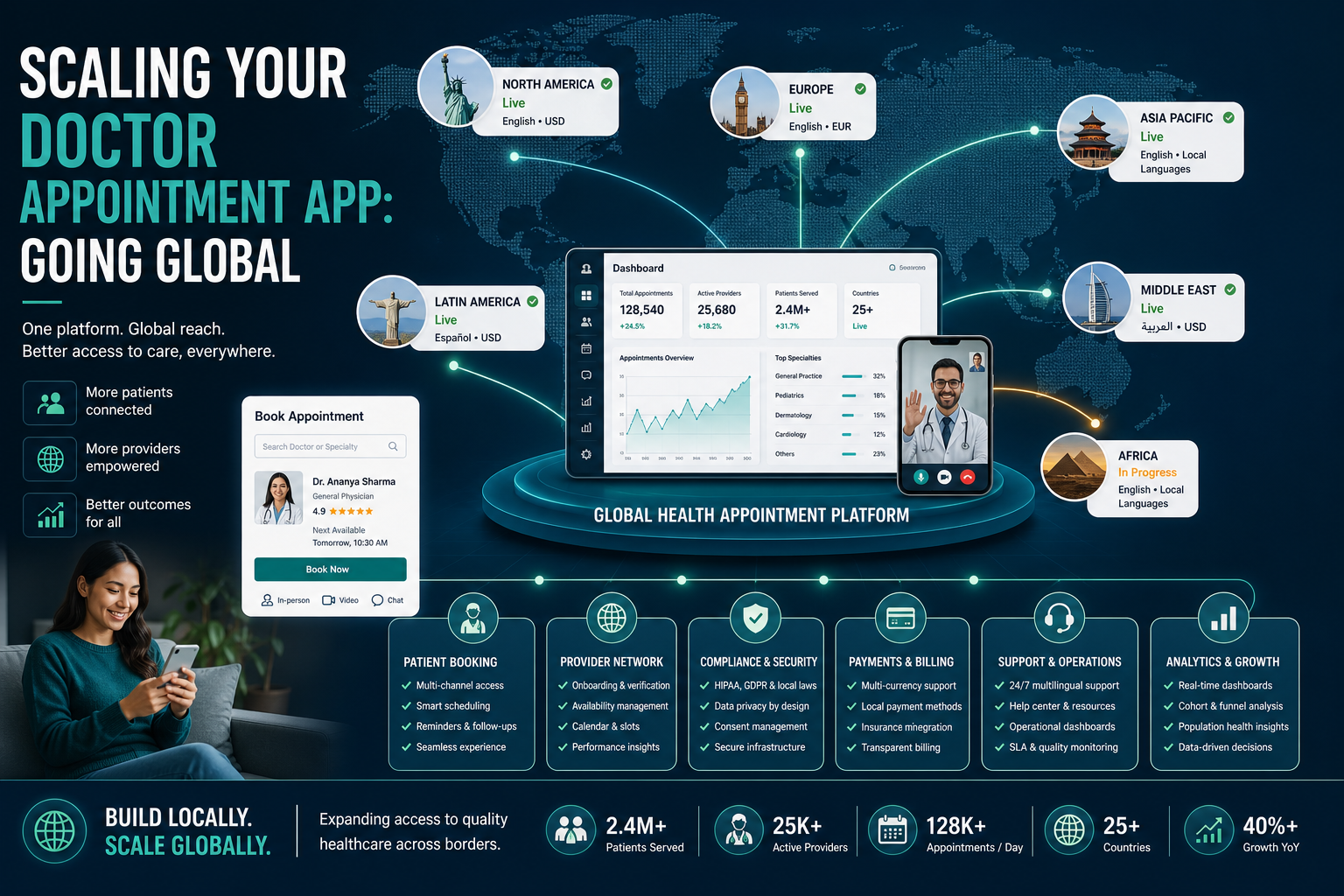
Audit Your Local Product Before Expansion
Before entering a new country, inspect the current product honestly. A local appointment app may work because the team manually fixes provider schedules, patient support issues, payment exceptions, and booking rules behind the scenes. Those manual fixes usually break once the app serves multiple languages, currencies, clinic groups, time zones, and regulatory contexts.
The audit should cover the full appointment journey: patient discovery, provider search, availability rules, booking confirmation, intake, reminders, cancellation policy, teleconsultation, payments, prescription or document flow, admin operations, and reporting. If the core model is still unclear, use the companion guide on how to develop a doctor appointment booking app to compare the product roles and workflow depth before expanding.
Choose Markets With A Readiness Scorecard
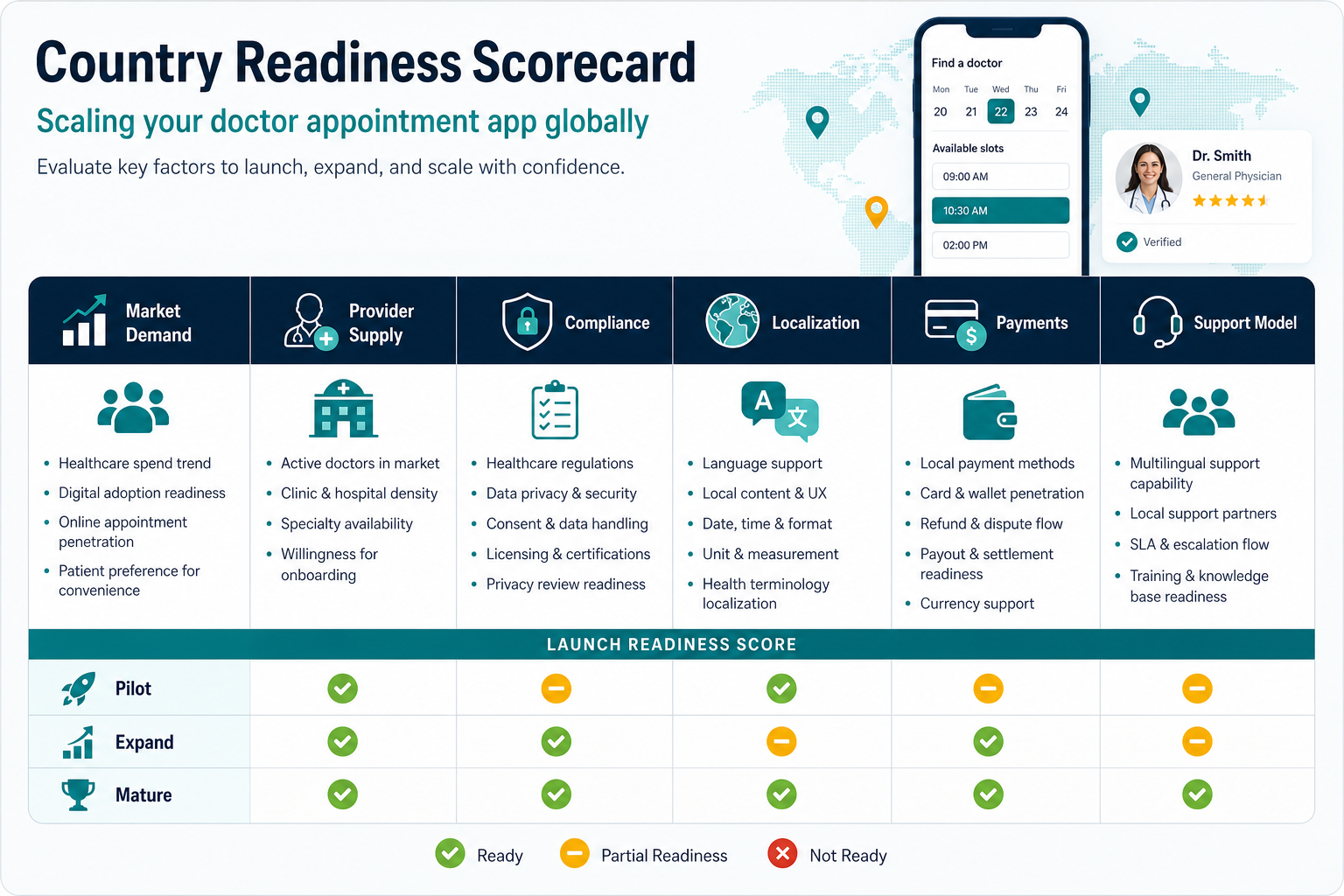
A useful expansion plan scores each country against six factors: market demand, provider supply, compliance complexity, localization effort, payment readiness, and support model. Strong demand is not enough if provider onboarding is slow, healthcare privacy rules are unclear, local payment rails are weak, or patient support cannot operate in the right language.
| Readiness Area | What To Check | Why It Matters |
|---|---|---|
| Market demand | Search demand, competitor density, patient wait times, booking friction, and specialty gaps. | Shows whether the app solves a real access problem. |
| Provider supply | Clinic willingness, specialist coverage, profile data quality, schedule ownership, and onboarding speed. | Prevents launching with too few useful appointment options. |
| Compliance | Privacy rules, consent records, data residency expectations, healthcare advertising rules, and audit needs. | Reduces legal, trust, and operational risk. |
| Localization | Languages, terminology, date and time formats, address formats, health-plan language, and accessibility. | Makes the product understandable to local patients and providers. |
| Payments | Consultation fees, refunds, insurance workflows, currency, taxes, invoices, and local methods. | Keeps conversion and reconciliation realistic. |
| Support | Service hours, escalation routes, clinical vs administrative messages, and language coverage. | Protects patient trust when appointments change or fail. |
Localization Is More Than Translation
Translation is only the visible part of localization. A global appointment app also needs local provider specialties, visit reasons, appointment duration, cancellation rules, holidays, support scripts, insurance terms, phone formats, address formats, and notification timing. A patient in one region may expect clinic-first booking, while another may compare individual doctors, teleconsultation slots, or insurance-linked care.
Use regional configuration wherever possible. Keep languages, currencies, time zones, appointment categories, cancellation policies, consent text, and provider profile fields manageable by operations teams instead of hard-coding them into each release. This keeps expansion faster and avoids fragmenting the app into separate country products.
Build Country-Aware Compliance And Data Controls
Healthcare expansion increases privacy and compliance complexity. Depending on the market, the product may need stronger consent capture, audit trails, role-based access, data retention controls, document security, breach response processes, and clear separation between administrative communication and medical advice. The platform should also make it obvious which data is stored, where it is processed, and who can access it.
Do not treat HIPAA, GDPR, local privacy laws, and healthcare-specific rules as copy changes. They influence architecture, logging, permissions, vendor choices, support tooling, analytics, and data lifecycle design. For a broader view of these cost and architecture drivers, compare your scope with healthcare app development cost planning.
Standardize The Global Operating Model
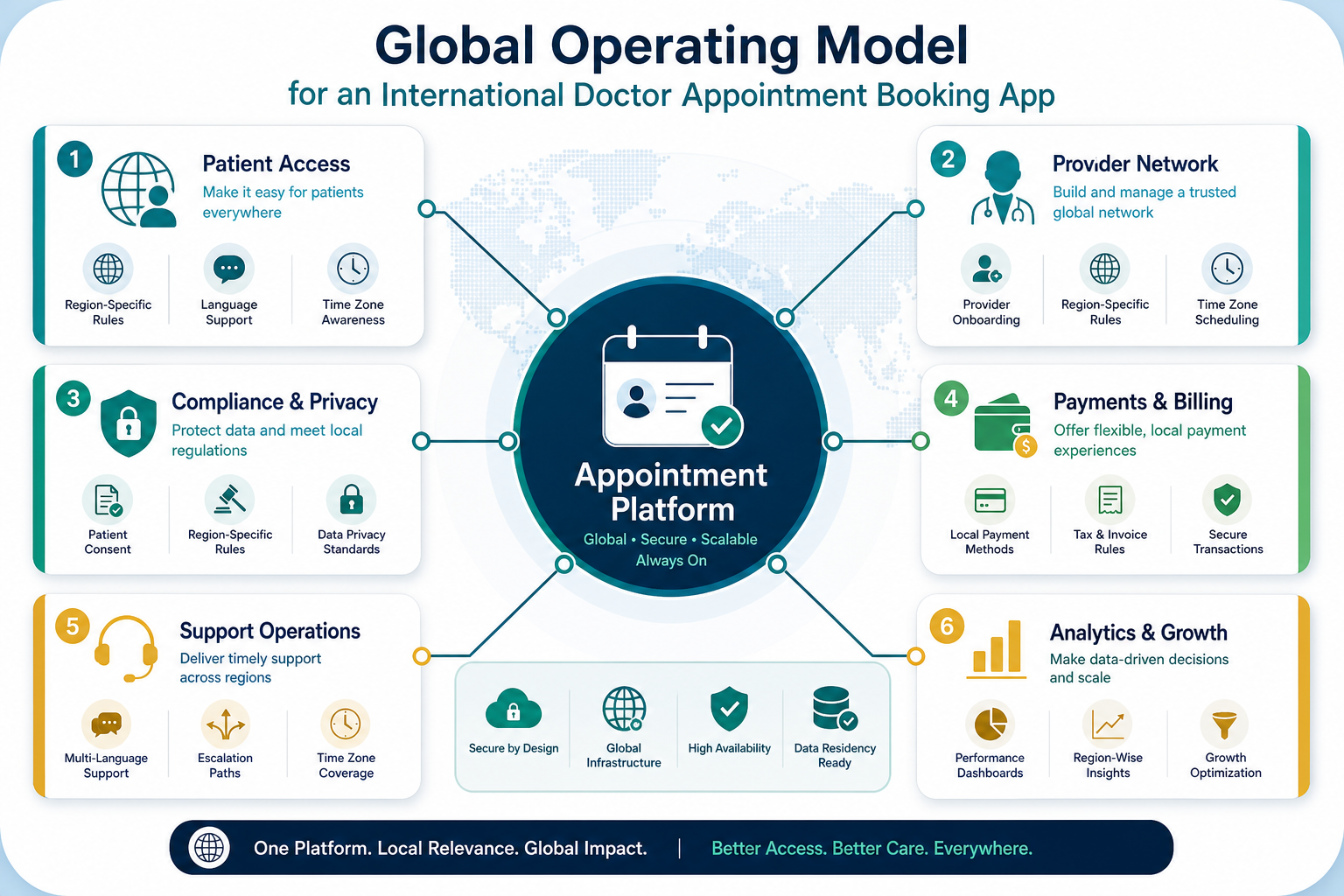
A global app needs a repeatable operating model, not just a translated interface. Define who owns provider onboarding, profile quality, appointment rules, support escalation, refunds, compliance reviews, content updates, analytics, and partner relationships in every country. Without ownership, the platform may launch but service quality will drift.
The operating model should also define which decisions are global standards and which are local. Authentication, security, core booking logic, audit logging, platform analytics, and deployment practices should be consistent. Provider categories, copy, payment methods, availability rules, and support playbooks often need local control.
Adapt Provider Onboarding For Each Market
Provider density is one of the biggest constraints on international growth. Patients will not return to an appointment app that has limited doctors, stale schedules, weak profiles, or unreliable availability. Each launch market needs a provider acquisition plan, profile data standards, credential review process, schedule integration approach, and support route for clinics.
Profile quality matters because patients make trust decisions quickly. Specialty, qualification, location, consultation mode, languages, fees, availability, reviews, and accepted payment or insurance options should be clear. The same expectations appear in the feature-level guide to key features for doctor appointment booking apps.
Plan Payments, Refunds, And Insurance Early
Payments become harder across countries because users expect local methods, currencies, tax documents, refunds, invoices, and sometimes insurance or employer benefit workflows. Even when the MVP starts with pay-at-clinic appointments, the data model should leave room for pricing rules, payment status, cancellation fees, refunds, reconciliation, and provider settlement.
Do not add payment methods before the booking and support experience is stable. A failed or disputed healthcare appointment payment is not just a checkout problem; it can become a trust problem for patients and providers. Teams should test payment flows with real operational scenarios before a broad launch.
Scale Notifications, Reminders, And Support By Region
Appointment reminders need regional behavior. Time zones, working hours, language, appointment urgency, channel preference, SMS delivery rates, WhatsApp availability, email reliability, and push-notification permissions vary by market. The same reminder strategy that reduces no-shows in one country may feel intrusive or arrive at the wrong time in another.
Support should distinguish administrative help from clinical advice. Patients may ask about rescheduling, fees, clinic directions, documents, prescriptions, or medical symptoms. The app should route these conversations safely and keep escalation policies clear for every region.
Measure Country Performance With Operational Metrics
Global growth needs country-level metrics. Track search-to-booking conversion, appointment completion, cancellation rate, no-show rate, provider response time, support volume, refund rate, profile completeness, reminder performance, patient satisfaction, and repeat booking. These metrics reveal whether the launch has real healthcare utility or only downloads.
Teams should compare markets using both growth and reliability metrics. A country with fast signups but poor provider availability may need operations support before marketing spend. A country with lower traffic but excellent appointment completion may be a better expansion template.
Sequence The Roadmap From Pilot To Multi-Country Platform
Start with a controlled pilot in one or two markets, then expand only when the core booking workflow, provider network, support model, and compliance controls are stable. The roadmap should move from market validation to regional configuration to automation and then to deeper integrations.
| Stage | Focus | Exit Criteria |
|---|---|---|
| Pilot | Localize core flows, onboard anchor clinics, validate appointment completion, and test support scripts. | Reliable bookings, clear provider supply, manageable support volume, and no unresolved compliance gaps. |
| Expand | Add regions, configure payments and reminders, improve admin tools, and standardize reporting. | Repeatable launch checklist and consistent country-level metrics. |
| Platform | Automate provider onboarding, improve analytics, add integrations, and manage regional operations centrally. | Reusable country configuration, scalable support model, and predictable release governance. |
When roadmap, budget, or team size is unclear, use the Custom Software Cost Estimator to compare pilot scope, integrations, support tooling, and platform complexity before committing to a multi-country build.
Common Mistakes That Slow Global Rollout
The most common mistake is copying the local product into every country without adapting provider data, compliance, payments, support, and patient communication. Another mistake is localizing only the patient app while leaving the admin console, clinic workflows, and support tooling built for the original market.
Teams also underestimate provider onboarding. A global appointment app needs enough trusted supply to make patient search useful. Marketing can create demand, but provider availability, schedule accuracy, and support reliability decide whether patients keep booking. For the strategic value of the core workflow, review why doctor appointment booking apps matter before expanding too quickly.
Final Recommendation
To scale a doctor appointment app globally, build the platform around reusable booking logic and country-specific configuration. Choose markets with a readiness scorecard, localize beyond language, design compliance into the architecture, standardize the operating model, and measure reliability as carefully as growth.
The best global rollout is deliberate. Launch where the product can deliver real appointments, operational support, trusted providers, and compliant data handling. Then use what you learn to turn each new country into a repeatable expansion playbook.