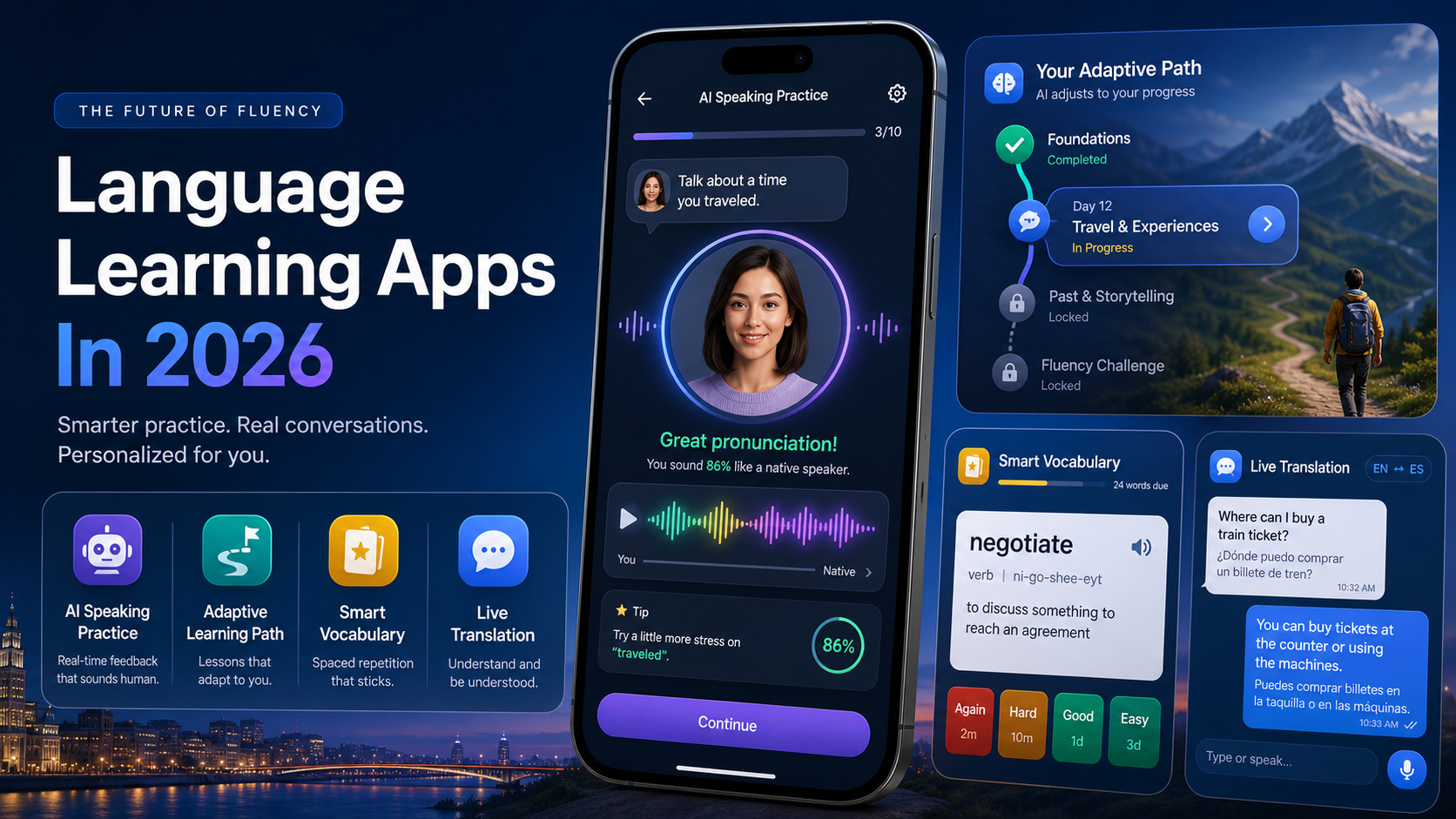

Language learning apps are no longer simple flashcard libraries. In 2026, the strongest options combine structured lessons, speech recognition, adaptive review, short daily practice, and AI conversation support so learners can move from recognition to real use.
The right app depends on the learner's goal. A casual traveler may need quick phrases and listening practice. A professional may need business vocabulary, pronunciation feedback, and role-play. A product team building in this category needs an even sharper view of learner personas, content operations, retention loops, and AI safety.
Quick Answer: What Makes A Language Learning App Worth Using In 2026?
A language learning app is worth using when it helps the learner practice every day, speak out loud, remember vocabulary, understand native-speed input, and apply the language in realistic situations. The app should also explain progress clearly so users know what to practice next.
For founders, schools, and training teams, the same criteria become product requirements: clear onboarding, adaptive placement, speech feedback, lesson sequencing, content quality, analytics, and reliable mobile performance. If you are scoping a new product, NextPage's mobile app development work is relevant because language apps depend on smooth practice sessions, offline behavior, notifications, audio quality, and long-term retention design.
Start With The Learner Goal, Not The App Ranking
Best-app lists are useful, but they can hide the most important decision: what the learner is trying to do. Someone preparing for a trip, someone taking a school exam, and someone joining a multilingual workplace need different lesson depth, speaking practice, grammar support, and accountability.
Before choosing or building an app, define the primary learner segment. NextPage's guide to user personas in app development explains why persona clarity affects feature priority, onboarding, content tone, and retention metrics. For language learning, persona work should include current level, motivation, target language, speaking confidence, practice time, and willingness to pay.
Core Features Every Serious Language App Needs
The best language apps usually combine several learning modes instead of relying on one exercise type. A strong feature set includes adaptive lessons, spaced repetition, pronunciation practice, listening drills, grammar explanation, cultural context, progress tracking, and reminders that respect the user's schedule.
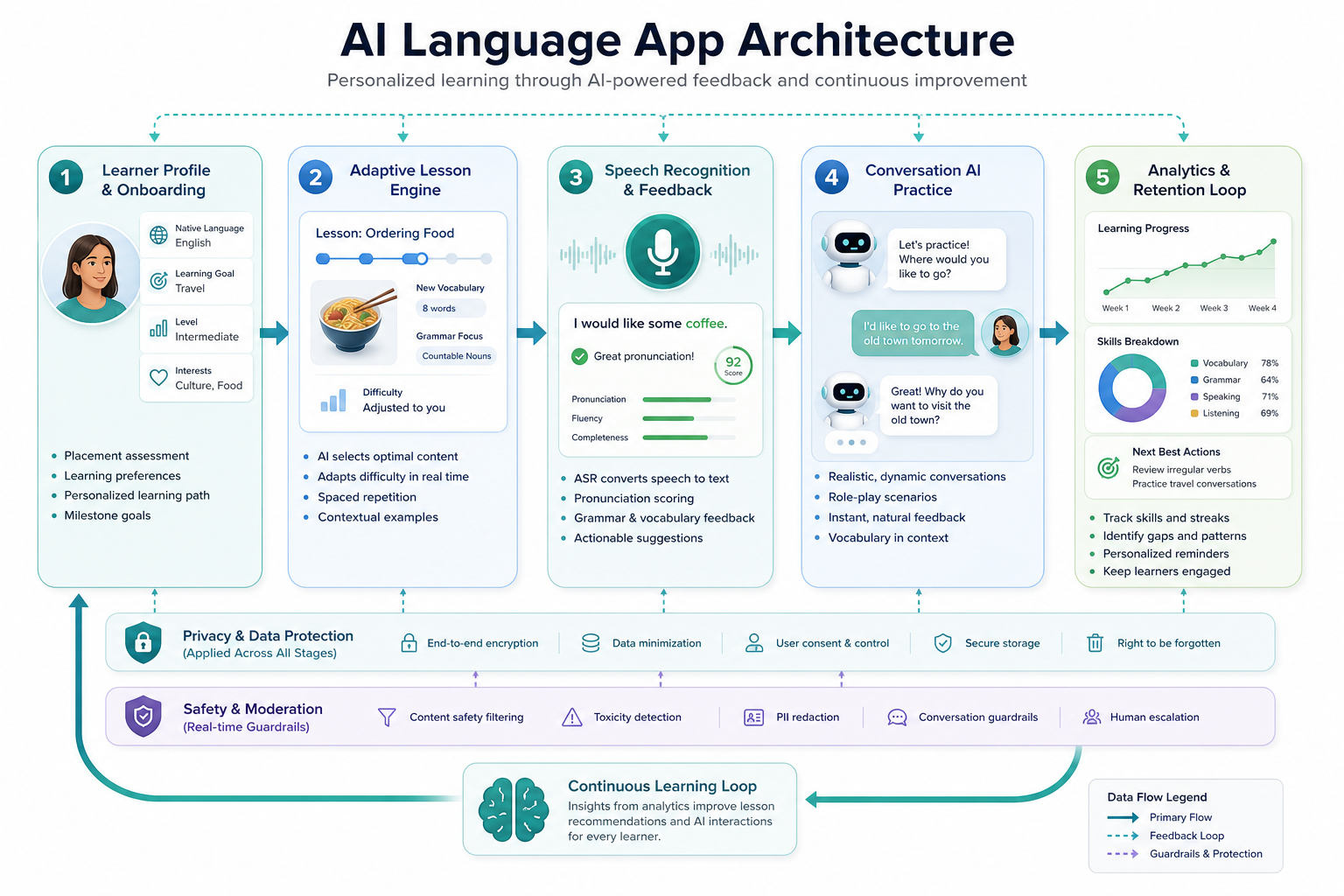
Feature depth matters more than feature count. A vocabulary trainer is useful only if it reviews words at the right interval. Speech recognition is useful only if it gives feedback the learner can act on. Gamification is useful only if it reinforces practice instead of distracting from it.
How Duolingo, Babbel, Rosetta Stone, Memrise, And Busuu Differ
Duolingo remains strong for habit-building, short exercises, and broad language access. Babbel is often chosen by learners who want practical conversations and clearer lesson structure. Rosetta Stone emphasizes immersion and pronunciation practice. Memrise leans into native-speaker video and AI-supported speaking practice. Busuu is useful for structured courses and community feedback.
No single app wins every use case. A beginner may value daily streaks and low-pressure practice. An intermediate learner may need longer listening tasks, writing feedback, and conversation role-play. A business learner may need professional scenarios, coach support, and reporting. The more specific the goal, the easier it becomes to choose the right app or design a better alternative.
AI Is Changing Speaking Practice And Personalization
AI has moved language apps beyond static drills. Modern products can support conversational role-play, pronunciation feedback, adaptive lesson paths, personalized review, and content recommendations based on learner behavior. Duolingo's AI-powered Video Call and Adventures features, Memrise's MemBot, and speech-recognition workflows from Babbel and Rosetta Stone all point in the same direction: more active speaking practice inside the app.
For product teams, AI is not a single feature. It is a system that needs prompt design, speech input handling, moderation, privacy rules, analytics, fallbacks, and evaluation. NextPage's AI chatbot development process is a useful reference when a language app needs conversation practice, scenario role-play, learner-safe responses, and escalation controls.
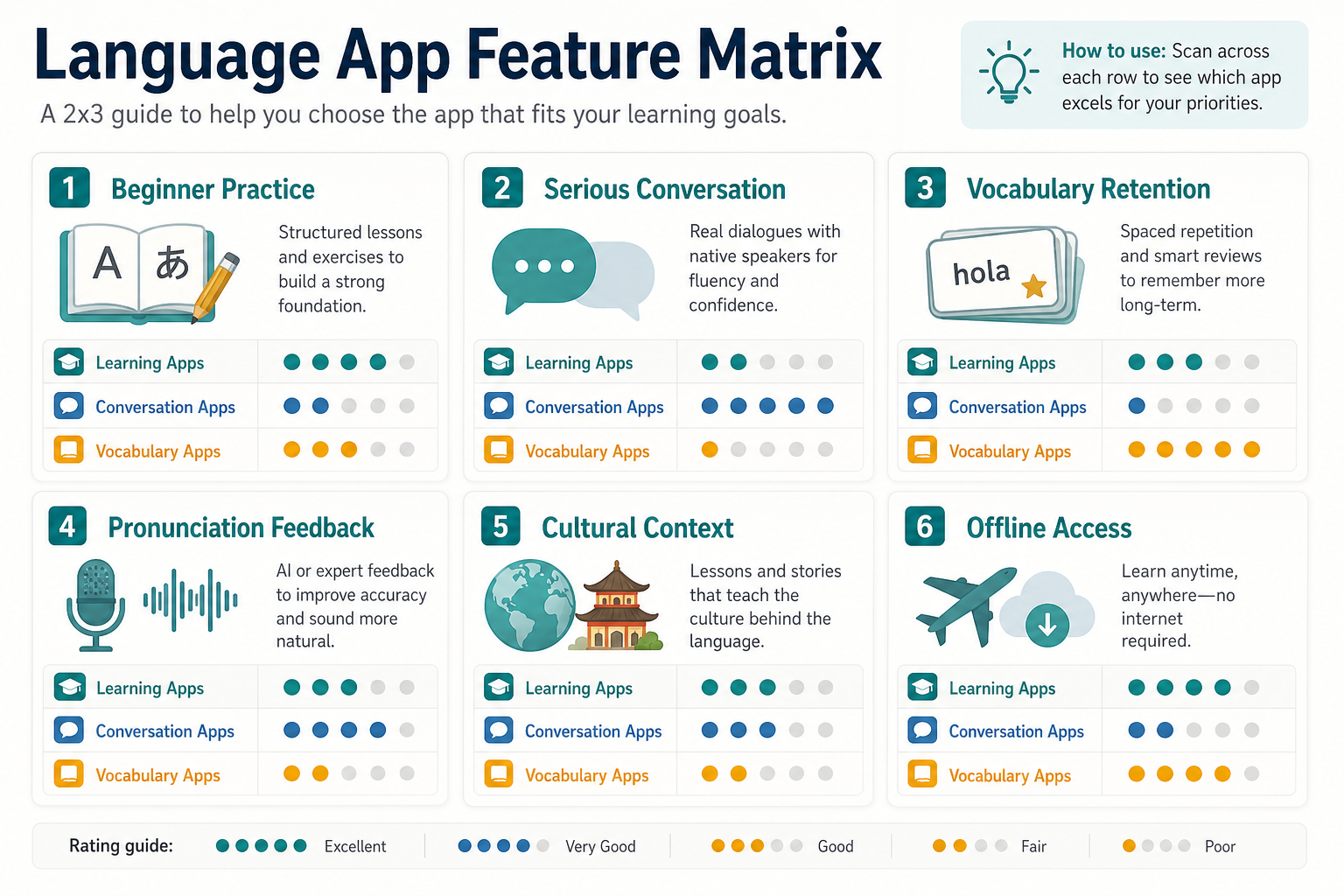
Vocabulary Growth Still Depends On Repetition And Context
Vocabulary grows when learners see and use words repeatedly in meaningful contexts. Spaced repetition helps users remember terms over time, but the word also needs to appear in phrases, listening examples, conversations, and writing prompts.
Good language apps mix review queues with real use. A learner might first see a word in a flashcard, then hear it in a native-speaker clip, then use it in a speaking prompt, then review it again after a delay. This sequence works better than a large list of isolated words because it builds recall and confidence together.
Free Language Apps Work Best As A Starting Point
Free language apps can help beginners build a habit, learn basic vocabulary, and test whether they enjoy a language. They are especially useful when the learner needs short daily practice and does not yet know which approach fits.
Paid plans usually become more valuable when the learner needs deeper content, fewer limits, offline access, pronunciation tools, conversation practice, certificates, or structured progression. For businesses building language products, the monetization model has to match this value curve. NextPage's article on language learning app monetization covers subscriptions, freemium design, premium content, and market positioning.
Design For Different Learning Styles Without Fragmenting The Product
Language learners often prefer different input modes: visual examples, audio lessons, speaking practice, writing drills, grammar explanations, or real-world scenarios. A good app supports these preferences without forcing users into a confusing maze of lesson types.
The best approach is a guided path with optional practice modes. The main path keeps momentum. Optional modes let learners deepen pronunciation, vocabulary, listening, or grammar when needed. This structure helps beginners avoid decision fatigue while giving motivated learners enough control.
What Product Teams Should Build First
If you are building a language learning app, the first release should prove that users can complete lessons, return consistently, and improve a measurable skill. A practical MVP might include onboarding placement, a short lesson path, vocabulary review, speaking prompts, progress tracking, and a small amount of AI-assisted conversation.
Teams should avoid launching with too many languages or too many exercise formats. Content quality, audio quality, feedback clarity, and retention analytics matter more than a crowded feature list. For AI-heavy products, NextPage's AI development services can help plan model selection, evaluation, privacy controls, and production monitoring before the product scales.
Budget And Scope Depend On Content, Audio, AI, And Analytics
A simple language learning MVP is usually smaller than a full adaptive learning platform. Scope grows when the product needs custom curriculum, recorded native-speaker audio, speech recognition, AI tutors, placement tests, payments, classroom management, certificates, or enterprise reporting.
Before committing to a build, use the Custom Software Cost Estimator to compare the likely budget and timeline for a basic MVP, a polished consumer app, or a more advanced AI learning platform. The estimate will be more useful if you already know the target languages, learner personas, content depth, and launch market.
How To Get More Value From Any Language App
- Set a specific goal, such as ordering food, joining a meeting, or passing an exam.
- Practice daily in short sessions instead of waiting for long study blocks.
- Speak out loud, even when the app also supports silent exercises.
- Use review features consistently so vocabulary does not fade after the first lesson.
- Add real-world input such as podcasts, videos, books, or conversations with native speakers.
- Change apps or add a tutor when the current app no longer challenges your weak areas.
Key Takeaways
- The best language learning app depends on the learner's goal, level, motivation, and speaking confidence.
- AI conversation practice is useful when it is paired with privacy controls, feedback quality, and clear lesson progression.
- Vocabulary features should combine spaced repetition with real listening, speaking, and writing context.
- Free apps are excellent starting points, while paid plans become more useful for deeper content, feedback, and accountability.
- Product teams should validate retention, content quality, and speaking outcomes before scaling into many languages or advanced AI features.
Language learning apps will keep getting more personalized, conversational, and connected to everyday life. The winners will not be the apps with the most features. They will be the products that help learners practice consistently, speak with confidence, and keep improving after the novelty fades.