
Quick Answer: Which Testing Type Should You Run?
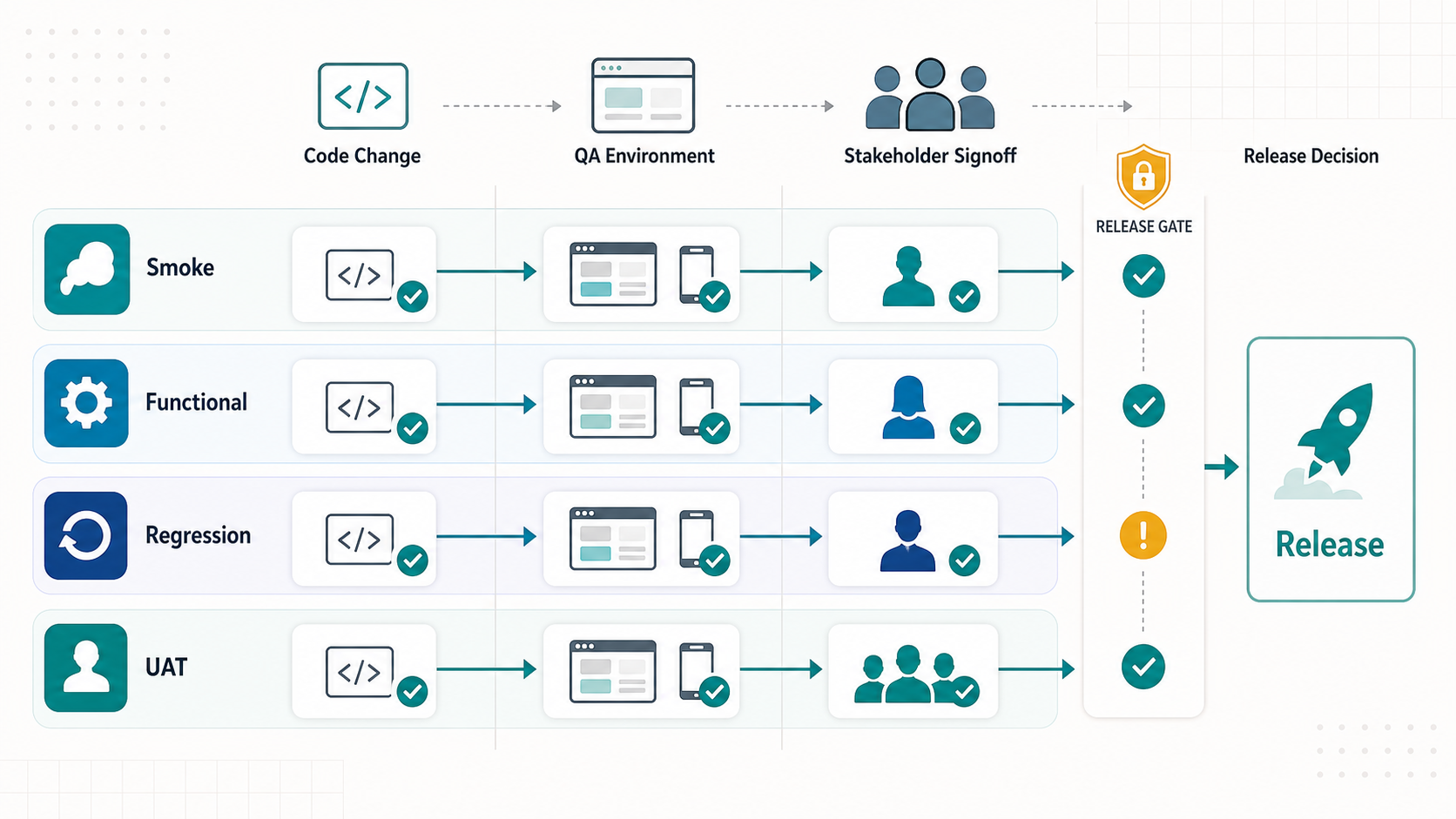
Run smoke testing first to decide whether a build is stable enough for deeper QA. Run functional testing to prove each feature, workflow, role, validation rule, integration, and error path works as specified. Run regression testing after changes to make sure existing behavior still works. Run UAT near the release decision so business users can confirm the product supports the real process they need to operate.
The mistake is treating UAT, functional testing, and regression testing as interchangeable names for “QA.” They answer different questions. Functional testing asks whether the system behaves correctly. Regression testing asks whether recent changes damaged something that used to work. UAT asks whether the product is acceptable for the business process, users, and launch context. A release plan needs all three, but not always with the same depth or owner on every sprint.
UAT vs Functional Testing vs Regression Testing: The Practical Difference
The easiest way to separate these testing types is to look at ownership and timing. QA or engineering usually owns functional and regression execution. Product owners, operations teams, customer-facing teams, or client stakeholders should own UAT signoff. QA can support UAT with scenarios and evidence, but QA should not be the only voice deciding whether a workflow fits the business process.
| Testing Type | Question It Answers | Typical Owner | Best Timing | Release Risk It Reduces |
|---|---|---|---|---|
| Smoke testing | Is this build stable enough for detailed testing? | QA or engineering | Immediately after a deploy or build | Wasted QA time on broken builds |
| Functional testing | Does the feature work as required? | QA with product and engineering input | During feature QA and before release regression | Broken workflows, validation, permissions, or integrations |
| Regression testing | Did the change break existing behavior? | QA, automation, or engineering | After bug fixes, feature merges, dependency changes, or release candidates | Unexpected defects in previously working flows |
| UAT | Can the business accept and operate this release? | Product owner, client, operations, or business stakeholders | After core QA evidence is ready and before final go/no-go | Workflow mismatch, missing acceptance criteria, launch confusion |
UAT Vs Regression Testing: One Change, Three Decisions
Regression testing checks whether a change broke existing behavior. UAT checks whether business users can accept the resulting workflow. Functional checks can be part of a regression suite, while UAT may exercise the same screens for a different decision. Passing one does not automatically satisfy the others.
Consider an illustrative expense-approval change: claims above a configured limit now need a second approver. This is a planning example, not a client result.
| Test purpose | Checks for this change | Decision and owner |
|---|---|---|
| Functional | Test claims below, at, and above the limit. Confirm the second approval is required only when specified, unauthorized users cannot approve, and rejection follows the agreed rule. | QA and engineering establish whether the implemented rule matches the requirement. |
| Regression | Recheck ordinary single-approval claims, receipt attachments, existing permissions, reimbursement exports, and notifications affected by the change. | QA reports whether the changed build preserves the selected existing behavior, with remaining coverage gaps recorded. |
| UAT | Finance staff and approvers complete representative claims, including an absent approver and a disputed expense, using realistic roles and approved test data. | The business owner accepts the workflow or records why users cannot operate it. Working exactly as specified can still be unacceptable if the process is incomplete. |
Copy into your release record: Change/build: ___; functional evidence: ___; regression scope and results: ___; UAT participants and scenarios: ___; unresolved defects and accepted exceptions: ___; release decision, owner, and date: ___.
If UAT finds that there is no workable substitute-approver process, clarify the requirement before changing the software. After the fix, retest the failed case, rerun regression checks for the affected paths, and ask the business owner to review the revised workflow. An earlier UAT signoff should not silently cover a materially changed process.
Microsoft's implementation testing guidance distinguishes business acceptance from regression checks after updates. For help defining the evidence for your own release, bring one critical workflow and its open risks to a software testing review.
Entry And Exit Criteria Before Each Testing Gate
A release plan becomes easier to manage when every testing type has entry and exit criteria. Entry criteria stop teams from starting the wrong test too early. Exit criteria stop teams from calling a phase complete when the evidence is still weak.
| Gate | Start When | Exit When | Do Not Use It To Prove |
|---|---|---|---|
| Smoke testing | A build is deployed to a testable environment. | Core paths load, login works, and no blocker prevents deeper QA. | That the release is functionally complete. |
| Functional testing | Requirements, acceptance criteria, test data, and changed workflows are ready. | Changed features, negative paths, permissions, integrations, and business rules have pass/fail evidence. | That old behavior outside the changed area is still safe. |
| Regression testing | Functional fixes are stable enough to retest existing critical workflows. | The selected regression pack passes or accepted risks have owners and rollback rules. | That the new feature is useful to business users. |
| UAT | QA evidence is ready and stakeholders have realistic data, roles, and scenarios. | The workflow owner accepts the release conditions or gives a clear no-go decision. | That QA already covered every technical edge case. |
This separation prevents two common release mistakes: asking stakeholders to perform QA on an unstable build, or treating a green regression pack as proof that the business process is acceptable.
Smoke Testing: Is The Build Safe Enough To Test?
Smoke testing is the fast first pass that protects the rest of the release cycle. It does not prove the product is ready. It proves that the build is worth testing. A smoke pack usually checks login, navigation, basic page loading, core API availability, one happy path through the main workflow, and whether the application can save or retrieve data without obvious failure.
Smoke tests should be short, repeatable, and ruthless. If login is broken, checkout cannot load, the API is down, or the dashboard throws server errors, deeper functional testing should pause until the build is fixed. For CI/CD pipelines, smoke tests are often automated because they run frequently and should fail fast.
Functional Testing: Does Each Feature Work As Required?
Functional testing validates behavior against requirements. It checks whether users can complete the actions the product promises: sign up, authenticate, change permissions, submit forms, search records, complete payments, upload files, receive notifications, generate reports, and move data between systems. It also checks negative paths such as invalid data, expired links, permission denial, failed payments, duplicate submissions, and integration timeouts.
A good functional testing checklist starts from workflows that must not break, not from a loose list of screens. For a web app, that can include authentication, roles, dashboards, exports, forms, payments, admin actions, and CRM handoffs. When teams estimate web app development cost, these same areas often drive QA scope because each role, integration, and data state multiplies the number of paths that need evidence.
Functional testing is not the same as UAT. QA may prove that the booking flow follows the requirement, applies the right validation, and writes the correct database record. A business stakeholder still needs to decide whether that booking flow matches how the team will actually sell, schedule, fulfill, and support the service after launch.
Regression Testing: Did This Change Break Existing Value?
Regression testing protects the product from accidental damage. Every feature change, bug fix, library update, environment change, API update, or UI refactor can break behavior outside the changed area. Regression testing reruns a selected set of important checks so the team can release with confidence that existing value still works.
The right regression pack is risk-based. Do not try to rerun every manual test before every small release. Start with business-critical flows: login, payment, booking, checkout, admin approvals, role-based permissions, reporting, data sync, notifications, and workflows with recent defect history. Then automate stable checks that run often and are expensive to repeat manually. The Regression Testing Checklist for Software Releases gives a deeper pack-building model for teams that need repeatable release confidence. Keep exploratory testing for new work, ambiguous behavior, and edge cases that scripts do not catch.
Regression testing should happen after functional testing for the changed feature and before final UAT or release approval. If regression fails, the release decision changes because the team has evidence that new work damaged existing behavior. For teams deciding what to automate, the Manual vs Automation Testing guide can help separate high-repeatability regression checks from judgment-heavy tests that still need human review.
UAT: Does The Product Support The Business Process?
User acceptance testing is the business acceptance step. It should use realistic users, roles, data, rules, and operational scenarios. The goal is not to repeat every QA test. The goal is to confirm that the product supports the workflow the business actually needs to run.
UAT scenarios should be written in plain business language. For example: “A sales manager approves a quote with a discount and finance receives the correct invoice data,” or “A clinic admin reschedules an appointment and both patient and provider receive the correct notification.” QA can prepare the environment, test data, and defect triage process, but stakeholders should validate the workflow fit.
UAT is most useful after obvious functional defects are fixed. If stakeholders are asked to test a broken build, they become unpaid QA and the acceptance signal becomes noisy. If QA hides business users until launch day, the team may discover too late that technically correct behavior does not fit the operating model.
What To Run Before Release: A Stage-By-Stage Matrix
The best release plans combine these testing types instead of choosing one. A small copy update may need a smoke check and a narrow regression pass. A payment workflow change needs functional testing, regression around orders and invoices, and UAT if finance or operations must change their process. A new mobile release may need device coverage, store readiness, crash monitoring, and stakeholder approval.
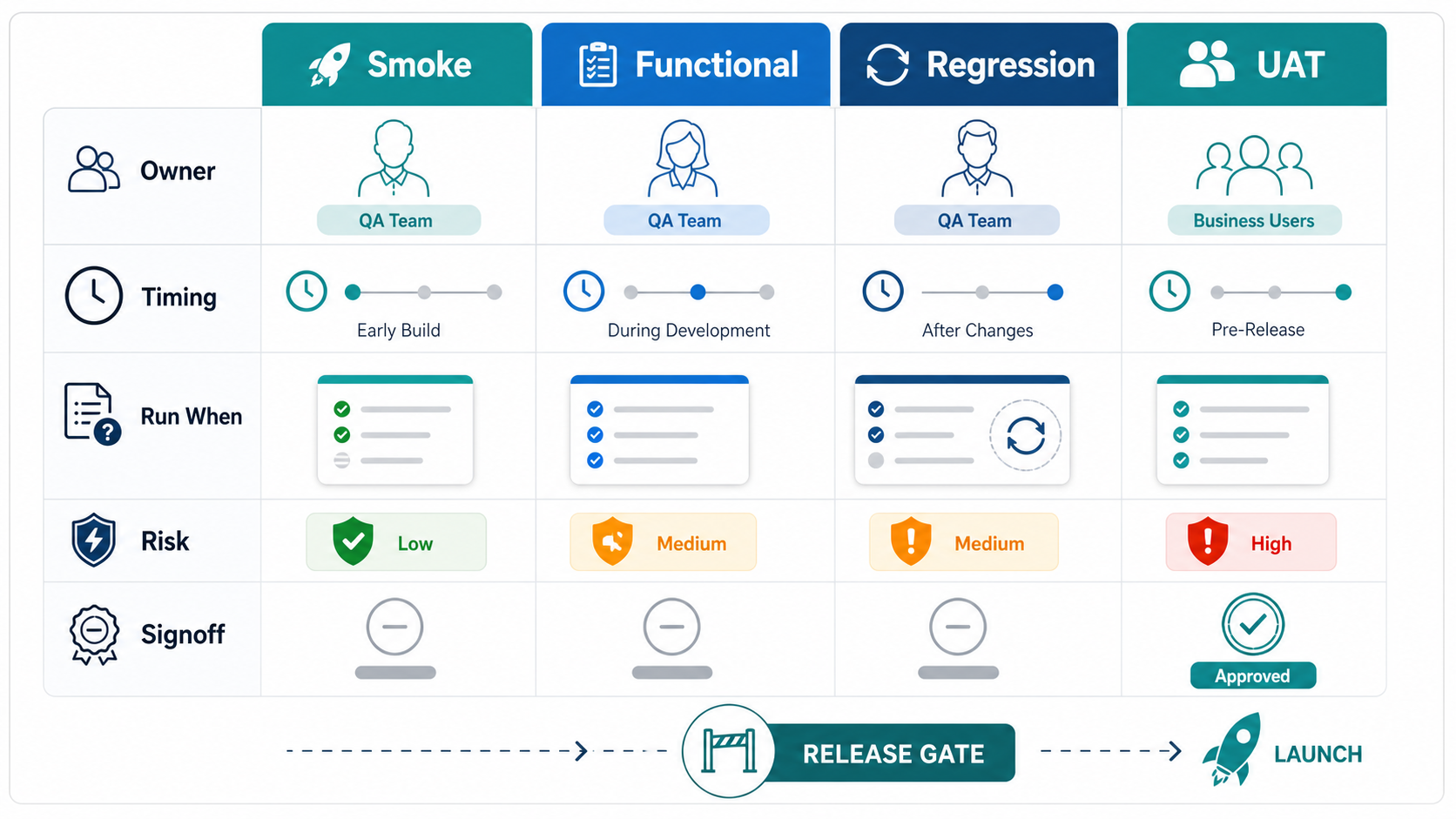
| Release Situation | Minimum Testing Mix | Who Signs Off? |
|---|---|---|
| Small UI or content change | Smoke test plus focused visual or workflow check | Product or QA |
| Bug fix in an existing workflow | Functional retest of the fix plus regression around nearby flows | QA and product owner |
| New feature release | Functional testing, risk-based regression, and UAT for changed business process | QA, product, and workflow owner |
| Payment, booking, or order change | Functional testing, integration checks, regression, reconciliation, and UAT | Product, finance/operations, QA, engineering |
| Mobile app release | Smoke, functional device checks, regression, store-readiness checks, UAT for critical flows | Product, QA, release owner |
For mobile releases, the Mobile App Testing Checklist is a useful companion because device coverage, permissions, push notifications, offline behavior, and app-store requirements create risks that a browser-only QA plan will miss. If the release is part of a broader mobile app development engagement, those checks should be planned before the release candidate, not after the final build is already waiting for approval.
Release Evidence: What Product, QA, And Stakeholders Should Sign Off
Testing only helps when it creates evidence that supports a release decision. Before go-live, product and QA should be able to show which critical workflows were tested, which roles were covered, which environments and devices were used, which defects remain open, and which risks were accepted with a workaround or rollback plan.
- Smoke evidence: build version, environment, core path status, and blocker list.
- Functional evidence: workflow matrix, expected results, actual results, screenshots or logs for critical paths, and defect links.
- Regression evidence: selected regression pack, pass/fail status, coverage rationale, automation results, and known gaps.
- UAT evidence: stakeholder scenarios, acceptance decisions, open process questions, signoff owner, and launch conditions.
- Release decision: go, no-go, limited launch, rollback rule, monitoring owner, and post-release support plan.
The mobile app QA and launch checklist explains this evidence mindset in more detail for iOS and Android launches. The principle is the same for web and custom software: testing should make the release decision clearer, not just produce a longer spreadsheet. When release risk is tied to integrations, roles, dashboards, or workflow complexity, the Custom Software Cost Estimator can also help frame how QA effort grows with scope.
Defect Triage And Retest Loop Before UAT Signoff
Defect triage is where teams often blur regression testing and UAT. A defect found during functional testing should first be classified by release impact, owner, proof, and rollback rule. Then the team can decide whether to fix it now, defer it with an accepted risk, or hold the release. UAT should not become the place where unresolved functional defects are rediscovered by stakeholders without context.
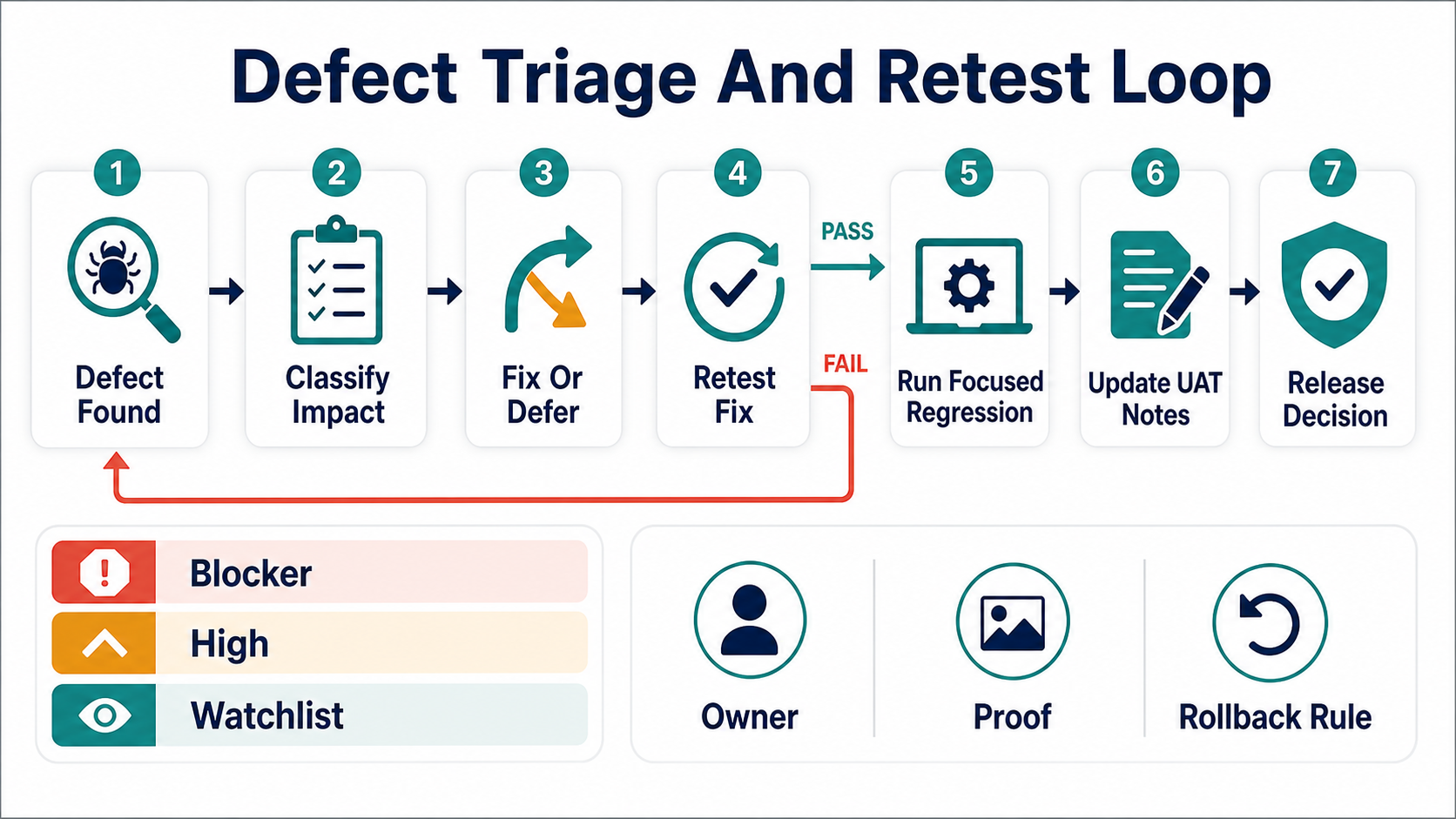
| Defect Signal | Retest Action | Release Decision Impact |
|---|---|---|
| Blocker in login, payment, booking, data sync, permissions, or reporting | Fix, retest the exact defect, and rerun focused regression around the touched workflow. | Hold the release until the blocker has evidence and an owner accepts any remaining risk. |
| High-priority defect with a workaround | Retest the workaround, update UAT notes, and confirm product or operations can support it. | Release only if the workaround is acceptable and the follow-up fix is scheduled. |
| Cosmetic or low-risk issue outside the launch path | Capture proof, defer with a ticket, and avoid expanding regression scope unnecessarily. | Release can proceed when the owner agrees it does not affect acceptance criteria. |
If retesting and regression evidence are slow or inconsistent, QA automation testing services can help convert stable checks into a repeatable release gate. Keep judgment-heavy UAT scenarios manual, but automate the high-repeatability checks that protect critical existing workflows.
Who Should Own Each Testing Decision?
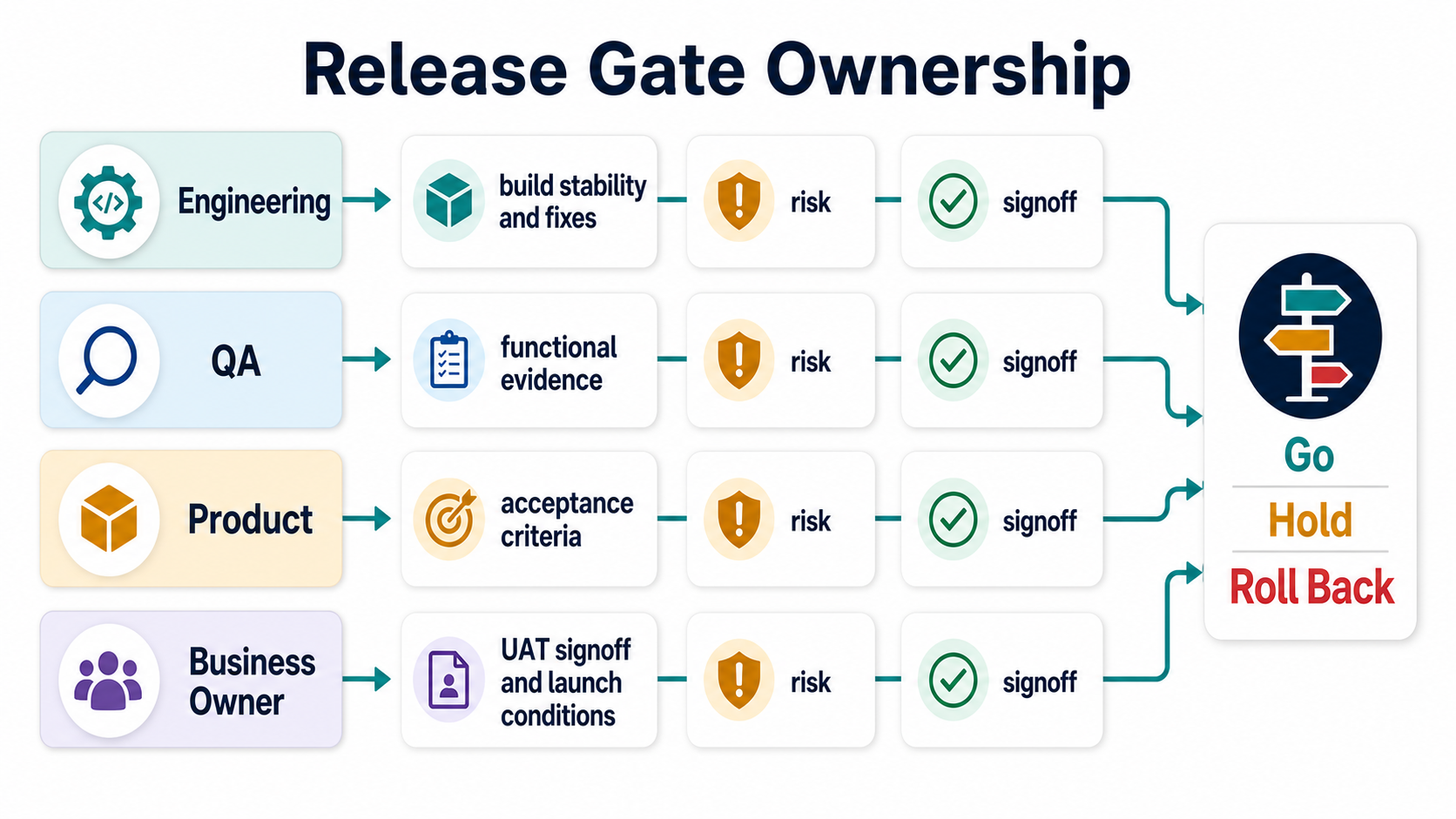
Ownership matters because each testing type answers a different business question. Engineering should own build stability and technical fixes. QA should own test design, execution discipline, defect evidence, and regression scope. Product should own acceptance criteria, priority calls, and release tradeoffs. Business users or client stakeholders should own UAT approval because they understand the operating process the software must support.
In small teams, the same person may wear more than one hat, but the decision should still be separated. A founder can help with UAT, a developer can write automated regression checks, and a QA lead can prepare stakeholder scenarios. The release meeting should still ask which evidence came from QA, which came from product, and which came from actual workflow owners. Teams that need an outside partner to organize that evidence can use software testing services to turn smoke, functional, regression, and UAT work into clearer release decisions.
After Release: Keep Regression And UAT Lessons Alive
After launch, support tickets, analytics, failed jobs, payment disputes, user feedback, and operational workarounds should feed back into the regression pack. If a defect escaped once, decide whether it deserves a new automated check, a manual release checklist item, better monitoring, or clearer UAT criteria.
Regression coverage also needs maintenance. Features change, third-party APIs change, browsers and operating systems change, and old test cases become stale. Budget recurring QA work alongside hosting, security, feature improvements, and support. The software maintenance cost guide explains why post-launch stability needs an ongoing plan instead of one final QA pass before go-live.
How NextPage Can Help
NextPage helps product teams turn release risk into a practical QA plan: workflow mapping, functional test design, regression prioritization, UAT scenario planning, launch evidence, and post-release improvement. The goal is not to run every possible test. The goal is to run the tests that answer the release questions your team is actually facing.
If your team is preparing a web, mobile, SaaS, or custom software release, a QA release plan review can map smoke, functional, regression, and UAT coverage to the workflows that matter most. That gives product, QA, engineering, and stakeholders a shared decision path before the release window arrives.