
Taxi booking apps changed how riders request a trip, how drivers accept work, and how operators control demand across a city. A strong app is not just a booking form. It is a connected passenger app, driver app, dispatch system, payment flow, safety layer, and analytics backend that work together in real time.
This guide explains the taxi booking app features worth planning before development starts. Use it to decide what belongs in your MVP, what can wait for later releases, and where the platform needs stronger operational controls. If you need a broader delivery plan, NextPage's mobile app development company page explains how we handle mobile backend, integrations, testing, and launch support for production apps.
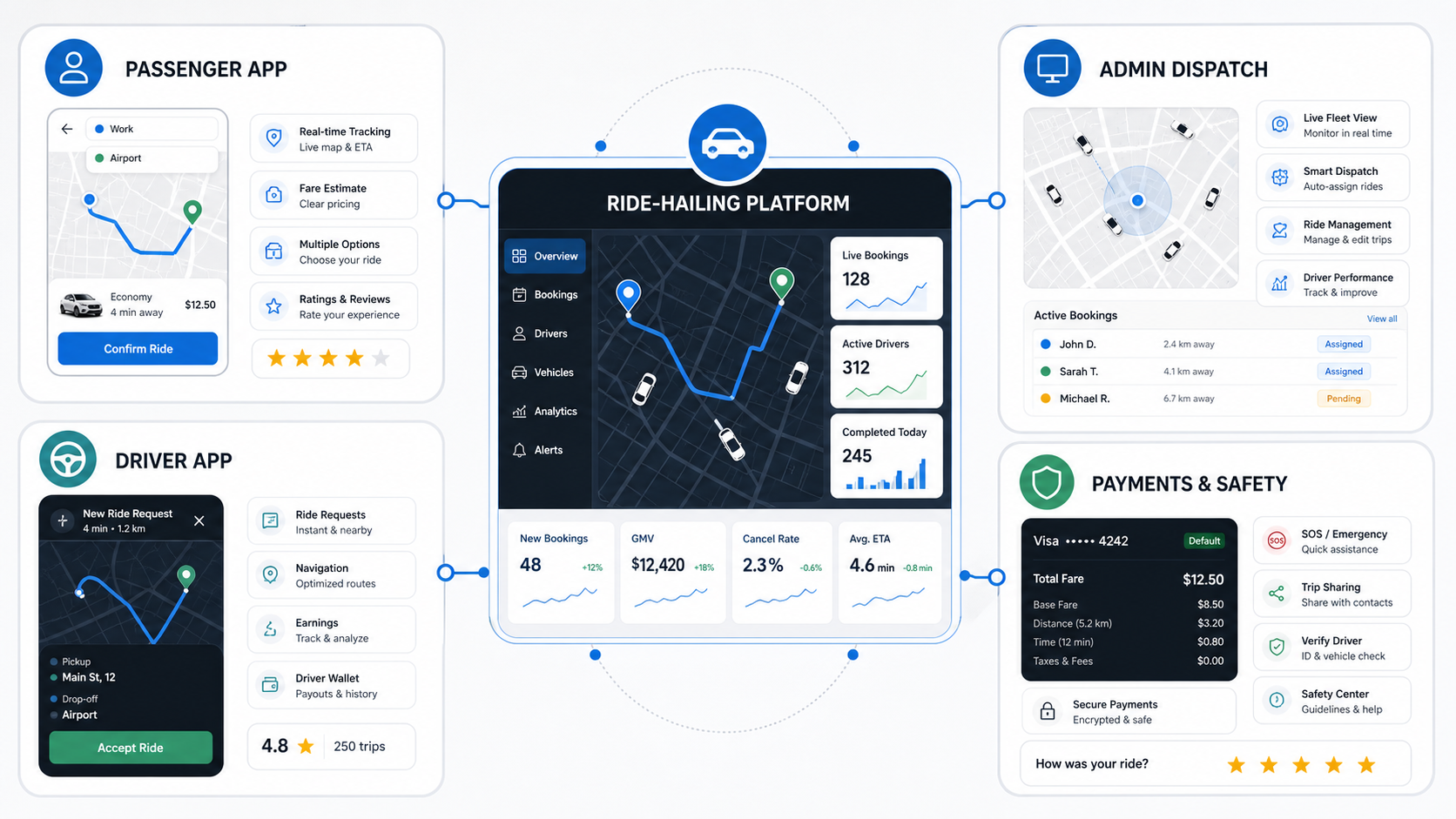
Quick Answer: The Core Taxi Booking App Features
A taxi booking app should launch with account registration, pickup and drop-off selection, real-time GPS tracking, fare estimates, driver matching, ride status updates, cashless payments, ratings, trip history, support, and an admin dashboard. Driver-side workflows should include ride requests, navigation, earnings, document checks, and availability controls.
For a competitive ride-hailing product, add safety features, surge or peak-demand controls, fraud checks, cancellation rules, fleet visibility, driver performance analytics, and customer retention tools. Real-time location quality is especially important; NextPage's guide to real-time GPS tracking for taxi booking apps covers the location layer in more depth.
Passenger App Features
The passenger app should make booking feel predictable from the first tap to the receipt. Prioritize features that reduce uncertainty: fast onboarding, saved addresses, clear pickup confirmation, vehicle categories, live driver ETA, fare estimates, payment choice, support, and transparent trip history.
- Registration and profile management: support email, phone, social login, saved addresses, preferred payment methods, and basic communication preferences.
- Pickup and drop-off selection: include map search, recent places, address correction, pickup notes, and location permission fallback.
- Fare estimate: show estimated fare, distance, time, tolls, taxes, cancellation policy, and surge pricing before booking.
- Ride options: allow economy, sedan, SUV, rental, outstation, scheduled rides, or local fleet categories based on the business model.
- Live ride tracking: show driver location, route, ETA, vehicle details, and status changes without forcing the user to contact support.
- Payments and receipts: support cards, wallets, UPI or local methods, cash where relevant, invoices, refunds, and failed-payment recovery.
- Ratings, reviews, and support: collect feedback, route complaints, handle lost items, and provide emergency help when needed.
Driver App Features
The driver app should help drivers accept rides quickly, navigate accurately, understand earnings, and comply with platform rules. A cluttered driver interface creates missed pickups, cancellation disputes, and support load.
- Driver onboarding: collect profile data, vehicle documents, license details, background checks, bank details, and approval status.
- Availability controls: let drivers go online, pause, reject responsibly, manage shifts, and receive demand-zone prompts.
- Ride request cards: show pickup distance, fare type, destination rules, incentives, and accept or reject actions clearly.
- Navigation and route context: integrate maps, turn-by-turn directions, pickup notes, route changes, and customer contact controls.
- Earnings dashboard: include completed trips, incentives, commission, wallet balance, payout status, and tax-ready summaries.
- Safety and support: add SOS, trip sharing, rider reporting, emergency contacts, and support escalation for disputes.
Admin And Dispatch Features
The admin panel is where the taxi business becomes manageable. Operators need to see active rides, resolve exceptions, manage pricing, review driver performance, control payouts, and understand demand patterns.
- Live booking dashboard: show requested, accepted, in-progress, completed, cancelled, and disputed rides.
- Dispatch and matching: assign rides based on proximity, driver rating, vehicle type, idle time, acceptance rate, and operational rules.
- Driver and vehicle management: manage approvals, documents, service zones, vehicle categories, suspensions, and compliance expiry dates.
- Pricing controls: configure base fare, distance, time, surge multipliers, tolls, coupons, cancellation fees, and commissions.
- Payments and payouts: track successful payments, refunds, cash reconciliation, driver payouts, invoices, and settlement reports.
- Analytics: monitor booking conversion, peak hours, service zones, cancellation causes, driver supply, customer cohorts, and support trends.
Peak-hour operations deserve extra attention because supply and demand rarely stay balanced. For a deeper operational layer, read NextPage's article on high demand and peak hours in taxi booking app development.
Feature Priority Matrix For Your MVP
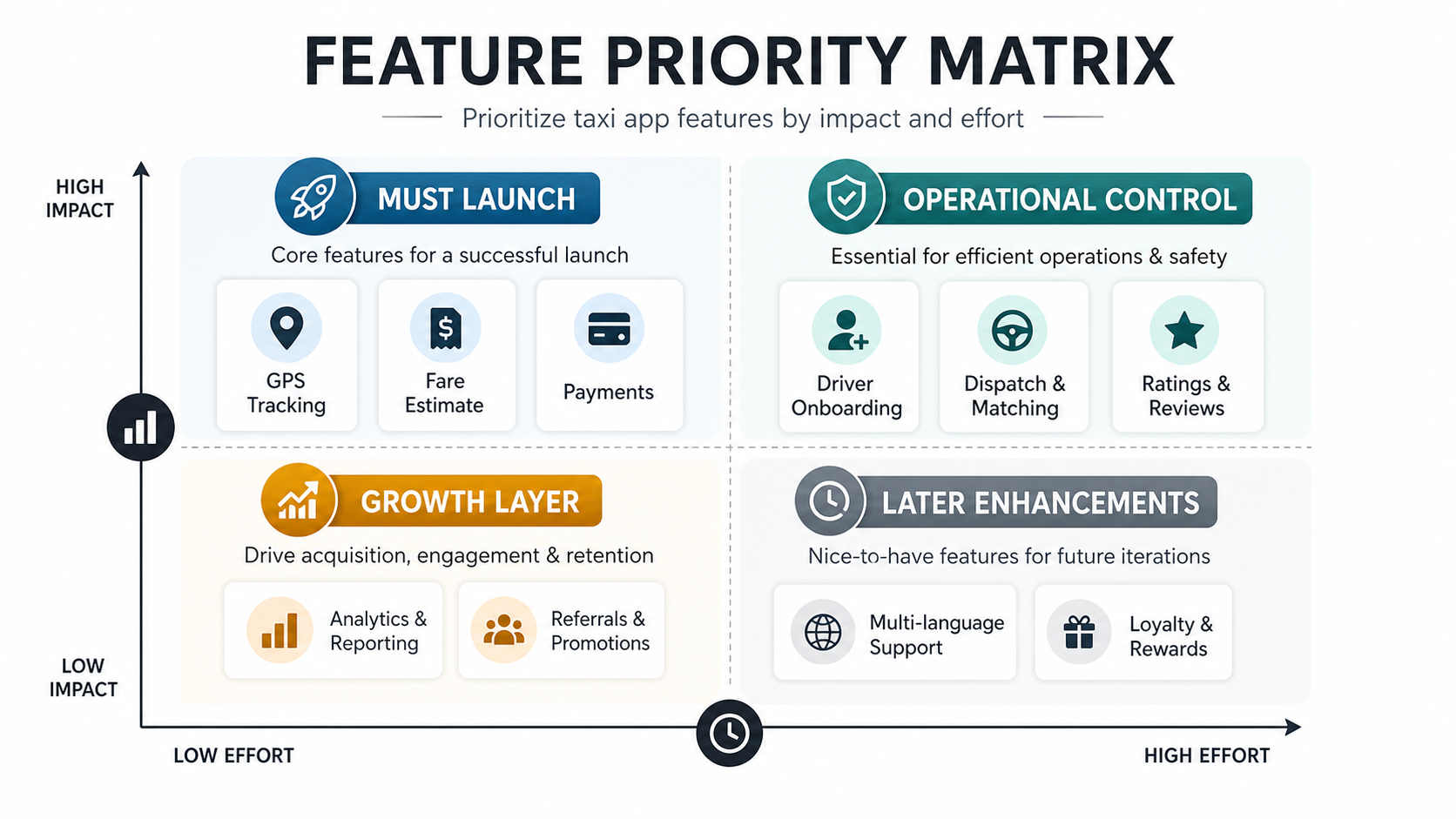
Not every feature needs to ship on day one. The first release should prove that riders can book reliably, drivers can complete trips, payments are recorded, and operators can resolve issues. Growth and personalization features become more valuable after the core network is stable.
| Priority | Feature Group | Why It Matters |
|---|---|---|
| Must Launch | Booking, GPS tracking, fare estimate, driver matching, payments | Without these, the marketplace cannot complete reliable rides. |
| Operational Control | Admin dashboard, driver onboarding, dispatch rules, ratings, support | These features keep service quality and exceptions manageable. |
| Growth Layer | Analytics, referrals, promotions, loyalty, scheduled rides | These improve retention and unit economics after core usage starts. |
| Later Enhancements | Multi-language expansion, subscriptions, enterprise accounts, advanced automation | These are useful when the product has clear market and city-level demand. |
Technology Choices For Taxi App Development
A taxi app usually needs iOS and Android frontends, a secure backend, real-time location services, payment integration, notifications, and an operations dashboard. React Native or Flutter can work for cross-platform delivery, while native Swift and Kotlin may be better when performance, platform-specific location behavior, or hardware integrations are critical.
The backend should handle authentication, ride lifecycle states, matching logic, pricing, payment events, notifications, admin permissions, audit logs, and reporting. Common choices include Node.js, Python, PostgreSQL or MySQL, Redis for real-time workloads, cloud object storage, push notification services, map APIs, and payment gateways. The exact stack should follow scale, team skill, compliance needs, and integration complexity.
Development Workflow
A taxi app like Uber or Lyft is complex because every ride touches multiple users and systems at once. Plan the product around workflows, not a flat feature checklist.
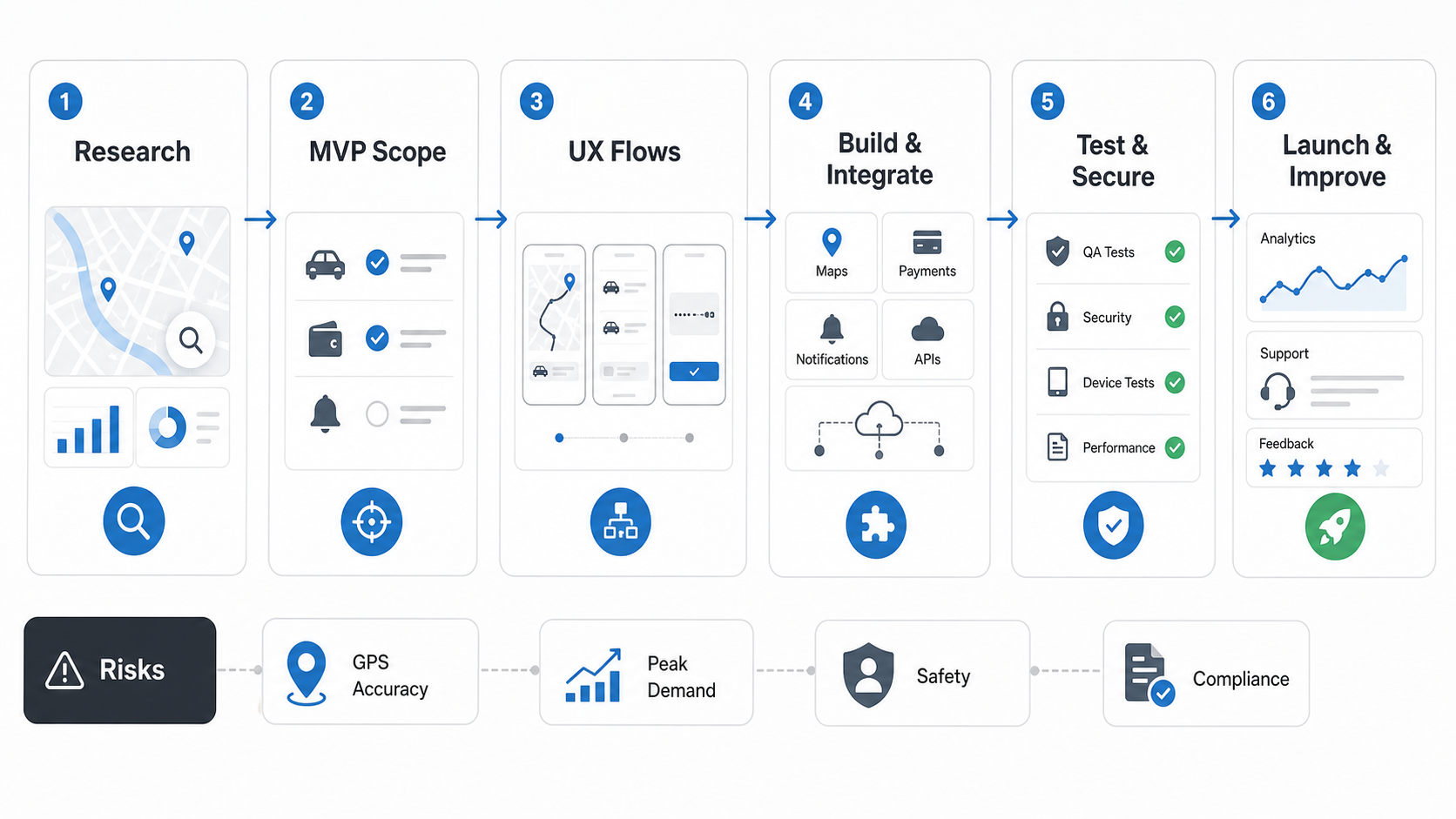
- Research the market: define service zones, competitors, passenger pain points, driver supply, local rules, and target ride categories.
- Scope the MVP: decide which passenger, driver, admin, payment, and safety workflows must be stable for launch.
- Design UX flows: map booking, acceptance, arrival, trip start, trip completion, cancellation, refund, and support journeys.
- Build and integrate: connect maps, payments, notifications, authentication, admin tools, analytics, and customer support systems.
- Test security and reliability: validate location accuracy, payment edge cases, driver/rider identity, load behavior, and support escalation.
- Launch and improve: track conversion, cancellations, driver acceptance, ETA accuracy, repeat rides, and feedback by service zone.
Cost Drivers In Taxi App Development
The cost to build a taxi booking app depends on platform coverage, feature depth, real-time infrastructure, admin complexity, security requirements, map and payment integrations, and how much custom dispatch logic is required. A simple MVP costs far less than a multi-city ride-hailing platform with driver verification, dynamic pricing, fleet tools, subscriptions, and advanced analytics.
Budget planning should separate the launch product from the scaling roadmap. Start with the features required to complete rides safely and gather operational data. Then add growth features based on usage. If you are comparing budget models across app types, NextPage's eCommerce app development cost guide shows a similar feature-and-integration approach to estimating build complexity.
Monetization Options
Taxi apps usually monetize through ride commission, driver subscriptions, booking fees, surge pricing, corporate accounts, local partnerships, advertising, or premium service categories. The right model depends on driver economics and passenger price sensitivity. Monetization should never make pricing confusing; riders need to understand why a fare changes before they confirm the booking.
Common Challenges To Plan For
Most taxi app failures come from operational gaps rather than missing decorative features. Plan for GPS drift, bad pickup points, peak-hour shortages, driver churn, cancellation abuse, refund disputes, regulatory compliance, safety incidents, fraud, and payment reconciliation. Build admin tools and support workflows early so the team can handle these issues without manual database work.
How NextPage Can Help
NextPage helps teams plan and build production mobile apps with user-facing experiences, backend systems, integrations, analytics, and launch support. A taxi booking app needs both product clarity and operational engineering, especially when real-time tracking, payment reliability, and driver workflows are central to the business.
If you are preparing a taxi, mobility, delivery, or local-services app, start by mapping the passenger, driver, admin, payment, and safety flows together. That shared system view will make the MVP easier to estimate, easier to test, and easier to scale after launch.