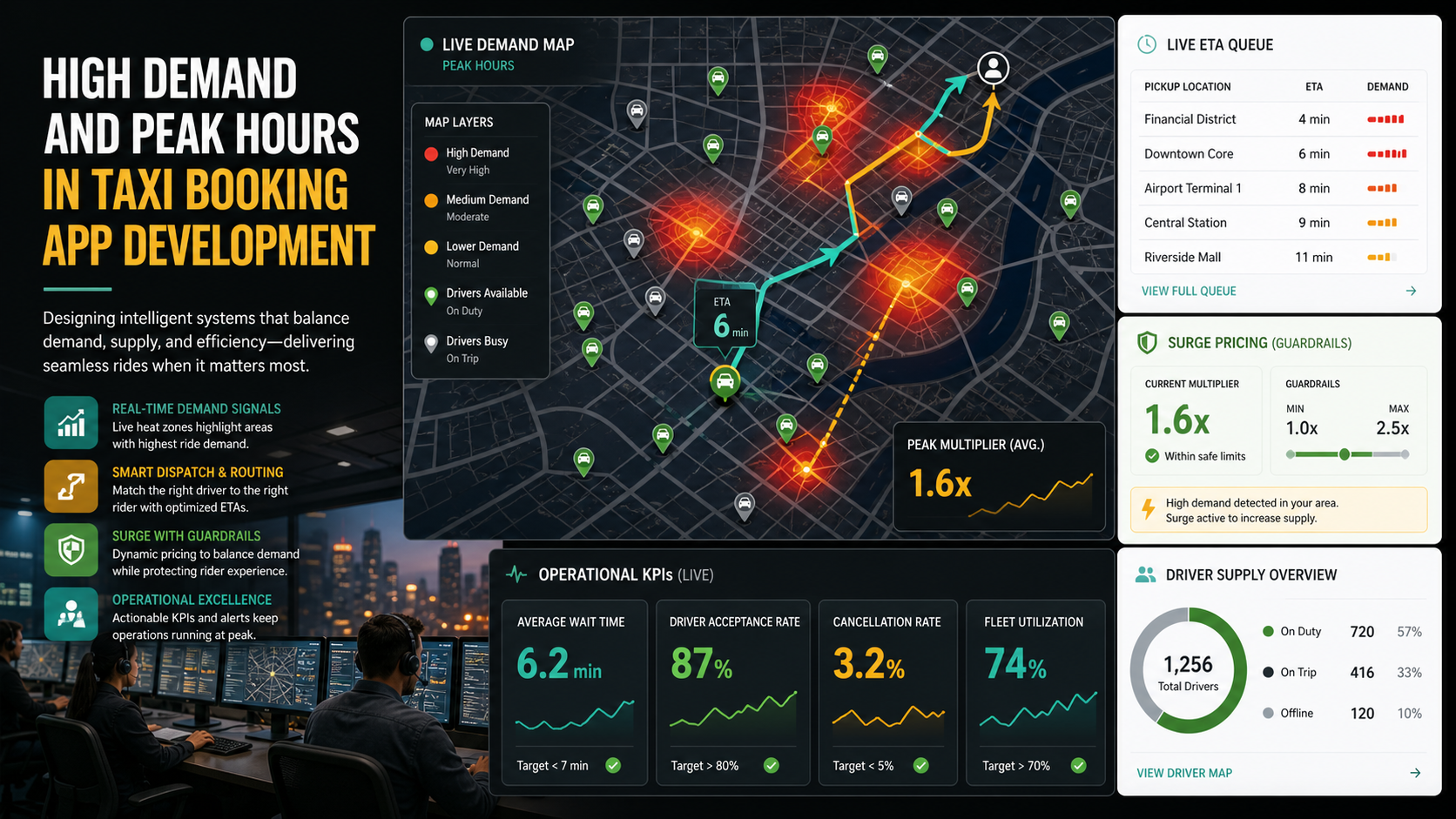

Quick Answer: Peak-Hour Taxi Booking App Development
Peak hours are the real stress test for a taxi booking app. The product has to balance rider demand, driver supply, route conditions, fare rules, support capacity, and transparent communication while thousands of people are trying to book at the same time. A polished booking screen is not enough if the dispatch layer cannot keep wait times, cancellations, and driver acceptance under control.
For operators, the goal is not simply to switch on surge pricing. A reliable peak-hour system forecasts demand, positions drivers before the spike, applies fair pricing rules, assigns trips intelligently, protects rider trust, and gives the operations team live controls when airports, offices, concerts, weather, or emergencies change demand patterns.
If you are planning mobile app development for a taxi or ride-hailing business, peak-hour behavior should be designed from the first architecture pass. The rider app, driver app, admin panel, dispatch service, payment flow, notifications, maps, analytics, and support workflows all need to work as one operating system.
Why Peak Hours Break Basic Taxi Apps
A taxi app can look successful during normal demand and still fail during the morning commute, Friday evening rush, airport arrival waves, bad weather, or major events. These periods compress every product problem into a short window. Riders expect fast ETAs, drivers become selective, routes slow down, prices move, and support tickets increase.
Legacy or underbuilt platforms usually fail in predictable ways: stale driver locations, slow matching, unclear fare changes, poor cancellation handling, overloaded notifications, and no operational view of supply gaps. The result is longer wait times, lower driver acceptance, rider complaints, and revenue leakage during the very hours that should generate the most value.
Peak-hour readiness starts with a product question: what should the system do before, during, and after a demand spike? That answer should shape the app roadmap, not sit as a late-stage admin feature.
Forecast Demand Before The Spike
The best way to handle peak demand is to prepare before riders open the app. Forecasting does not need to begin with advanced machine learning. Even a practical first version can combine historical ride volume, day-of-week patterns, weather, event calendars, airport schedules, public transit disruptions, and local business zones.
The admin panel should show expected demand by zone and time block so operators can move drivers into position early. The driver app can show heat zones, scheduled incentives, queue guidance, and recommended staging areas. The rider app can show scheduled ride options or honest availability messaging when a spike is expected.
As data quality improves, forecasting can become more granular. The platform can learn which zones need extra supply before office closing times, which event venues create post-show surges, and which airport terminals need larger vehicle pools. This turns peak-hour management from reactive firefighting into planned capacity management.
Build A Peak-Hour Dispatch Control Loop
Dispatch is where peak-hour taxi booking app development becomes operationally serious. The system must decide which driver gets which trip, how long the rider should wait, whether a driver is likely to accept, and how route conditions affect the actual pickup time.
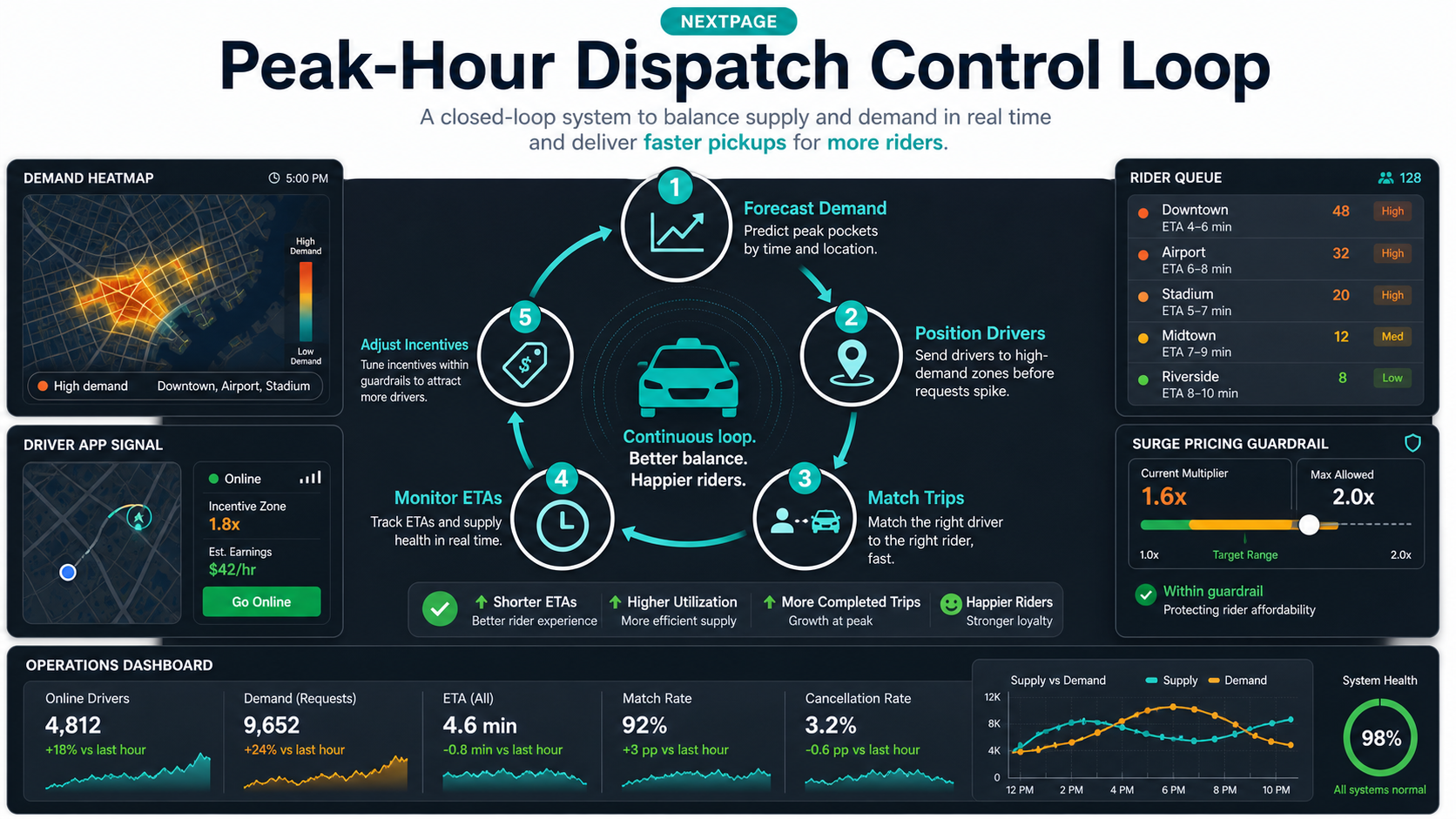
A strong dispatch model uses live location, route distance, driver status, vehicle category, acceptance history, pickup complexity, service zone rules, and rider priority signals. This overlaps with core taxi booking app features, but peak hours require tighter thresholds and more transparent fallback rules.
| Dispatch decision | Peak-hour requirement | Operational risk if missing |
|---|---|---|
| Driver eligibility | Filter by availability, distance, vehicle type, rating, and current route | Low acceptance and rider cancellations |
| ETA quality | Use traffic-aware pickup time instead of straight-line distance | False promises and support complaints |
| Zone balancing | Keep enough drivers near future demand, not only current requests | One zone drains supply from another |
| Retry logic | Escalate to nearby drivers quickly when a match is declined | Long silent waits for riders |
| Operations override | Let admins adjust service zones, queues, incentives, and alerts | No practical control during events or disruptions |
Use Surge Pricing With Guardrails
Surge pricing can help balance supply and demand, but it should be treated as a governed product rule rather than a blunt multiplier. If prices jump without explanation, riders lose trust. If prices stay flat while demand climbs, drivers may ignore requests and the marketplace stalls.
A better approach is to define clear pricing guardrails: maximum multipliers by city or zone, cooldown periods, rider-facing explanations, driver incentive splits, event-specific rules, and admin review for extreme conditions. The app should show price changes before booking and should avoid surprising riders after confirmation.
Operators also need to distinguish between rider pricing and driver incentives. Sometimes the business can improve supply by offering targeted bonuses without pushing the full cost to riders. The right rule depends on margin, market expectations, driver behavior, and customer trust.
Increase Driver Supply With Smarter Incentives
Peak demand cannot be solved only with software if drivers are not available. The app should make peak-hour work easier and more worthwhile for drivers. That means clear heat zones, predictable bonuses, pickup guidance, fast support, and fewer wasted trips.
Driver incentives can be tied to specific goals: entering a high-demand zone before the spike, accepting short trips that keep queue movement healthy, staying online through a rush window, completing airport pickups, or serving underserved neighborhoods. Incentives should be visible in the driver app before the driver makes the decision.
Driver experience also affects rider experience. If the driver app is confusing during busy periods, acceptance drops. If routes are inaccurate, drivers become frustrated. If incentives are unclear, supply does not move where the marketplace needs it.
Optimize Routes, ETAs, And Real-Time Tracking
During peak hours, riders judge the app by the accuracy of the ETA more than by the elegance of the interface. The system should calculate pickup and trip estimates using road-network distance, live traffic, pickup-side complexity, one-way streets, waiting restrictions, and driver movement history.
For high-density cities, real-time GPS tracking has to be paired with routing logic. Raw coordinates only tell the app where a driver is. Routing and traffic data explain whether that driver can actually reach the pickup quickly.
Fleet operators may also need fleet management app capabilities such as vehicle status, shift schedules, depot zones, compliance alerts, and driver performance dashboards. Peak-hour dispatch improves when the booking app understands more than location alone.
Communicate Clearly With Riders During Delays
Riders can tolerate some delay when the app is honest. They lose confidence when ETAs jump without explanation, fares change unexpectedly, or a ride appears stuck in matching. Peak-hour communication should be proactive, brief, and tied to useful choices.
The rider app should show when demand is unusually high, why pricing changed, whether scheduling could be a better option, and what happens if no nearby driver accepts the trip. Push notifications, in-app banners, support macros, and cancellation flows should use the same source of truth so the user does not receive conflicting messages.
Clear communication also reduces support pressure. A simple message such as "High demand near your pickup; we are expanding the driver search radius" is more helpful than a spinner with no context.
Monitor Peak Demand Readiness Metrics
Peak-hour performance should be measured in real time and reviewed after each spike. The most useful dashboard combines marketplace, product, driver, and support signals so operators can see whether the system is healthy or merely busy.
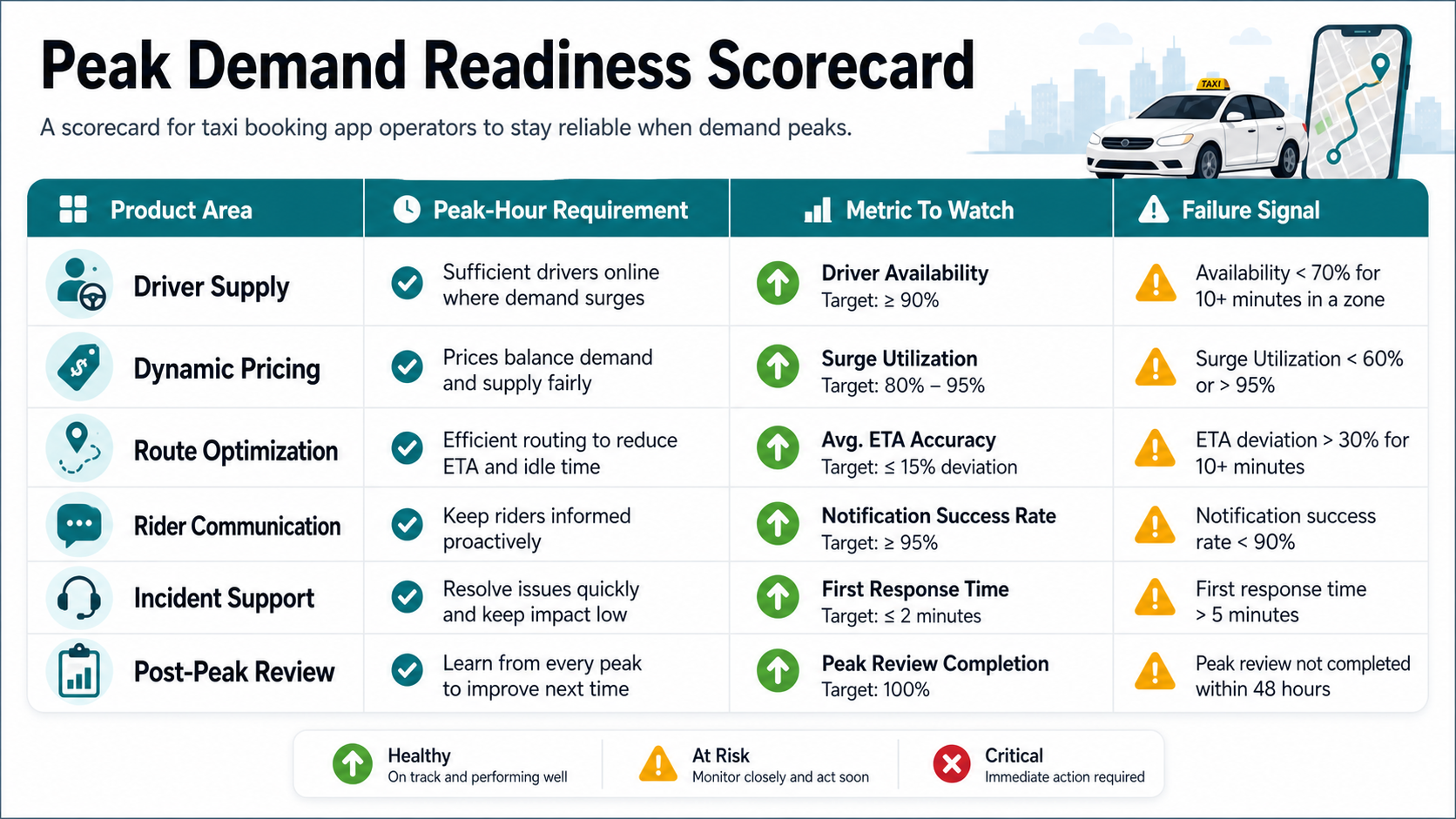
- Request-to-match time: how quickly riders are paired with a driver during high demand.
- Driver acceptance rate: whether pricing, incentives, pickup distance, and route quality are attractive enough.
- Cancellation rate: split by rider cancellation, driver cancellation, and no-driver-found outcomes.
- ETA accuracy: difference between promised pickup time and actual arrival time.
- Supply gap by zone: areas where rider demand consistently exceeds available drivers.
- Support volume: ticket spikes tied to pricing, waiting, driver movement, payment, or cancellations.
These metrics should feed product decisions. If acceptance drops in one zone, the issue may be pickup complexity or driver payout. If ETA accuracy drops after events, route assumptions may be wrong. If cancellations rise after price changes, the rider explanation may need work.
Prepare For Events, Weather, And Emergencies
Not every demand spike follows a normal rush-hour pattern. Concerts, sports matches, festivals, storms, outages, and emergencies can create sudden imbalances. The taxi booking platform should give operators event controls that can be configured quickly without a code deployment.
Useful controls include temporary pickup zones, event geofences, manual surge caps, driver staging guidance, rider messaging templates, priority support queues, vehicle category restrictions, and incident notes. For airport and venue operators, the app may also need queue management and pickup-point instructions.
The key is to avoid improvising through support chats and manual calls. When event operations are modeled inside the product, the team can respond faster and learn from each demand spike.
Cost And Architecture Considerations
Peak-hour taxi app features affect architecture and cost. Real-time matching, live tracking, pricing rules, notifications, maps, analytics, and admin controls need backend services that can handle traffic spikes without corrupting state or slowing the rider experience.
Teams should plan for queueing, cache strategy, location update frequency, map API usage, database indexes, observability, retry rules, and graceful degradation. The product does not need every advanced feature on day one, but the architecture should not make peak-hour reliability impossible later.
Before committing budget, the Custom Software Cost Estimator can help frame the likely scope across rider app, driver app, dispatch backend, admin panel, map services, payment integrations, analytics, support tooling, and infrastructure. The Build vs Buy Decision Tool is also useful when deciding whether to extend an existing dispatch product or build a custom peak-hour operating layer.
How NextPage Builds Peak-Hour-Ready Taxi Apps
NextPage approaches peak-hour taxi booking app development as a combined product, marketplace, and operations problem. We map rider expectations, driver workflows, dispatch rules, pricing governance, map dependencies, payment flows, support scenarios, and admin controls before recommending the build plan.
For a version-one launch, we usually prioritize accurate location handling, dependable matching, transparent pricing, basic incentives, reliable notifications, admin visibility, and post-ride analytics. More advanced features such as predictive demand models, event playbooks, driver repositioning, automated surge governance, and city-level optimization can follow after the platform has real usage data.
A taxi app that handles peak demand well earns trust when users need it most. The product should make busy periods more predictable for riders, more profitable for drivers, and more manageable for operators.