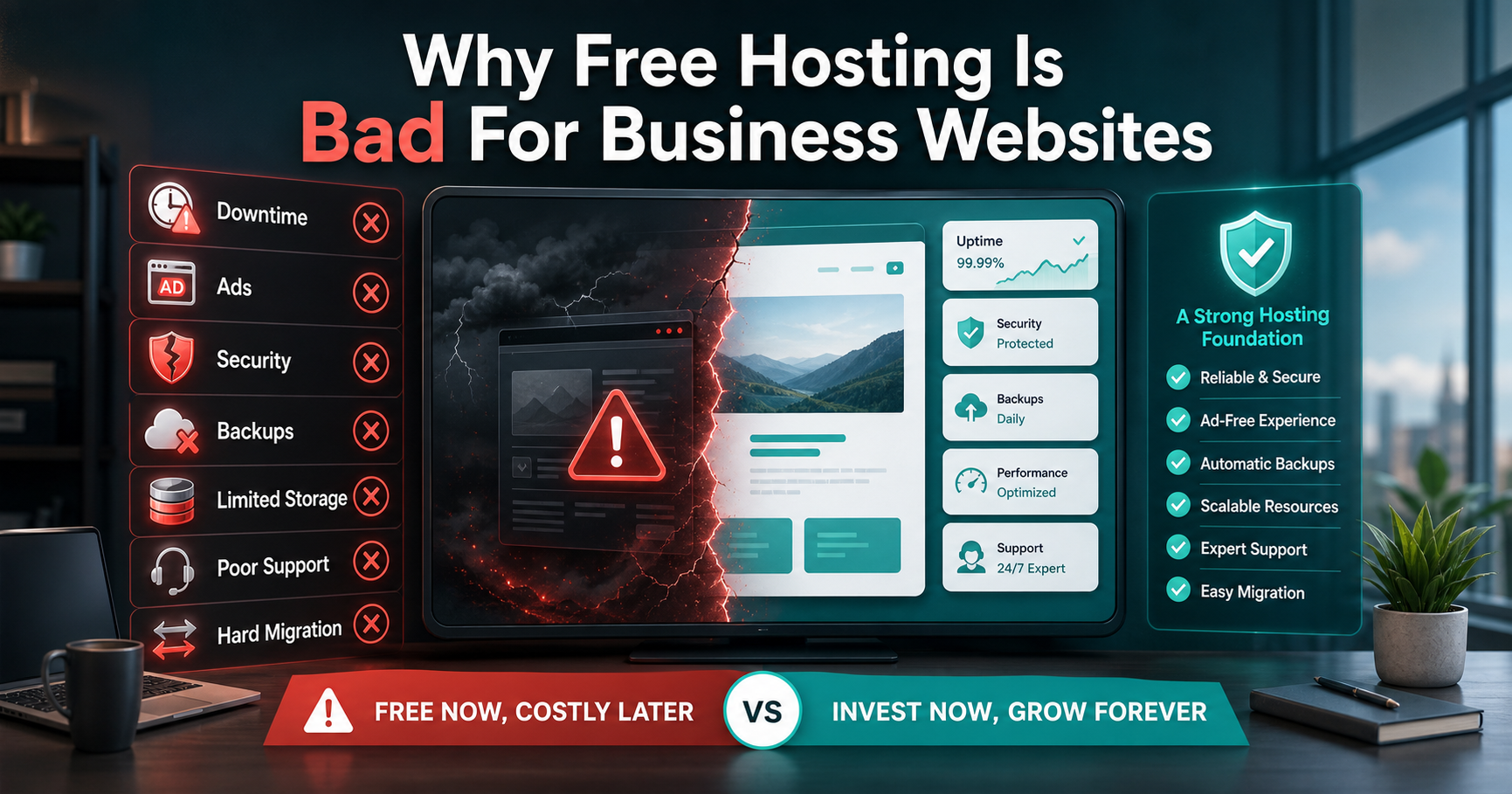

Free hosting looks attractive when a website is still an experiment. It removes the first invoice, gives you a quick place to publish, and feels harmless when traffic is low. The problem is that a business website has a different job than a hobby page. It must earn trust, load reliably, protect customer data, support search visibility, and give your team enough control to improve the experience over time.
That is where free hosting becomes expensive. The real cost usually appears later through forced ads, weak branding, limited storage, poor support, downtime, missing backups, security gaps, and migration work that should have been planned before the site started attracting customers.
Quick Answer: Is Free Hosting Bad For A Business Website?
Free hosting is usually bad for a business website because it limits control over your domain, email, performance, backups, security, design, analytics, and migration path. It can be acceptable for a temporary prototype, class project, or personal experiment, but it is a risky foundation for a company site, lead-generation website, ecommerce store, SaaS landing page, or any website that represents a real brand.
If the website supports sales, hiring, customer support, paid ads, SEO, forms, bookings, payments, or investor conversations, choose a managed hosting setup or plan the site as part of a broader website development process. Hosting is not just a server decision; it shapes how credible, secure, and maintainable the website can become.
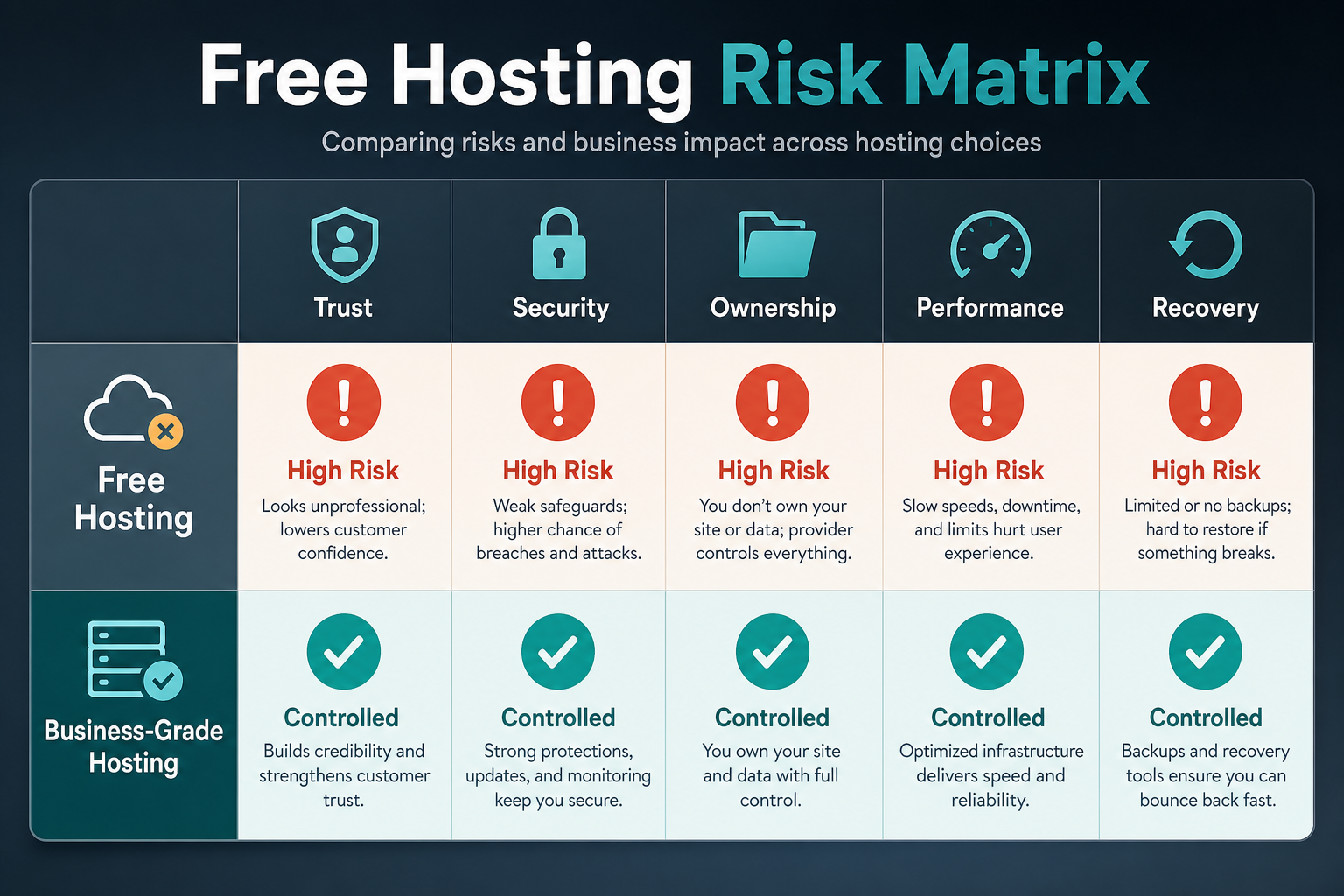
Free Hosting Risk Matrix
The biggest free hosting risks are not isolated technical annoyances. They compound. A weak domain hurts trust. Poor speed hurts conversion. Missing backups make recovery harder. Limited access makes migration slower. Weak support makes every incident more stressful.
10 Reasons Why Free Hosting Is Bad For Your Website
1. Free Hosting Looks Unprofessional
Many free hosting plans place your site on a subdomain, limit your branding, or add provider marks that make the site feel temporary. That is acceptable for testing an idea, but it works against a company trying to build credibility. Customers, partners, and candidates often judge the professionalism of a business by its website before they speak to anyone.
A business website should use its own domain, consistent page templates, clear conversion paths, and branded email. If you are deciding whether to keep a basic site or move into a custom build, a practical web development cost estimate can help compare the real cost of ownership rather than only the hosting bill.
2. Design And Functionality Are Limited
Free hosting platforms usually restrict themes, plugins, scripts, integrations, database access, server settings, and custom workflows. Those limits may not matter on day one, but they become painful when the website needs a better design system, landing pages, analytics, CRM forms, multilingual content, performance tuning, or ecommerce features.
The limitation is not just visual. A business website often needs a clean content model, fast front end, lead capture, automation, and room for future product or service pages. If the website is expected to support growth, treating it as part of custom software development is more realistic than treating hosting as the only decision.
3. Security Controls Are Usually Weak
Free hosting providers often limit access to security controls, monitoring, backups, malware cleanup, firewalls, audit logs, and recovery options. You may not control the server configuration, update cadence, or isolation model. If one account on shared infrastructure is abused, your site can still be affected by downtime, blacklisting, or degraded performance.
Security matters even for simple marketing sites because forms, tracking scripts, admin accounts, media uploads, and customer inquiries create risk. For regulated products or data-heavy workflows, security and hosting should be evaluated during architecture planning, not after launch.
4. You May Not Fully Control The Website
Some free platforms make it difficult to export content, move files, preserve URL structure, manage redirects, or retain the same design after migration. Terms can also restrict how you use the platform, what features you can access, and what happens if the provider changes pricing or shuts down a plan.
Ownership is not only about legal rights to the content. It is also about practical control over the domain, codebase, database, media, redirects, backups, analytics, and deployment process. Without that control, even a small redesign can become a rebuild.
5. Storage And Bandwidth Limits Restrict Growth
Free hosting plans typically cap disk space, traffic, file uploads, media quality, database size, and background jobs. Once the site has case studies, blog posts, downloadable assets, product images, videos, or campaign landing pages, those limits can force upgrades or awkward workarounds.
Storage and bandwidth also affect user experience. Compressed media, slow delivery, and blocked uploads make the site feel less polished. For content-led growth, the hosting foundation should support the editorial and marketing roadmap instead of constraining it.
6. Support Is Often Minimal
When a business site goes down, you need fast answers. Free hosting usually comes with community forums, slow ticket queues, limited documentation, or no guaranteed support at all. That leaves the owner responsible for diagnosing outages, DNS issues, SSL problems, plugin conflicts, hacked files, and failed updates.
Support quality becomes especially important when a website is connected to paid campaigns, search traffic, launch announcements, hiring pages, or lead forms. A small hosting saving can be erased by one missed campaign day or one unresolved production incident.
7. Backups And Recovery Are Not Dependable
Business websites need dependable recovery. That means scheduled backups, restore testing, offsite storage, version history, and a clear incident process. Free hosting plans often offer limited or manual backup options, and some provide no recovery help if content is deleted, corrupted, or compromised.
Backups are also part of migration readiness. If you cannot export the database, media, and page structure cleanly, moving the website later becomes slower and riskier.
8. Migration Becomes Harder Later
Free hosting is easy to start and often hard to leave. You may discover that file access is limited, redirects are restricted, templates cannot be exported, URLs need to change, or media must be rebuilt. Those issues can create downtime, SEO drops, broken links, and manual cleanup work.
If the site already supports customers, a migration should be planned like a production change. For teams moving from constrained hosting into a more resilient environment, a cloud migration assessment can map dependencies, traffic, data, security controls, and rollback paths before anything is moved.
9. Performance And Uptime Are Unreliable
Free hosting providers usually optimize for low cost, not guaranteed performance. Sites may share crowded infrastructure, receive fewer resources, or sit behind limited caching. The result can be slow pages, intermittent outages, restricted traffic spikes, and poor Core Web Vitals.
Performance affects trust and revenue. Slow pages reduce conversions, weaken paid campaign efficiency, and make search growth harder. If the website is part of an ecommerce or transactional experience, review the hosting decision alongside broader ecommerce app development requirements such as checkout reliability, inventory sync, and customer account flows.
10. Downtime Has A Real Business Cost
Downtime is not just a technical metric. It can mean lost leads, missed bookings, failed payments, weaker ad performance, lower customer confidence, and more support messages. Free hosting makes this harder because you may not receive strong uptime commitments, incident transparency, or priority recovery help.
For a business website, the better question is not "Can we host this for free?" It is "What would an outage, breach, migration failure, or credibility gap cost us?" That comparison usually makes paid, well-managed hosting look like a practical risk-control decision.
When To Move From Free Hosting
You do not need enterprise infrastructure for every idea. Free hosting can help validate a concept before there is a business case. But once the site starts representing a company, collecting leads, ranking in search, or supporting customers, it needs a stronger foundation.
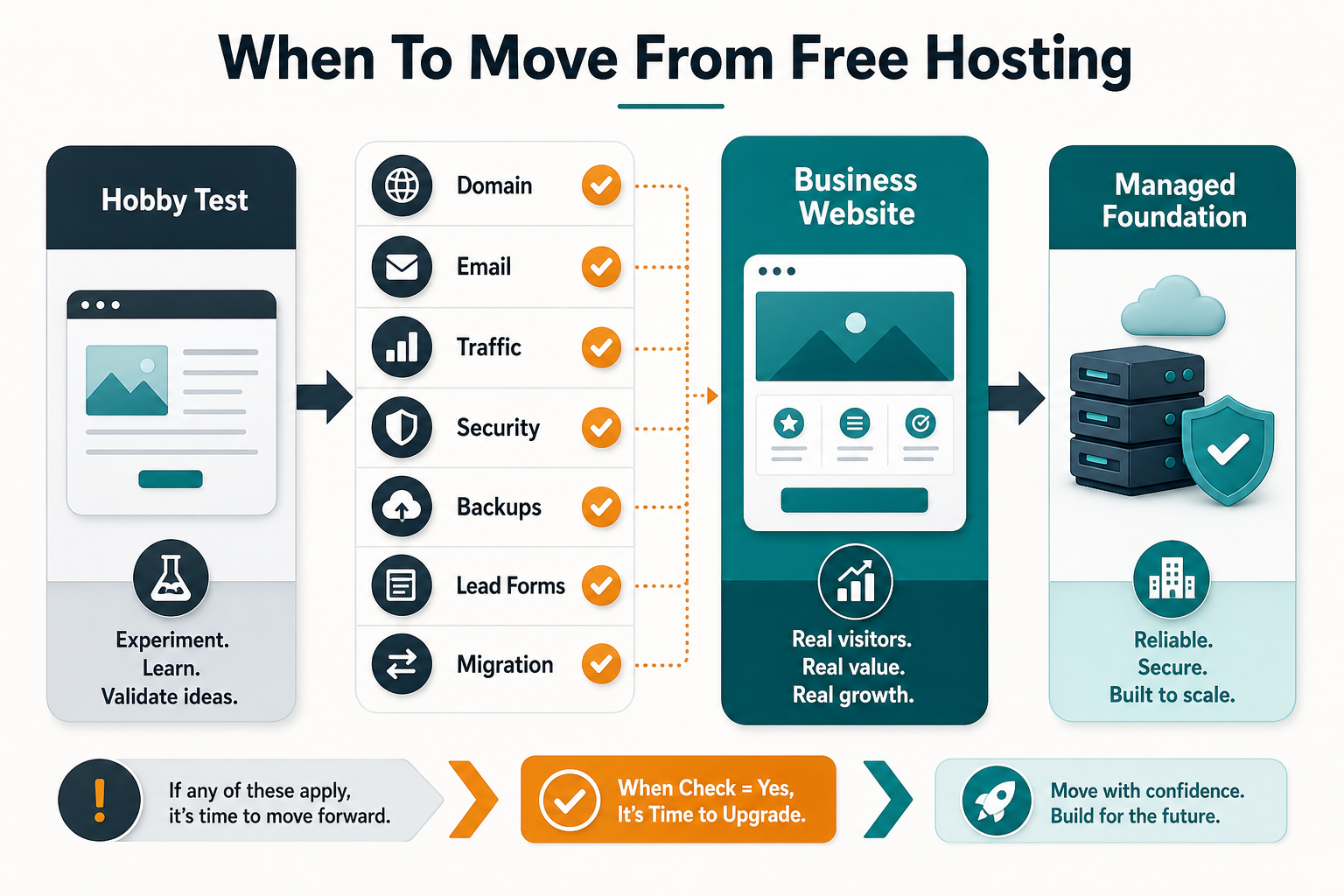
Upgrade before the website becomes difficult to move. The best time to choose a better host is before you launch paid campaigns, publish a large content library, add customer forms, connect payments, or depend on the site for sales conversations.
Business Website Hosting Checklist
Use this checklist before choosing a hosting setup for a business site:
- Domain and email: You can use a custom domain and branded email without provider marks.
- Performance: Pages load quickly, caching is configurable, and traffic spikes are handled predictably.
- Security: SSL, updates, access controls, malware protection, and monitoring are available.
- Backups: Backups are scheduled, retained offsite, and restore-tested.
- Ownership: You can export content, files, database records, redirects, and analytics data.
- Support: There is a clear support channel for incidents, DNS, SSL, and migration issues.
- Scalability: The host can support more pages, campaigns, integrations, and traffic without a rebuild.
- Migration path: There is a plan for moving the site without losing SEO value or customer access.
How NextPage Helps Build Websites That Can Grow
NextPage helps businesses move beyond fragile website foundations by planning the full web stack: content structure, page experience, performance, integrations, hosting, security, analytics, and future product needs. That can mean improving an existing WordPress presence, rebuilding a marketing site, or creating a custom web platform that supports workflows a template cannot handle.
If your current site started on a free platform and now needs to support real business operations, start with an audit of the site, hosting, content, forms, analytics, and migration risk. For WordPress-heavy teams, this can pair naturally with guidance on hiring a WordPress development company. For teams planning a more custom product, compare hosting decisions against the whole software roadmap rather than choosing the cheapest first step.
Conclusion
Free hosting is useful for experiments, but it is a weak foundation for a business website. The risks show up in branding, control, performance, security, backups, support, storage, migration, and downtime. Those issues can quietly cost more than a paid hosting plan once the website starts supporting real customers or revenue.
Choose free hosting only when the website is temporary and low-risk. Choose business-grade hosting when the site needs to build trust, capture leads, rank in search, support campaigns, or grow into a more capable digital product.