
Quick Answer: Which MVP Engagement Model Should A Startup Choose?
Choose a fixed-price MVP only when the problem, scope, acceptance criteria, and launch deadline are already clear enough that change should be managed tightly. Choose time and material when the product still needs learning, experiments, user feedback, or technical discovery during the build. Choose a dedicated team when the MVP is not a one-off launch but the first stage of an ongoing product roadmap.
Most startups should not pick the model from a vendor rate card. They should pick it from risk. If the risk is scope drift, fixed price or a capped sprint can help. If the risk is building the wrong thing, time and material with weekly demos is usually safer. If the risk is moving too slowly after validation, a dedicated team gives better continuity.
A practical starting point is to turn your first-release assumptions into a buildable scope with the MVP Scope Builder. Once the core workflow, must-have features, integrations, and launch goal are visible, the engagement model becomes a delivery decision instead of a guess.
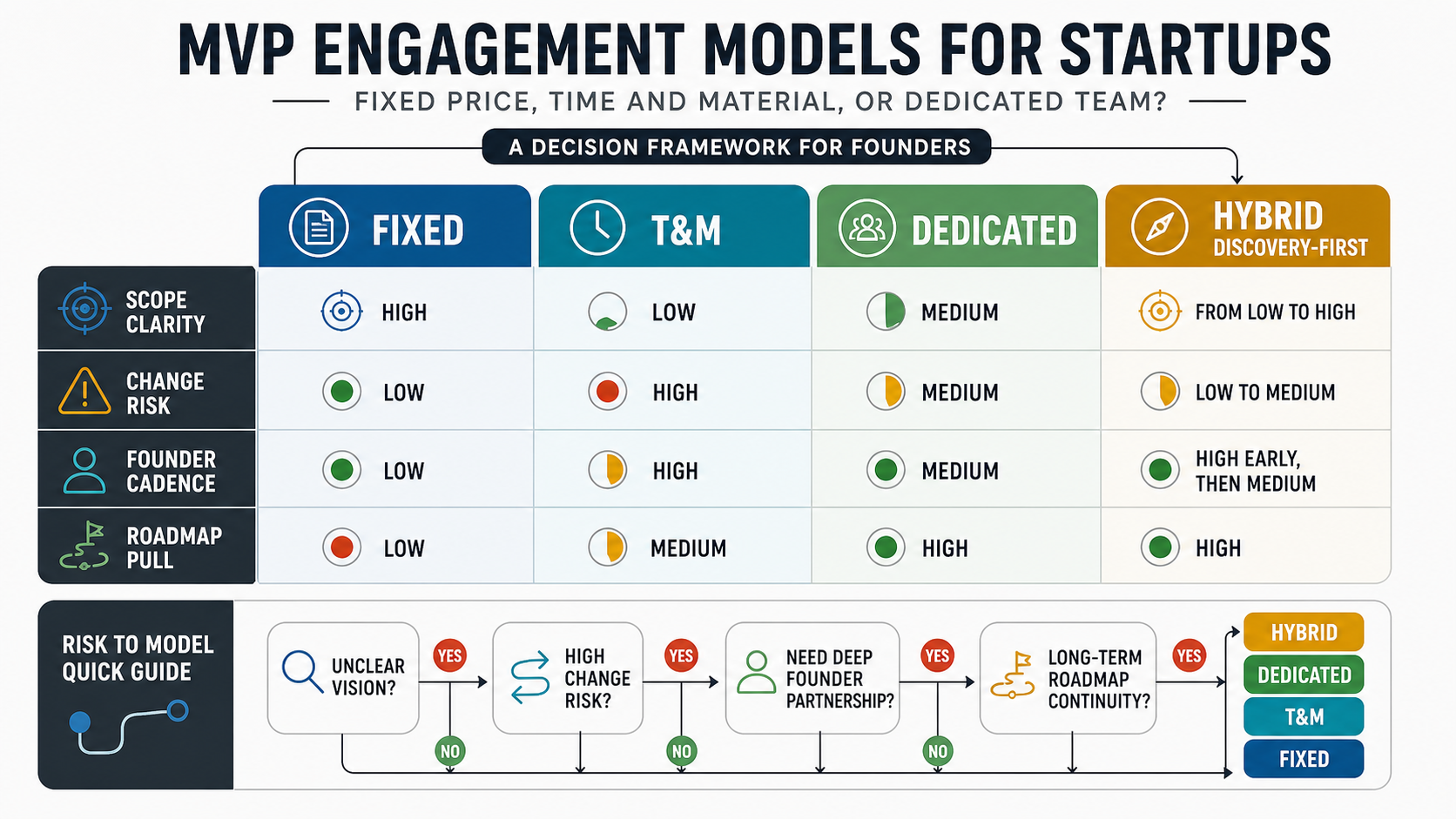
Why The Engagement Model Matters More For MVPs
An MVP is not just a smaller software project. It is a learning vehicle. The first release has to prove that a target user will complete a real workflow, value the outcome, and give the startup enough evidence to keep investing. That makes the commercial model unusually important.
A model that looks cheaper at proposal time can become expensive if it locks the team into weak assumptions. A flexible model can become wasteful if nobody owns priority decisions. A dedicated team can create speed, but only when the founder has enough roadmap clarity and product leadership to keep the team focused.
Before choosing a model, ask four questions:
- How stable is the scope? Are screens, roles, edge cases, integrations, and acceptance criteria already clear?
- How likely is change? Will user interviews, market feedback, API discovery, or investor input change the backlog?
- How involved can the founder be? Can someone review demos, answer product questions, and make tradeoffs every week?
- What happens after launch? Is this a contained MVP, or will the team immediately need analytics, iterations, support, and new features?
If those answers are fuzzy, do product discovery before development. Discovery does not need to be heavy. It should clarify the workflow, risk register, release scope, dependencies, and estimate inputs enough to choose a model responsibly.
Fixed Price Vs Time And Material Vs Dedicated Team
The three common models are easy to define, but harder to use well. The buyer needs to understand what each model optimizes and what it pushes back onto the startup.
| Model | Best Fit | Startup Gets | Main Risk | Control Needed |
|---|---|---|---|---|
| Fixed price | Clear scope, short MVP, known workflow, limited integrations | Defined budget, defined deliverables, tighter change control | Wrong assumptions get frozen into the contract | Discovery, acceptance criteria, change request rules |
| Time and material | Uncertain scope, product learning, evolving backlog, technical discovery | Flexibility, faster adaptation, transparent burn | Budget can drift if priorities are loose | Sprint goals, weekly demos, cap, decision owner |
| Dedicated team | Ongoing roadmap, multiple releases, complex product, long-term velocity | Continuity, product context, stable capacity | Team can become expensive capacity without focus | Roadmap, backlog ownership, metrics, sprint governance |
| Hybrid discovery-first | High uncertainty before build, founder needs estimate confidence | Lower-risk planning before larger commitment | Discovery becomes theater if it does not end in decisions | Decision gates, build-ready scope, technical spikes |
The best model may also change over time. A startup can begin with a short discovery sprint, run a fixed-price prototype for a narrow release, move into capped time and material while testing user behavior, and later keep a dedicated team once the roadmap stabilizes.
When Fixed Price Works For A Startup MVP
Fixed price works when the startup can define the result clearly enough that the delivery team can estimate, build, and verify it without constant scope renegotiation. It is strongest for a narrow first release: a landing-to-onboarding flow, a controlled booking workflow, a simple marketplace pilot, an admin dashboard, or a proof-of-concept app with defined integrations.
Fixed price is attractive because it creates a budget boundary. For a founder with limited capital, that can be useful. It also forces discipline: fewer nice-to-have features, more written acceptance criteria, and clearer launch priorities.
But fixed price does not remove risk. It moves change risk into the contract. If the startup learns mid-build that users need a different workflow, the team must either submit change requests, reduce another part of scope, or push the learning into a later release. That can be fine for a stable operational tool. It can be painful for a product that is still searching for fit.
Use fixed price when:
- The workflow has already been validated with users or operators.
- The feature list is small enough to explain without hidden assumptions.
- Third-party APIs are known and documented.
- The launch milestone matters more than exploring alternatives.
- The startup can accept strict change control.
A good fixed-price MVP still needs discovery. The difference is that discovery should happen before the fixed commitment, not during it. For teams that need a production-minded first release rather than a disposable prototype, a focused MVP development company path can turn discovery output into a buildable release plan. If you are not sure what the first release should include, use the Custom Software Cost Estimator only after reducing uncertainty around users, roles, integrations, and must-have flows.
When Time And Material Is Safer
Time and material is usually safer when the startup expects the product to change as the team learns. The buyer pays for effort instead of a fully locked scope, so the team can adjust backlog priority, refine UX, test risky assumptions, and respond to technical discoveries without rewriting the entire contract.
This model is common for MVPs because early products contain unknowns. Users may not behave the way the founder expects. A payment, location, AI, notification, or reporting flow may be harder than it looked. An investor or pilot customer may push for a different launch path. Time and material gives the team room to react.
The risk is weak budget discipline. Flexibility is not the same as an open-ended blank check. A startup using T&M needs sprint goals, backlog ranking, weekly demos, burn visibility, and a named decision owner. A capped T&M model can work well: the team agrees on a budget ceiling, reviews progress weekly, and either cuts scope, extends intentionally, or stops at a decision gate.
Use time and material when:
- User feedback is expected to change the workflow.
- The first release includes uncertain integrations or technical spikes.
- The startup needs to compare feature options during development.
- Speed of learning matters more than a fixed specification.
- The founder or product owner can stay actively involved.
T&M is best when paired with evidence. Set a launch goal, success metric, budget band, and tradeoff rule before sprint one. If the product is mostly a web workflow, benchmark the scope against the web app development cost drivers before treating an hourly model as open-ended capacity. If a new feature appears, ask whether it helps prove the MVP's core assumption or only makes the product feel more complete.
T&M Guardrails That Keep Flexibility From Becoming Scope Drift
Time and material is safest when it is flexible inside a visible operating system. The startup should know the budget cap, sprint goal, weekly demo date, owner for decisions, and the point where the team must cut scope, extend deliberately, or stop.
Use a 75% budget alert as a hard decision gate. At that point, the team should not keep adding work by momentum. The founder and delivery lead should review what has been learned, what is still risky, and which features are no longer necessary for the launch decision.
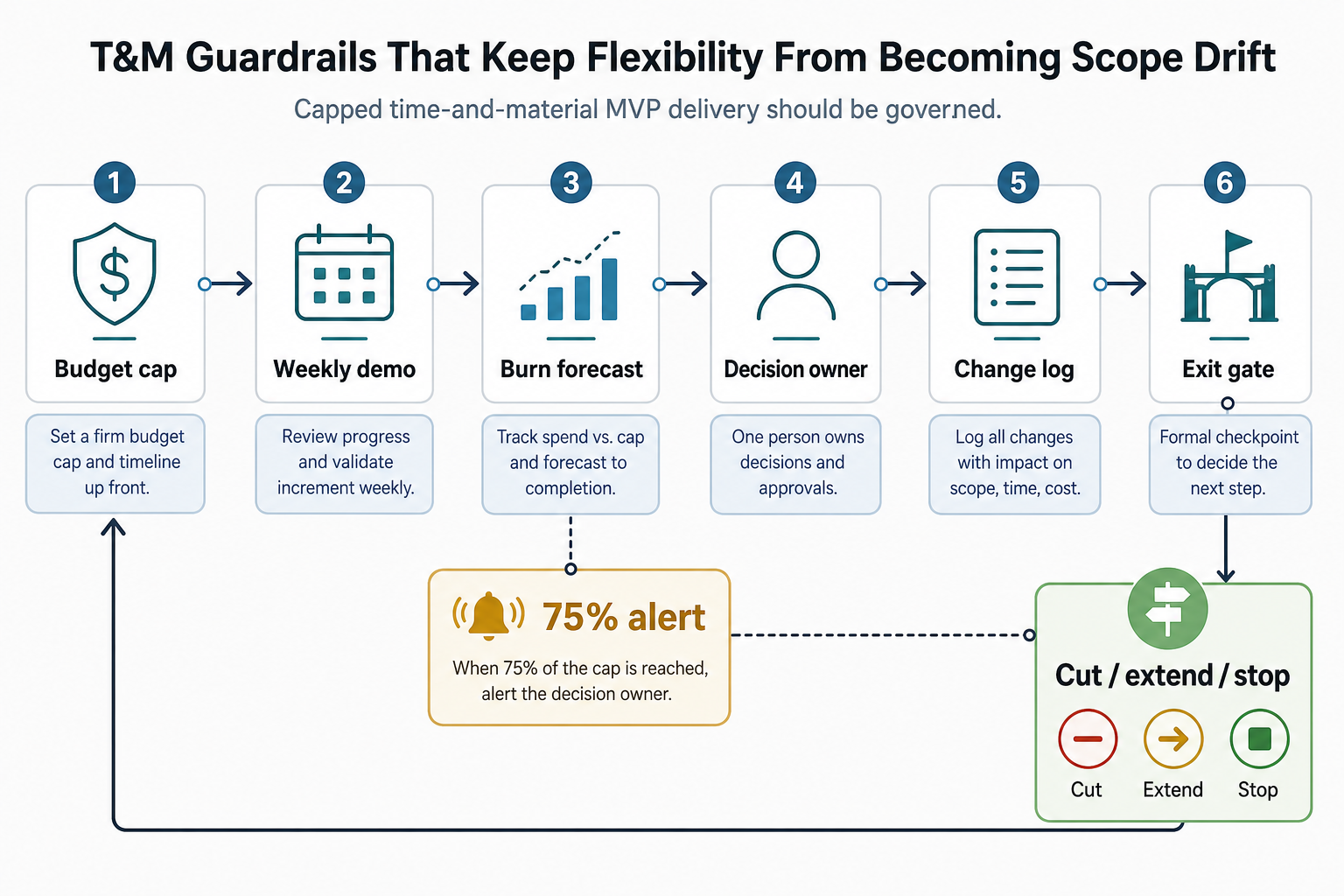
A useful T&M cadence has six mechanics: a written cap, demoable sprint outcomes, burn forecast, one decision owner, a change log with cost impact, and an exit gate. Without those mechanics, T&M can become the most expensive model because every new idea feels small in isolation.
When A Dedicated Team Makes Sense
A dedicated team makes sense when the startup needs sustained product velocity, not just a single MVP handoff. The team may include developers, QA, a project manager, designer support, or specialists who stay close to the roadmap over multiple releases.
This model fits startups that already have enough product direction to keep a team busy and enough runway to use stable capacity well. It is often useful after an MVP has early traction, pilot customers, investor commitments, or a clear backlog of experiments. It can also fit complex MVPs where backend, mobile, web, QA, DevOps, and integrations need continuous coordination.
The advantage is context. A dedicated team learns the domain, codebase, release process, tradeoffs, and product history. That continuity reduces handoff loss and helps the startup move faster after launch. NextPage's hire dedicated developers in India model is designed for this kind of ongoing capacity when founders need engineers plus delivery structure.
The risk is paying for capacity before the roadmap is ready. A dedicated team can burn budget quickly if the founder is still deciding the market, audience, core workflow, or business model. Before committing, estimate the likely team shape with the Dedicated India Team Cost Calculator and decide who will own backlog priority each week.
Use a dedicated team when:
- The product roadmap extends beyond the first launch.
- The startup needs continuous iteration, analytics, support, and feature growth.
- There are multiple workstreams across web, mobile, backend, QA, or integrations.
- The founder has enough product leadership to direct a standing team.
- Knowledge continuity is more valuable than a one-time delivery quote.
Hybrid Models Often Fit MVPs Best
Many startups do not fit cleanly into one model. A hybrid structure can reduce risk without forcing a premature commitment.
- Discovery first, then fixed price: use a short discovery sprint to define the workflow, risks, acceptance criteria, and release scope. Then quote the build phase more confidently.
- T&M with a cap: keep flexibility inside a maximum budget or timebox. Review tradeoffs weekly and stop at a decision gate.
- Fixed-price sprint blocks: define narrow milestones such as clickable prototype, technical spike, beta launch, or admin dashboard.
- Dedicated team after validation: start lean, prove the core workflow, then move to a stable team when there is enough roadmap pull.
- Core fixed scope plus T&M backlog: lock the non-negotiable launch workflow and keep experiments or polish in a flexible backlog.
Hybrid models work because MVPs mix certainty and uncertainty. The payment workflow may be clear, but the onboarding flow may need testing. The admin panel may be fixed, but the AI recommendation logic may need a spike. The contract should reflect those differences instead of pretending the whole MVP has the same risk profile.
A Staged MVP Engagement Path
The strongest answer is often not one model forever. A startup can use discovery to remove ambiguity, a fixed sprint for stable scope, capped T&M for learning, and a dedicated team only after the roadmap has evidence behind it.
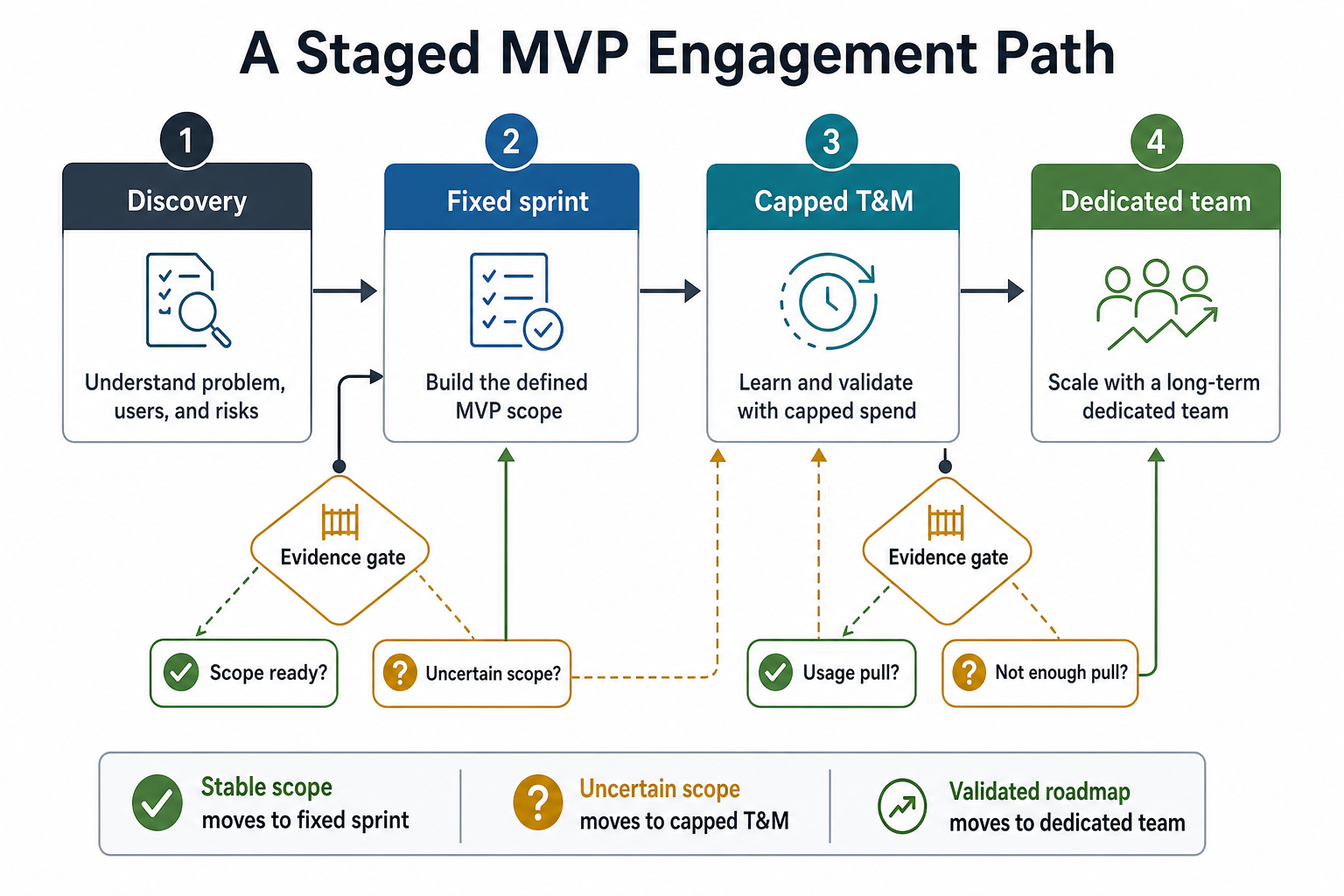
This path protects the budget because each model has a job. Discovery answers whether the scope is ready. A fixed sprint ships the defined workflow. Capped T&M absorbs controlled learning. A dedicated team scales the product only when usage, backlog depth, and business commitment justify persistent capacity.
The Scope-Readiness Test Before You Choose
Before asking for a quote, score the MVP against these readiness signals. The more yes answers you have, the more fixed-price-friendly the project becomes. The more no answers you have, the more you should lean toward discovery, capped T&M, or a smaller first release.
| Readiness Signal | If Yes | If No |
|---|---|---|
| Primary user and job are clear | Scope can be tied to one workflow | Run discovery and interviews first |
| Must-have features are separated from later ideas | Fixed scope is more realistic | Use MVP prioritization before estimating |
| Integrations are known and accessible | Estimate risk is lower | Run a technical spike or T&M phase |
| Acceptance criteria are testable | Fixed price can work | Define demo and QA criteria first |
| Founder can review weekly | T&M or dedicated team can stay controlled | Use narrower fixed milestones |
| Roadmap after launch is visible | Dedicated team may fit | Start with a smaller MVP commitment |
This test also helps with budget conversations. The real driver of custom software development cost is usually workflow complexity, role count, integrations, security, data migration, and change risk, not only the number of screens.
Red Flags In MVP Engagement Proposals
Model labels can hide weak delivery practices. Review the proposal mechanics, not only the pricing name.
- Fixed price with vague scope: if the vendor cannot explain assumptions, exclusions, acceptance criteria, and change rules, the fixed price is not real control.
- T&M without burn visibility: flexibility needs weekly progress, hours, demo output, and next-sprint priorities.
- Dedicated team without product ownership: a standing team needs backlog direction, sprint goals, review cadence, and success metrics.
- No discovery for uncertain products: if the MVP has unknown users, integrations, or workflows, skipping discovery usually moves risk into development.
- No QA or release plan: a cheap quote that ignores QA, environments, deployment, analytics, and support can become expensive later.
- No exit criteria: every MVP phase should define what decision the startup can make at the end.
For offshore or distributed delivery, also check communication overlap, code ownership, repository access, sprint rituals, and decision turnaround. The model can be fixed price, T&M, or dedicated team, but the delivery system still needs transparency. Our guide to software development outsourcing to India covers the operating questions that often decide whether the model works in practice.
What The Founder Must Own In Each Model
Engagement models do not remove founder responsibility. They change where the founder needs to be most active.
| Model | Founder Must Own | Common Failure |
|---|---|---|
| Fixed price | Scope decisions before build, fast change approvals, acceptance criteria | Treating fixed price as a substitute for product clarity |
| Time and material | Weekly priority decisions, budget guardrails, review feedback | Letting flexibility turn into unmanaged backlog expansion |
| Dedicated team | Roadmap, product metrics, team focus, release sequencing | Buying capacity before the startup can direct it |
| Hybrid | Decision gates, phase outcomes, what changes after new evidence | Running discovery or spikes without a clear build decision |
The best vendor cannot compensate for a buyer who cannot make tradeoffs. A startup should know who can approve scope cuts, who answers product questions, who reviews demos, and who decides whether a new request belongs in the MVP or a later phase.
NextPage's Practical Recommendation
For most startup MVPs, NextPage recommends a staged model:
- Start with scope discovery if the problem, users, workflows, or integrations are not yet clear.
- Use fixed price for a narrow, validated first release with stable acceptance criteria.
- Use capped T&M when the MVP still needs user learning, technical spikes, or backlog tradeoffs.
- Move to a dedicated team after the startup has a roadmap, usage data, and enough validated work to justify stable capacity.
This is why many projects start with planning tools and a scoped conversation rather than a full team commitment. The MVP Scope Builder helps founders organize launch goals, features, integrations, and risk before deciding whether the next step should be a fixed-scope build, a capped discovery sprint, or an ongoing team.
If the product already has traction and the backlog is bigger than one release, software development outsourcing to India or a dedicated NextPage team can give the startup product engineering capacity with delivery rituals, QA support, and clearer operating costs.
A Simple Decision Workflow
Use this workflow before asking vendors for final numbers:
- Write the launch decision: what will the MVP prove?
- Map the core workflow: user roles, screens, admin needs, integrations, edge cases, and data.
- Cut non-essential scope: remove features that do not help prove the launch decision.
- Identify unknowns: APIs, compliance, data migration, AI behavior, payments, mobile platform risk, or user behavior.
- Pick the model: fixed price for stable scope, capped T&M for learning, dedicated team for ongoing roadmap, hybrid when risk varies by phase.
- Set governance: demo cadence, decision owner, change process, burn visibility, QA criteria, and exit gate.
The goal is not to find the cheapest-looking model. The goal is to choose the model that gives the startup the most useful learning and launch progress for the budget it can responsibly spend.
Final Takeaway
Fixed price, time and material, and dedicated team are not just billing choices. They are ways to allocate uncertainty. Fixed price controls change after the scope is ready. Time and material absorbs learning while the product is still moving. Dedicated teams preserve velocity when there is enough roadmap to justify stable capacity.
For an MVP, the safest answer is often staged: clarify the first release, price the stable parts, keep uncertain parts flexible, and only scale the team once the product has evidence. If you are still unsure which model fits, start by defining the smallest workflow that can prove the business case. The model should follow that decision.