
Quick Answer: Event Management App Revenue Models
An event management app can earn revenue through ticketing fees, organizer subscriptions, sponsor and exhibitor packages, premium attendee networking, virtual-event access, marketplace commissions, analytics upsells, and white-label licensing. The strongest model is usually not one revenue stream; it is a staged mix that starts simple, proves demand, and adds recurring or sponsor-backed revenue once the product has enough usage data.
For founders planning mobile app development around conferences, expos, festivals, webinars, trade shows, or community events, monetization should be designed into the product architecture early. Payments, roles, sponsor inventory, analytics, CRM exports, attendee permissions, and compliance controls all affect which revenue models can work at launch.
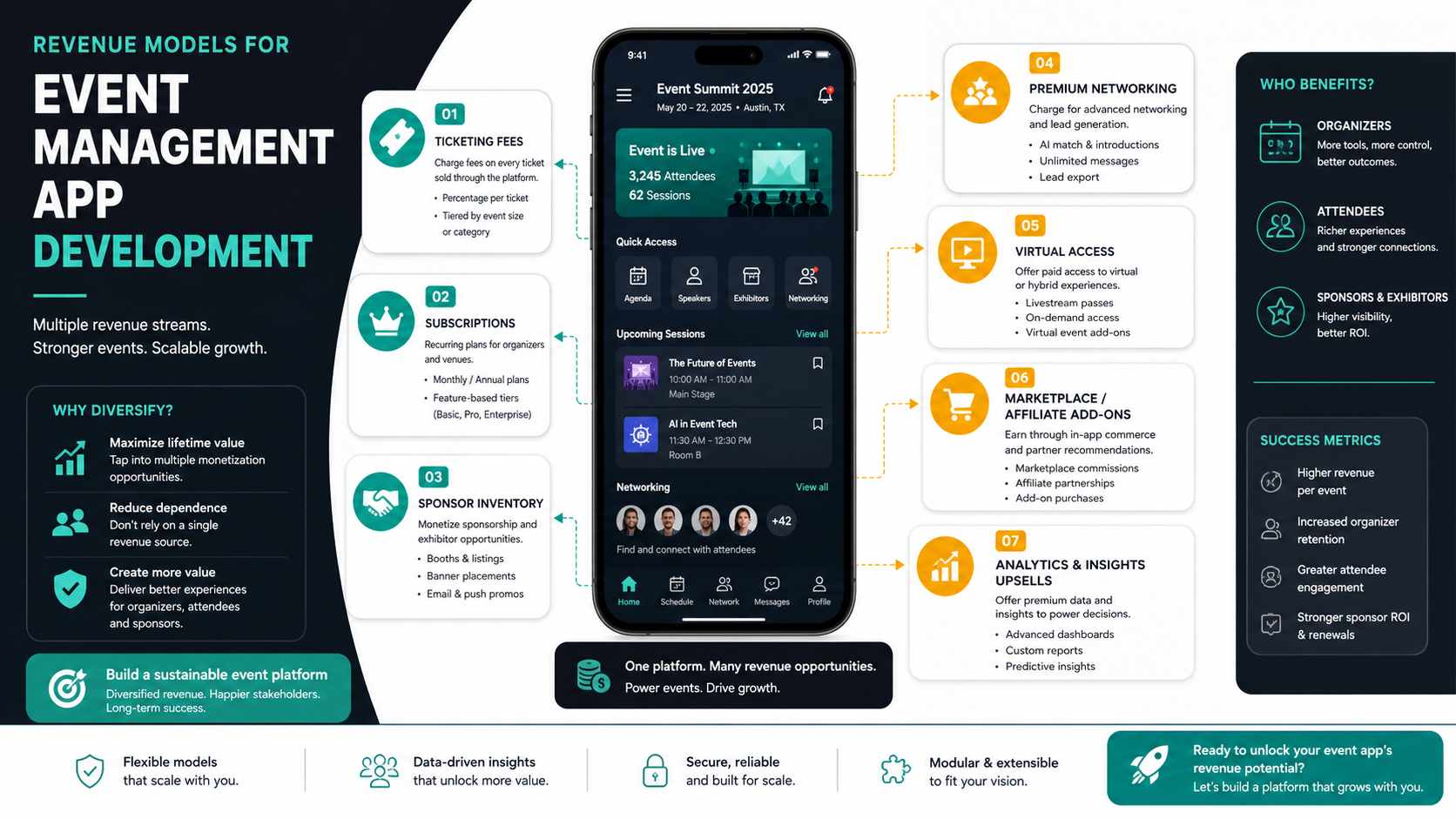
Why Event App Monetization Needs A Product Strategy
The original article listed revenue ideas, but an event app cannot simply turn on every monetization lever at once. Ticketing fees need reliable checkout and refund handling. Sponsor inventory needs placements, reporting, and lead capture. Subscriptions need recurring organizer value. Premium attendee features need a reason for users to pay without making the free experience feel incomplete.
That is why monetization belongs in the product strategy, not only in a pricing page. A strong event app creates value for three groups at the same time: organizers need control and measurable outcomes, attendees need a smoother event experience, and sponsors need credible visibility or leads. The revenue model should map to that value exchange.
If you are still defining the product surface, pair this monetization plan with a deeper review of event management app features. Features such as digital tickets, agendas, notifications, sponsor booths, networking, analytics, and admin dashboards determine which revenue streams are technically realistic.
Revenue Model Comparison For Event Management Apps
The table below separates common event app revenue models by who pays, what the app must support, and when each model is most useful.
| Revenue Model | Who Pays | Product Requirements | Best Fit |
|---|---|---|---|
| Ticketing and registration fees | Attendees or organizers | Checkout, coupons, refunds, seat or capacity rules, tax handling, payment reconciliation, and ticket validation. | Fastest path to early revenue when the app controls registration or ticket sales. |
| Organizer subscriptions | Event organizers | Tiered plans, account roles, event limits, analytics access, templates, support levels, and billing management. | Recurring revenue for organizers who run multiple events or need a year-round event operations tool. |
| Sponsor and exhibitor packages | Sponsors, exhibitors, partners | Branded placements, sponsor profiles, lead capture, session sponsorships, push-message rules, and ROI reports. | Conferences, expos, festivals, and trade shows with sponsors that need measurable visibility. |
| Premium networking | Attendees, exhibitors, recruiters, sponsors | Profiles, matching logic, meeting booking, chat, lead export, moderation, and privacy controls. | B2B events, investor events, hiring fairs, trade communities, and membership conferences. |
| Virtual or hybrid access | Remote attendees, organizers, sponsors | Livestream access control, on-demand content, entitlement checks, chat, recordings, and virtual sponsor placements. | Hybrid conferences, paid webinars, multi-city events, education programs, and content-heavy summits. |
| Marketplace or affiliate commissions | Vendors or partner services | Partner listings, tracking links, booking handoff, offer rules, order status, and reporting. | Events that naturally connect users to hotels, transport, merchandise, workshops, food, services, or local experiences. |
| Analytics upsells | Organizers, sponsors, enterprise clients | Event data model, dashboards, funnel metrics, engagement scoring, exports, permissions, and data governance. | Mature products with enough usage data to sell insights, benchmarks, and sponsor ROI reporting. |
| White-label licensing | Agencies, venues, enterprise event teams | Branding controls, tenant isolation, configuration, onboarding, support, security review, and long-term maintenance. | Products that have repeatable event workflows and can support multiple customer brands. |
Choose The Right Revenue Model Before You Build
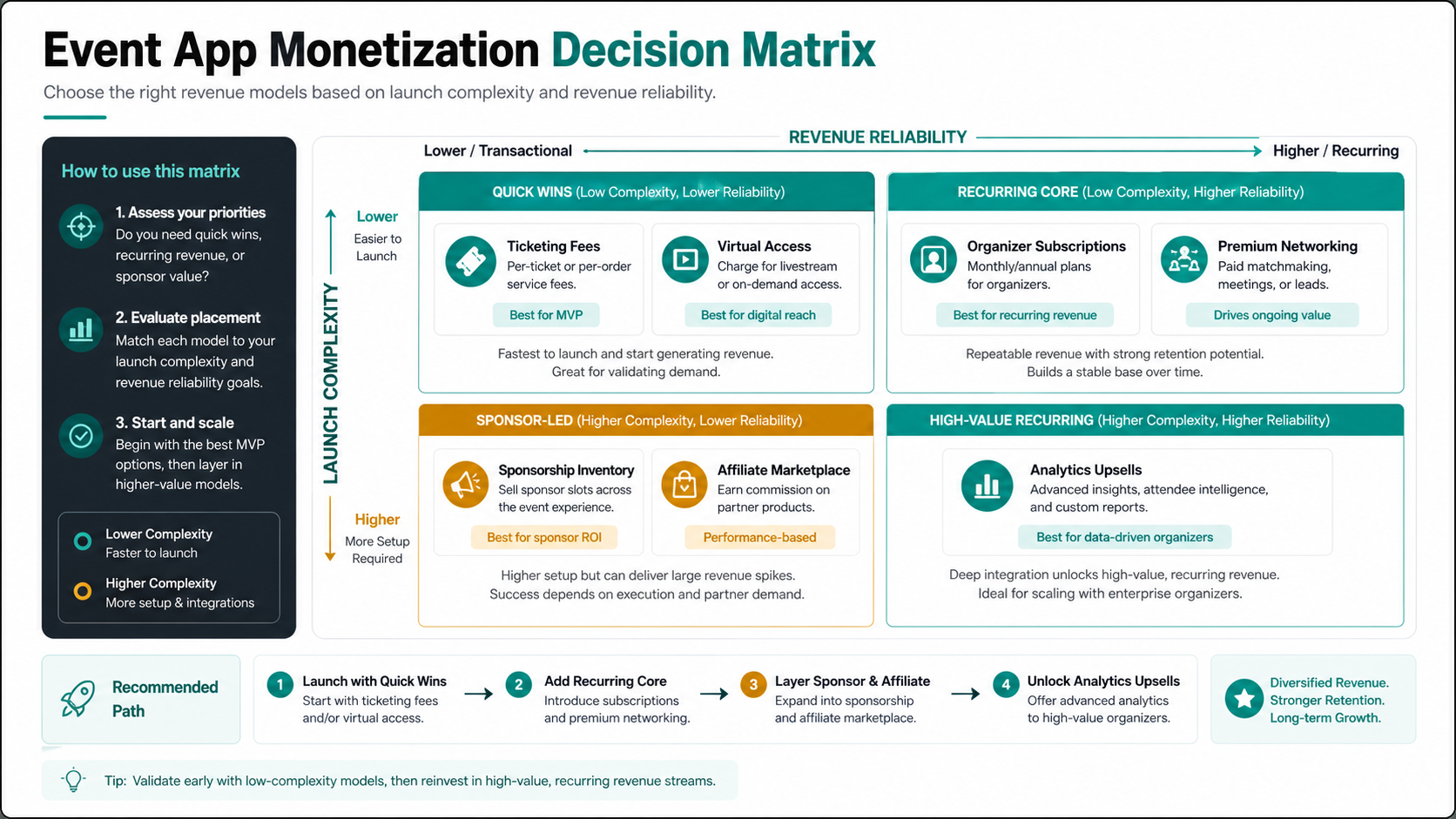
A practical decision framework is to score each model against launch complexity, revenue reliability, and user trust. Ticketing fees and virtual access are often easier to validate because users already expect to pay for access. Subscriptions are better for predictable revenue, but they require organizers to see repeat value beyond a single event. Sponsor packages can create large revenue spikes, but they require credible audience size, inventory controls, and reporting.
Analytics upsells are powerful later because they turn event activity into decision support. However, they should not be promised before the app has clean data capture and reporting. If your team is unsure what to include in the first release, use the MVP Scope Builder to separate launch-critical monetization workflows from later sponsor, marketplace, and analytics layers.
Ticketing Fees And Registration Commissions
Ticketing is the simplest revenue model when the app owns event discovery and registration. The app can charge a fixed service fee, a percentage of each ticket, or a blended fee. It can also support organizer-paid fees where attendees see one clean ticket price.
Do not underestimate the operational work behind this model. The app needs secure payment processing, refunds, taxes, failed payment handling, invoice records, coupon rules, waitlists, capacity limits, QR check-in, fraud controls, and clear organizer payout reporting. If these workflows are weak, the fee model will create support costs that eat into revenue.
Organizer Subscriptions And Tiered Plans
Subscriptions work when organizers get continuous value: event templates, recurring campaign tools, attendee CRM, sponsor management, analytics, team roles, branded pages, and customer support. A useful pricing ladder might start with a basic plan for small organizers, then add advanced analytics, automation, white-label branding, integrations, and priority support in higher tiers.
The product should make plan limits easy to understand. Price by active events, attendee count, team seats, sponsor modules, registration volume, or analytics depth. Avoid pricing that punishes success too early; organizers should feel that upgrading unlocks outcomes, not that the app is blocking normal event operations.
Sponsor, Exhibitor, And Advertising Revenue
Sponsor revenue is strongest when placements are part of the event journey instead of generic ads. Useful sponsor inventory includes branded event sections, exhibitor profiles, sponsored sessions, banner placements, push notifications with frequency controls, gamified booth visits, lead retrieval, and post-event performance reports.
Trust matters here. Attendees should understand when something is sponsored. Sponsors should receive clear metrics such as impressions, profile visits, saved sessions, scanned leads, content downloads, meetings booked, or survey responses. Organizers should be able to review sponsor messages before they reach attendees.
Premium Attendee Networking And Community Features
Networking can become a paid feature when the event has high-value relationships: investors and founders, recruiters and candidates, vendors and buyers, community members, or enterprise teams. Premium networking can include AI-assisted matching, meeting slots, private chat, attendee filters, lead export, introductions, and sponsor-hosted rooms.
This model depends heavily on UX. The app must make profiles, discovery, consent, scheduling, notifications, and privacy feel natural. For the interface side, review the event app UX roadmap so monetized networking features do not become cluttered screens that reduce attendee engagement.
Virtual Access, Hybrid Events, And Content Replays
Virtual and hybrid access can create revenue beyond venue capacity. Event apps can sell remote passes, session-specific access, on-demand replay libraries, workshop recordings, VIP Q&A access, or sponsor-backed digital content. This model is especially useful for education events, conferences, internal company events, creator communities, and professional associations.
The app needs entitlement checks so users can only access the content they purchased. It also needs livestream reliability, recording management, content expiry rules, chat moderation, and sponsor visibility that feels native to the digital experience.
Marketplace, Affiliate, And Partner Add-Ons
Some events naturally lead to additional transactions: hotel bookings, transport, merchandise, workshops, food, local services, certification exams, recruiting services, or vendor demos. The app can earn affiliate or marketplace commissions when those transactions are relevant and clearly disclosed.
This model should be introduced carefully. Poorly matched offers make the app feel noisy. Strong offers solve attendee or organizer problems at the right moment, such as hotel suggestions after ticket purchase, shuttle options before arrival, workshop add-ons during agenda planning, or sponsor demos after a user saves a related session.
Analytics Upsells And Data Products
Analytics can become a premium product when the app captures reliable event behavior. Organizers may pay for funnel reports, attendance patterns, check-in rates, session popularity, engagement scores, sponsor ROI, content performance, drop-off points, and exportable attendee insights. Sponsors may pay for lead scoring or engagement reports.
Build analytics with governance from the start. Define which events are tracked, who can access data, how consent is handled, what gets anonymized, and how exports are secured. Teams planning budget around these capabilities can compare the effort against broader custom software development cost drivers such as integrations, dashboards, permissions, and compliance.
Event App Revenue Roadmap From MVP To Scale
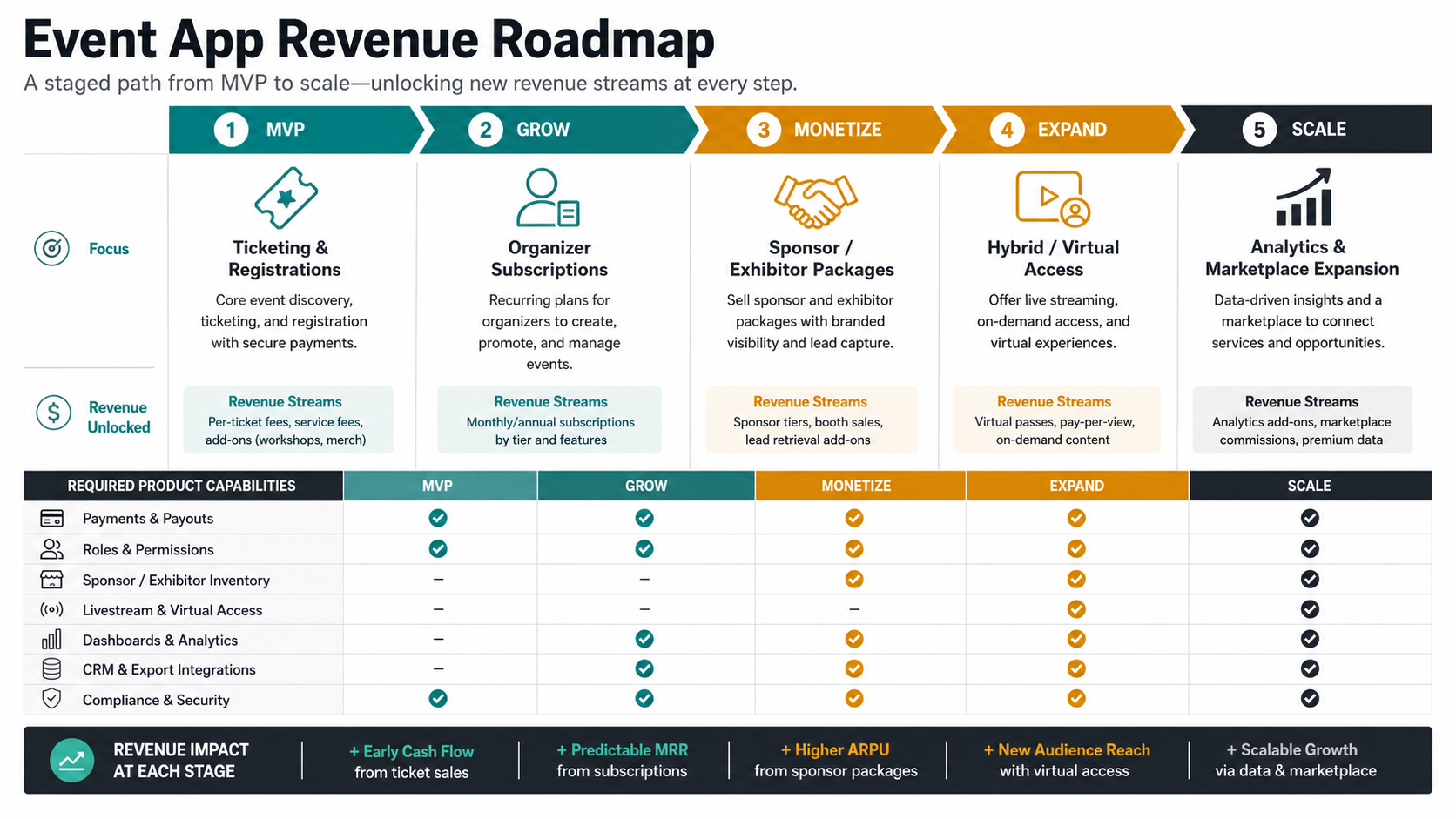
- MVP: launch event discovery, registration, secure checkout, ticket validation, attendee profiles, and basic organizer reporting.
- Grow: add organizer subscriptions, templates, CRM exports, roles, notifications, branded event pages, and support tiers.
- Monetize sponsors: introduce sponsor profiles, exhibitor listings, session sponsorships, lead capture, message controls, and ROI reports.
- Expand access: support hybrid passes, livestream entitlement, on-demand replays, virtual sponsor placements, and paid digital content.
- Scale: add analytics upsells, marketplace integrations, white-label licensing, enterprise permissions, and benchmark reporting.
This roadmap also helps with budgeting. The Custom Software Cost Estimator can help approximate the cost difference between a ticketing MVP, a subscription SaaS product, and a more complex sponsor or analytics platform.
Pricing And Packaging Guidelines
Start pricing with the customer outcome, not only the feature list. Organizers may pay for fewer manual tasks, higher ticket conversion, better attendee communication, sponsor revenue, faster check-in, or usable event data. Sponsors may pay for qualified leads, branded visibility, meeting bookings, or proof that their sponsorship worked.
A practical pricing structure often combines a base organizer plan, usage-based ticket or attendee fees, sponsor packages, and add-ons for virtual access, advanced analytics, white-label branding, or premium support. Keep the first package simple enough for sales and onboarding teams to explain quickly.
Common Monetization Mistakes To Avoid
- Adding too many paid gates: charging attendees for basic utility can reduce adoption and make the app less valuable to organizers.
- Selling sponsor visibility without reporting: sponsors need credible performance data, not just logo placement.
- Launching subscriptions without repeat value: organizers will cancel if the app only helps during one event week.
- Ignoring payment operations: refunds, chargebacks, failed payments, invoices, and payout reconciliation need product support.
- Promising analytics before data is clean: weak event tracking creates misleading reports and damages trust.
Final Recommendation
The best event management app revenue model is the one that matches the product's maturity. Start with ticketing, registration, or virtual access if you need fast validation. Add organizer subscriptions when the app supports repeat event operations. Layer sponsor and exhibitor packages when you can prove audience engagement. Sell analytics only when your data model is reliable enough to guide decisions.
Most importantly, keep monetization aligned with event value. The app should help organizers run better events, attendees get a smoother experience, and sponsors measure real outcomes. Revenue follows when those three groups can see why the product matters.