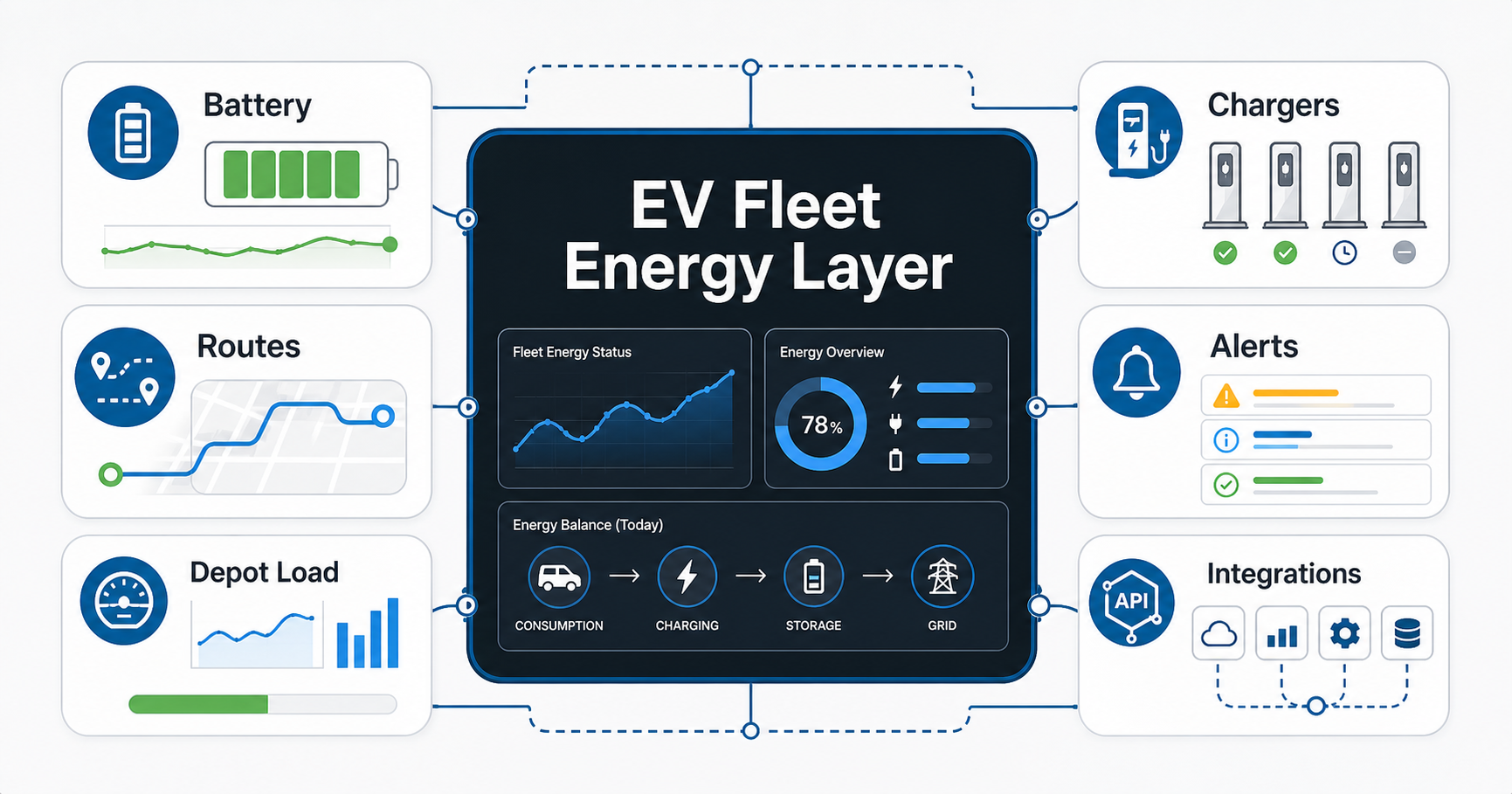

Quick Answer: EV Fleet Energy Management Software
EV fleet energy management software helps operators decide which vehicle can take which route, when it should charge, where charging capacity is available, how depot load should be managed, and which exceptions need human attention. It is not just a vehicle tracking dashboard. It is the operating layer that connects battery state, charger availability, route demand, driver shifts, energy cost, maintenance status, and business reporting.
A useful platform starts with reliable vehicle and charger data, then adds route feasibility logic, charging schedules, depot energy controls, alerts, and integrations with dispatch, telematics, maintenance, finance, and enterprise systems. Teams that already run mixed fleets can use the same roadmap to manage EVs, hybrids, and internal-combustion vehicles while they phase in more electric capacity.
The strongest commercial EV fleet platforms now compete on state-of-charge visibility, charging readiness, queue management, route-aware energy planning, depot load control, and exception workflows. That means a custom build should not be scoped as a dashboard project alone. It should be scoped as an operations product that helps dispatch, depot, finance, maintenance, and leadership teams make the same energy-aware decision from trusted data.
If you already have basic fleet management software, the EV layer should focus on energy constraints that generic GPS tracking usually ignores: battery health, state of charge, charging time, connector type, charger reliability, route elevation, payload, weather, queue time, and depot power limits. Those details decide whether a dispatch plan is profitable or fragile.
Why Generic Fleet Tools Fall Short for EV Operations
Traditional fleet systems are built around vehicle location, driver assignment, trip history, fuel records, compliance, and maintenance. EV fleets still need those capabilities, but energy changes the operating model. A diesel truck can refuel quickly and return to service. An EV may need a planned charging window, the right connector, enough dwell time, a reliable charger, and confidence that the next trip will not create range risk.
That difference affects dispatch, depot planning, customer commitments, driver behavior, asset utilization, and finance. Without an energy-aware layer, operators often rely on spreadsheets, charger portals, manual calls, and conservative buffers. The result is predictable: underused vehicles, avoidable charging downtime, missed routes, and dashboards that explain problems after they happen instead of preventing them.
| Operational Need | Generic Fleet Tool | EV Energy Management Layer |
|---|---|---|
| Vehicle readiness | Location, status, driver assignment | Battery state, usable range, charger history, route fit, and maintenance constraints |
| Dispatch planning | Nearest vehicle or scheduled vehicle | Vehicle that can complete the route, return, and charge without breaking the next commitment |
| Depot operations | Parking, shift, service bay, and route schedule | Charger queues, load windows, energy tariffs, priority vehicles, and exception handling |
| Cost reporting | Fuel, labor, maintenance, and trip cost | Energy cost, charger utilization, idle charging time, battery degradation signals, and cost per mile |
| Risk control | Late trip and maintenance alerts | Range-risk, charger failure, depot overload, missed charge window, and low-confidence telemetry alerts |
Core Modules an EV Fleet Platform Needs
A strong EV fleet platform should be designed around decisions, not screens. Each module should either improve dispatch reliability, reduce charging friction, protect utilization, lower operating cost, or create evidence for managers and finance teams.
- Vehicle and battery data: ingest state of charge, estimated range, battery health, odometer, location, duty cycle, payload context, and vehicle availability.
- Charger operations: track charger status, connector type, output, queue, fault state, reservation, session start, session end, and failed sessions.
- Route feasibility: compare trip distance, stops, payload, terrain, driver shift, service windows, return-to-depot needs, and safety buffer against vehicle energy.
- Depot energy planning: coordinate charger assignment, load limits, tariff windows, priority routes, backup vehicles, and exceptions.
- Dispatch and driver workflow: recommend vehicle assignment, charging tasks, pre-trip checks, route warnings, and escalation paths.
- Alerts and review queues: surface low charge, missed charging windows, unavailable chargers, battery-health anomalies, route risk, and telemetry gaps.
- Reporting and finance: show energy use, charging cost, vehicle utilization, cost per mile, downtime, route completion, and emissions-related reporting where appropriate.
- Integrations: connect telematics, charger networks, ERP, maintenance, dispatch, maps, identity, notifications, and business intelligence systems.
The first version does not need every advanced optimization feature. It does need a reliable data model and workflow design so future AI, forecasting, and automation can be added without rebuilding the platform.
Data Architecture for Battery, Charger, and Route Decisions
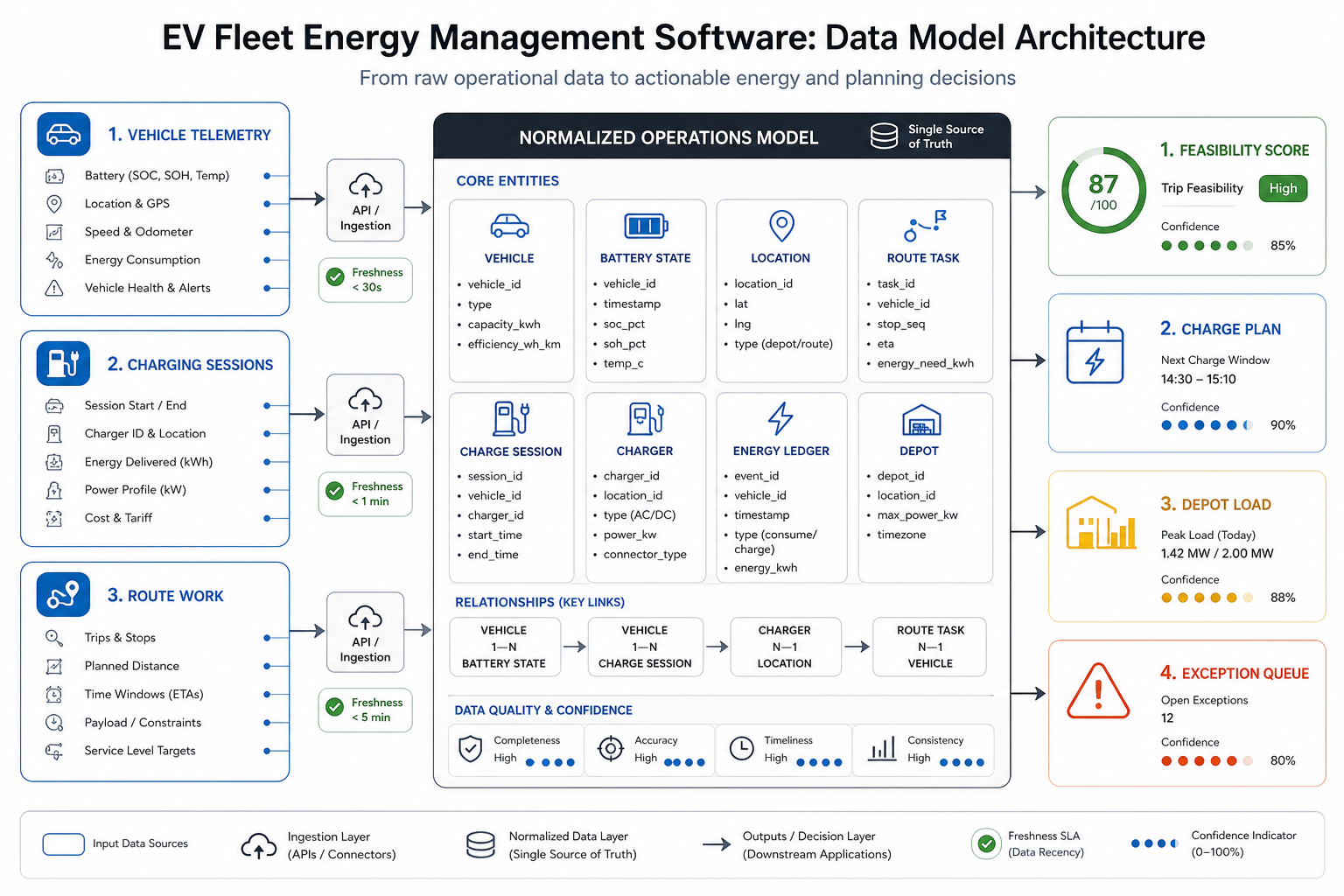
The architecture should normalize three streams of information: vehicle telemetry, charger/session data, and planned work. These streams usually come from different vendors and arrive with different IDs, update intervals, units, and reliability levels. If the platform cannot reconcile them, operators will not trust the recommendations.
Start with a clean domain model: vehicle, battery, charger, connector, depot, route, stop, driver, shift, charging session, dispatch assignment, alert, and exception. Then build ingestion and validation rules around that model. The system should know whether state of charge is fresh, whether a charger status is stale, whether a route plan has changed, and whether a manual override should supersede an automated recommendation.
This is where IoT app development discipline matters. Vehicle and charger telemetry needs device-aware ingestion, retry handling, freshness checks, role-based access, and downstream APIs before any dispatch recommendation can be trusted. A useful reference pattern is the RouteLedger fleet operations API platform, where fleet assets, telemetry, inspections, maintenance, files, notifications, and permissions are modeled as a multi-service operations backend rather than a flat reporting app.
| Data Area | Examples | Design Requirement |
|---|---|---|
| Vehicle telemetry | State of charge, location, odometer, health, speed, energy consumption | Normalize units, timestamp freshness, vehicle IDs, and confidence scores |
| Charging data | Charger status, connector type, session history, output, faults, price | Handle vendor APIs, delayed updates, failed sessions, and reservation states |
| Route data | Stops, distance, time windows, payload, traffic, depot return, service priority | Score route feasibility before assignment and after route changes |
| Depot constraints | Power capacity, charger count, queue, tariff windows, parking layout | Prevent schedules that look good in dispatch but fail at the depot |
| Business systems | ERP, maintenance, finance, customer commitments, billing, BI | Write back outcomes so cost, service, and utilization reporting stays current |
Charging and Depot Energy Planning
Charging is where many EV fleet plans become operationally messy. The platform needs to answer practical questions: which vehicle must charge now, which can wait, which charger is available, how long the session should run, what happens if a charger fails, and whether depot load stays within limits.
For early deployments, rules may be enough. For example: reserve higher-power chargers for vehicles with morning priority routes, avoid assigning low-state vehicles to long routes, keep a minimum return-to-depot buffer, and alert dispatch when a charging session is late. As volume grows, the platform can add forecasting for route demand, charger congestion, tariff windows, and battery degradation signals.
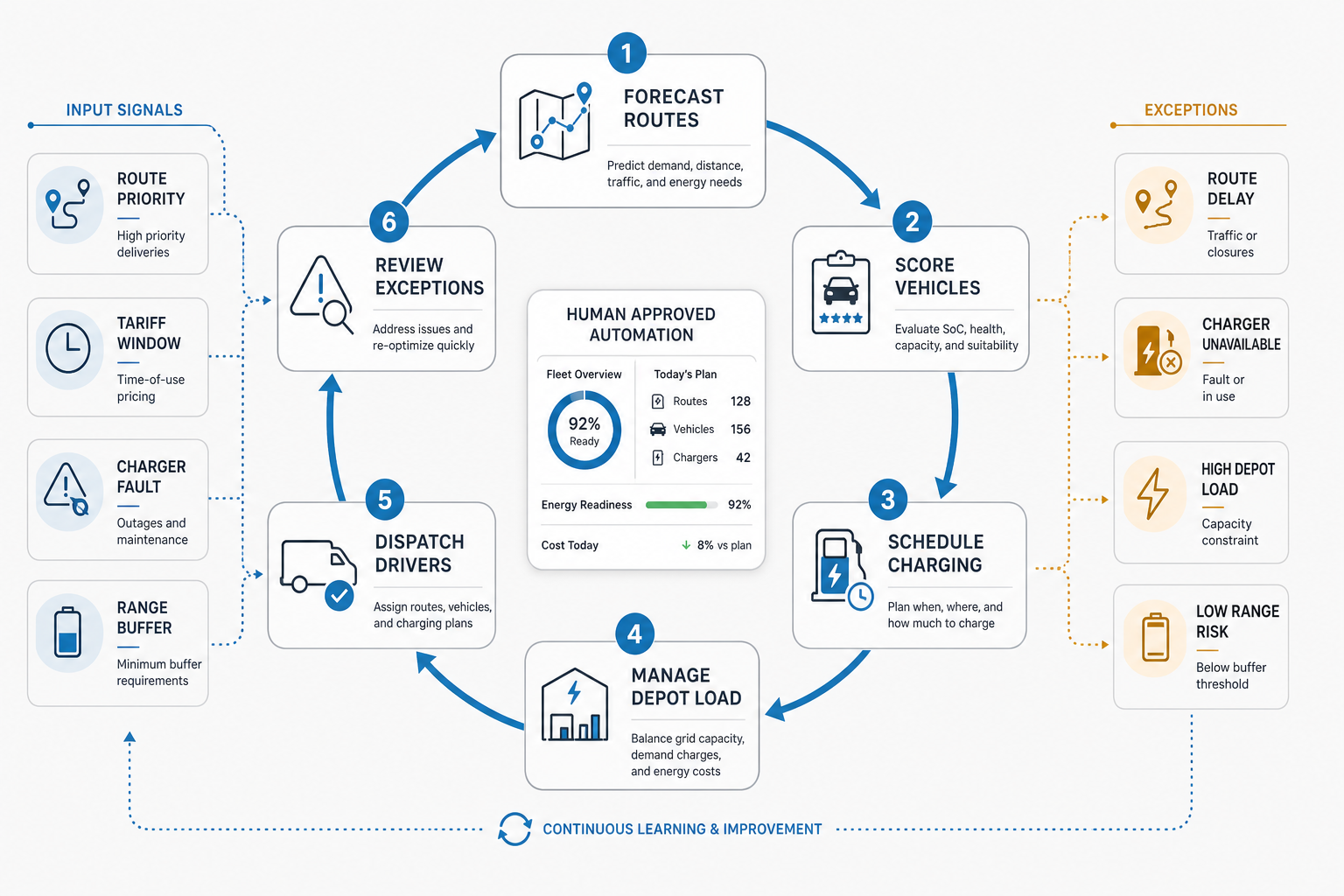
Depot planning should also support human review. Operations teams need to see the next set of at-risk vehicles, the reason for each recommendation, and the decision options: charge now, swap vehicle, adjust route, delay dispatch, move to another charger, or escalate maintenance.
Route Feasibility, Dispatch Rules, and Driver Workflows
Route feasibility is the bridge between energy data and customer service. The software should not simply show that a vehicle has 62 percent charge. It should decide whether that charge is enough for the route, the payload, the expected traffic, the driver shift, the depot return, and the next scheduled charging window.
Dispatch rules should be transparent. Operators need to know why the system recommends one vehicle over another: better range buffer, closer charger, lower route risk, required vehicle type, driver assignment, maintenance status, or customer priority. Black-box assignment creates distrust when a route fails.
The driver workflow matters just as much as the admin dashboard. Drivers need simple pre-trip status, route warnings, charging instructions, support escalation, and confirmation that a charging task was completed. If the driver app makes EV work harder than existing dispatch routines, adoption will suffer.
Dashboards, Alerts, and Reports That Operators Actually Use
The dashboard should separate monitoring from action. A senior operations view may show fleet readiness, charger utilization, route risk, energy cost, and depot load. A dispatcher needs vehicle recommendations and exceptions. A depot manager needs charger queues and missed sessions. Finance needs cost-per-mile and utilization evidence. For teams that need trusted KPI and BI surfaces, a dedicated custom dashboard development track can keep the reporting model, permissions, refresh cadence, and alert ownership clear.
Good alerts are tied to decisions. Do not notify everyone whenever a battery percentage changes. Alert when an assigned vehicle may not complete a route, a charger fails during a priority session, a vehicle misses its charge window, telemetry becomes stale, or depot load creates a conflict. Each alert should have an owner, severity, recommended action, and closure reason.
- Dispatch alerts: route risk, insufficient buffer, vehicle swap required, delayed driver, or charger dependency.
- Depot alerts: charger fault, queue conflict, power limit risk, missed plug-in, or priority vehicle not charging.
- Maintenance alerts: battery-health anomaly, repeated charging failure, abnormal consumption, or vehicle unavailable.
- Finance alerts: high energy cost window, poor charger utilization, repeated idle charging, or cost-per-mile variance.
Integrations With Telematics, Chargers, ERP, and Maintenance Systems
EV fleet energy management software usually succeeds or fails at the integration layer. The platform must read from telematics providers, charging hardware, charger management systems, route planning tools, and dispatch systems. It may also need to write outcomes into ERP, maintenance, billing, and reporting systems.
Teams building around delivery operations should also think beyond the depot. Route promises, customer time windows, proof-of-delivery events, returns, driver instructions, and service exceptions often sit in dispatch or on-demand delivery app development workflows. The EV layer should read and write to those systems instead of becoming another place operators have to copy trip data.
Design integrations with failure modes in mind. Vendor APIs may rate-limit requests, return stale charger status, change payloads, or provide inconsistent vehicle identifiers. The platform should include retry logic, data-quality flags, manual override, audit logs, and clear ownership for each system of record.
Budgeting should include this integration work. The screen count alone will understate the effort. The custom software development cost drivers for an EV fleet platform usually include real-time data, third-party APIs, workflow rules, reporting, identity, security, and post-launch support, not just dashboard UI. For a directional estimate, teams can model feature complexity, user roles, and integration count in the Custom Software Cost Estimator before committing to a delivery roadmap.
Build Vs. Buy: When Custom EV Fleet Software Makes Sense
Buy when the requirement is mostly standard telematics, charger status, EV suitability reporting, or basic fleet electrification dashboards. Mature vendors already cover many of those needs, and a custom build will rarely beat them on generic hardware coverage alone.
Build or extend when the operating model is specific: multiple depots, unusual route constraints, proprietary dispatch logic, mixed charger vendors, custom tariff handling, private ERP workflows, strict customer service windows, or role-based exception approval. In those cases, the competitive advantage is not a generic EV screen. It is the workflow logic that lets your team run routes, charging, maintenance, finance, and service commitments together.
A pragmatic approach is to integrate commercial telematics and charger systems first, then build the decision layer your operators cannot buy off the shelf. If the first release needs scoping discipline, the MVP Scope Builder can help separate launch-critical workflows from later optimization ideas.
MVP Roadmap for EV Fleet Energy Management Software
A good MVP is narrow enough to ship but complete enough to change daily operations. Start with a defined fleet segment, one or two depots, a limited charger set, and the routes where energy constraints already create planning work.
| Stage | Build Focus | Validation Question |
|---|---|---|
| Discovery | Map vehicle data, charger data, route workflows, depot constraints, and current exceptions | Which energy decisions are causing the most delay, cost, or service risk? |
| Data foundation | Normalize vehicle, charger, route, depot, and session records with freshness checks | Can operators trust the data enough to act on it? |
| Operational MVP | Build dashboard, route feasibility rules, charger schedule, alerts, and manual override | Does the system prevent missed routes and reduce spreadsheet coordination? |
| Integration hardening | Connect dispatch, telematics, charger management, maintenance, and reporting workflows | Can teams run daily operations without duplicate entry? |
| Optimization | Add forecasting, tariff-aware charging, utilization scoring, and exception analytics | Which automation improves cost, reliability, or utilization without reducing trust? |
Keep automation gated at first. Let dispatchers and depot managers approve recommendations while the platform learns which routes, vehicles, chargers, and operating conditions create the most exceptions. If growth is expected across depots, regions, or vehicle classes, design the MVP as the first layer of a scalable software development roadmap rather than a one-off depot tool.
KPIs That Prove the Platform Is Working
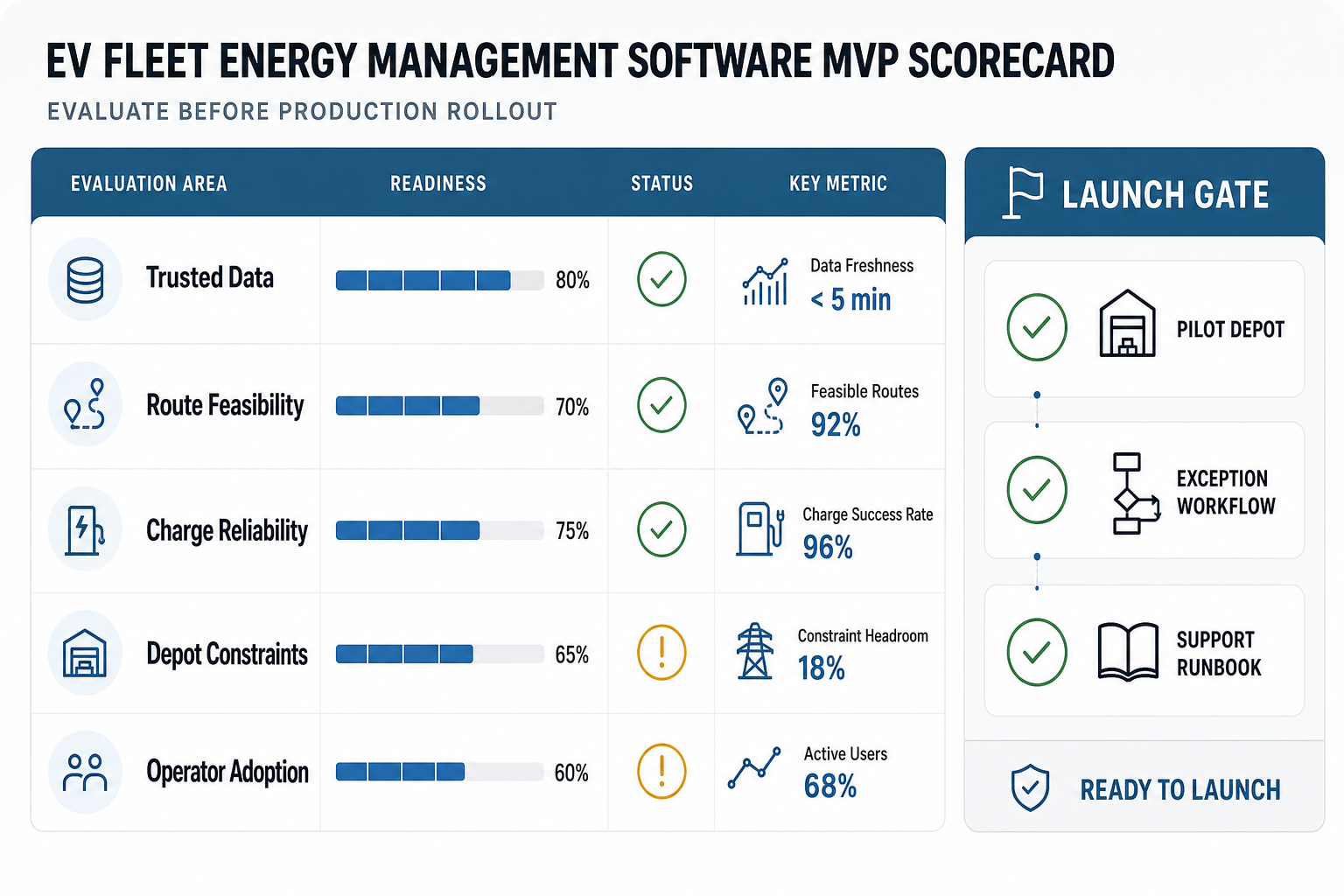
The scorecard should combine fleet availability, charging performance, route reliability, cost, and user adoption. Avoid measuring only software usage. The platform must improve the operating model.
| KPI | What It Shows | How to Use It |
|---|---|---|
| Route completion without energy exception | Whether vehicles are assigned to feasible work | Track by depot, route type, vehicle class, and dispatcher |
| Charging downtime | How much service time is lost to charging or charger queues | Identify depot bottlenecks and scheduling gaps |
| Vehicle utilization | Whether EV assets are earning enough active hours | Compare planned use, actual use, and missed opportunities |
| Charger utilization and failure rate | Whether charging infrastructure is reliable and correctly sized | Plan maintenance, expansion, and vendor escalation |
| Cost per mile or trip | Whether energy operations are improving unit economics | Compare across depots, tariffs, vehicle types, and route groups |
| Alert action rate | Whether alerts lead to useful decisions | Tune rules that create noise or arrive too late |
| Telemetry freshness | Whether recommendations are based on current data | Flag vendors, vehicles, or chargers with unreliable data feeds |
Security, Governance, And Operating Controls
EV fleet software touches vehicle location, driver activity, energy usage, maintenance state, business costs, and sometimes customer delivery commitments. Treat that data as operationally sensitive. The platform should include least-privilege access, audit logs, integration secrets management, event history, data retention rules, and clear ownership for manual overrides.
Governance is also practical. Define who can change dispatch rules, who can override a charging recommendation, who owns failed telemetry, who reviews charger faults, and which alerts can interrupt a route. Without those controls, automation can create confusion faster than it improves utilization.
Common Risks and How to Reduce Them
Most EV fleet software risks are predictable. Address them in the roadmap before writing too much code.
- Stale telemetry: show data freshness and confidence instead of treating every value as real time.
- Vendor lock-in: create normalized vehicle, charger, and session models so hardware vendors can change over time.
- Over-automation: start with recommendations and human approval before automatic dispatch or charging changes.
- Depot blind spots: include power limits, charger queues, parking constraints, and manual operations in the model.
- Weak driver adoption: make charging instructions, route warnings, and support escalation simple in the driver workflow.
- Unclear ownership: define who owns dispatch rules, charger data, route changes, alert closure, and integration support.
- Underestimated support: plan monitoring, data fixes, vendor API changes, and post-launch optimization from the start.
Next Steps for EV Fleet Teams
Start with the routes, vehicles, chargers, and depots where energy constraints already create daily planning work. Map the decisions operators make today, the data they trust, the systems they copy data between, and the exceptions that create missed routes or charging downtime. That map becomes the first version of the product plan.
NextPage helps teams scope EV fleet platforms around the operating model: battery and charger data, dispatch rules, depot energy planning, dashboards, integrations, and rollout metrics. The useful first step is an EV fleet software requirements worksheet followed by a platform scoping session that turns the workflow into an MVP roadmap, integration plan, and support model.