
Quick Answer: Food Delivery App Development Cost
Food delivery app development cost usually depends on the business model before it depends on the number of screens. A direct restaurant or cloud-kitchen ordering MVP can often be scoped around $35,000-$80,000 when it includes customer ordering, menu management, checkout, order status, basic promotions, and an admin panel. A marketplace-style MVP with customer, restaurant, courier, and operator workflows usually moves into the $80,000-$180,000 range. A full delivery platform with multi-city operations, routing, POS sync, loyalty, subscriptions, advanced analytics, and automation can move past $180,000 and into the $350,000+ range.
Those ranges are planning bands, not fixed quotes. The real estimate changes when you add native apps, courier dispatch, map routing, restaurant tablets, split payments, refunds, wallet credits, driver incentives, menu availability rules, customer support tooling, and data dashboards. If you need a directional number before discovery, start with the Custom Software Cost Estimator and then validate the assumptions with a product scope workshop.
The market is large enough to justify serious planning. Grand View Research estimated online food delivery at USD 288.84 billion in 2024 and projected USD 505.50 billion by 2030. But a growing market does not make every custom build economical. The product has to improve contribution margin, repeat orders, kitchen throughput, or customer ownership enough to repay the software investment.
What You Are Actually Building
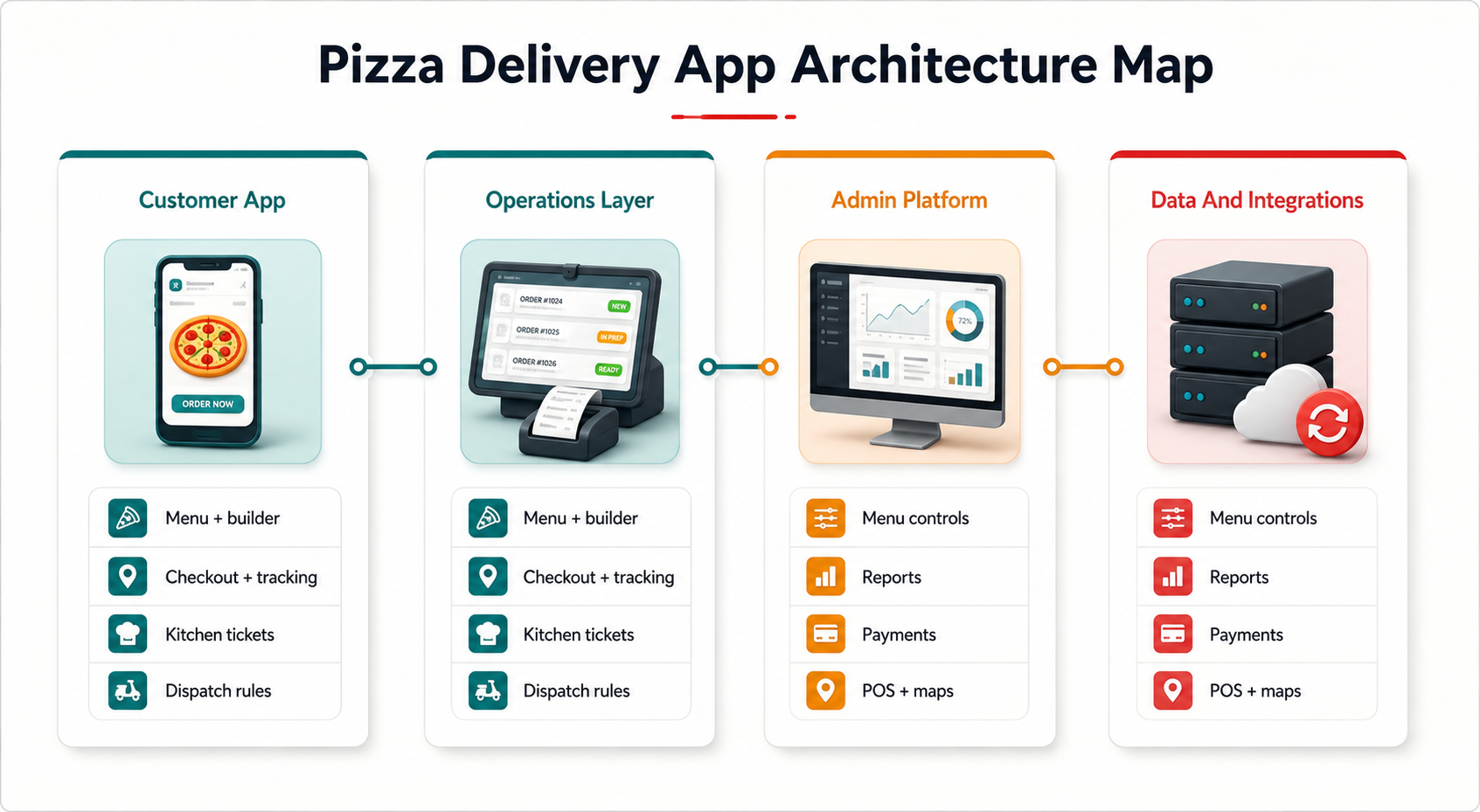
A food delivery app is not one app. It is usually a connected operating system made of customer ordering, restaurant operations, courier dispatch, admin controls, payment workflows, support, analytics, and marketing automation. A single-brand restaurant product may only need customer ordering plus a strong back-office workflow. A marketplace needs multiple restaurants, menus, commissions, courier allocation, payouts, disputes, and trust controls.
This is why a food delivery estimate should begin with ownership. Are you trying to own a direct channel for existing customers? Are you creating a local delivery marketplace? Are you giving cloud kitchens a fulfillment layer? Are you adding grocery or scheduled meal delivery? Each answer changes the product architecture and the commercial risk.
For direct restaurant groups, NextPage usually frames the project as a mobile app development engagement with operational integrations. For marketplace founders, we compare the scope against the Marketplace App Development Cost model because seller onboarding, payouts, trust, and moderation become central budget drivers.
Cost Bands By Product Stage
Use these bands to shape trade-offs before writing a feature wishlist. The same app can be inexpensive or expensive depending on whether the first release is a narrow ordering channel, a managed local marketplace, or a high-scale delivery system.
| Stage | Typical Scope | Planning Range | What Raises Cost |
|---|---|---|---|
| Direct Ordering MVP | Customer ordering app or web app, menu/catalog, cart, checkout, order status, promotions, admin panel, basic reporting | $35,000-$80,000 | Native iOS and Android, POS sync, loyalty, scheduled orders, wallet credits, custom delivery zones |
| Managed Marketplace MVP | Customer app, vendor panel, courier app, admin console, restaurant onboarding, commissions, dispatch, ratings, support workflows | $80,000-$180,000 | Multi-restaurant rules, split payouts, real-time tracking, complex refunds, restaurant tablet mode, route optimization |
| Growth Platform | Multi-city operations, advanced analytics, CRM, loyalty, subscriptions, delivery pricing rules, inventory/menu sync, automation | $180,000-$350,000+ | High-scale architecture, AI recommendations, ERP/POS depth, multi-brand controls, data warehouse, experimentation platform |
The SparxIT reference page uses similar broad planning ranges, from lower-cost basic apps to advanced platforms beyond $100,000. Treat those external ranges as a sanity check, then adjust for your operating model, region, team model, integration depth, and launch timeline.
MVP Scope That Keeps Cost Under Control
A good food delivery MVP proves ordering economics before it automates every edge case. The first release should make it easy for customers to browse menus, customize items, pay, track order status, and reorder. It should help restaurants accept orders, update menu availability, manage prep status, and resolve common issues. It should give operators enough control to see orders, customers, payments, refunds, delivery status, and basic performance metrics.
Courier automation is the biggest MVP decision. If you already have a small delivery team, you may start with manual assignment and status updates. If delivery speed is the product promise, you need a courier app, live location, dispatch rules, route handling, and failed-delivery workflows from day one. That can double the operational complexity of the first build.
For restaurant-specific launches, it helps to study focused delivery patterns such as How To Develop A Pizza Delivery App Like Domino's. Pizza, grocery, meal prep, and multi-cuisine marketplaces all look like food delivery, but the menu logic, prep times, delivery windows, and repeat-order behavior are different.
Integration Cost Drivers
Integrations often create more cost than visible screens. Payment gateways must support failed payments, refunds, coupons, tips, taxes, and settlements. Maps must handle address capture, service zones, distance pricing, courier tracking, ETA estimates, and route exceptions. POS systems can be straightforward or painful depending on vendor APIs, menu sync rules, modifiers, inventory behavior, and offline restaurant operations.
Other common integrations include SMS and WhatsApp notifications, email, CRM, analytics, accounting, fraud checks, helpdesk tools, loyalty engines, and marketing automation. A low-cost build can start with standard APIs and manual back-office checks. A growth platform needs stronger audit logs, retry logic, reconciliation, data quality checks, and admin tools for support teams.
If the admin portal is a major part of the system, compare it with the planning model in Web App Development Cost. Many food delivery budgets underestimate the operator console even though it is where refunds, menu exceptions, partner onboarding, reports, disputes, and support workflows live.
Unit Economics And Operating Model
Food delivery software should be scoped around unit economics, not only features. The important numbers are average order value, gross margin, delivery cost per order, payment fees, discounts, support cost, failed delivery rate, repeat order rate, and customer acquisition cost. A feature is worth building when it improves one of those numbers or protects customer experience.

For example, loyalty points may feel important, but a faster reorder flow can produce better repeat behavior in the first release. Dynamic delivery pricing may sound advanced, but fixed zones are often enough until the order volume proves courier utilization. AI menu recommendations can wait if the current constraint is restaurant onboarding or driver reliability.
The older NextPage guide on the Benefits Of Food Delivery App Development is useful for business-case framing. This cost guide narrows that conversation into what to build first and how each module should connect to margin, retention, or operational control.
Team, Timeline, And Delivery Plan
A focused direct-ordering MVP often takes 10-16 weeks with a small product team: product manager, UX/UI designer, mobile or full-stack engineers, backend engineer, QA, and DevOps support. A managed marketplace MVP usually needs 16-28 weeks because customer, restaurant, courier, and admin workflows must be tested together. A growth platform can require several release waves over 6-12 months.
| Phase | Typical Work | Output |
|---|---|---|
| Discovery And Scope | Business model, personas, order lifecycle, integrations, launch geography, MVP cuts, metrics | Prioritized backlog, architecture plan, estimate, delivery roadmap |
| Design And Prototype | Customer flow, restaurant operations, courier states, admin controls, error cases, design system | Clickable prototype and validated workflows |
| MVP Build | Apps, APIs, admin console, payments, menu/order logic, notifications, basic analytics | Testable release candidate |
| Pilot Launch | Restaurant onboarding, delivery tests, payment reconciliation, support scripts, analytics review | Operational pilot with fixes from real orders |
| Scale Releases | POS sync, loyalty, CRM, routing improvements, automation, dashboards, A/B tests | Growth roadmap tied to order volume and margin |
Feature Checklist By Module
A realistic estimate groups features by module so stakeholders can see which roles are driving cost.
| Module | MVP Features | Growth Features |
|---|---|---|
| Customer App | Signup, location, menu browsing, customization, cart, payment, order status, reorder | Loyalty, wallet, subscriptions, scheduled orders, personalized offers, referrals |
| Restaurant Panel | Order acceptance, prep status, menu updates, availability, basic reports | POS sync, inventory rules, promotions, staff roles, demand forecasting |
| Courier App | Assignment, pickup/drop-off status, navigation handoff, proof of delivery | Batching, route optimization, incentives, wallet, shift scheduling, performance metrics |
| Admin Console | Users, restaurants, orders, refunds, coupons, service zones, reports | Commission rules, partner onboarding, dispute workflows, fraud checks, dashboards |
| Data And Marketing | Basic analytics, email/SMS events, order cohorts | CRM, segmentation, lifecycle campaigns, experimentation, data warehouse |
Build Vs Marketplace Vs White Label
Custom development is not always the right first move. If you only need online ordering for one restaurant, a SaaS ordering tool can validate demand. If you need brand-owned data, custom workflows, local delivery rules, or a differentiated marketplace, a custom build becomes easier to justify. If you are competing with large aggregators, your advantage needs to be clear: niche supply, superior operations, lower commission, local density, loyalty, or bundled restaurant services.
White-label food delivery products can reduce launch time, but they often limit pricing logic, integrations, code ownership, UX flexibility, and data control. A custom MVP costs more upfront, yet it can be cheaper long term when your business needs unique workflows or lower dependency on vendor roadmaps.
Budget Mistakes To Avoid
The most common mistake is scoping customer screens while ignoring restaurant and operator work. The second is building courier automation before order density exists. The third is adding promotions and loyalty without defining contribution margin. The fourth is assuming POS integration is a small task without checking API quality, menu modifiers, taxes, availability rules, and reconciliation. The fifth is launching without enough admin tooling for refunds, cancellations, support, and restaurant onboarding.
Also budget for maintenance. Food delivery products need ongoing work for OS updates, payment changes, security patches, map API changes, analytics, restaurant support, offer experiments, and performance tuning. A reasonable planning model reserves 15-25% of the initial build budget per year for maintenance and continuous improvement.
How NextPage Scopes Food Delivery Products
NextPage scopes food delivery products by mapping the order lifecycle before estimating screens. We identify the launch model, customer journey, restaurant workflow, delivery workflow, admin responsibilities, integrations, data needs, and operating metrics. Then we split the roadmap into MVP, growth, and scale releases so the first budget goes toward the workflows that prove demand and economics.
For a direct restaurant channel, that may mean fast ordering, clean menu management, checkout, notifications, and retention basics. For a marketplace, it may mean restaurant onboarding, courier dispatch, payments, refunds, service zones, and trust workflows. For a cloud-kitchen or grocery operator, it may mean inventory, delivery slots, substitutions, batch preparation, and route planning.
If you are planning a food delivery product, estimate the first release with the Custom Software Cost Estimator, then use a discovery sprint to validate the workflows, integrations, and economics behind the number.