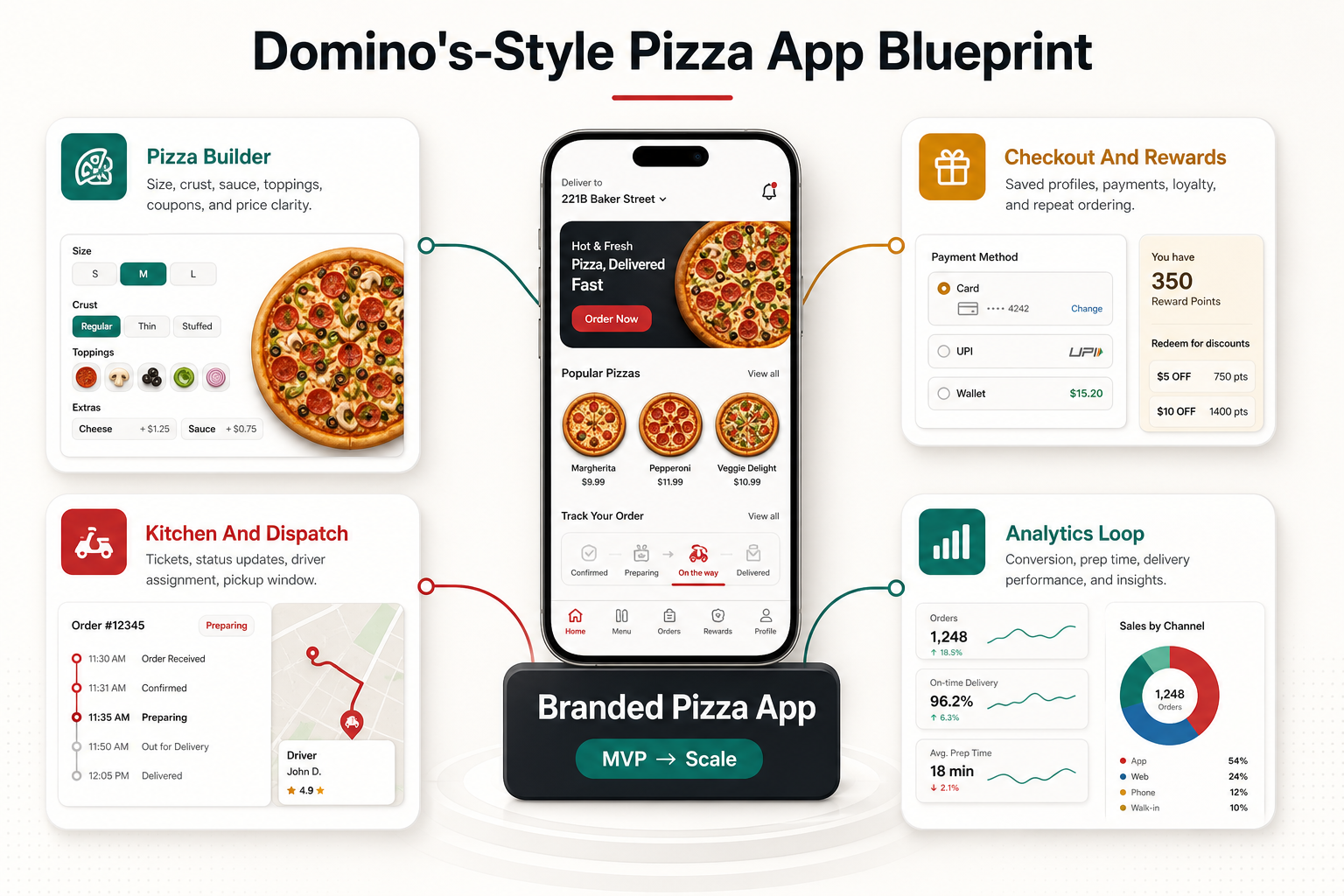

Quick Answer: How To Develop A Pizza Delivery App Like Domino's
To develop a pizza delivery app like Domino's, start by defining the ordering model, service locations, menu rules, delivery workflow, and retention strategy. Then build a focused first release with menu browsing, pizza customization, cart and checkout, secure payments, user profiles, saved addresses, order tracking, notifications, admin controls, and restaurant operations support.
The strongest apps do not copy a famous brand screen by screen. They recreate the system behind the experience: fast ordering, reliable store operations, clear delivery status, consistent promotions, and useful data. A Domino's-style app should feel simple to customers while giving the business enough control to manage menus, prices, offers, stores, delivery areas, refunds, and repeat-order campaigns.
What A Domino's-Style App Really Means
Domino's is known for making pizza ordering feel fast, predictable, and repeatable. Public app-store descriptions and Domino's own digital updates highlight features such as profiles, easy ordering, payment options, rewards, voice-assisted ordering, and order tracking. The strategic lesson is not that every restaurant should clone those exact features on day one. The lesson is that a branded pizza app must reduce friction across the whole ordering lifecycle.
That lifecycle begins before the customer opens the cart. The app must help people choose the right pizza, customize it without confusion, apply a valid offer, pick delivery or pickup, pay safely, and trust the order status. Behind the scenes, the restaurant needs accurate tickets, kitchen timing, store availability, driver or third-party delivery coordination, customer support, and analytics. This is why a pizza delivery product often needs both mobile app development and a practical admin or operations web layer.
Market Research And Positioning
Begin with the market you actually serve. A single-location pizzeria, a regional franchise group, and a national restaurant chain have different needs. Study local ordering behavior, average delivery distance, popular deals, menu complexity, competitor apps, marketplace dependency, payment preferences, and customer complaints. The goal is to understand where an owned app can beat third-party marketplaces: lower commission exposure, better customer data, branded loyalty, faster reorders, and tighter control over promotions.
Your value proposition should be specific. Examples include faster local delivery, better customization, family meal bundles, dietary-friendly pizza options, corporate ordering, scheduled pickup, subscriptions, or loyalty rewards that only exist in your owned channel. If the positioning is unclear, the app becomes a generic menu with a payment form.
Development Roadmap From Idea To Launch
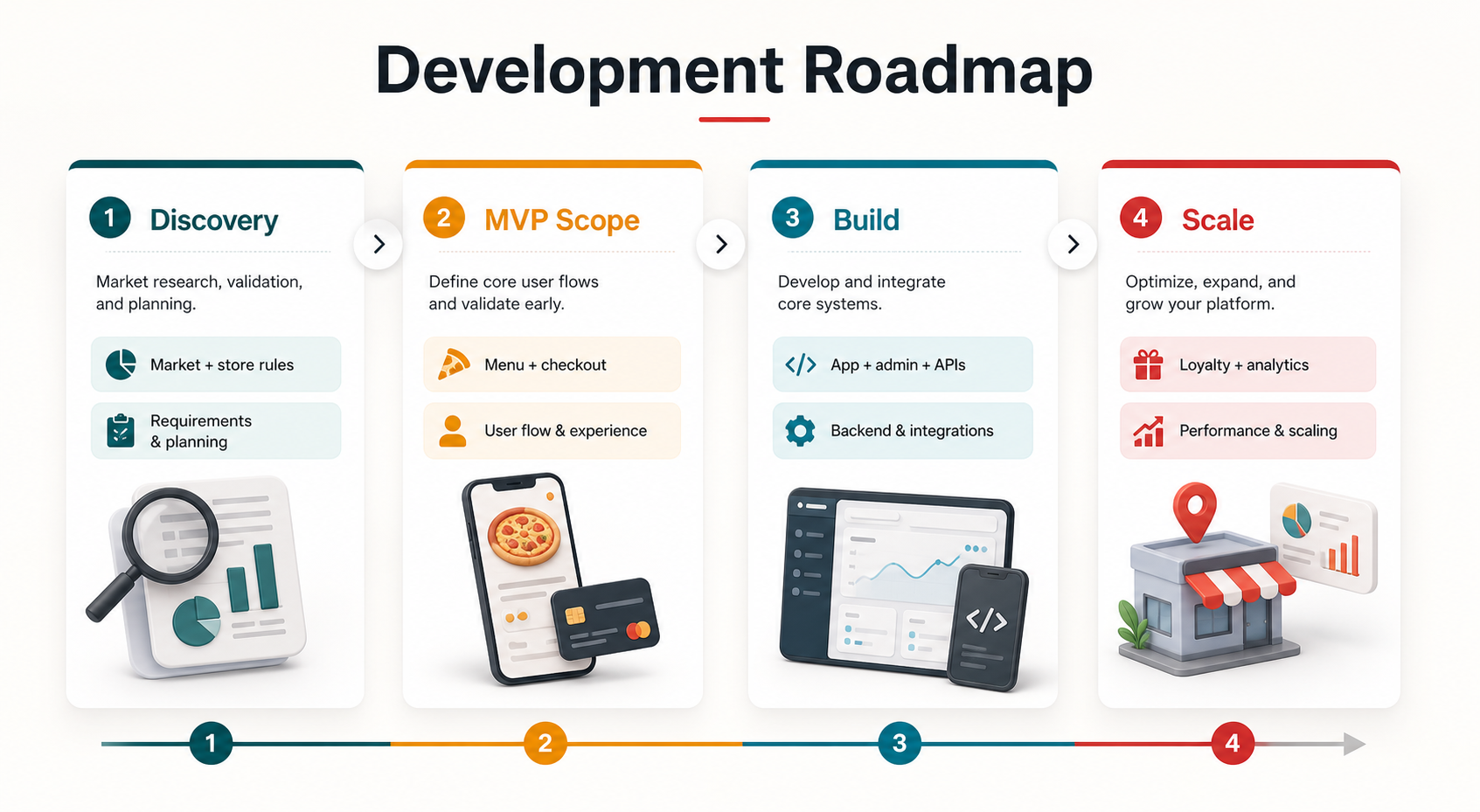
- Discovery: define customer segments, store model, menu rules, delivery workflow, integrations, launch market, success metrics, and operational constraints.
- MVP scope: choose the smallest release that supports reliable ordering: menu, customization, cart, checkout, address management, payments, order confirmation, status updates, and admin controls.
- Product design: map customer, kitchen, support, and manager journeys. Design for fast repeat ordering, clear prices, accessible forms, and low-friction status visibility.
- Engineering build: implement the mobile app, backend APIs, admin dashboard, payment integration, store rules, notification system, and analytics events.
- Testing and rollout: test payments, coupons, menu changes, store availability, delivery edge cases, refunds, notifications, slow networks, and peak-order performance.
- Scale: add loyalty, referrals, campaigns, personalization, multi-store reporting, POS/KDS integrations, AI-assisted recommendations, and deeper attribution.
If the first release is still hard to define, use the MVP Scope Builder to separate launch-critical ordering workflows from later growth ideas. For budget scenarios, the Custom Software Cost Estimator can help frame the cost impact of roles, integrations, payments, notifications, and admin complexity.
Must-Have Features For A Pizza Delivery App
| Feature Area | What It Should Include | Why It Matters |
|---|---|---|
| Menu and search | Categories, item details, photos, availability, filters, combos, and featured offers. | Customers need to find the right pizza quickly. |
| Pizza builder | Size, crust, sauce, cheese, toppings, half-and-half rules, dietary notes, and live pricing. | Customization is the core pizza-ordering experience. |
| Cart and checkout | Coupons, taxes, delivery fees, tips, saved addresses, pickup/delivery choice, and payment. | Trust breaks when totals or options change late. |
| Order tracking | Accepted, preparing, baking, quality check, out for delivery, delivered, or ready for pickup. | Clear status lowers support pressure and uncertainty. |
| Admin controls | Menu updates, pricing, delivery zones, store hours, offers, roles, content, and reports. | The business needs control after launch. |
| Loyalty and reorder | Saved favorites, order history, one-tap reorder, points, referrals, and winback campaigns. | Repeat ordering is where an owned app creates durable value. |
For a deeper feature planning companion, connect this roadmap with essential pizza delivery app features. If your target market includes allergen-sensitive or preference-heavy ordering, review dietary customization in pizza delivery apps before finalizing the menu builder.
Architecture Map For Pizza Ordering Platforms
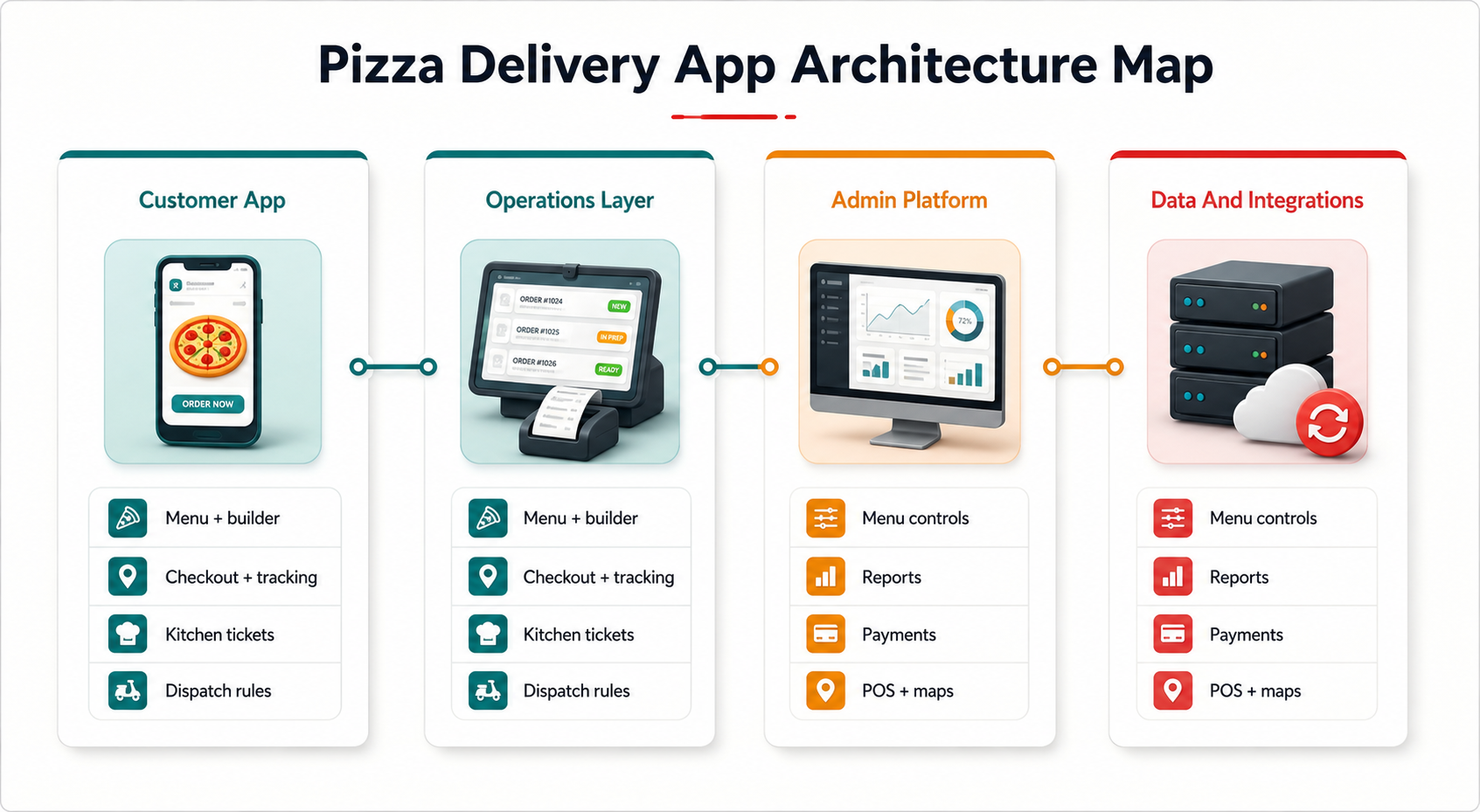
The customer app is only one part of the build. A Domino's-style experience also needs backend services for menu logic, pricing, coupons, user accounts, orders, payments, status updates, notifications, store configuration, and reporting. If the app serves multiple stores, the backend must understand store-level hours, delivery areas, item availability, tax rules, pickup windows, and manager permissions.
Many restaurants also need integrations with POS systems, kitchen display systems, payment gateways, maps, SMS or email providers, CRM tools, analytics, and support systems. When packaged tools cannot support those workflows cleanly, custom software development can provide better control over the operating model.
Payments, Tracking, And Notifications
Payments should support the methods your customers trust: cards, wallets, gift cards, cash-on-delivery where relevant, and secure saved payment profiles. The checkout page should make the final amount obvious, including coupon effects, tax, delivery charges, and tip choices. Payment failures should be handled gracefully so customers do not lose a customized order.
Tracking and notifications are equally important. Customers want to know whether the restaurant accepted the order, whether it is being prepared, when it leaves the store, and when it is ready for pickup or delivery. Transactional messages should be clear and consent-aware. Marketing messages should be segmented and measurable, especially when promotions are part of the retention plan. For that layer, pizza delivery app promotions and marketing is a useful next read.
Cost Drivers And Timeline
The cost of building a pizza delivery app depends less on the word "pizza" and more on the operating complexity. A basic single-store MVP with menu, cart, checkout, payments, order status, and admin controls is very different from a multi-location platform with POS integration, driver dispatch, loyalty, promotions, analytics, and personalization.
Major cost drivers include the number of user roles, custom pizza-builder rules, payment methods, coupon complexity, delivery assignment logic, POS/KDS integrations, native iOS and Android requirements, admin reporting, notification channels, support workflows, and data migration. Teams planning a broader food ordering platform can compare this with benefits of food delivery app development.
Testing, Launch, And Growth
Testing should cover real restaurant scenarios, not just happy-path ordering. Validate unavailable items, out-of-zone addresses, expired coupons, payment failures, duplicate taps, refund workflows, kitchen status changes, delayed delivery, store closing time, slow mobile networks, and peak-order load. A pizza app that fails during Friday dinner can lose trust quickly.
After launch, track funnel conversion, menu search success, pizza-builder completion, cart abandonment, payment failure rate, average order value, delivery time, refund rate, repeat order rate, promotion redemption, loyalty engagement, app crashes, and support tickets. For product inspiration around food-service workflows, the FeastFlow portfolio case study shows how ordering, operations, and customer experience can be treated as a connected platform. If the app also needs a browser-based ordering surface or admin dashboard, plan web app development alongside the mobile experience.
Final Recommendation
Build a Domino's-style pizza delivery app by focusing on the operating system behind the customer experience. Start with reliable ordering, clear customization, secure checkout, and trustworthy status updates. Then add admin control, integrations, loyalty, promotions, analytics, and personalization when the core ordering flow is stable.
The best first step is a scoped product plan: which stores are included, which workflows must launch, which integrations are required, and which metrics will prove the app is worth scaling. Once those decisions are clear, the build can move quickly without turning into a generic feature list.