
Logistics app development cost in 2026 usually depends less on the app idea and more on the operating system behind it: booking, dispatch, driver execution, route decisions, warehouse or fleet data, exception handling, proof of delivery, billing, and reporting. A focused logistics MVP can stay lean when it proves one delivery loop. A multi-role platform costs more because it becomes an operational control layer that people depend on during live shipments.
For logistics companies, delivery startups, and operations teams, the useful question is not whether an app can be built for a fixed low number. The useful question is which version should be built first, which integrations are business-critical, and which features can wait until the team has real operational data. If you already have a rough feature list, start with the custom software cost estimator to frame the likely scope before requesting a detailed quote.
Quick Answer: How Much Does Logistics App Development Cost?
A focused logistics MVP usually costs about $45,000-$90,000 when it includes one or two user roles, core shipment booking, basic driver updates, simple admin controls, notifications, and standard map integration. A stronger operating platform often lands around $90,000-$180,000 when it adds dispatch workflows, customer and driver apps, richer admin tooling, route management, analytics, proof of delivery, and integrations with payment, CRM, or warehouse systems.
Enterprise-grade logistics software can exceed $180,000-$350,000+ when the system needs multi-branch rules, real-time fleet tracking, time-window routing, offline driver workflows, barcode scanning, IoT or telematics data, ERP/TMS/WMS integrations, compliance reporting, audit logs, and high-availability operations. The exact range depends on complexity, not only on screen count.
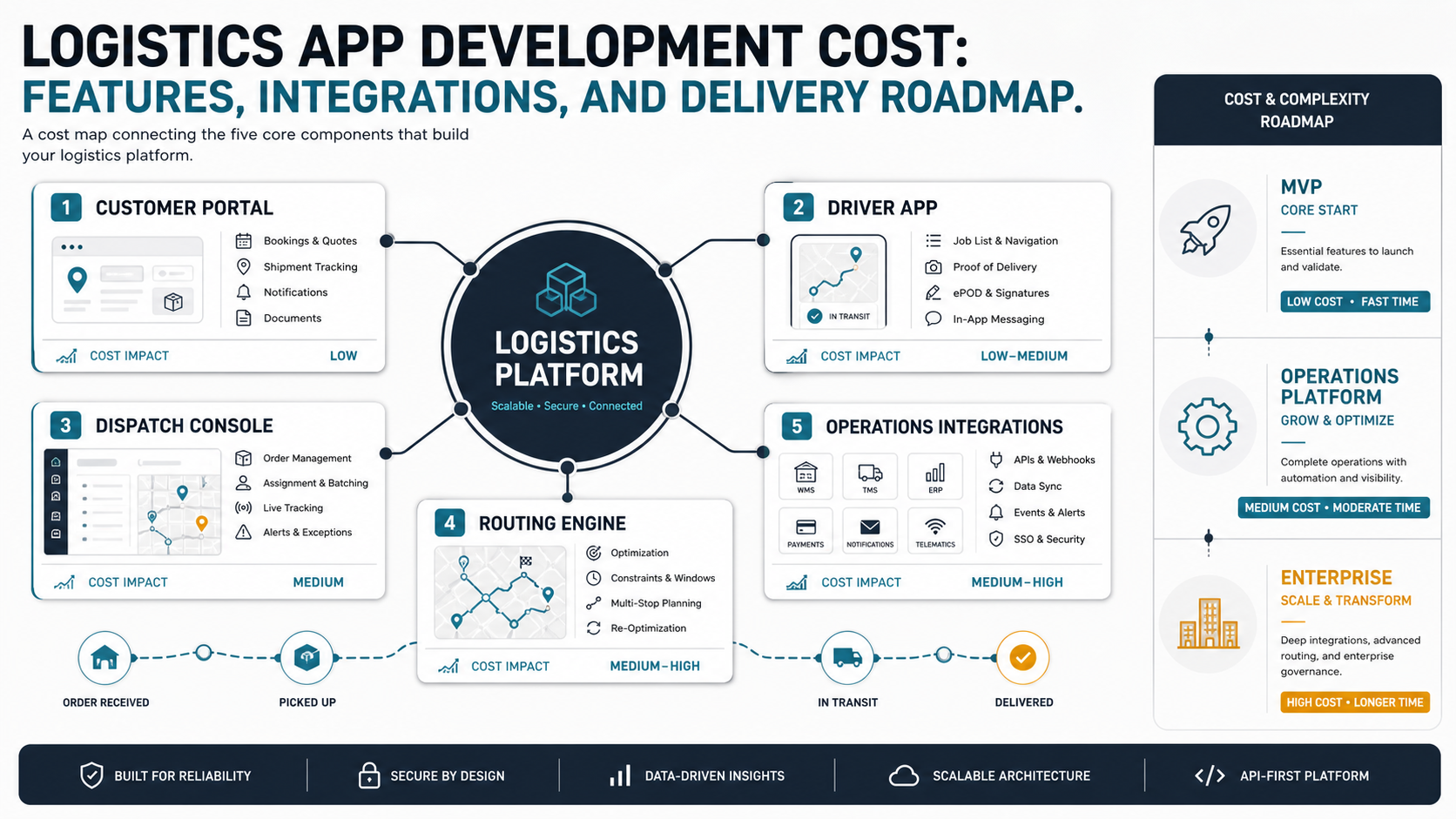
Why Logistics App Estimates Vary So Much
Logistics products sit close to real-world operations. Every hidden rule in dispatch, pricing, loading, routing, proof of delivery, exception handling, and customer communication becomes software behavior. That is why two apps with similar-looking tracking screens can have very different budgets.
The biggest cost drivers are usually the number of operational roles, the depth of real-time tracking, the number of integrations, and the amount of exception handling. A parcel delivery startup may need booking, payment, driver status, and a basic admin panel. A 3PL provider may need shipper portals, partner carrier workflows, warehouse events, route optimization, SLA alerts, invoice reconciliation, and reporting across branches.
This is where logistics software overlaps with custom software development. The app is not only a mobile interface. It becomes a control layer for business rules, data flow, and operational accountability.
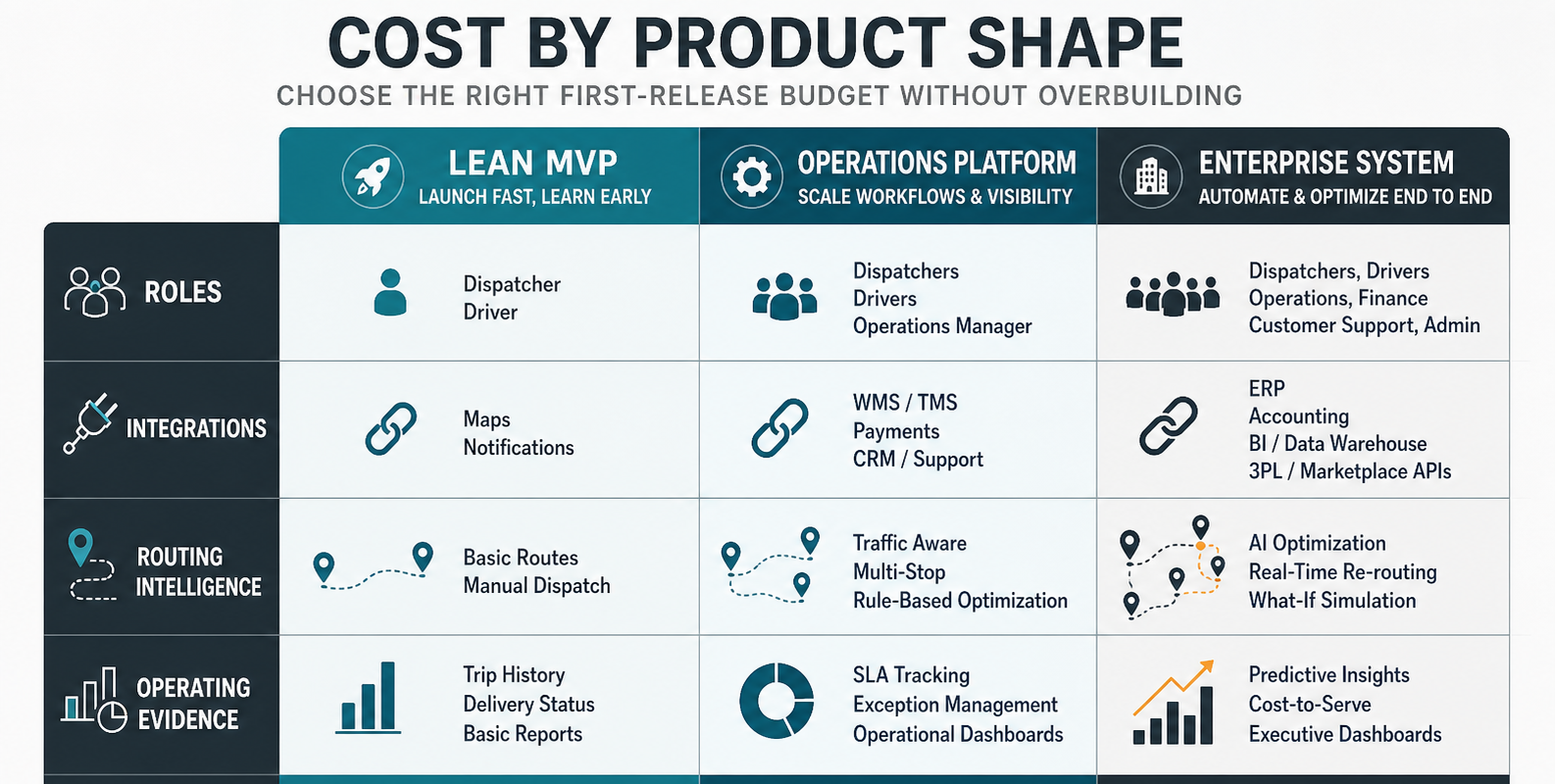
Cost By Product Shape
The cleanest way to estimate a logistics app is to separate the product into practical build shapes.
| Product Shape | Typical Scope | Planning Range |
|---|---|---|
| Lean Logistics MVP | Customer booking, shipment status, driver task list, simple admin panel, notifications, basic maps | $45,000-$90,000 |
| Operations Platform | Customer portal, driver app, dispatcher console, route planning, proof of delivery, analytics, selected integrations | $90,000-$180,000 |
| Enterprise Logistics System | Multi-branch operations, advanced routing, offline workflows, WMS/TMS/ERP, telematics, audit trails, compliance, high-scale reporting | $180,000-$350,000+ |
These ranges are planning bands, not fixed quotes. The final estimate should follow discovery, workflow mapping, integration review, and a clear release plan. If the first release is still unclear, use the MVP Scope Builder to separate launch-critical workflow from later platform scope.
Core Features That Shape The Budget
A logistics app often needs more than one product surface. Each role adds design, backend rules, permissions, QA scenarios, and support requirements.
- Customer or shipper portal: quote requests, shipment booking, saved addresses, package details, pickup scheduling, shipment status, invoices, support, and proof of delivery.
- Driver app: assigned stops, route view, pickup and drop-off confirmation, barcode or QR scanning, photo capture, signature capture, cash collection if needed, failed delivery reasons, offline support, and push notifications.
- Dispatcher console: job assignment, capacity view, route changes, live exceptions, driver status, ETA changes, SLA warnings, and manual override controls.
- Admin and back office: users, roles, pricing rules, zones, branches, reports, invoice exports, support workflows, audit logs, and configuration.
- Partner or carrier workflows: third-party carrier assignment, partner performance, handoff status, settlement data, and shared tracking access.
The MVP does not need every role at launch. A better first release focuses on the workflow that removes the most operational friction: booking to dispatch, dispatch to delivery, or visibility across active shipments.
Integration Costs: Maps, Routing, And Operations Data
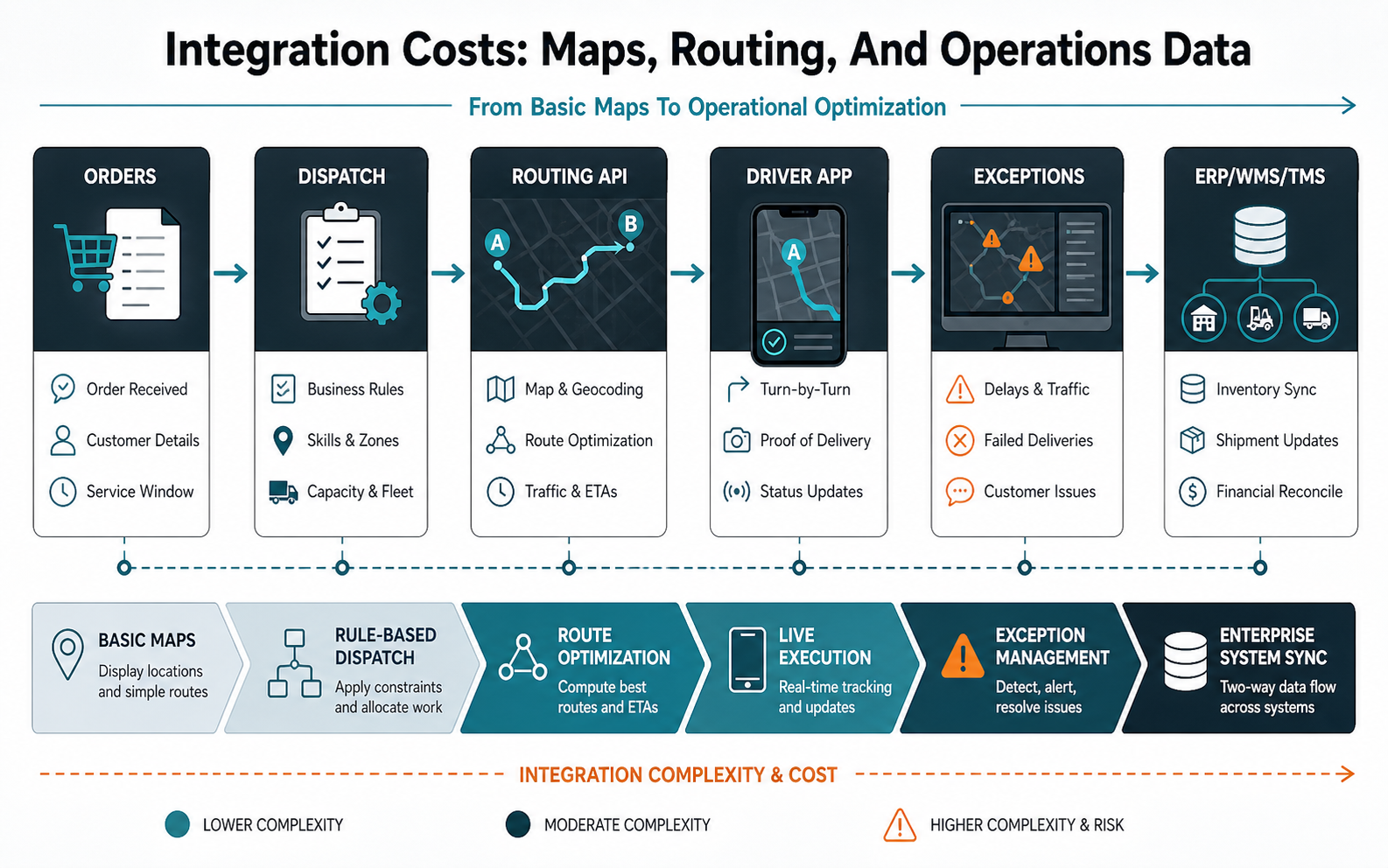
Integrations are often the budget line that grows after a first feature list is written. Logistics platforms commonly connect to mapping providers, route engines, payment gateways, SMS and email services, CRM, ERP, warehouse systems, transportation management systems, barcode scanners, telematics, and customer support tools.
Mapping and routing need extra care. Google Maps Platform groups route products such as Compute Routes, Compute Route Matrix, Navigation SDK, Roads, and Route Optimization for different routing needs. Google bills Compute Routes by request and Compute Route Matrix by origin-destination elements, so dispatch-heavy products need volume modeling before launch. Mapbox separates maps, navigation, directions, optimization, and map-matching capabilities, which means a product that only displays a route is materially different from one that optimizes stops or re-plans during live operations. The development cost is only one part of the decision; ongoing API usage, traffic volume, route calculation frequency, geocoding volume, and caching strategy can affect operating cost.
If the app only shows a driver a destination, standard maps may be enough. If the app needs multi-stop route optimization with capacity constraints, time windows, driver shifts, pickup/drop-off dependencies, or dynamic traffic adjustments, the scope moves into a more complex routing product. This changes backend design, QA, monitoring, and monthly provider cost.
What Moves An App From MVP To Enterprise Cost?
Screen count is a weak proxy for logistics app cost. A single dispatch screen can hide complex rules for capacity, service areas, cut-off times, vehicle type, delivery priority, customer SLA, driver availability, and exception handling.
The largest cost jumps usually come from these layers. For delivery-heavy products, this is where generic app scope starts to become on-demand delivery app development services, fleet software, or a custom logistics operations platform.
- Role complexity: more roles mean more permissions, workflows, notifications, and edge cases.
- Real-time behavior: live tracking, ETA updates, driver status, geofencing, and dispatch alerts require event design and monitoring.
- Offline workflows: drivers may need to scan, capture proof, or complete stops when connectivity is weak.
- Optimization rules: time windows, vehicle capacity, batch routing, priority orders, and driver shifts need careful modeling.
- Integration risk: ERP, WMS, TMS, telematics, and carrier APIs often need mapping, retries, reconciliation, and support tooling. Warehouse-heavy teams should plan this with the same rigor as warehouse and inventory management software.
- Operational reporting: managers need delivery performance, exception rates, driver productivity, route efficiency, customer SLA views, and cost-to-serve data.
Build Vs Buy: Routing And Delivery Management Decisions
Not every logistics team should build routing from scratch. Buy or integrate a delivery management tool when the workflow is standard, the provider already supports your stop volume, and your team mostly needs dispatch, notifications, driver execution, proof of delivery, and customer ETAs. Build or customize when routing rules are tied to proprietary service windows, vehicle constraints, warehouse handoffs, carrier selection, pricing, customer commitments, or system-of-record ownership.
| Decision Area | Buy Or Integrate When | Build Or Customize When |
|---|---|---|
| Routing | Routes are simple and provider limits fit daily stop volume. | Capacity, service windows, dependencies, or re-optimization rules are business-specific. |
| Dispatch | Manual assignment and standard driver workflows are enough. | Dispatchers need custom queues, exception rules, branch logic, or approval controls. |
| Driver App | Standard proof of delivery, status updates, and navigation handoff are enough. | Offline scans, cash collection, chain-of-custody, or custom compliance evidence is required. |
| System Sync | One or two clean integrations can be handled through standard APIs. | ERP, WMS, TMS, telematics, accounting, and BI flows need reconciliation and write-back. |
Fleet or vehicle-data-heavy programs should also compare scope against automotive software development services, because telematics, diagnostics, maintenance, and driver behavior data can change the architecture.
MVP Roadmap For A Logistics App
A cost-controlled logistics MVP should prove one operational loop before expanding into a full platform. The roadmap below works for many delivery, courier, fleet, and logistics workflow products.
- Discovery and workflow mapping: document shipment lifecycle, roles, pricing rules, service zones, dispatch rules, integrations, exception types, reporting needs, and launch constraints.
- Prototype and scope baseline: design the customer or shipper flow, driver task flow, dispatcher decisions, admin controls, and the no-scope list for version one.
- Backend and data model: define shipments, stops, drivers, vehicles, addresses, route plans, status events, proof records, invoices, users, roles, and audit logs.
- MVP build: deliver the minimum role set, shipment creation, assignment, status updates, notifications, simple tracking, and admin management.
- Operations hardening: add monitoring, retries, support tools, exports, QA across devices, low-connectivity checks, and launch dashboards.
- Optimization phase: add route optimization, richer analytics, advanced integrations, customer self-service, and automation after real usage data confirms the priority.
This phased path is similar to strong mobile app development work: the first release should be narrow enough to ship and useful enough to reveal what needs to be built next. When route planning, shipment visibility, and exception prediction become central to the product, compare the roadmap with NextPage's AI solutions for logistics and supply chain operations so AI is added to measurable decisions instead of decorative dashboards.
Feature Prioritization Checklist
Before estimating, separate must-have launch scope from future platform scope.
- Which user must the first release serve: customer, driver, dispatcher, warehouse, or admin?
- What is the first measurable workflow: booking, dispatching, tracking, proof of delivery, or exception reduction?
- Does live tracking need second-by-second visibility, periodic updates, or milestone-based statuses?
- Are route calculations informational, driver-facing, or operationally binding?
- Which systems must integrate at launch, and which can be imported/exported manually at first?
- What happens when a driver loses connectivity, misses a stop, rejects an assignment, or records a failed delivery?
- Which reports are needed for daily operations, and which are executive dashboards for later?
For related delivery and location-heavy planning, NextPage's existing guides on real-time GPS tracking, delivery app development, and dispatch and location-heavy app features can help frame common route, driver, and operations decisions.
How To Avoid Budget Overruns
Most logistics app overruns come from late discovery of operational rules. The fix is not a longer feature list. The fix is a better pre-build review.
- Map exception flows early: failed pickup, failed delivery, partial delivery, damaged package, no driver, duplicate address, incorrect weight, and payment failure.
- Define integration ownership: know who controls each external system, sandbox access, API limits, test data, and production credentials.
- Use decision gates: approve workflow, prototype, architecture, API contracts, QA plan, and rollout plan before each phase expands.
- Instrument operations: track delayed assignments, ETA variance, proof-of-delivery completion, support tickets, route exceptions, failed delivery reasons, and cost-to-serve trends from launch.
- Keep optimization out of the first release unless it is the core product: manual dispatch plus good data can be a better first step than premature algorithmic routing.
Launch Evidence And Scalability Gates
A logistics platform should not move from pilot to scale because the screens look complete. It should move when the team has evidence that daily operations can trust it. Before expanding routes, branches, carriers, or customer groups, review assignment latency, GPS update reliability, proof-of-delivery completion, failed-delivery categorization, integration retry queues, support escalation time, and reporting accuracy.
Scaling also changes infrastructure expectations. A product that works for one branch may need stronger observability, queue processing, database indexing, permission design, backup procedures, and release controls when it handles thousands of stops or multiple customer accounts. For that phase, pair the logistics roadmap with scalable software development services instead of treating scale as a hosting-only decision.
How NextPage Estimates Logistics Software
NextPage estimates logistics software by turning business operations into a delivery model. The team reviews roles, shipment lifecycle, dispatch rules, integrations, reporting needs, data ownership, security, and launch constraints before recommending a release plan. That gives buyers a clearer view of what should be built now, what should be deferred, and what could create operational risk if it is skipped. For an NDA-safe example of logistics finance and operational evidence thinking, review the FreightLens logistics revenue audit case study.
If you are planning a logistics app, begin with the custom software cost estimator. For hands-on delivery, NextPage can shape the product through custom software development and mobile app development support, including discovery, UX, backend architecture, integrations, QA, and production rollout.