
Quick Answer: Pizza Delivery App Marketing That Increases Orders
Pizza delivery app marketing works best when promotions are tied to customer behavior, not scattered as one-off discounts. The app should help the business plan offers, segment customers, send timely campaigns, measure margin impact, and turn first-time orders into repeat orders.
For a pizza brand, the strongest promotion system usually combines loyalty rewards, limited-time bundles, referral incentives, push notifications, email or SMS campaigns, social proof, local partnerships, seasonal offers, targeted ads, and customer feedback loops. The goal is not simply to make every pizza cheaper. The goal is to give the right customer the right reason to order at the right time.
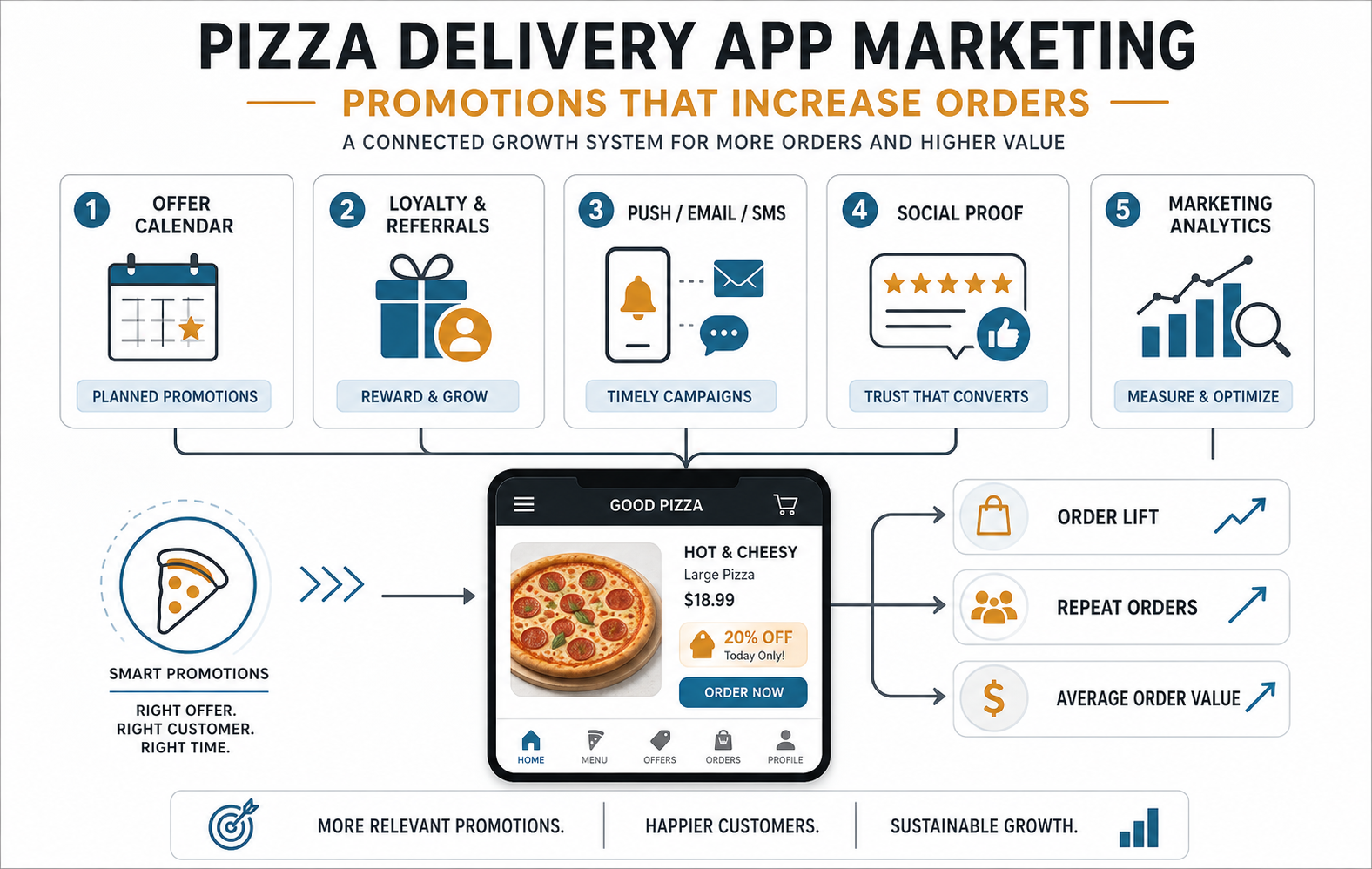
Why Promotions Need To Be Built Into The App
Promotions are more effective when the app can personalize, schedule, and measure them. A static coupon code may create a short spike, but an app-level promotion engine can target lapsed customers, reward frequent buyers, highlight a new topping, increase average order value, or protect slow weekday demand.
This is why marketing should be considered during mobile app development, not bolted on after launch. The product needs campaign rules, offer eligibility, attribution, notification preferences, coupon controls, analytics, and admin workflows. Without those foundations, the team is left guessing which promotions actually changed ordering behavior.
The current article already covered useful tactics such as loyalty programs, limited-time offers, referrals, push notifications, social media, email, partnerships, seasonal campaigns, targeted ads, and reviews. The optimization below connects those tactics into a practical operating model.
Promotion Calendar And Offer Mix
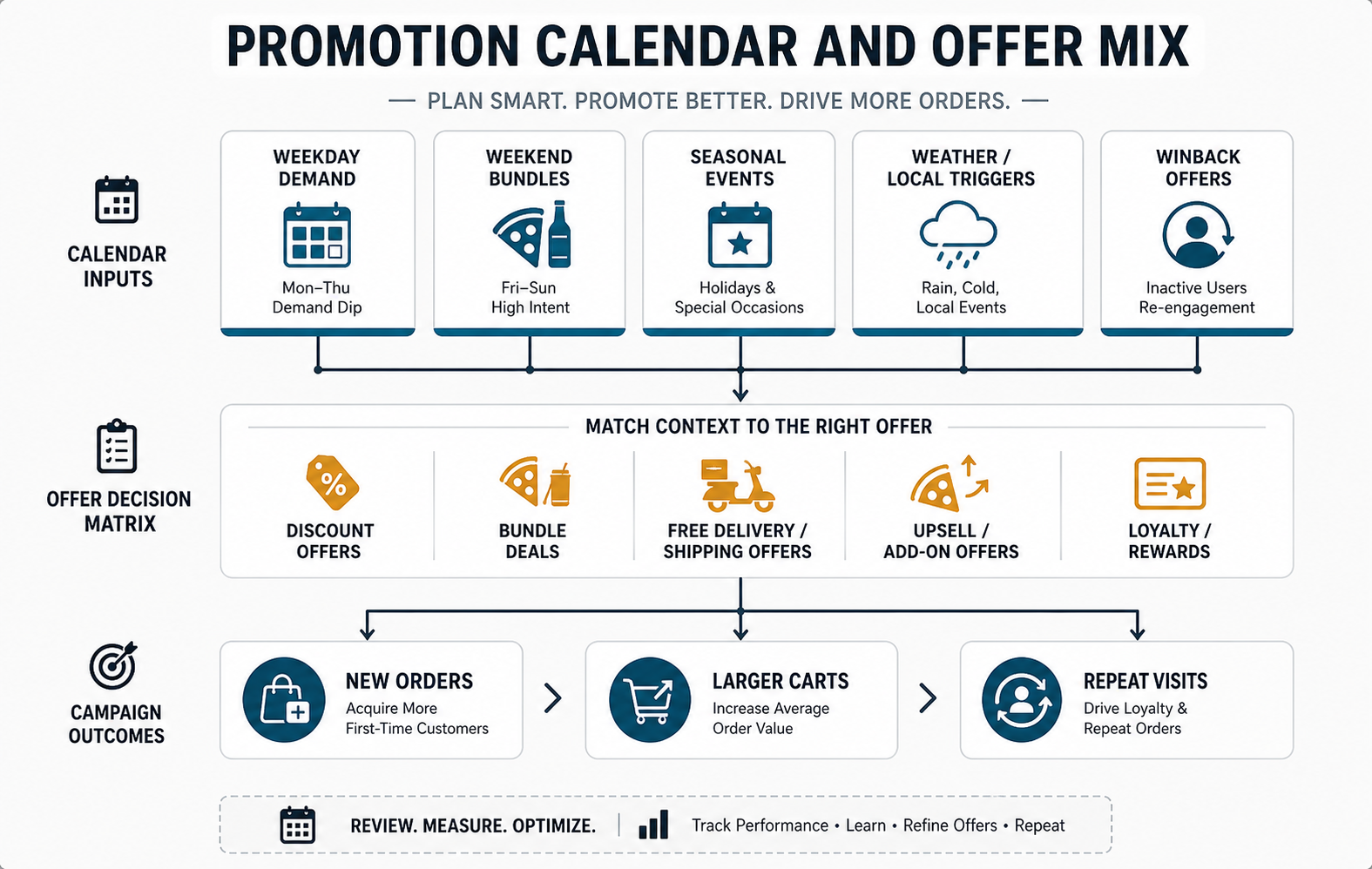
A useful promotion calendar starts with demand patterns. Weekday demand may need lunch combos, family meal deals, or free delivery thresholds. Weekend demand may support bundles, premium toppings, party packs, or upsell offers. Seasonal periods can support limited-time flavors, game-day menus, holiday bundles, or local event tie-ins.
The offer mix should include more than discounts:
- Acquisition offers: first-order discounts, free delivery, local launch deals, and referral rewards that bring new customers into the app.
- Cart-building offers: bundles, side-item prompts, drink pairings, dessert add-ons, and threshold discounts that increase average order value.
- Retention offers: loyalty points, streak rewards, saved favorites, birthday offers, and member-only menu drops.
- Winback offers: targeted campaigns for customers who have not ordered recently, based on their prior preferences and location.
- Operational offers: slow-hour specials, store-specific deals, pickup incentives, and inventory-aware promotions.
If the business is still defining the product scope, the custom software cost estimator can help separate a simple coupon feature from a deeper marketing and analytics engine.
Loyalty, Referrals, And Repeat Orders
Loyalty programs should reward behavior that the business actually wants: repeat orders, higher-value baskets, direct app ordering, or ordering from underused locations. A basic points system can work, but stronger programs often include tiers, member-only offers, saved favorites, and rewards that feel relevant to the customer's order history.
Referral programs work best when both sides understand the value. Existing customers need a clear reason to invite friends, and new customers need a simple first-order path. The app should track referral source, prevent abuse, and attribute the order correctly so the marketing team can compare referral performance with paid acquisition.
For food delivery businesses, loyalty and referral logic often overlaps with broader product architecture: customer accounts, wallets, coupon rules, notification preferences, analytics, and fraud controls. That is where a custom software development approach can be useful if packaged tools cannot support the promotion model cleanly.
Push, Email, And SMS Campaigns
Push notifications, email, and SMS should not all carry the same message. Push is useful for timely prompts such as lunch deals, abandoned carts, order status, limited-time menu drops, and location-specific offers. Email is better for weekly menus, loyalty summaries, seasonal campaigns, and longer storytelling. SMS should be used carefully for high-intent or transactional moments because it feels more intrusive.
The app should allow opt-in management, frequency controls, segmentation, and campaign suppression. A customer who ordered yesterday should not receive a desperate winback offer today. A vegan customer should not receive a meat-heavy bundle if the app already knows their preference. A customer near one store should not receive a promotion for a location that cannot deliver to them.
AI can help with segmentation, send-time recommendations, offer selection, and churn prediction, but only after the app has clean order history, consent data, and campaign outcomes. NextPage's AI development services can support those use cases when the data foundation is ready.
Social Proof And Local Marketing
Social media integration should make sharing natural, not forced. Customers may share a favorite pizza, limited-time bundle, loyalty milestone, or review when the experience feels worth sharing. The app can support shareable order cards, referral links, review prompts, and user-generated content campaigns without interrupting checkout.
Reviews are also part of the marketing system. Positive reviews can reassure new customers, while negative feedback can reveal delivery delays, confusing offers, poor menu photos, or checkout issues. The app should prompt reviews at the right moment, route service issues to support, and feed recurring themes back into product and operations.
Local partnerships can expand reach when they fit the ordering moment. Beverage brands, dessert shops, gyms, schools, workplaces, venues, or community events can all support co-marketing. The best partnerships create an offer that makes sense in the app, not just a logo exchange.
Targeted Advertising And Landing Paths
Paid ads can attract pizza customers, but the landing path matters. If an ad promotes a family bundle, the app or web ordering flow should open near that bundle, not dump the customer on a generic menu. If a campaign targets students, offices, late-night diners, or families, the offer, creative, location, and checkout path should match that segment.
Ad campaigns should connect to deep links, coupon eligibility, attribution, and post-order retention. Otherwise, the business may pay for first orders without knowing which customers came back, which campaign drove profitable demand, or which offer simply discounted orders that would have happened anyway.
Teams comparing packaged ordering platforms with owned app development can use the Build vs Buy Decision Tool to weigh launch speed, promotion control, customer data ownership, integrations, and long-term marketing flexibility.
Measure Promotions With The Right Metrics
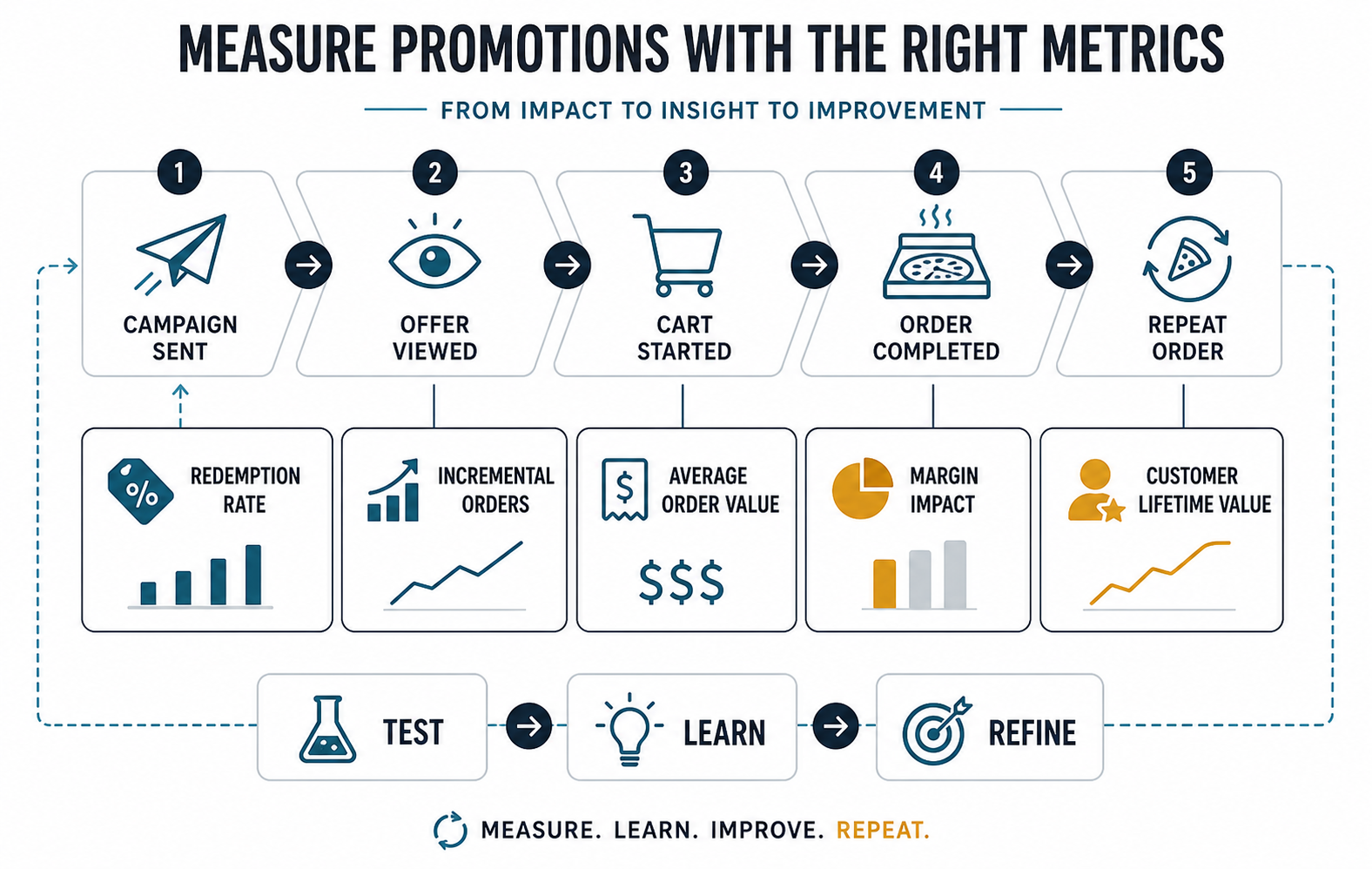
Coupon redemptions are not enough. A promotion can look successful while reducing margin or training customers to wait for discounts. The app should track the full funnel: campaign sent, offer viewed, cart started, order completed, average order value, margin impact, repeat order, and customer lifetime value.
Useful promotion metrics include:
- Redemption rate: how many eligible customers used the offer.
- Incremental orders: whether the campaign created new demand or only discounted existing demand.
- Average order value: whether bundles and add-ons increased basket size.
- Gross margin impact: whether the offer still made business sense after discount, delivery, and ingredient costs.
- Repeat purchase rate: whether customers came back after the promotion ended.
- Segment performance: which audiences responded profitably and which should be suppressed or retargeted differently.
These metrics should flow into a simple test-learn-refine loop. Keep offers that create profitable repeat behavior, revise offers that only spike low-margin orders, and stop campaigns that annoy customers or confuse operations.
App Features That Support Marketing
A pizza delivery app needs specific product features to support serious marketing. The most important are customer accounts, saved favorites, coupon rules, campaign segments, referral tracking, loyalty balances, notification preferences, deep links, review prompts, analytics events, and admin controls for offer creation.
The operational side matters too. Store managers may need location-specific campaigns, inventory-aware offers, and the ability to pause promotions when demand is too high. Marketing teams need approval workflows, start and end dates, campaign calendars, and clean reporting. Finance teams need visibility into discount cost and margin impact.
Related posts such as Essential Features For Your Pizza Delivery App, How To Develop A Pizza Delivery App Like Domino's, and Benefits Of Food Delivery App Development can help product teams connect marketing features to the wider food delivery roadmap.
How NextPage Can Help
NextPage can help restaurant and food delivery businesses design the app workflows, promotion rules, loyalty systems, analytics, and admin tooling needed to make marketing measurable. The focus is on owned customer relationships, cleaner campaign operations, and app experiences that convert without relying on endless discounts.
If you are planning a pizza delivery app, food ordering platform, or restaurant marketing system, start with the product scope and measurement model. From there, NextPage can help design and build the mobile app, backend, integrations, and campaign infrastructure needed to turn promotions into repeatable growth.