
Quick Answer: Essential Pizza Delivery App Features
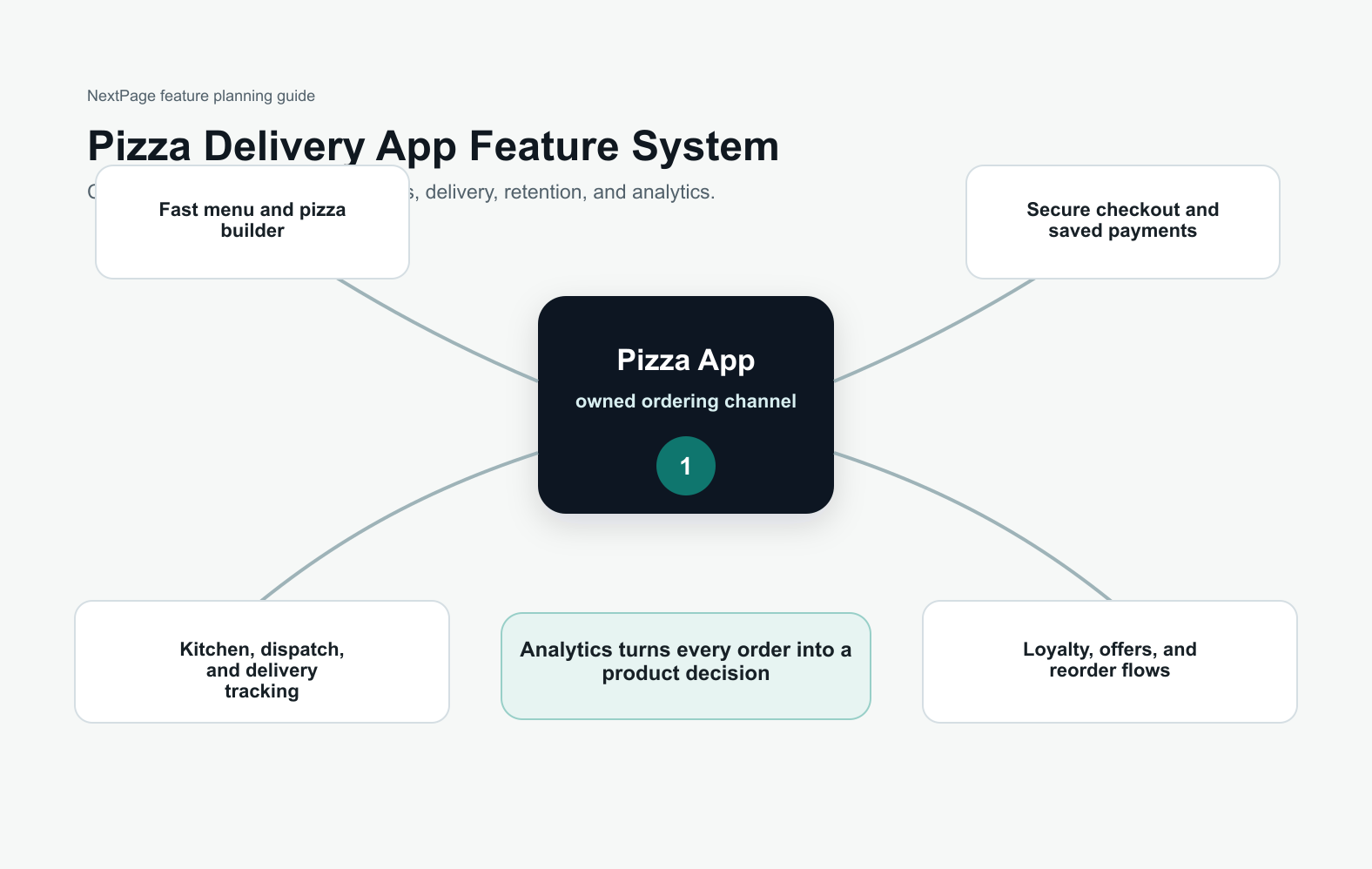
A strong pizza delivery app needs more than a menu and a checkout button. The essential feature set should help customers build the exact pizza they want, help the restaurant prepare and deliver it reliably, and help the business learn from every order.
For most teams, the first release should include a searchable menu, pizza customization, cart and checkout, secure payments, saved addresses, real-time order status, delivery instructions, push or SMS updates, customer support, ratings, and basic admin controls. Growth features such as loyalty, referrals, app-only promotions, social sharing, and AI-assisted recommendations should follow once the core ordering experience is stable.
Why Feature Prioritization Matters
Pizza ordering looks simple from the outside, but it combines menu configuration, pricing rules, location availability, kitchen preparation, delivery coordination, payment handling, support, and retention. If the app only focuses on the customer screen, the business may still struggle with wrong tickets, delayed deliveries, unclear refunds, and weak repeat-order behavior.
This is why pizza delivery app features should be planned during mobile app development, not added as isolated plugins. A useful roadmap separates launch-critical ordering features from later growth and intelligence features, then connects each feature to an operational owner and success metric.
Must-Have Feature Stack For Pizza Delivery Apps
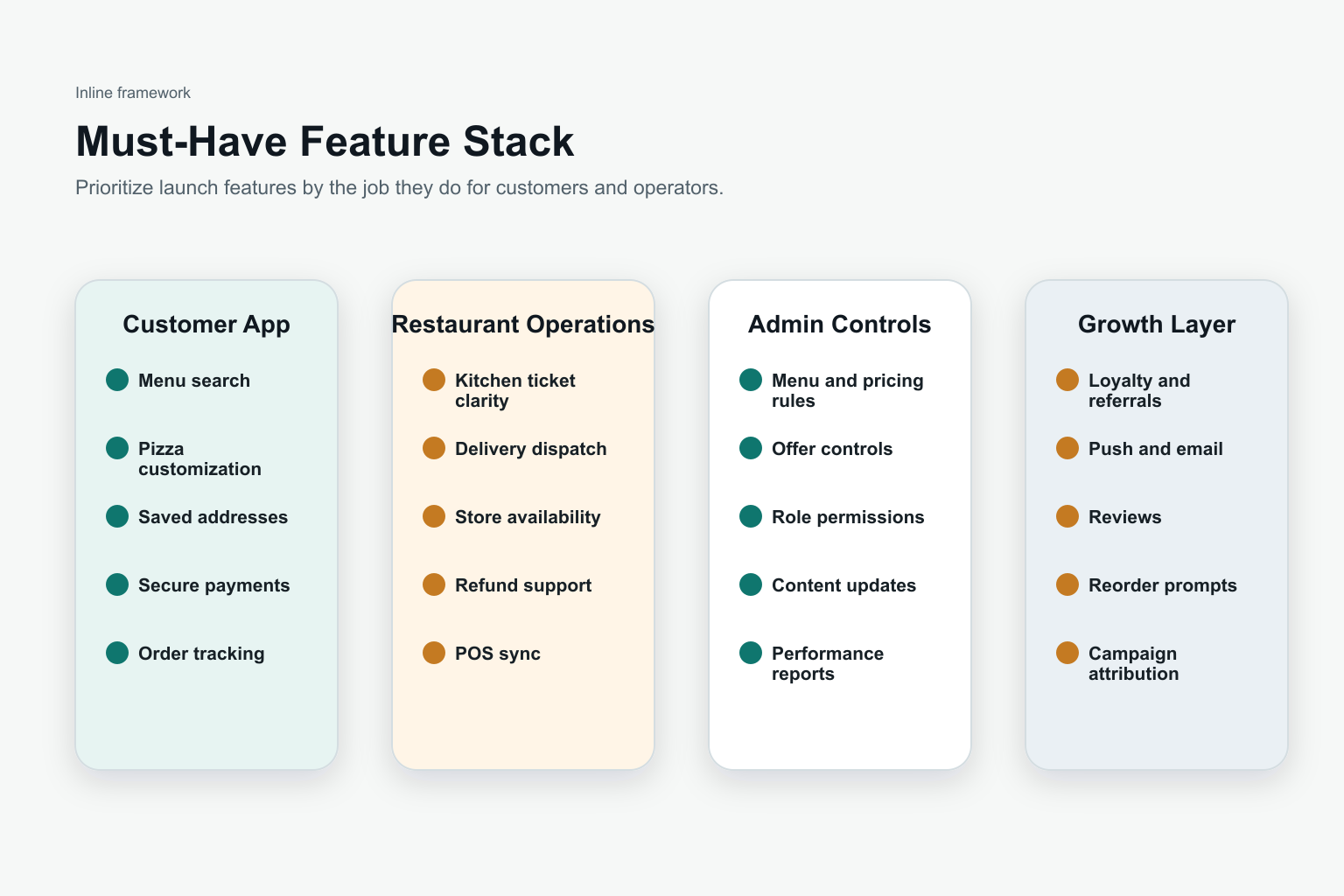
| Feature Area | Why It Matters | Launch Priority |
|---|---|---|
| Menu browsing and search | Customers need to find pizza, sides, combos, and deals quickly. | Must have |
| Pizza customization | Crust, sauce, cheese, toppings, half-and-half rules, and dietary choices drive the core pizza experience. | Must have |
| Cart and secure checkout | The app must handle pricing, coupons, taxes, delivery fees, tips, and payment safely. | Must have |
| Order tracking | Status updates reduce support pressure and build trust during preparation and delivery. | Must have |
| Admin and menu controls | Restaurant teams need to update prices, items, availability, offers, and store rules without developer help. | Must have |
| Loyalty and promotions | Retention features turn a one-time order into repeat business. | Growth stage |
| Analytics and attribution | Operators need to know which menu items, offers, and channels create profitable orders. | Growth stage |
Customer-Facing Features
The customer app should make ordering feel fast and controlled. Prioritize a clean menu, useful filters, high-quality item details, clear pricing, saved favorites, saved addresses, delivery notes, multiple payment methods, order history, reorder flows, and transparent status updates. A pizza builder should show how each crust, topping, size, and sauce choice affects price and availability before checkout.
Dietary and preference features are especially important for pizza because customers often customize around allergens, lifestyle choices, or group needs. If your roadmap includes gluten-free, vegan, halal, low-carb, or allergy-sensitive options, pair this article with dietary customization in pizza delivery apps.
Restaurant Operations Features
The app must support the restaurant team, not only the customer. Useful operational features include clear kitchen tickets, preparation status, delivery assignment, store availability, pickup windows, stockout handling, refund and cancellation workflows, and POS or kitchen display integrations. Without these workflows, a polished app can still create messy restaurant operations.
For businesses that need ordering, kitchen, delivery, support, and reporting to work in a specific way, custom software development can be a better fit than forcing packaged tools to match the operating model.
Admin And Business Control Features
Restaurant managers need admin controls for menu items, pricing, location rules, delivery zones, coupons, featured items, push campaigns, customer support, and reporting. Multi-location brands also need role permissions, approval workflows, and store-level overrides. These controls keep the app useful after launch, when menus, prices, delivery coverage, and campaigns keep changing.
Feature Roadmap From MVP To Scale
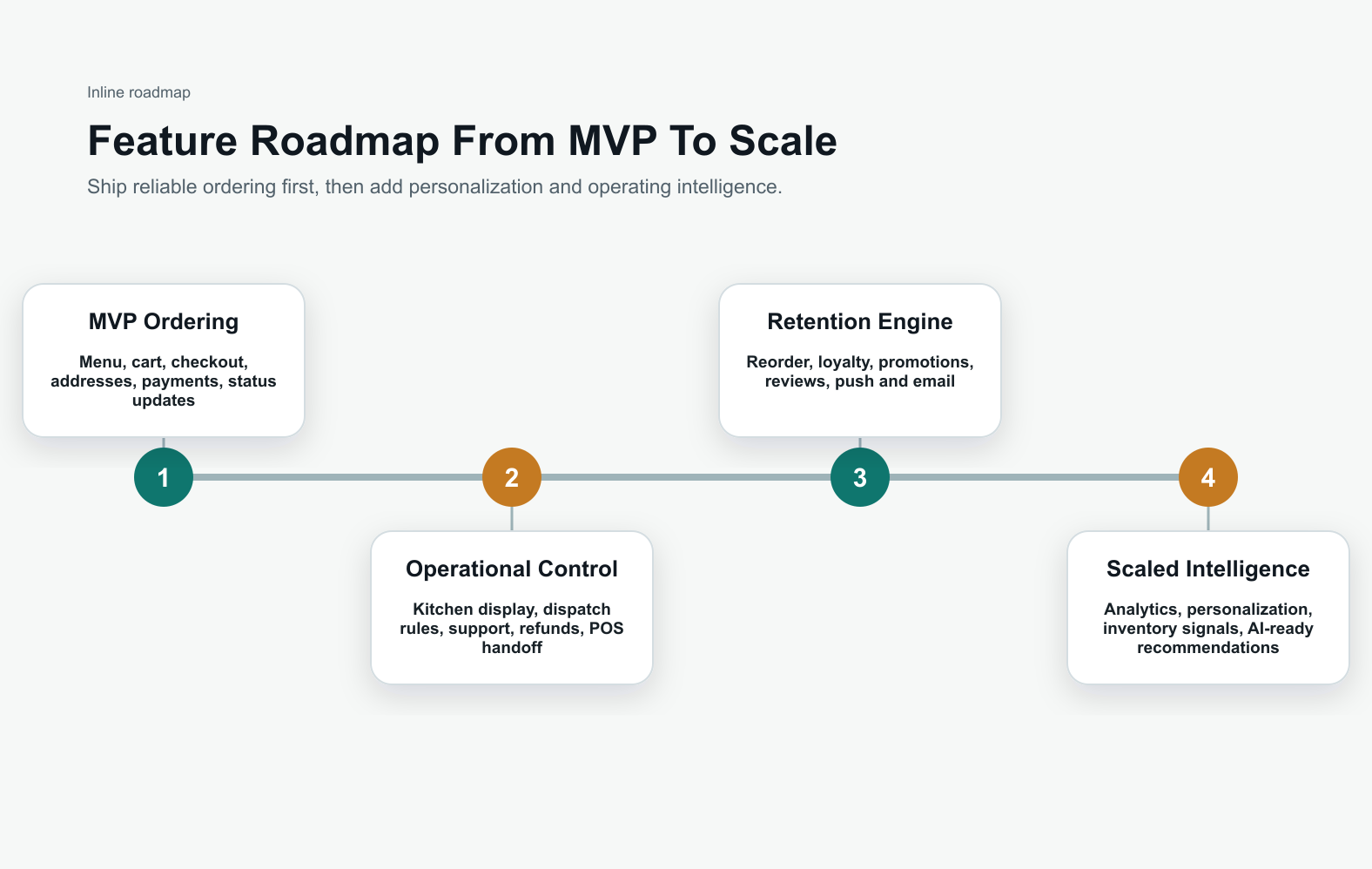
- MVP ordering: menu, item details, pizza builder, cart, checkout, payment, saved address, order confirmation, and basic status updates.
- Operational control: kitchen ticket clarity, delivery assignment, store availability, cancellation and refund handling, and POS or kitchen system handoff.
- Retention engine: saved favorites, one-tap reorder, loyalty points, referrals, app-only promotions, reviews, and segmented notifications.
- Scaled intelligence: product analytics, campaign attribution, personalized recommendations, inventory-aware suggestions, and demand forecasting.
If you are still deciding what belongs in the first release, the MVP Scope Builder can help separate must-have launch functionality from later roadmap features. The Custom Software Cost Estimator can also help frame effort around integrations, roles, payments, and admin complexity.
Payments, Tracking, And Notifications
Payment and tracking features deserve careful product design because they sit close to trust. Customers should see accepted payment methods, delivery fees, taxes, tip options, coupon effects, and the final total before paying. After ordering, they should receive clear status changes such as accepted, preparing, baking, quality check, out for delivery, delivered, or ready for pickup.
Notifications should be useful, not noisy. Transactional updates belong in push, SMS, email, or WhatsApp depending on the market and consent model. Marketing notifications should respect customer preferences and order history. If offers are part of the roadmap, use pizza delivery app promotions and marketing to connect campaigns with loyalty, referrals, and measurement.
Personalization, Loyalty, And Reorder Features
Pizza apps benefit from memory. Saved favorites, previous orders, preferred crusts, topping combinations, addresses, and delivery instructions can make repeat orders much faster. Loyalty and referral features then give customers a reason to keep ordering directly from the brand instead of returning to a third-party marketplace.
Personalization should stay transparent. Recommend compatible toppings, popular bundles, or reorder shortcuts, but let customers edit everything before checkout. For more advanced recommendation systems, NextPage's AI development services can help once the business has reliable order, menu, and campaign data.
Integrations That Make The App Operational
A pizza delivery app often needs integrations with payment gateways, POS systems, kitchen displays, maps, delivery routing, SMS or email providers, CRM, analytics, inventory, and customer support tools. The right integration depth depends on whether the app is a lightweight ordering channel or a full operating system for multiple locations.
Teams comparing packaged ordering platforms with custom product development can use the Build vs Buy Decision Tool to compare control, launch speed, integration limits, and long-term cost. For related planning, review how to develop a pizza delivery app like Domino's and benefits of food delivery app development.
Metrics To Track After Launch
The most useful app metrics connect customer behavior with restaurant outcomes. Track menu search success, pizza builder completion, cart abandonment, payment failure rate, average order value, delivery time, refund rate, repeat order rate, promotion redemption, loyalty engagement, customer support volume, and rating trends.
For restaurant and food-service product inspiration, the FeastFlow portfolio case study shows how food ordering, operations, and customer experience can be treated as one product system. If your app also needs a web ordering surface or admin dashboard, web app development should be planned alongside the mobile experience.
Final Recommendation
Build the pizza delivery app around the full ordering lifecycle: discover the menu, customize the pizza, pay safely, track the order, resolve issues, reorder easily, and learn from the data. Start with reliable ordering and operational control, then expand into loyalty, promotions, personalization, and analytics when the foundation is ready.