
Quick Answer: Which IT Services Should You Outsource First?
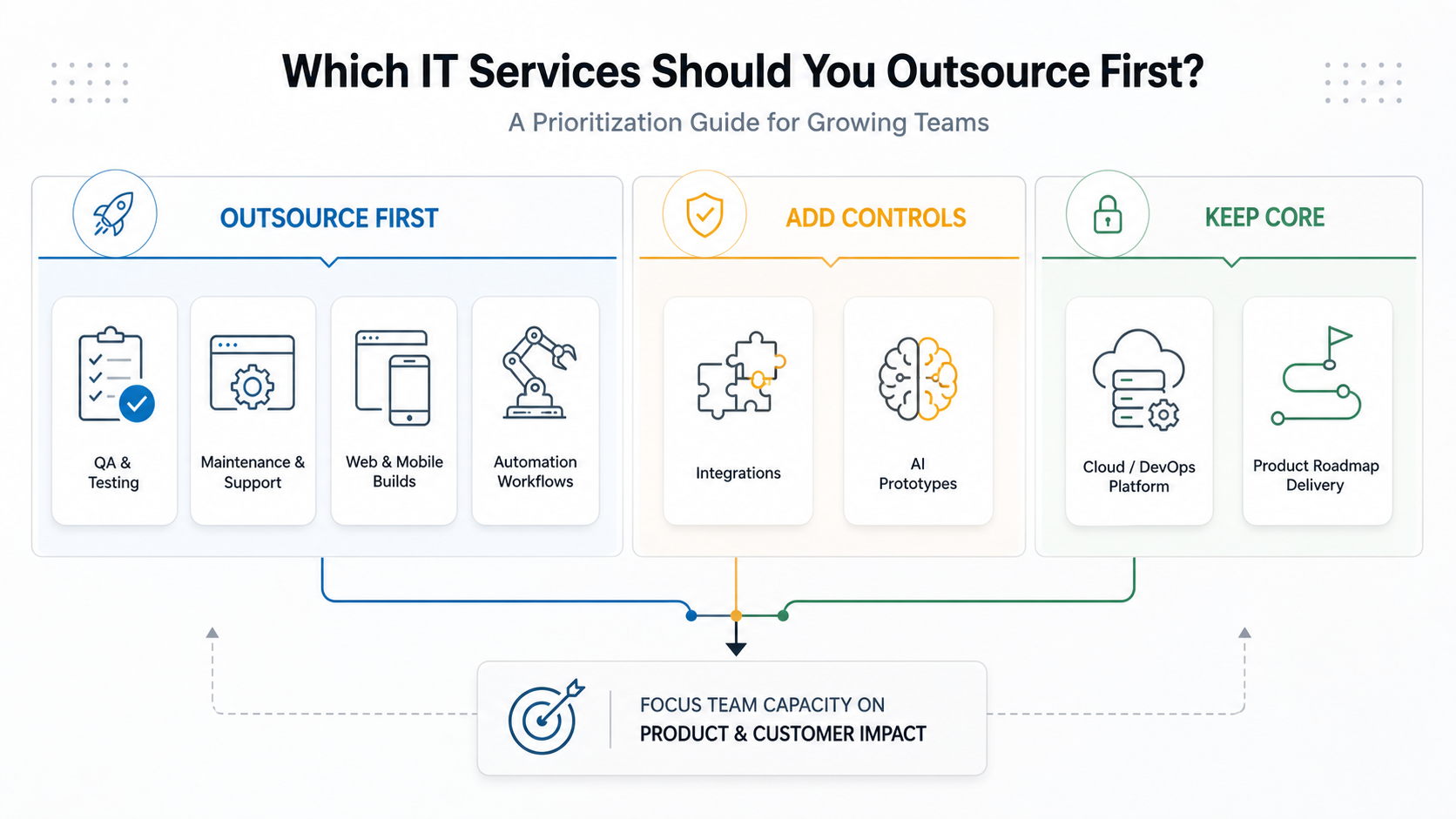
Growing teams should outsource IT services that are important, repeatable, measurable, and bounded enough for an outside partner to deliver without taking over product control. In 2026, the safest first candidates are maintenance, support queues, QA regression coverage, web app improvements, mobile app feature delivery, API integrations, reporting dashboards, automation workflows, and focused AI or data prototypes. Keep product strategy, customer discovery, core architecture decisions, security policy, data ownership, and final release acceptance inside the business. If you need a delivery partner across several of these lanes, start with a scoped IT outsourcing services plan instead of buying generic developer hours.
The decision is not whether a service can be outsourced. Almost every IT service can be outsourced in some form. The better question is whether the work has enough definition, access boundaries, review capacity, and business ownership to be outsourced now. If you are comparing delivery models, NextPage's guide to software development outsourcing in India explains cost and engagement models, while this guide helps decide which service area should come first.
Use A Score Before You Pick A Vendor
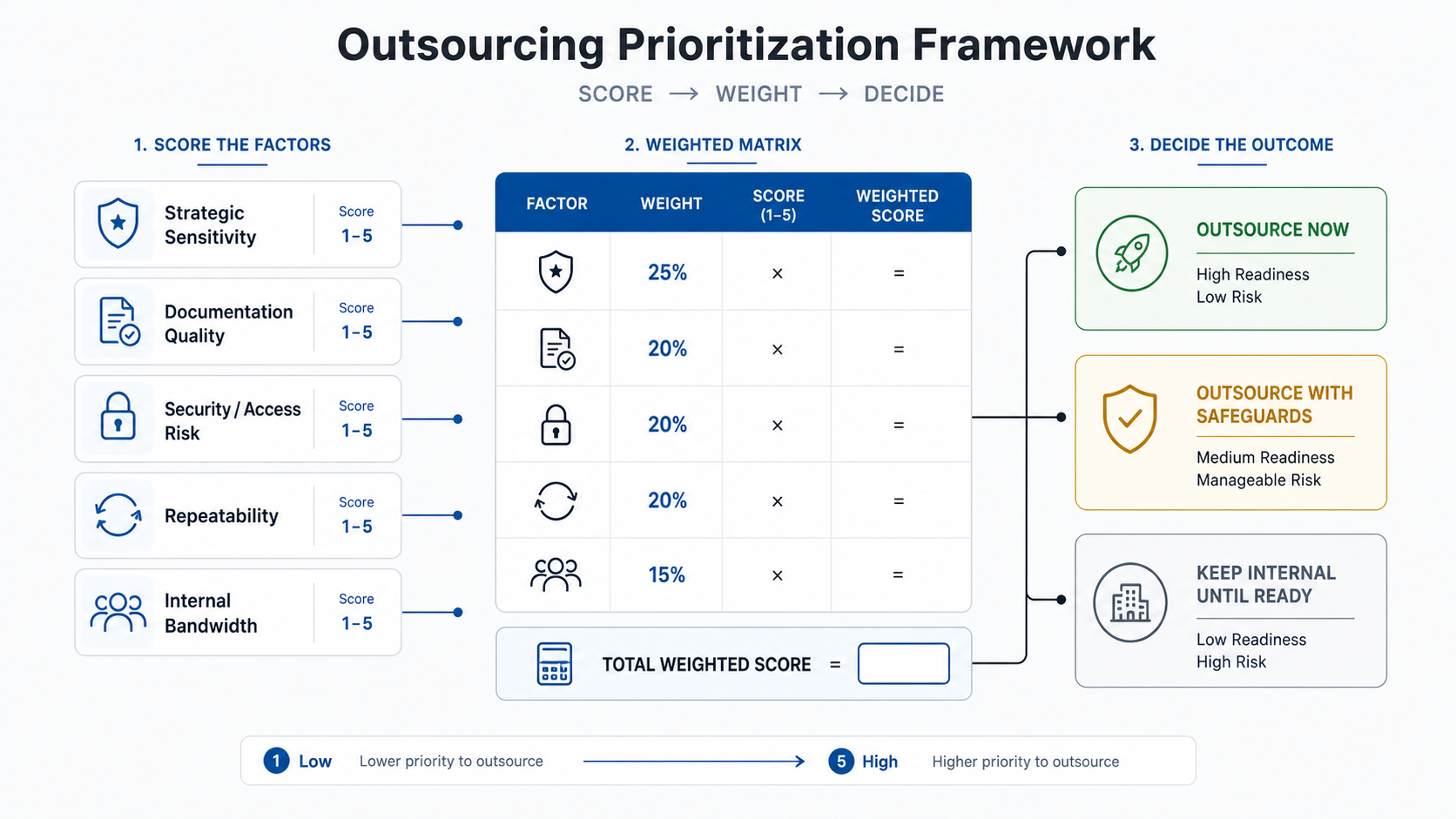
Before asking for proposals, score each service area against five criteria. A high outsource-readiness score means the work can move outside the company with clear acceptance criteria. A low score means you either need more internal preparation or a tighter governance model.
| Criterion | Outsource-ready signal | Delay or control signal |
|---|---|---|
| Strategic sensitivity | The work supports the roadmap but does not define the company's product strategy. | The work decides positioning, pricing, customer promise, data moat, or core architecture. |
| Documentation quality | Requirements, flows, acceptance criteria, environments, and owners are clear. | Knowledge lives in one person's head or changes every meeting. |
| Security and access risk | Least-privilege access, test data, repo rules, and review workflows are practical. | The vendor needs broad production, customer, payment, or regulated-data access on day one. |
| Repeatability | The work follows a known cadence, checklist, sprint flow, or support queue. | The work is mostly ambiguous discovery or high-stakes one-off judgment. |
| Internal bandwidth | Your team can review outputs, answer questions, and make decisions quickly. | No internal owner exists to unblock the partner or accept completed work. |
If a service scores high on repeatability and documentation but low on strategic sensitivity, it is a strong first outsourcing candidate. If it scores high on sensitivity or access risk, keep internal ownership and outsource only bounded execution tasks.
Services To Outsource First
Maintenance and support are often the cleanest first step. Bug fixes, dependency updates, monitoring checks, small enhancements, CMS updates, and support queues can be documented, prioritized, and reviewed without handing over product strategy. This work also creates a useful operating rhythm with the partner before larger projects begin.
QA and regression testing are another strong candidate because pass or fail criteria can be made explicit. A partner can build test cases, run cross-browser and mobile checks, verify release candidates, and report defects before each launch. For teams that ship frequently, outsourced QA can protect internal developers from becoming the only release safety net. Use a regression testing checklist, a clear defect severity model, and a scoped software QA testing services lane before moving QA outside the core team.
Functional testing for web and mobile flows is a good early package when the product already has stable user journeys. A partner can validate login, account management, checkout, booking, notifications, permissions, admin workflows, and edge-case forms. NextPage's functional testing checklist for web and mobile app launches is useful when you need a release-ready test scope instead of a vague QA request.
Web app and internal tool improvements are good early candidates when the backlog is stable. Dashboard changes, admin workflows, reporting views, approval flows, and integrations can move quickly with clear user stories. If the first package is a customer portal, SaaS workflow, or back-office tool, compare the outsourcing scope with a dedicated web app development plan. If you need a budget frame before choosing scope, the custom software cost estimator can help turn features and complexity into a first planning range.
Mobile app feature delivery can also be outsourced when the app has an existing product owner, design system, analytics, release process, and device testing checklist. Outsourcing works especially well for defined modules such as onboarding improvements, payment flows, notifications, account management, or performance fixes. For broader planning, see NextPage's mobile app development service path.
Services To Outsource With Controls
Some services are valuable to outsource, but only after you define boundaries. Cloud and DevOps support can reduce operational pressure, but production access must be least-privilege, logged, and reviewed. Start with infrastructure documentation, CI/CD cleanup, backup checks, observability, cost monitoring, and staging environments before handing over critical production changes. When cloud migration or release infrastructure is part of the scope, connect the work to a defined cloud foundation and DevOps plan.
API integrations and data pipelines need careful ownership because they touch business processes. A partner can build connectors, retry logic, webhooks, dashboards, and error handling, but the internal team should own source-of-truth decisions, data retention, compliance requirements, and customer-facing commitments.
Business process automation is a good controlled outsourcing area. The partner can map workflows, remove manual handoffs, connect tools, and build internal apps. The business must still own approvals, exception rules, audit needs, and what should not be automated. Automation without process ownership often creates a faster version of a bad workflow. For repeated operational work, compare the expected savings with an AI automation ROI calculator and validate the candidate workflow against the Workflow Automation Opportunity Finder before turning a prototype into a platform.
AI prototypes and AI-enabled features can move quickly with an outside team, but they need guardrails around data access, evaluation, human review, privacy, model changes, and failure handling. Outsource prototypes, workflow automation, retrieval experiments, and dashboards before outsourcing a core AI decision system that affects customers without oversight. For repeatable operational workflows, a focused AI automation services engagement is safer than a broad AI transformation contract with unclear success metrics.
What To Keep In-House For Now
Keep product vision, customer insight, pricing logic, roadmap tradeoffs, brand voice, and business-model decisions internal. A partner can challenge assumptions and build prototypes, but the company should decide what problem matters and why it is worth solving.
Also keep final ownership of architecture direction, security policy, vendor access, data governance, and production acceptance. These decisions can involve outside specialists, but accountability should stay with the business. The goal is not to block outsourcing; it is to make sure the company never loses the ability to understand, change, or audit its own software.
This is the same practical concern behind NextPage's guide on mitigating loss of control in IT outsourcing. Loss of control usually starts when the buyer outsources decisions without creating reporting, code review, documentation, and access boundaries.
A Practical Priority Order For Growing Teams
| Priority | Service area | Why it belongs there | Control to add |
|---|---|---|---|
| 1 | Maintenance, support, and small improvements | Low ambiguity, visible outcomes, useful partner onboarding. | Issue triage, branch rules, review owner, release notes. |
| 2 | QA, regression, and release checks | Measurable, repeatable, and immediately reduces launch risk. | Test plan, device matrix, defect severity rules, sign-off process. |
| 3 | Web app, mobile app, and admin modules | Clear user stories can become sprint-ready delivery work. | Product owner, acceptance criteria, analytics, demo cadence. |
| 4 | Integrations, dashboards, and automation | High leverage but touches workflows and data ownership. | Data map, rollback plan, audit logs, exception handling. |
| 5 | AI prototypes, cloud/DevOps, and architecture-heavy work | Can create leverage, but risk increases with access and ambiguity. | Security model, evaluation plan, technical owner, staged rollout. |
This order is a starting point. A SaaS company with overloaded engineers may outsource regression testing first. A retailer with disconnected systems may start with integrations. A founder with a clear prototype may start with a managed product pod. If the scope is still being validated, use an MVP development company model to keep release one narrow before expanding the outsourced team. The right answer depends on the work that is both painful and ready.
Choose The Outsourcing Starting Point By Team Stage
The same service can be a good or bad first outsourcing candidate depending on the maturity of the buyer. A five-person startup, a scaling SaaS team, and an established operations team have different bottlenecks. Use team stage to decide how much ownership the partner should carry and how much must remain internal.
| Team stage | Best first outsourcing package | Why it works | What to avoid |
|---|---|---|---|
| Founder-led MVP team | Prototype build support, UI implementation, API integration, or QA before demo release. | The founder can keep product decisions internal while borrowing focused delivery capacity. | Outsourcing the entire roadmap without a product owner, backlog, or acceptance criteria. |
| Small product team | Maintenance, regression testing, admin modules, reporting, and mobile/web feature slices. | The internal team can review work while the partner clears execution bottlenecks. | Giving the vendor broad architecture authority before trust and review cadence are proven. |
| Scaling SaaS or marketplace | Dedicated developers, QA pod, integration pod, DevOps cleanup, or automation pilot. | The company usually has enough process for a partner to plug into a repeatable delivery rhythm. | Expanding roles faster than onboarding, documentation, security, and review capacity. |
| Enterprise or regulated team | Controlled QA, migration support, internal tools, data cleanup, and workflow automation. | Bounded scopes can reduce backlog without weakening compliance and architecture ownership. | Giving production, payment, customer, or regulated-data access before controls are approved. |
This stage-based view prevents overbuying. A small team does not need a large outsourced department before it has a release process. A mature team may waste time with freelancers when it really needs a managed pod, QA ownership, or a dedicated India team with documented sprint rituals. The right starting point should reduce the bottleneck that is currently blocking product progress.
First 90 Days Outsourcing Governance Plan
The first engagement should prove that the operating model works before the scope expands. Treat the first 90 days as a controlled pilot with clear owners, access rules, reporting, and exit criteria.
| Period | Focus | Evidence To Collect | Expansion Decision |
|---|---|---|---|
| Days 1-30 | Onboard the partner, document systems, limit access, and deliver a narrow first backlog. | Setup time, blocker frequency, review quality, communication latency, defect leakage. | Continue only if the team can ship small work without creating internal chaos. |
| Days 31-60 | Increase scope to a second workflow such as QA plus maintenance or one app module. | Velocity trend, rework rate, acceptance criteria quality, support load, sprint predictability. | Add capacity only if quality is stable and internal owners are not overloaded. |
| Days 61-90 | Formalize delivery cadence, dashboards, security reviews, and escalation paths. | Release reliability, documentation completeness, access audit, cost versus output. | Expand into integrations, automation, or a managed pod only with governance evidence. |
If the work requires multiple roles, compare staff augmentation with a managed delivery pod. A dedicated India team cost calculator can model whether you need only developers or a blended setup with QA, PM, and senior technical review. For teams with internal leadership but limited capacity, hire dedicated developers in India can be the right path; for teams that need outcome ownership, a managed software outsourcing model is usually safer.
2026 Outsourcing Decisions: What Has Changed?
Outsourcing decisions in 2026 are less about finding the cheapest external team and more about choosing which work can benefit from specialist capacity without weakening control. Current 2026 outsourcing guidance consistently emphasizes AI-assisted delivery, cybersecurity review, measurable outcomes, specialist capacity, managed cloud and security services, and hybrid internal-external teams. That makes the first service choice more important: outsource a bounded workflow where better tooling, repeatable process, and clear acceptance criteria can improve speed without handing over strategic ownership.
| 2026 pressure | What it means for the first outsourced service | Practical response |
|---|---|---|
| AI-assisted delivery | Partners may work faster, but outputs still need review, evaluation, and data boundaries. | Start with prototypes, workflow copilots, or reporting assistants before core customer decisions. |
| Cybersecurity and access risk | Vendor access, secrets, production data, and regulated workflows need explicit controls. | Use least-privilege access, audit logs, staging environments, and named approval owners. |
| Outcome-based buying | Buyers increasingly want measurable progress, not just more hours. | Define sprint outcomes, release gates, defect targets, and handoff evidence before comparing rates. |
| Specialist capacity gaps | Teams outsource QA automation, DevOps, AI, data, and mobile skills they cannot hire quickly. | Package one specialist workstream first, then expand only when quality and communication hold. |
This is why the scorecard matters. A service that looks attractive because it is urgent may still be a poor first outsourcing candidate if access risk is high, acceptance criteria are unclear, or the internal team cannot review decisions quickly.
Outsourcing Readiness Red Flags
Do not treat every backlog problem as an outsourcing problem. If the internal team cannot explain the expected outcome, an outside team will usually amplify the confusion. Resolve the highest-risk readiness gaps before expanding the contract.
- No single owner: nobody can answer product questions, approve tradeoffs, or accept completed work.
- Unclear access model: the vendor needs production, customer, payment, or regulated-data access before least-privilege rules exist.
- Hidden architecture decisions: a few internal engineers know the system, but the information is not documented or reviewable.
- Undefined quality bar: acceptance criteria, test evidence, performance targets, and support expectations are missing.
- Procurement before scope: the team is comparing hourly rates before defining what the first outcome should be.
- No offboarding path: there is no plan for code ownership, documentation, credentials, handover, or continuity if the vendor changes.
These red flags do not mean outsourcing is impossible. They mean the first engagement should include discovery, documentation, governance, or audit work before full delivery. A good outsourcing partner will call this out because it protects both sides from a contract that looks cheap but becomes expensive through rework and coordination debt.
How To Package The First Outsourced Engagement
Do not begin with a vague request such as "we need developers." Package the first engagement as a narrow outcome. For example: stabilize the release process, clear a maintenance backlog, build one integration, redesign one admin workflow, or deliver one mobile feature set.
A good first package includes the business goal, users affected, current system context, acceptance criteria, environments, access rules, known risks, reporting cadence, and a named internal owner. For build-heavy projects, compare scope against custom software development cost drivers. Outsourcing does not remove cost drivers such as integrations, user roles, security, data migration, or admin tooling. It changes who supplies the capacity and how delivery is governed.
Vendor Questions To Ask Before You Start
- Which parts of this work would you outsource first, and which would you keep internal for now?
- Who owns backlog refinement, technical decisions, QA signoff, deployment, and support after launch?
- What access do you need in week one, and what can wait until trust is proven?
- How will you report progress, blockers, defects, risks, and scope changes?
- How do you handle code review, documentation, handoff, and replacement if a role changes?
- What would make this project unsuitable for outsourcing in its current form?
A serious partner will not push every service into the first contract. They should be able to recommend sequencing, name risks, and explain the operating model. If you need a partner that combines India-based capacity with senior delivery ownership, review NextPage's software outsourcing in India service page.
How NextPage Helps Teams Prioritize Outsourcing
NextPage helps teams choose the right outsourcing starting point before adding headcount. We map the backlog, score service areas, identify access risks, define acceptance criteria, and recommend whether the first engagement should be maintenance, QA, web or mobile delivery, integrations, automation, AI prototyping, dedicated developers, or a managed product pod.
The practical goal is simple: outsource the work that can create momentum without weakening control. Once the first service area proves communication, quality, and cadence, the team can expand into more complex work with better evidence and fewer surprises.