
Quick Answer: Freelance Platform In A Salon App
A freelance platform inside a salon app lets independent stylists, makeup artists, nail technicians, barbers, and beauty professionals publish profiles, manage availability, accept bookings, receive payments, collect reviews, and grow their client base through one controlled marketplace. For salon brands, it can expand service coverage without hiring every provider as full-time staff.
The platform works only when supply quality, booking rules, trust controls, payments, and admin oversight are designed together. Treat it as a service marketplace, not just a directory. The same planning discipline used in mobile app development applies here: define the roles, permissions, service taxonomy, payment model, and support workflow before polishing the screens.
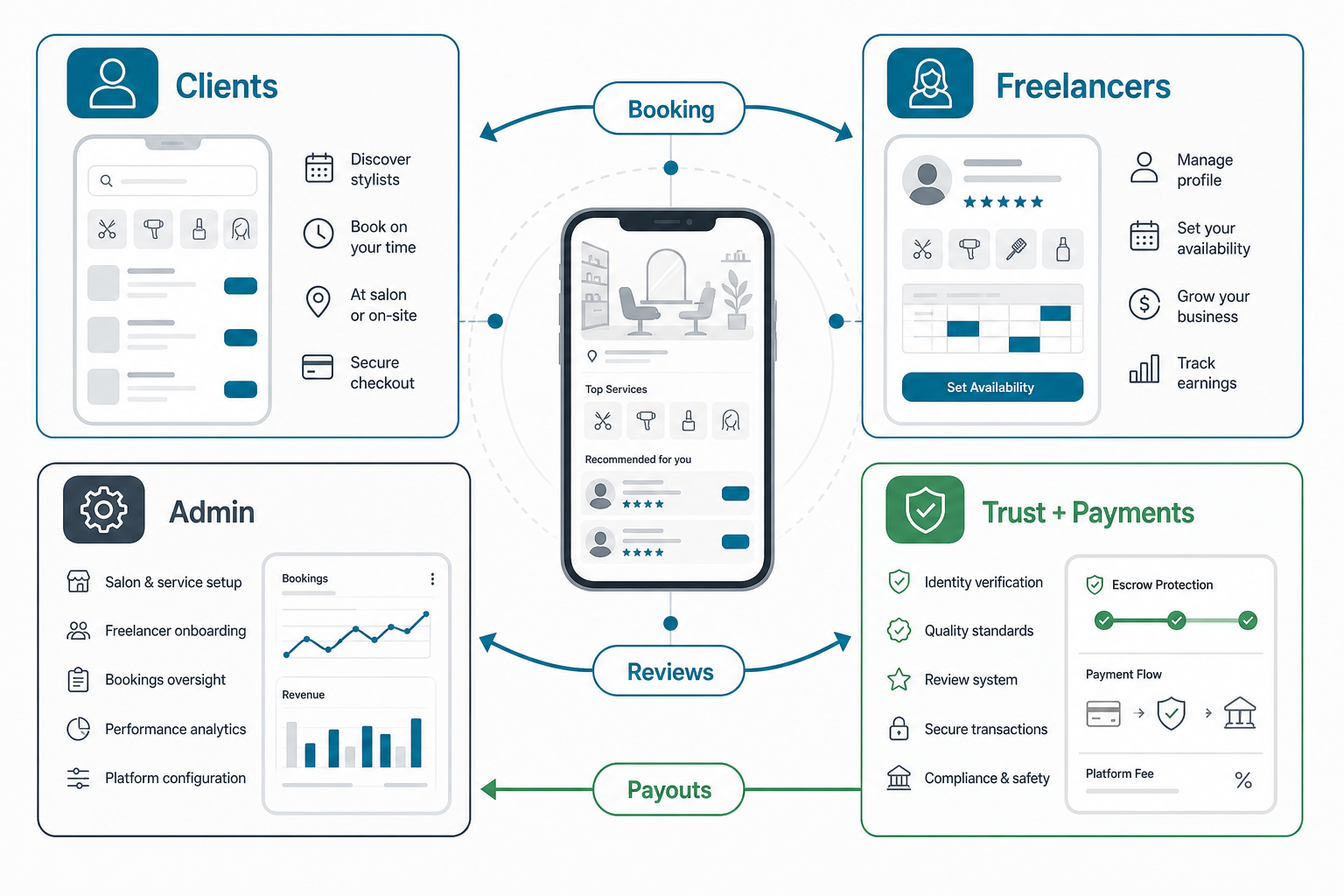
Why Salon Apps Add Freelance Marketplaces
Beauty demand is increasingly flexible. Clients want home visits, event styling, bridal packages, after-hours appointments, specialist services, and provider choice. Freelance stylists want visibility, predictable bookings, fair payouts, and tools that help them operate professionally without running a full salon.
A salon app can connect both sides if it keeps the marketplace controlled. The app should help clients discover verified professionals, compare services, book confidently, pay securely, and leave feedback. It should help freelancers manage their profile, portfolio, service menu, travel radius, schedule, cancellations, earnings, and client communication.
If you are still shaping the broader beauty product, review the supporting guide to beauty app features. A freelancer layer should extend the core service, booking, payment, review, and loyalty systems instead of becoming a separate workflow.
Choose The Right Marketplace Model
Before building, decide what kind of freelance platform the salon app will support. The model affects onboarding, payments, customer support, insurance expectations, cancellation rules, pricing controls, and compliance obligations.
| Model | How It Works | Best Fit |
|---|---|---|
| Salon-managed freelance network | The salon approves providers, controls service categories, and routes bookings through its brand. | Salon chains, premium beauty brands, and curated marketplaces. |
| Open beauty marketplace | Freelancers create listings and the platform focuses on discovery, booking, reviews, and payments. | Regional beauty service marketplaces and home-service platforms. |
| Hybrid staff plus freelancers | Clients can book in-house staff or approved freelancers depending on location, time, and service. | Salons expanding capacity without opening new branches. |
| Event and package marketplace | Freelancers collaborate on bridal, fashion, photography, wellness, or corporate event packages. | High-value bookings where multiple providers may work together. |
Marketplace complexity grows quickly once you add provider pricing, platform commissions, payouts, refunds, disputes, and support workflows. NextPage's guide to marketplace app development cost is useful when estimating how buyer, seller, admin, payment, and trust features change the build scope.
Freelancer Onboarding, Trust, And Quality Controls
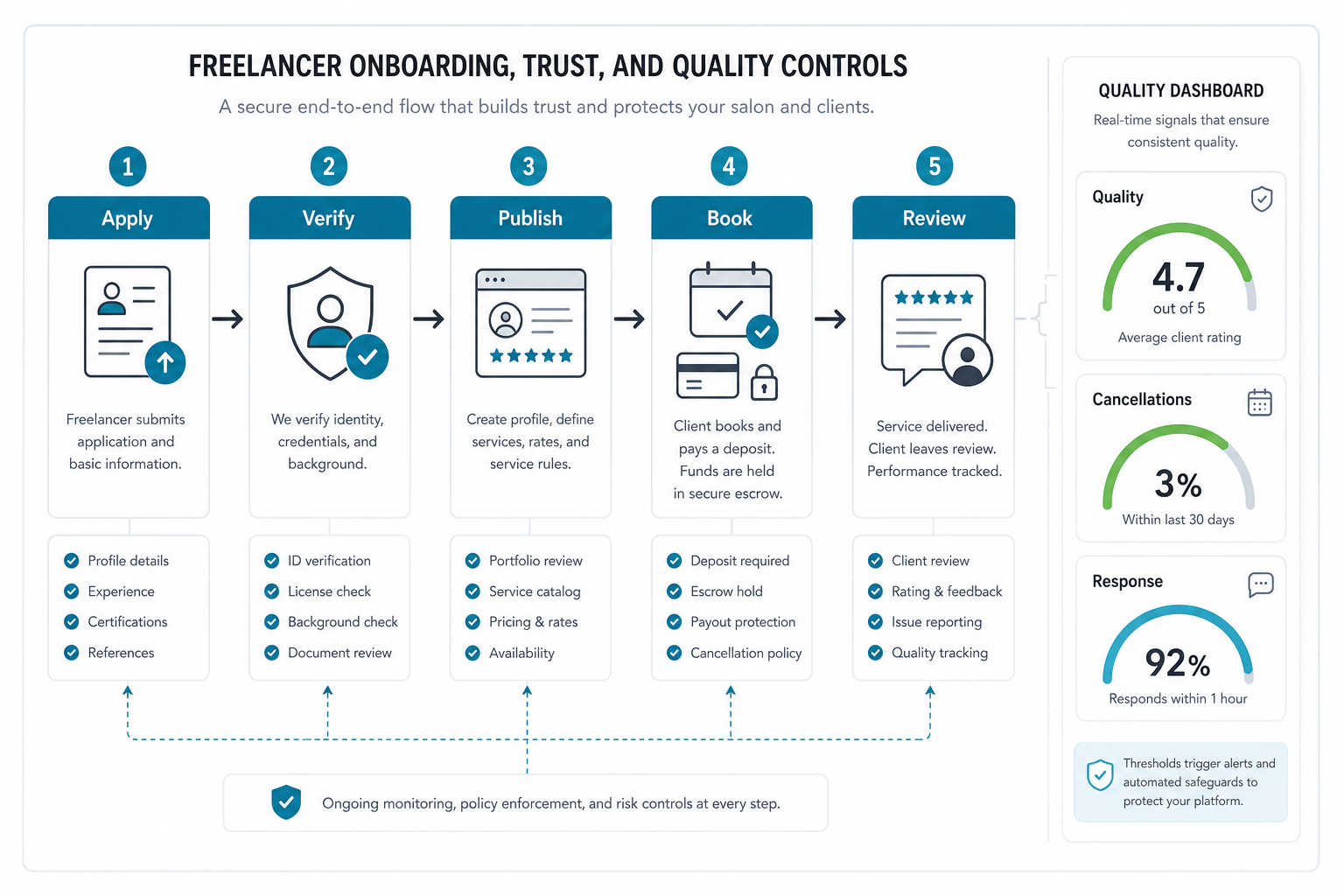
Trust is the biggest difference between a useful salon freelancer platform and a risky listing board. Build an onboarding workflow that collects identity details, credentials, portfolio samples, service specialties, experience, certifications, travel radius, pricing preferences, availability, cancellation expectations, and agreement acceptance.
Verification does not need to be heavy for every service, but the app should make quality controls visible. Use profile badges, approval statuses, portfolio review, rating thresholds, complaint tracking, cancellation monitoring, and admin flags. Clients need enough information to book confidently; operators need enough control to remove poor-fit supply before it damages the marketplace.
Profiles, Portfolios, And Service Catalogs
A freelancer profile should answer the client's decision questions quickly: who the provider is, what services they offer, where they work, what they charge, when they are available, what past work looks like, what reviews say, and what policies apply. Strong profiles should include service categories, skill tags, before-and-after media, package options, add-ons, languages, travel fees, preparation notes, and cancellation rules.
Keep the service catalog structured. If each freelancer writes free-form service names, filtering and pricing become messy. Use platform-level categories such as haircut, color, makeup, nails, spa, bridal, grooming, and treatment, then allow controlled provider-specific descriptions, durations, prices, and add-ons.
Booking, Scheduling, And Location Rules
Freelance scheduling has more constraints than standard salon booking. The app may need provider availability, travel buffers, service duration, location eligibility, preparation time, cancellation windows, deposit requirements, client address handling, salon-chair booking, and multi-provider event coordination.
For appointment-led marketplaces, the Schedulink appointment marketplace case study is a useful analogue because it connects customer booking, provider availability, dashboards, and admin oversight. A salon freelancer product needs the same operational clarity, adapted for beauty services and local provider supply.
Secure Payments, Payouts, And Platform Fees
Payments should protect clients, freelancers, and the salon brand. Common options include deposits, full prepayment, cancellation fees, refund rules, tips, split payments, package payments, commission deductions, and scheduled payouts. The app should show fees clearly before checkout and keep a clean transaction record for support.
Do not treat payouts as an afterthought. Freelancers need visibility into completed bookings, pending balances, platform fees, refunds, chargebacks, and payout timing. Admin teams need controls for disputes, manual adjustments, tax records, and suspicious activity. These workflows often determine whether freelancers continue using the platform.
Marketing, Loyalty, And Community Loops
Freelancers need demand, not just profile pages. The app can support featured listings, targeted offers, referral codes, seasonal packages, portfolio highlights, push campaigns, client rebooking prompts, and content-led discovery. Give providers practical tools without letting the marketplace become noisy or discount-driven.
Loyalty can connect salon clients and freelancer supply when rules are clear. For example, rewards can apply to repeat bookings, package purchases, referrals, reviews, or membership tiers. The related guide to salon app loyalty programs can help structure rewards without weakening marketplace economics.
Admin Controls, Analytics, And Support
Operators need a dashboard that shows freelancer applications, profile approvals, active bookings, cancellations, disputes, payment status, platform revenue, provider earnings, ratings, repeat bookings, response times, and service demand by area. Admin controls should include category setup, commission settings, offer approval, review moderation, refund handling, complaint workflows, and provider suspension.
When these rules are specific to your business model, custom software development can be a better path than forcing marketplace logic into a generic booking plugin. The right architecture keeps client, provider, and admin states aligned instead of spreading them across disconnected tools.
Launch Roadmap For A Salon Freelance Platform
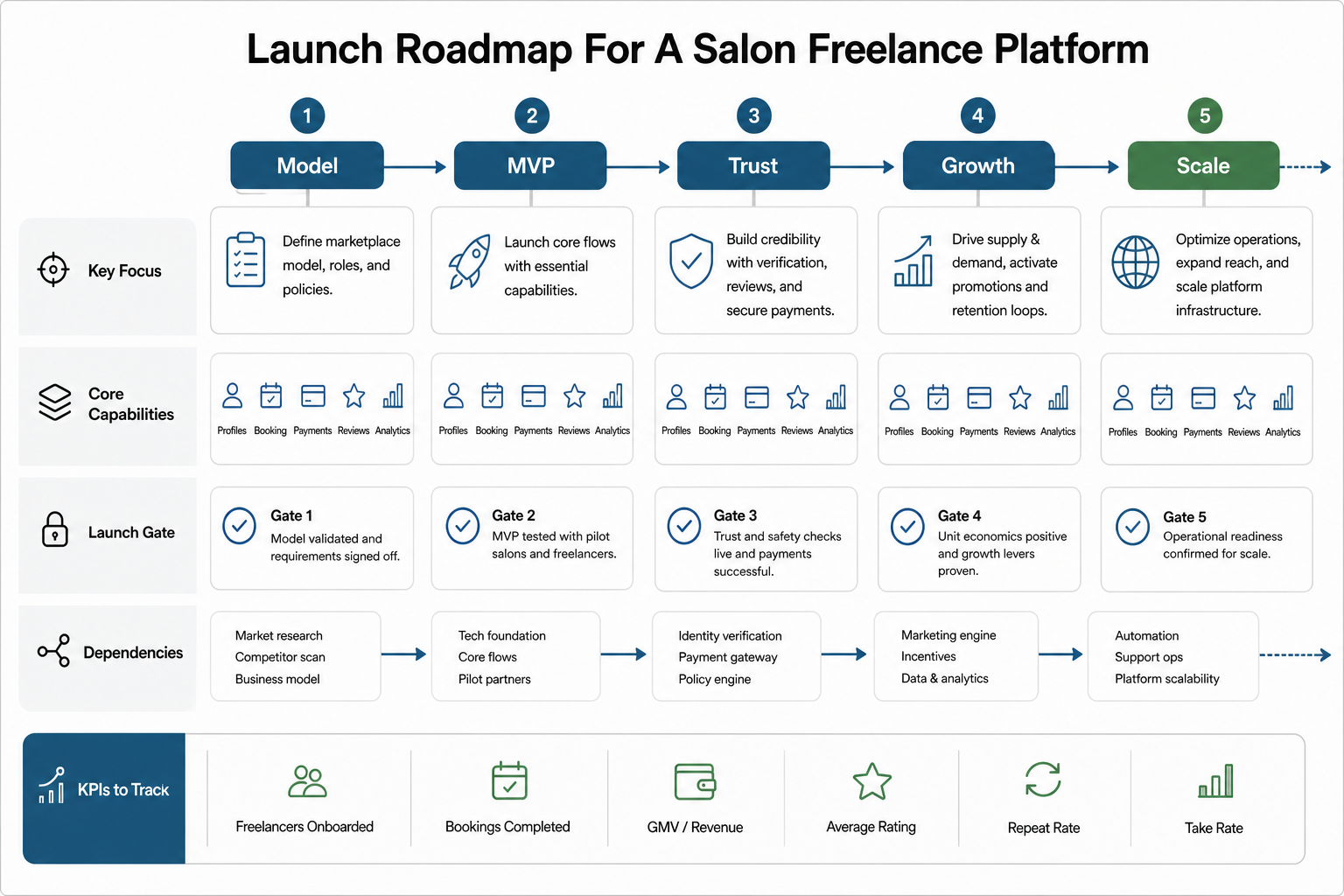
- Model: define provider types, service categories, pricing control, commission rules, geography, salon involvement, and support obligations.
- MVP: launch freelancer profiles, service catalog, availability, booking, client messaging, deposits, admin approval, and basic reviews.
- Trust: add verification, portfolio review, dispute handling, payout controls, cancellation rules, and quality thresholds.
- Growth: add promotions, loyalty, referrals, featured providers, packages, rebooking prompts, and campaign analytics.
- Scale: add multi-location rules, automation, fraud monitoring, advanced reporting, provider education, and infrastructure improvements.
If the first release scope is unclear, the Custom Software Cost Estimator can help frame budget and timeline assumptions for marketplace roles, booking flows, payment rules, admin dashboards, and analytics.
Metrics That Show The Platform Is Working
Track both marketplace health and beauty-service quality. Useful metrics include approved freelancers, active freelancers, profile completion rate, booking conversion, repeat booking rate, cancellation rate, no-show rate, average rating, response time, dispute rate, refund rate, gross booking value, platform take rate, payout cycle time, customer acquisition cost, and provider retention.
Watch for imbalance. Too many clients and too few available freelancers creates poor booking experiences. Too many freelancers and not enough demand lowers provider trust. The platform should expose these signals early so operators can adjust onboarding, promotions, pricing, or location coverage.
Common Mistakes To Avoid
- Launching as a directory: profiles without booking, payments, reviews, and support do not create a real marketplace.
- Ignoring provider economics: freelancers need clear fees, predictable payouts, and enough demand to justify participation.
- Weak verification: beauty services rely on trust, hygiene, skill, and personal safety. Quality controls should be visible and enforceable.
- Overbuilding too early: start with one strong service category or location before expanding into every beauty vertical.
- Separating admin from marketplace state: support teams need direct visibility into bookings, payments, messages, reviews, and provider history.
Final Recommendation
Build the freelance layer as a controlled service marketplace inside the salon app. Start with verified freelancer profiles, structured services, reliable booking, secure payments, reviews, and admin oversight. Then add loyalty, promotions, community features, analytics, and automation once the marketplace has stable supply and repeat demand.
The winning product is not the one with the most profile fields. It is the one that helps clients book trusted beauty professionals, helps freelancers earn reliably, and gives operators enough control to protect service quality as the platform grows.