
Quick Answer: What Should A Transportation App Include?
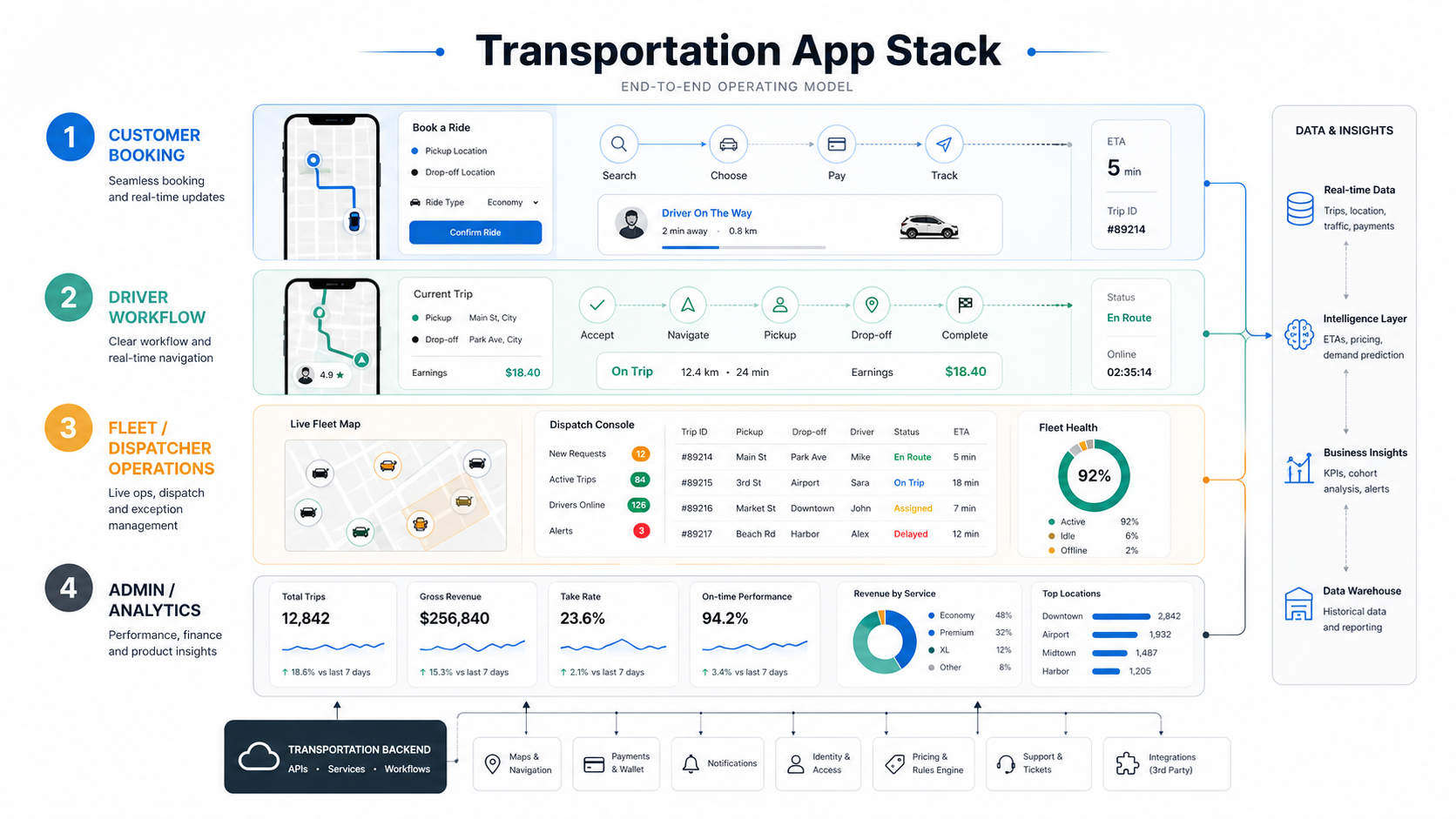
A strong transportation app should connect customers, drivers, dispatchers, fleet managers, and administrators in one operating system. The first release usually needs account setup, booking or shipment creation, route planning, real-time GPS tracking, fare or freight estimates, payments, notifications, support, driver workflows, dispatcher controls, admin reporting, and security controls.
The right scope depends on the business model. A taxi app, freight marketplace, fleet management app, courier platform, school transport system, and enterprise dispatch product all share tracking and workflow patterns, but they do not need the same MVP. Start with the jobs users repeat every day, then add automation after the operating model is clear.
Define The Transportation App Product Model First
Before listing features, decide what kind of transportation product you are building. A consumer ride-booking app optimizes for fast pickup, trust, pricing, and driver availability. A freight or logistics app optimizes for shipment data, documents, load status, route exceptions, billing, and operational visibility. A fleet app focuses on vehicles, drivers, inspections, maintenance, utilization, fuel, and compliance.
This decision changes the architecture, user roles, compliance burden, and cost. If the product includes mobile apps, web operations, integrations, and custom workflows, it usually sits between mobile app development and custom software development. Treat it as a business platform, not only as a booking screen.
Transportation App MVP Scope
A practical MVP should prove that requests can move from customer demand to driver execution to operational review without manual coordination outside the product. Keep the first release narrow enough to launch, but complete enough to run the real workflow.
| Area | MVP Scope | Why It Matters |
|---|---|---|
| Customer app | Registration, service selection, pickup and drop details, estimate, booking, payment, tracking, notifications, support. | Customers need confidence that the service is available, priced clearly, and trackable. |
| Driver app | Profile, availability, assigned jobs, route view, status updates, proof of pickup or delivery, earnings, support. | Drivers need a simple workflow that does not slow down field execution. |
| Dispatcher portal | Live jobs, vehicle and driver assignment, route exceptions, cancellation handling, customer updates, manual override. | Operations teams need control when automation cannot resolve a real-world exception. |
| Admin console | Users, vehicles, pricing rules, documents, service zones, payments, analytics, roles, audit logs. | The business needs governance, visibility, and configuration after launch. |
For teams comparing delivery-style workflows, the guide on building a Domino's-style delivery app is useful because it shows how ordering, tracking, payments, and operations need to work together.
Role-Based Feature Roadmap
Customer App Features
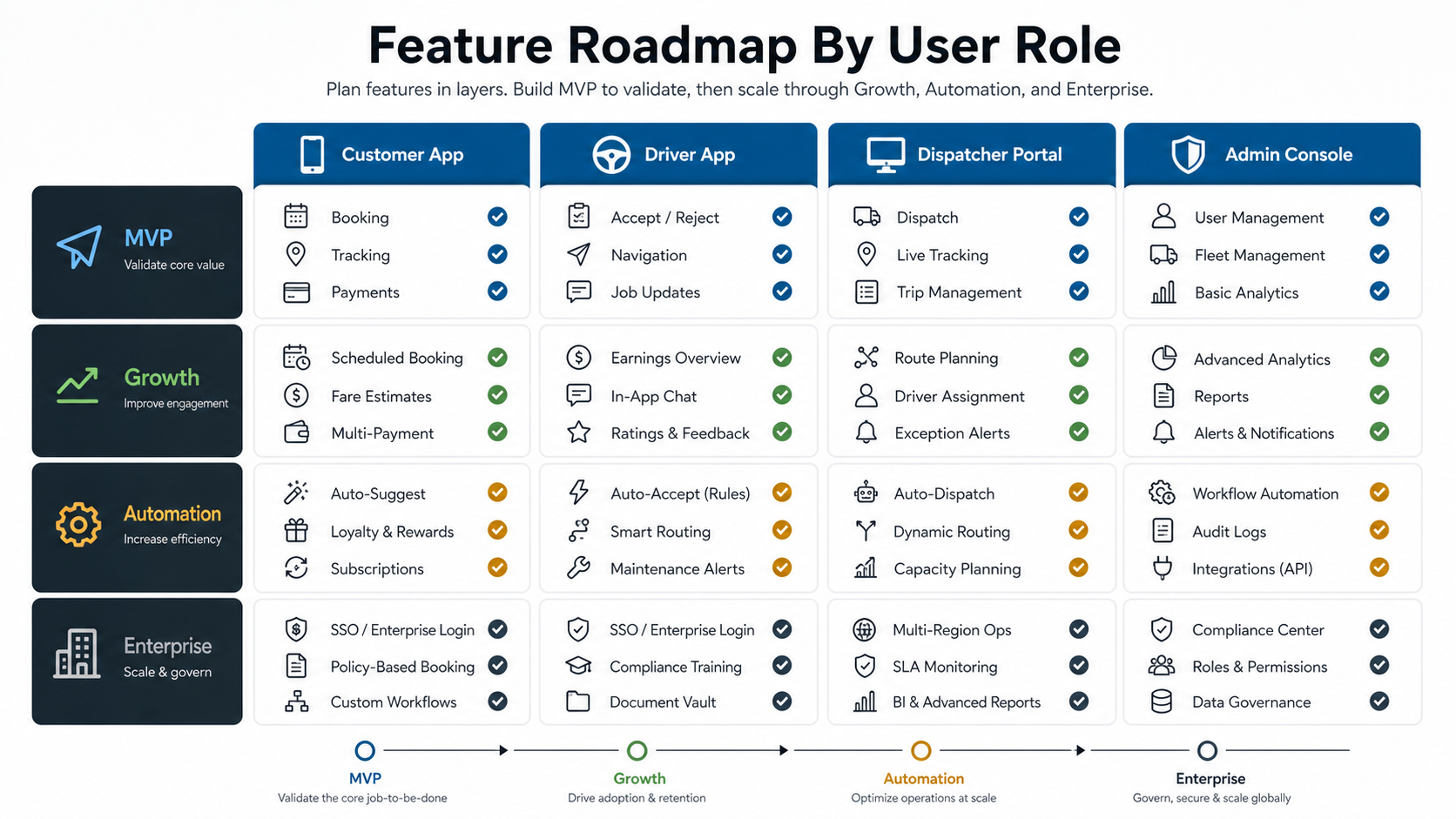
The customer app should reduce uncertainty. Core features include fast signup, saved addresses, service or vehicle selection, fare or delivery estimate, booking schedule, secure payment, live tracking, arrival updates, in-app support, ratings, refunds, and loyalty options. For B2B transportation, add shipment references, document uploads, billing contacts, recurring routes, and account-level approvals.
Driver App Features
The driver app should protect field productivity. Include onboarding, availability status, request acceptance, navigation, pickup and drop instructions, call or chat masking, status updates, proof capture, incident reporting, earnings, payout history, and support. If the workflow includes freight or fleet operations, add inspections, fuel logs, vehicle condition, route notes, and compliance documents.
Dispatcher And Operations Features
Dispatchers need a live operating view rather than a passive dashboard. Useful features include job queues, map view, driver and vehicle assignment, route progress, SLA alerts, delay handling, cancellation control, manual reassignment, customer messaging, exception notes, and shift visibility. This is where many transportation apps become operationally valuable.
Admin Console Features
The admin console should manage the business rules behind the app: users, roles, vehicles, service areas, pricing, commissions, taxes, documents, payment settings, promo codes, support queues, reports, and audit history. When the platform handles multiple branches, vendors, or clients, tenant-aware permissions become essential.
Transportation App Architecture
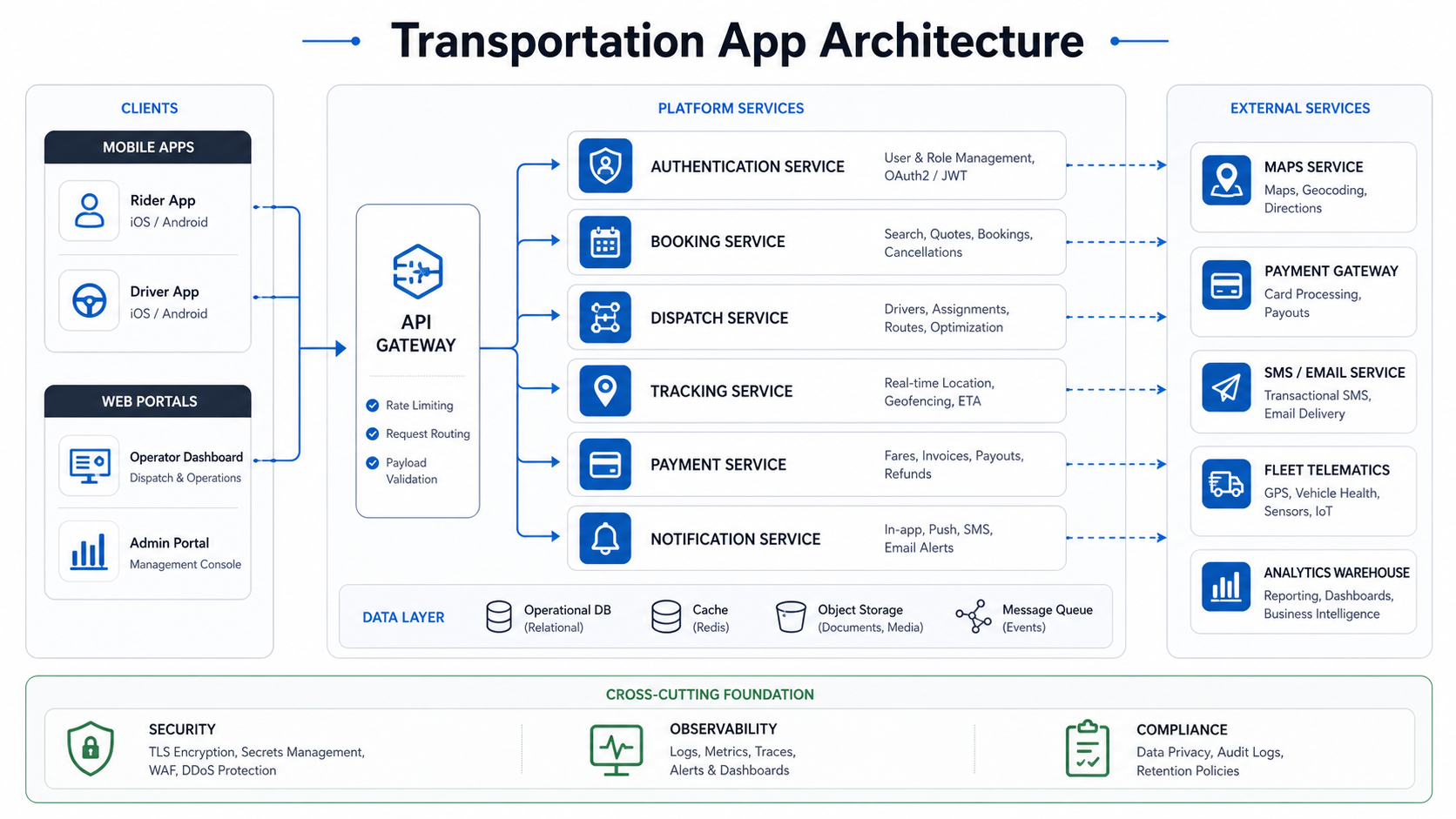
The architecture usually starts with mobile apps and web portals connected to an API layer. Behind that, split the platform into clear domains: authentication, booking, dispatch, route tracking, pricing, payments, notifications, support, analytics, and admin configuration. External integrations often include maps, geocoding, payment gateways, SMS or email, fleet telematics, accounting, CRM, and analytics tools.
Real-time tracking deserves special attention. Location data can be noisy, delayed, or battery-intensive. Use sensible update intervals, background location rules, retry handling, map matching where needed, and clear privacy controls. For taxi-style products, the post on GPS integration for taxi booking apps gives more context on tracking expectations.
Transportation App Development Cost Drivers
The cost of transportation app development is driven by workflow depth, not only by the number of screens. A simple booking MVP costs far less than a multi-role platform with live tracking, dispatch automation, fleet integrations, payments, analytics, and compliance workflows.
| Cost Driver | Lower Complexity | Higher Complexity |
|---|---|---|
| Business model | Single city, one service type, direct bookings. | Multi-city, multiple vehicle types, marketplace or enterprise accounts. |
| Tracking | Basic driver location and ETA. | Live telemetry, route replay, geofencing, exceptions, and historical analytics. |
| Payments | Standard card or wallet checkout. | Split payouts, invoices, wallet balances, refunds, taxes, and reconciliation. |
| Operations | Manual assignment and simple admin tools. | Dispatch optimization, SLA alerts, driver scoring, and role-based workflows. |
| Integrations | Maps, payment gateway, SMS/email. | Telematics, ERP, accounting, CRM, data warehouse, compliance systems. |
If you need an early range before committing to detailed discovery, the Custom Software Cost Estimator can help frame the likely scope and investment level.
Step-By-Step Development Process
- Discovery: map users, workflows, service areas, pricing rules, vehicle types, operational exceptions, integrations, and success metrics.
- Product design: design customer, driver, dispatcher, and admin flows around real operational scenarios, not isolated screens.
- Architecture planning: define APIs, data model, tracking behavior, payment flows, notification paths, roles, and analytics needs.
- MVP build: develop the core app surfaces, backend, admin console, integrations, testing, and deployment pipeline.
- Operational testing: test route changes, cancellations, payment failures, location gaps, driver no-shows, support escalations, and admin overrides.
- Launch and iterate: monitor adoption, completed jobs, fulfillment time, support issues, payment reliability, and user feedback before adding advanced automation.
For technology choice, review native versus cross-platform mobile app development. Many transportation products can start cross-platform, while apps with heavy background location, device integrations, or performance constraints may need more native engineering depth.
Fleet And Logistics Patterns To Consider
Transportation apps often overlap with fleet and logistics products. If your product manages owned vehicles, inspections, maintenance, telematics, or driver compliance, study the patterns in essential fleet management app features. If the business handles freight finance, invoice review, or shipment exceptions, the FreightLens logistics revenue audit case study shows how operational records, queues, and reports can be connected.
For fleet-heavy backend architecture, the RouteLedger fleet operations API case study is relevant because it covers inspection APIs, maintenance workflows, GPS telemetry, asset data history, notifications, and deployment architecture. For field teams and facility operations with fleet visibility, OpsLink shows how mobile field execution and admin operations can share one platform model.
Security, Privacy, And Compliance
Transportation apps handle location data, personal details, payments, operational records, and sometimes regulated documents. Build privacy controls from the start: role-based access, least-privilege admin permissions, encrypted transport, secure payment handling, audit logs, data retention rules, and explicit consent for location tracking.
For driver and fleet workflows, define who can see live location, historical routes, documents, and earnings. For enterprise or logistics workflows, add client-level permissions and export controls. Security should also cover operational abuse cases such as fake bookings, payment disputes, account takeover, document fraud, and admin misuse.
Launch Metrics To Track
Useful transportation app metrics include booking conversion, successful job completion, cancellation rate, driver acceptance rate, average dispatch time, ETA accuracy, route delay rate, payment success, support tickets per job, customer repeat rate, driver retention, vehicle utilization, and revenue per active user or account.
App store performance matters after launch, too. Once the product is stable, use the principles in App Store Optimization for app listings to improve installs with clear screenshots, feature proof, and benefit-led descriptions.
Common Mistakes To Avoid
- Building only the customer app: transportation businesses also need driver, dispatcher, and admin workflows.
- Adding real-time tracking too casually: location accuracy, battery use, privacy, and retry behavior need deliberate design.
- Ignoring manual overrides: dispatchers need tools for delays, cancellations, route changes, unavailable drivers, and customer escalations.
- Underestimating integrations: maps, payments, telematics, accounting, CRM, and notifications often shape the project timeline.
- Skipping operational analytics: without metrics, the business cannot improve fulfillment, pricing, driver supply, or support quality.
How NextPage Can Help
NextPage can help plan and build transportation apps as complete operating systems: mobile apps, web portals, admin consoles, backend APIs, location tracking, payment flows, integrations, analytics, and launch support. The strongest first step is a product discovery sprint that turns the service model into user roles, workflow diagrams, MVP scope, architecture, and a realistic build plan.
If you are planning a transportation, logistics, fleet, delivery, or dispatch platform, start by defining the real operational workflow and the smallest release that can run it reliably. Once that is clear, the feature roadmap, cost range, and engineering sequence become much easier to defend.