
Quick Answer: OTA Updates And Remote Diagnostics Implementation
OTA updates and remote diagnostics work best when they are treated as an operating model, not a feature toggle. The implementation has to connect vehicle eligibility, firmware inventory, release cohorts, diagnostics signals, telemetry quality, monitoring, rollback criteria, customer communication, and support workflows before the first production campaign reaches a real fleet.
A safe roadmap starts with one question: which remote action or diagnostic insight is valuable enough to justify the release risk? Updating infotainment content, fixing a battery management issue, enabling a subscription feature, or triaging recurring fault codes all need different validation, authorization, observability, and support paths.
If the broader platform architecture is still forming, start with the connected vehicle platform architecture guide and use the MVP Scope Builder to separate the first OTA and diagnostics release from later fleet, analytics, and automation phases.
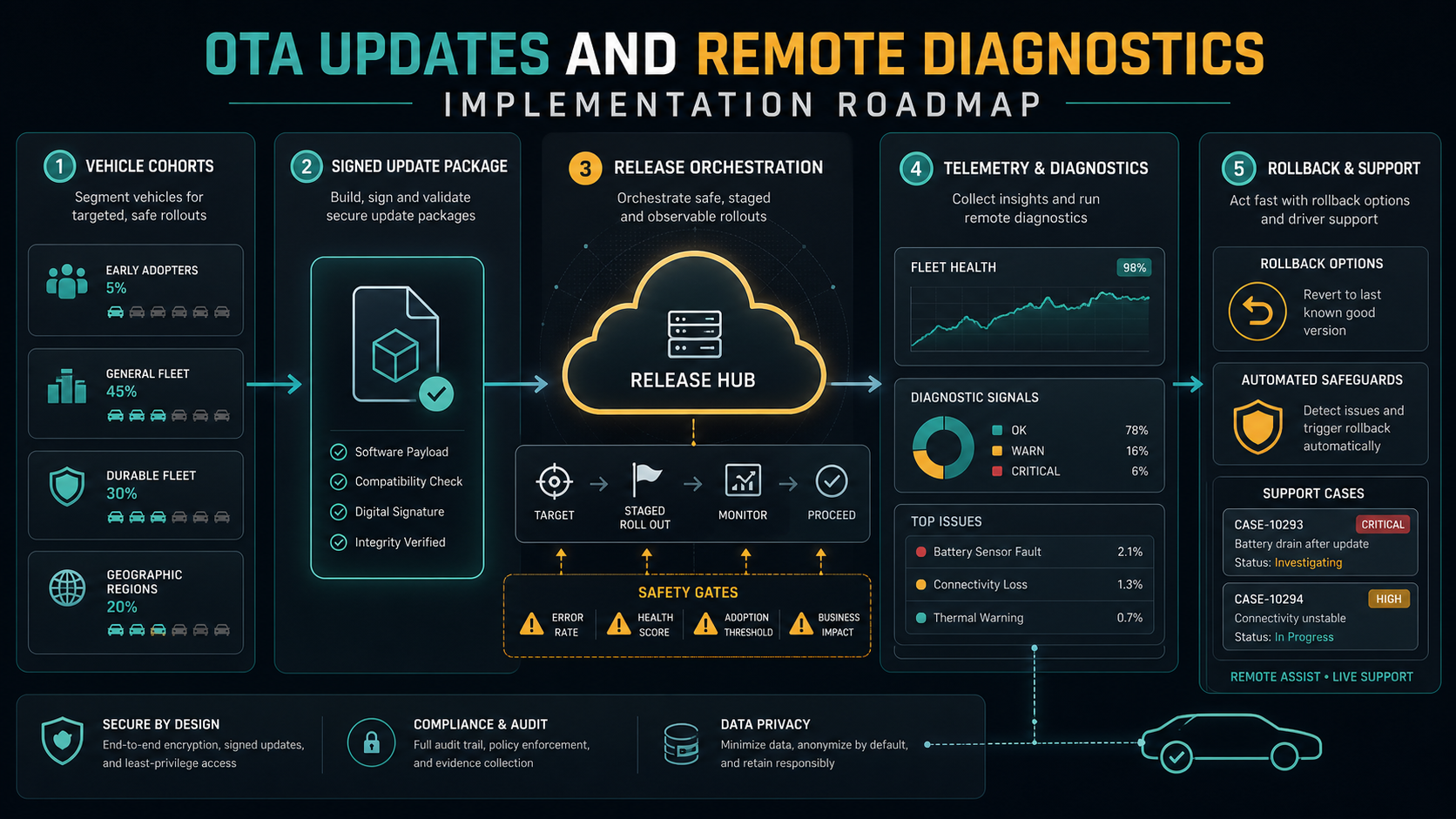
What Must Be Ready Before Launch
OTA updates, remote diagnostics, telematics, fleet management, cloud-native architecture, and connected vehicle services are valuable only when the operating model is ready. A production implementation depends on readiness across vehicle software, cloud services, release governance, diagnostics data, support operations, cybersecurity, and audit evidence. For teams building the broader product layer, NextPage's automotive software development services connect these controls to driver, fleet, dealer, and operations workflows.
Before launching, confirm these prerequisites. If the mobile and device stack is still being shaped, the IoT mobile app development roadmap is a useful companion because OTA and diagnostics depend on the same device pairing, telemetry, cloud ingestion, offline behavior, and QA decisions.
- Firmware and software inventory: each vehicle, module, hardware variant, and firmware version must be identifiable before release eligibility can be trusted.
- Vehicle state rules: define when an update can start, pause, fail, or roll back based on battery, ignition, connectivity, region, user consent, and safety constraints.
- Telemetry quality: diagnostics events, install status, failure codes, device health, and connectivity signals must be reliable enough for operational decisions.
- Release ownership: name the accountable owners for campaign approval, validation, monitoring, customer support, rollback, and post-release review.
- Support workflow: decide how failed updates, critical diagnostic alerts, and customer-visible symptoms become service cases instead of dashboard noise.
- Security controls: protect packages, commands, device identity, signing keys, operator roles, audit trails, and emergency access paths from the start.
Teams often underestimate the cost of these supporting workflows. Use the Custom Software Cost Estimator for a first-pass model, then pressure-test integration, validation, support tooling, monitoring, and long-term maintenance with the custom software development cost guide.
Reference Architecture For OTA And Diagnostics
A practical OTA and diagnostics architecture has to separate the update package, release decision, vehicle communication path, telemetry stream, diagnostics interpretation, and support action. If these concerns are collapsed into one admin screen, the system becomes hard to audit and risky to scale.
| Layer | Purpose | Implementation questions |
|---|---|---|
| Vehicle software | Receives packages, reports state, executes install, and exposes diagnostics signals. | Which modules are updateable? What state checks block installation? |
| Gateway or edge client | Handles secure communication, buffering, retry, and command confirmation. | How does the vehicle prove identity and recover from network loss? |
| Release orchestration | Controls eligibility, cohorts, scheduling, approvals, staged rollout, and rollback. | Who approves a campaign and which metrics stop expansion? |
| Telemetry and diagnostics | Collects install state, fault codes, device health, and derived operational alerts. | Which events are raw signals, alerts, cases, or audit records? |
| Monitoring and observability | Shows campaign progress, failures, latency, data quality, and fleet health. | What dashboard tells teams to pause, continue, or roll back? |
| Service and support | Routes diagnostic findings and failed updates to owners with context. | How are service cases created, escalated, and closed? |
The architecture should expose stable APIs for release management, diagnostics triage, dashboards, partner systems, and customer communication. Teams planning customer or operator-facing apps should connect these APIs to a durable mobile app development and backend integration model instead of letting every downstream workflow consume low-level vehicle payloads directly. That separation keeps firmware changes from breaking business tools.
OTA Release Roadmap From Pilot To Scale
An OTA program should expand through evidence, not optimism. Start with a narrow release that proves package delivery, install status, telemetry, monitoring, and support ownership. Then widen cohorts only when the system shows that failures are visible, explainable, and recoverable.
| Phase | Goal | Exit evidence |
|---|---|---|
| 1. Readiness | Confirm inventory, vehicle state rules, signing, package validation, telemetry events, and support ownership. | Release checklist, test matrix, rollback plan, monitoring dashboard, incident contacts. |
| 2. Pilot | Deploy to internal vehicles, test fleet, or low-risk cohort with active observation. | Install success rate, failure categories, telemetry completeness, support case quality. |
| 3. Cohorts | Segment by model, region, firmware version, connectivity, usage, customer type, or risk profile. | Cohort rules, pause criteria, communications plan, expansion approval records. |
| 4. Monitor | Track install state, failures, retries, vehicle health, customer impact, and operational workload. | Dashboards, alerts, daily release notes, incident review, unresolved exception queue. |
| 5. Rollback | Restore known-good behavior or stop expansion when safety, reliability, or customer-impact thresholds are crossed. | Rollback decision log, affected vehicles, recovery status, root-cause notes. |
| 6. Scale | Standardize release governance, automation, analytics, and regional support for larger fleets. | Reusable playbooks, SLOs, audit trail, release calendar, post-release learning loop. |
Release engineering discipline matters here. The DevOps consulting for SaaS teams checklist is not automotive-specific, but its release mapping, automation, incident, and cloud operations lens applies directly to OTA governance.
Remote Diagnostics Workflow
Remote diagnostics should turn vehicle signals into useful decisions. Raw diagnostic trouble codes, sensor anomalies, install failures, gateway errors, battery events, and connectivity gaps are only valuable when they reach the right owner with enough context to act.
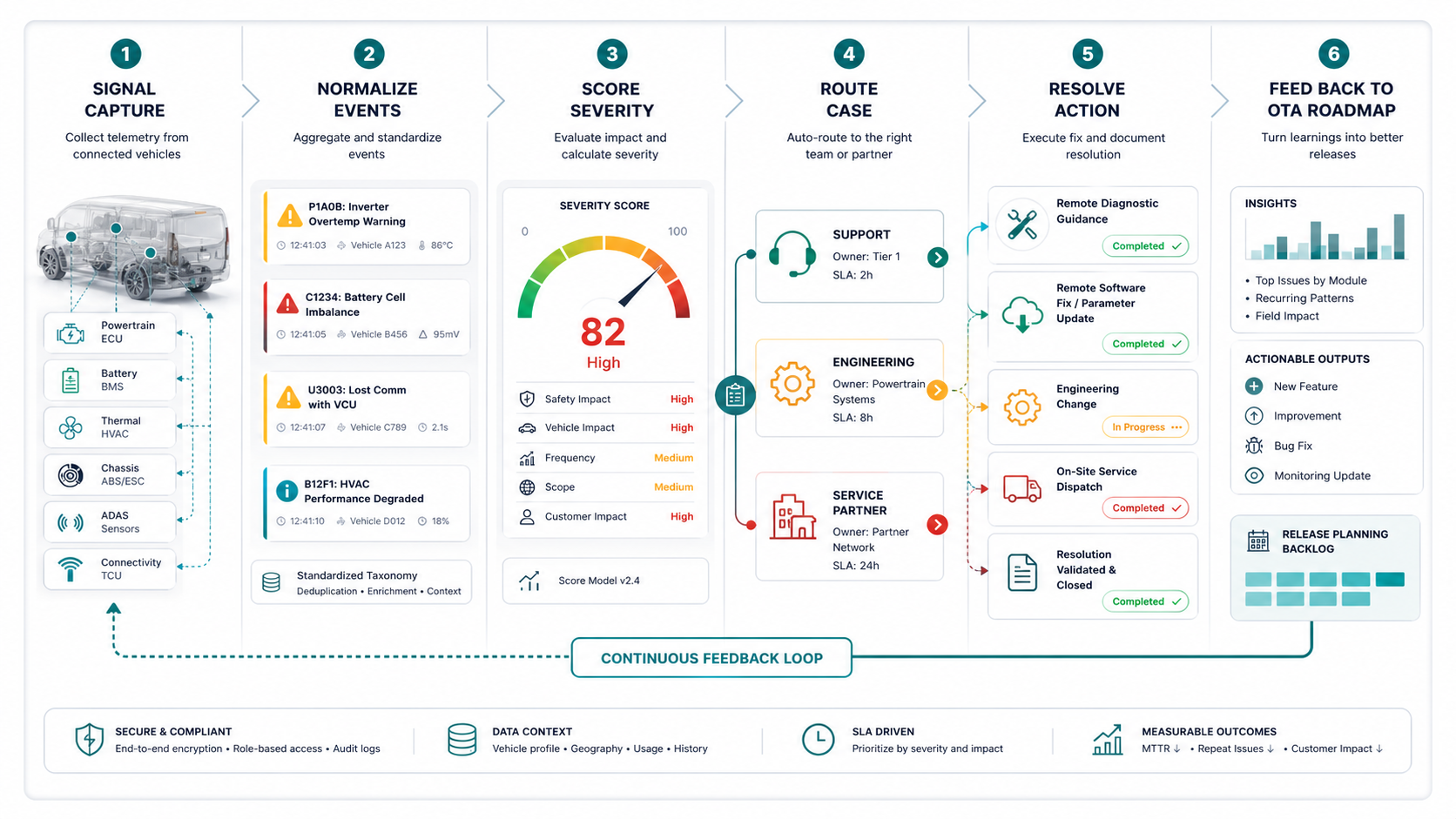
A durable workflow usually follows this path:
- Signal capture: collect fault codes, module health, event timestamps, firmware versions, vehicle state, location context when appropriate, and recent update history.
- Normalization: map raw events into stable schemas so dashboards and service systems do not depend on hardware-specific payloads.
- Severity rules: classify events as informational, customer-visible, service-needed, safety-sensitive, campaign-related, or engineering investigation.
- Triage: route cases to support, maintenance, engineering, warranty, partner, or release teams with owner, SLA, and next action.
- Feedback loop: feed recurring diagnostics patterns back into OTA prioritization, firmware quality, documentation, and service planning.
Diagnostics should also explain uncertainty. If telemetry is stale, duplicated, partial, or inconsistent across modules, the workflow should show data quality status instead of presenting a false answer. That small detail prevents field teams from making expensive decisions on unreliable signals.
Testing And Quality Gates Before Every Campaign
OTA and diagnostics programs need multiple quality gates because failures can spread quickly. Do not rely on a single pre-release test pass. Use layered checks that cover package integrity, compatibility, installation behavior, telemetry events, rollback paths, dashboard accuracy, and support runbooks.
| Gate | What to check | Owner |
|---|---|---|
| Package validation | Signature, hash, version, dependency, size, and compatibility checks. | Release engineering |
| Vehicle-state testing | Battery, ignition, connectivity, interrupted install, retry, and resume behavior. | Embedded and QA teams |
| Telemetry validation | Install started, paused, failed, retried, completed, rolled back, and post-update health events. | Platform and data teams |
| Dashboard validation | Campaign counts, cohort filters, failure reasons, alert thresholds, and audit logs. | Product and operations |
| Support readiness | Customer scripts, escalation paths, service notes, incident contacts, and rollback instructions. | Support and operations |
The CI/CD testing strategy guide can help teams decide which release checks belong in automated gates, while the regression testing checklist helps teams validate critical workflows before campaign expansion. Hardware-in-the-loop checks, fleet pilots, and manual approvals should stay explicit where automation cannot prove real-world safety.
Compliance And Evidence For OTA Programs
OTA implementation is not only a release-engineering problem. Automotive teams also need evidence that software updates are planned, approved, traceable, monitored, and reversible. UN Regulation No. 156 introduced the Software Update Management System idea for vehicle manufacturers, while ISO 24089 frames software update engineering as a lifecycle discipline. Even when a project is not directly inside those approval paths, the same evidence model is useful for connected fleet products and remote diagnostics platforms.
| Evidence Area | What To Keep | Why It Matters |
|---|---|---|
| Release intent | Change summary, affected modules, target cohorts, business owner, and risk class. | Prevents unclear campaigns from reaching vehicles without accountable approval. |
| Package integrity | Build provenance, hash, signature, dependency list, compatibility rules, and SBOM or component notes when available. | Supports secure update handling and rollback analysis. |
| Eligibility logic | Vehicle state checks, region/model filters, firmware prerequisites, opt-in/consent status, and blocked conditions. | Stops unsafe or incompatible vehicles from joining a campaign. |
| Operational monitoring | Install state, failures, telemetry lag, support volume, stop thresholds, rollback events, and post-release review notes. | Shows whether the rollout should expand, pause, or revert. |
| Audit trail | Approvals, operator actions, incident decisions, customer communications, and retained metrics. | Makes release decisions explainable to engineering, support, customers, partners, and auditors. |
Do not wait until certification, procurement, or enterprise security review to assemble this evidence. The same records help engineering teams debug failures, support teams explain customer impact, and product leaders decide whether OTA scale is safe.
Operating Metrics That Decide Whether To Scale
A rollout should expand only when operating metrics are strong enough to justify the next cohort. The exact thresholds depend on vehicle type, update risk, customer exposure, and safety relevance, but the dashboard should separate engineering quality, fleet health, diagnostics usefulness, and support workload.
| Metric | Healthy Signal | Pause Or Investigate When... |
|---|---|---|
| Install success rate | Successful installs are stable across cohorts, versions, regions, and connectivity patterns. | Failures cluster around a module, firmware version, region, gateway, or customer segment. |
| Telemetry completeness | Install, health, failure, retry, and rollback events arrive on time with consistent identifiers. | Data gaps make campaign status, fleet health, or support routing uncertain. |
| Diagnostics actionability | Alerts include severity, context, likely owner, next action, and related release history. | Teams see noisy fault codes without triage logic or case-routing confidence. |
| Support load | Support cases stay within SLA and recurring issues feed engineering review quickly. | Ticket volume, unresolved cases, or partner escalations exceed the rollout plan. |
| Rollback readiness | Rollback criteria, package availability, customer communication, and recovery monitoring are proven. | The team cannot reverse, pause, or explain impact quickly enough. |
These metrics also shape the build-versus-buy decision. If the differentiator is release policy, diagnostics triage, fleet workflow, or partner integration rather than raw package delivery, custom orchestration and dashboards may create more value than replacing every OTA primitive.
Security, Safety, And Governance Guardrails
OTA updates and remote diagnostics touch vehicle behavior, customer trust, operational continuity, and sometimes safety-relevant systems. Governance cannot be a spreadsheet added after launch. It must shape package signing, command authorization, approval paths, telemetry retention, incident response, and audit logs.
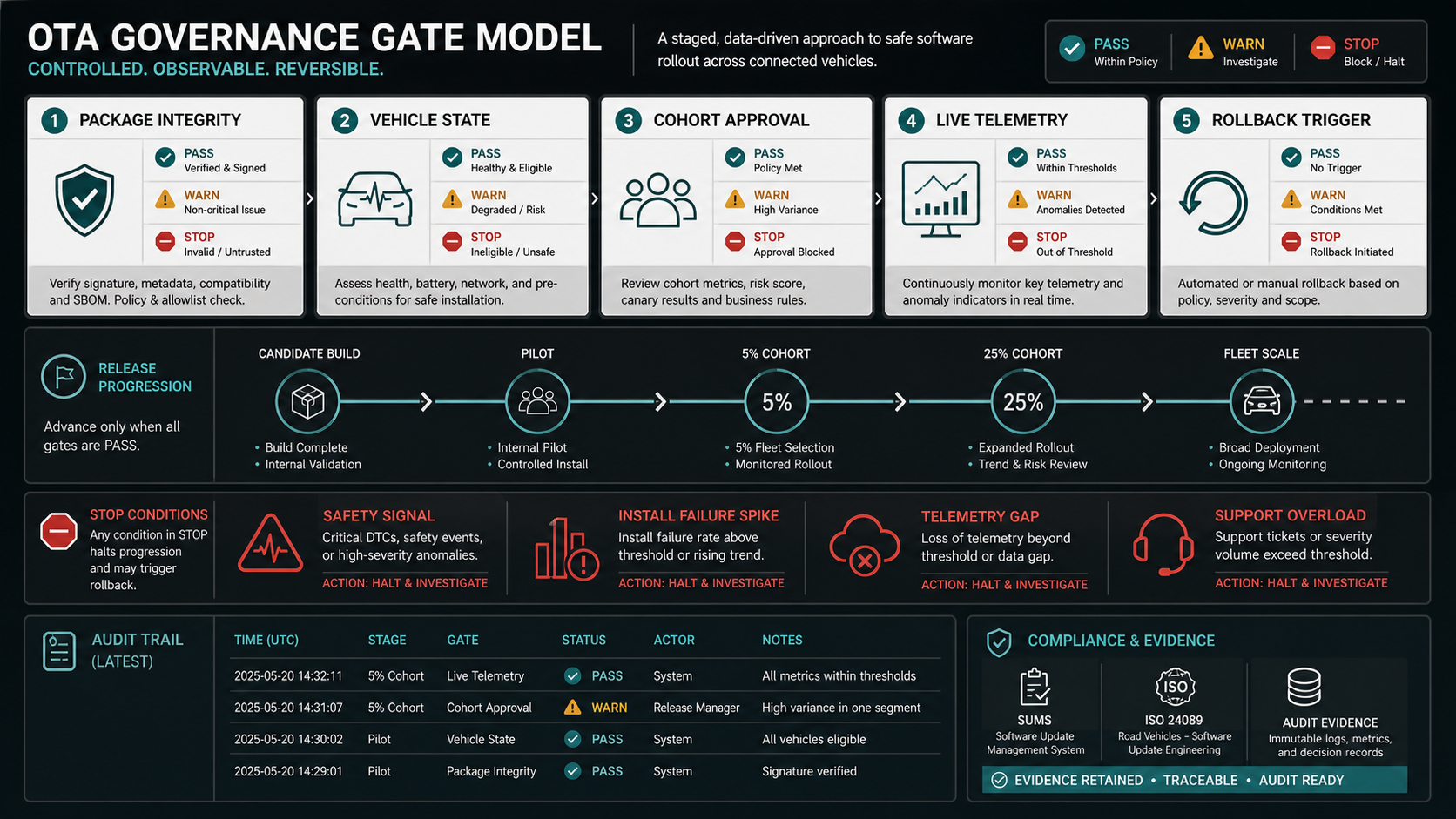
- Package security: sign update packages, protect keys, validate hashes, enforce version rules, and block unauthorized downgrade paths.
- Command authorization: use least-privilege roles, dual control for sensitive campaigns, approvals for high-risk cohorts, and immutable audit logs.
- Functional safety: define what can be updated remotely, what requires service intervention, and what vehicle state makes an update unsafe.
- Privacy: classify diagnostic, location, driver behavior, account, and service data before deciding retention or dashboard access.
- Observability: monitor campaign health, fleet health, failed commands, data pipeline lag, dashboard latency, and support workload.
- Incident response: create runbooks for failed campaigns, bad packages, missing telemetry, stuck vehicles, customer complaints, and suspected compromise.
The rule is simple: every remote action needs an owner, an approval trail, a stop condition, and a recovery path. Without those controls, OTA convenience turns into operational risk.
Build, Buy, Or Extend
Most teams should not build every OTA and diagnostics component from scratch. Managed device platforms, cloud IoT services, monitoring tools, service systems, and diagnostics products can reduce risk. Custom software becomes valuable where the workflow is specific to your vehicles, release policy, customer experience, partner ecosystem, or data model. For a fleet-oriented example of API, telemetry, maintenance, and operations patterns, review the RouteLedger fleet operations API case study. If charging, telematics, and depot workflows are part of the roadmap, the EV fleet software cost guide shows how security, telemetry, and rollout controls affect scope.
| Decision | Use managed or vendor tooling when... | Use custom software when... |
|---|---|---|
| OTA delivery | You need proven package delivery, device identity, signing, and campaign primitives. | Your release rules, vehicle state checks, or customer workflow are differentiating. |
| Diagnostics | Standard fault interpretation and service workflows cover most cases. | You need proprietary triage logic, fleet-specific rules, or integration with existing operations tools. |
| Dashboards | Default operational views answer the team’s actual release and service questions. | Different roles need decision-focused views across vehicle, release, support, warranty, and partner data. |
| Integrations | The vendor already supports your CRM, ERP, service, ticketing, and data stack. | Manual handoffs, duplicate entry, or weak audit trails create business risk. |
Revisit the decision after the first pilot. Early managed tools may be right for speed, while custom diagnostics workflows or dashboards may become important once real campaign data shows where operational value sits.
How NextPage Helps With OTA And Diagnostics Roadmaps
NextPage helps teams turn OTA updates and remote diagnostics into a buildable roadmap. We map vehicle cohorts, firmware inventory, telemetry events, release gates, rollback criteria, diagnostics data, dashboards, support workflows, integrations, and cybersecurity controls before engineering effort is committed.
For a useful readiness review, bring your vehicle or device types, current software inventory, update package constraints, diagnostics data sources, cloud stack, dashboard users, release approval process, support workflow, and target rollout window. We will help define the smallest safe launch, the quality gates required before scale, and the implementation work that should be managed, bought, or custom-built.
Book an OTA readiness and remote diagnostics workflow assessment with NextPage. Bring the release policy, diagnostics events, integration map, and support workflow so the first session can separate launch-critical controls from later automation.